Software
Houzz Logo Print
katie_layfield

Cracking Shaw Castlewood Oak Engineered

8 years ago

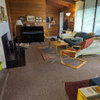
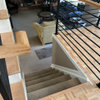
These floors were installed in our new construction home 2.5 years ago We are now seeing cracking and having issues with splintering in some areas Is this a common problem with these floors? Our builder is of no help in answering questions since we are past the one year mark


Comments (13)

  • 8 years ago

    It looks like the board has some give underneath on one side and that's why it cracked...but I might be wrong...

  • 8 years ago

    If you are in a northern climate - there is no way indoor humidity should be 40 - 50%.

  • 8 years ago
    last modified: 8 years ago

    40 to 50% might be perfect for wood, but apparently it isn't perfect for everything else.

    http://www.thermastor.com/information/Relative-Humidity-And-Your-Home.aspx

    Maintaining relative humidity below 50% prevents dust mite infestations, mold and mildew growth, and inhibits bacteria. This lower relative humidity also reduces the out-gassing of VOCs. In colder climates, wintertime humidity levels must be even lower—generally 30-40%—to prevent condensation on windows and other surfaces.

    https://www.woodfloorbusiness.com/installation/how-to-prevent-wood-floor-gaps-in-winter.html

    Engineered flooring is supposed to be more stable than solid wood. From a technical aspect, this should be true. But many engineered flooring manufacturers restrict the use of their products to a certain RH range. I've seen warranties that specify 35 to 55 percent RH or 40 to 60 percent RH as the acceptable range. If the flooring is exposed to conditions outside these ranges, the warranties are void. In my 30-plus years of experience dealing with indoor environments in the U.S., I don't know any location that will consistently maintain those RH ranges. So using engineered flooring may be an option for reducing winter-time floor issues, but check the manufacturer's recommendations and warranty.

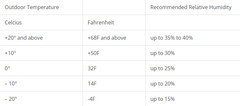
    Honeywell, another large manufacturer of humidifiers, recommends an indoor RH no higher than 35 percent when it is 20 degrees outside, 30 percent at 10 degrees, 25 percent at 0 degrees, 20 percent at -10 degrees and 15 percent at -20 degrees. According to Consumer Reports, when the outside temperature drops below 20 degrees, even 30 percent RH may be too high. What all this means is that if we add too much moisture to a house, we can cause condensation and possibly mold on windows. In some cases, walls can rot

    Bottom line: Winter weather dries out wood flooring, causing gaps, possibly increasing squeaks and opening surface cracks. Wood will be wood. Physics will be physics. Inform your clients of these facts, and don't rely on humidifiers or other sources of moisture to prevent normal winter conditions. Humidifiers can help some, as can choosing the right wood flooring for the right situation, but only to a certain extent. If your client wants 7-inch hickory plank flooring with minimal winter gapping, major changes to the house may be necessary. If hairline gaps aren't acceptable, even 1½-inch quartersawn oak strip flooring may not work. Establish proper customer expectations, and everyone wins.


    Really sounds like this is just the way it is, if you have wood floors. How convenient that flooring warranties are unrealistic.

  • 8 years ago

    The question is if those recommendations apply to US houses also. The temperatures are in Celsius, which means the recommendations are for European houses, built from one solid wall of brick/cement. US houses are made mostly of wood, 2 walls with isolation between them, which I think reduces condensation and mold...at least I think it does, I haven't seen any condensation in the winter here...

  • 8 years ago
    last modified: 8 years ago

    No. One of those companies is in Madison Wisconsin, the other in South Carolina. They are not referring to homes in Europe.

    For example, this is clearly not providing information about a home across the ocean.

    http://info.staycomfyminnesota.com/what-is-the-proper-level-of-home-humidity

    The University of Minnesota has developed guidelines for the minimum recommended humidity levels for houses. Based on a 70ºF interior room temperature, engineering studies established the following guidelines:

    Outside Temperature Inside Humidity

    20º to 40ºF Not over 40%

    10º to 20ºF Not over 35%

    0º to 10ºF Not over 30%

    -10º to 0ºF Not over 25%

    -20º to –10ºF Not over 20%

    -20ºF or below Not over 15%

  • 8 years ago

    I don't know...We don't have a humidifier right now, in the winter humidity is somewhere between 20 and 30% and it's uncomfortable. I would feel much better with a higher humidity...

  • 8 years ago

    You might feel better, but your house won’t.

  • 8 years ago

    Interesting. Thanks for the feedback. We are in Fargo, ND so big changes in temperature throughout the year here.

  • PRO
    8 years ago

    Looks like dry cracking. Buy or borrow a thermo-hygrometer immediately and determine your indoor relative humidity.

  • 8 years ago

    We are in Fargo, ND so big changes in temperature throughout the year here.

    Is this a joke? North Dakota: -10 degrees in winter / 90 degrees in the summer - that's a 100 temperature differential.

  • 8 years ago

    Um, I think that’s exactly what they just said?

  • 8 years ago

    DO NOT BUY SHAW Flooring. I purchased and installed Shaw Castlewood flooring in my entire house and the finish is paper thin. It simply scratches right off the surface. Within weeks of installation it peels off the surface with the slightest scratch. NOT what normal good quality engineered flooring does under absolutely light normal wear and tear. BEWARE and do not purchase this flooring. AWFUL! I"m so sad that my whole house has this cheaply made and horrible flooring.