Software
Houzz Logo Print
quercusnut

Best High-Acids?

8 years ago

There was a thread here about the best high-acid tomatoes. I've searched in vain with no luck.
Anyway someone mentioned an indeterminate variety that produced lots of medium-sized tomatoes. I can't recall the name. I thought I had saved the seed source but can't find it now.
Soooo...how about a new discussion on best high-acids? Any recommendations? Maybe I'll recognize the one I wanted. Thanks.

Comments (14)

  • 8 years ago

    A lot of it is in how you grow it. I've found some to be acidic one year and not acidic another year. If your soil is low potassium, the tomatoes should be more acidic. If you water less, they should be more acidic, too. If they get more sun, they may be more acidic than if they're shaded.

    You might try tomatoes like Early Girl F1, Silvery Fir Tree, Matina, Marmande, Sasha's Altai, Mountain Princess, New Yorker V, Lemon Boy F1, and Manitoba. I would avoid large tomatoes if you want them to be acidic (large tomatoes are usually more mild—although I have a feeling that Cuostralee could be acidic if grown in conditions to help it be acidic, since it had a tang similar to Matina, and Matina was more acidic grown the next year in dryer conditions). Go for cherries or salad types most, followed by medium-sized.

    If you like acidic tomatoes, you might like Tatura (although I wouldn't exactly call it acidic; it just has a lot of flavor that someone who likes acidic tomatoes might enjoy).

    I know McGee can be pleasantly acidic.

  • 8 years ago

    Thanks. I'll check some of those out though none are ringing a bell.

  • 8 years ago

    Ding! Ding! Ding!

    Thanks, Dave!

    Found it:

    Bolseno

    "Another tomato that I think has a very strong acid bite is Bolseno hybrid from Johnny's Selected Seed. It's also a heavy producer on a unbelievably rampant vine. The tomatoes are about baseball size and flawless."

    https://www.gardenweb.com/discussions/2200219/a-tomato-that-has-a-lot-of-acid?n=18

  • 8 years ago

    Actually high potassium is needed for higher acidity. Also somewhat slow ripening, like in cooler weather will concentrate acidity as well as drier conditions/high EC. I normally have at the end of the season some tomatoes that I feel burn the tongue (some can be sweet and sour).

    From the common ones, Pink Berkley Tie Die comes to mind in first place. Azoychka and Aunt Gertie's Gold are also quite high. Many new red hybrids have good potential for acidity if properly fed.

  • 8 years ago

    Thanks, fungus for the info. Up till now I believed acidity was totally dependent on variety.

  • 8 years ago
    last modified: 8 years ago

    Are you talking about flavor or pH, with regard to potassium levels?

    I don't mean to contend your experience, which is quite interesting. However, as far as acidic flavor goes (I haven't tested pH), that's definitely not my experience (except with one variety in a raised bed).

    I've given lots of tomatoes a disproportionate amount of potassium, including Pink Berkeley Tie Dye (which wasn't anything like acidic for me, whether or not I gave it much extra potassium, whether or not it was ripe).

    There must be other factors at play here.

    I've also found early-ripening tomato varieties to most often be the most acidic in my garden (although Marmande took a while to ripen, and it was kind of acidic), although in 2017 the later ones had more acid than usual (probably because it didn't rain a lot at the end of the season like it often has, and I stopped watering them early on). My personal opinion is that the kind of sun in the area, how you water, and whether or not you have a clay type soil makes a big difference here. I have noticed that watering less can make a difference, as can the year.

    Perhaps soil type, and how much air the roots get makes a difference.

    Plant stress levels is probably a big issue, since stress can result in more of certain nutrients/chemicals. The stress from UV rays increasing capsaicin in chiles is an example there, but it's not the only time that happens. However, I've had very mild stressed tomatoes. I think the kind of stress probably matters if that's the case.

    It could be the form of potassium. I've used potassium sulfate, wood ash, and monopotassium phosphate (mostly the first two, though). It's possible that potassium chloride might bring out acidity more. Are you adding nitrogen or phosphorus with the potassium?

    My soil seems like it's more alkaline than most, and though it's closer to a clay type soil, it doesn't seem to be one that's naturally full of available potassium or calcium, somehow (hence why I add extra for improved results with some plants, especially).

    Some of my most acidic tomatoes have been potassium deficient, as evinced by how easily the stems broke. A tomato with a good supply of potassium (particularly potassium sulfate) would be tough as nails (figuratively speaking), in my experience, regardless of the variety.

    Again, I'm not saying you're wrong, but I am saying our experiences seem to show that there's more to it than potassium.

    Kyle thanked Mokinu
  • 8 years ago

    Thanks. I will be starting my Bolseno seeds very soon.

  • 8 years ago

    Kyle -- Bolseno was the Best of all we grew last year in taste,
    production and disease resistance (last standing and still producing
    tomatoes till first frost killed it 11-11-2017)!

    Tony

    Kyle thanked 14tomatoes_md_7a
  • 8 years ago

    Did you stake or cage it?

  • 8 years ago
    last modified: 8 years ago

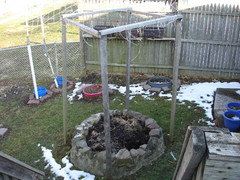
    Since they grow 10+ feet tall, all are on 7' stakes set in a rectangle, with thick copper wire crisscrossing the tops of the stakes, so they can spread at 7' height between the stakes for easy picking.

    Tony

  • 8 years ago

    Here is my set up -- we grow 5 of them there.

    Tony

    Kyle thanked 14tomatoes_md_7a
  • 8 years ago

    Very nice. Great idea. Thanks for the pic.