Software
Houzz Logo Print
kublakan

What the...BS or DM?

8 years ago
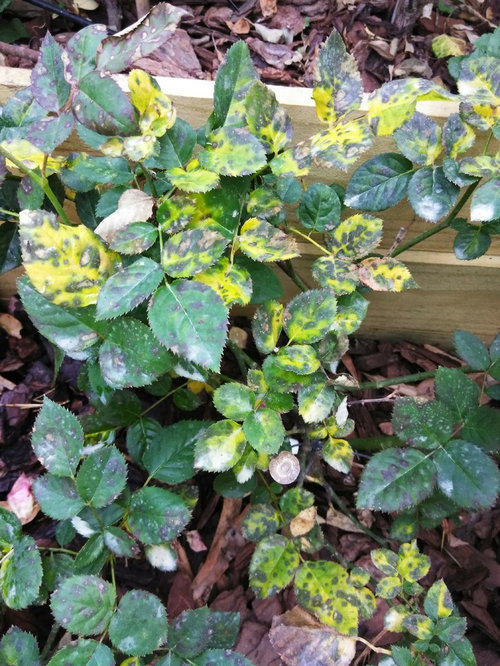
So I've been keeping a regular spray program going as part of my New Years resolution, but I am stumped. Here's the run down:

Week 1 - Honor Guard, Dithane, Conserve SC, Super Thrive

Week 2 - Heritage, Dithane, Conserve, Super Thrive, Water Soluble Fertilizer

Week 3 - Clearys, Conserve, Super Thrive, Water Soluble Fertilizer

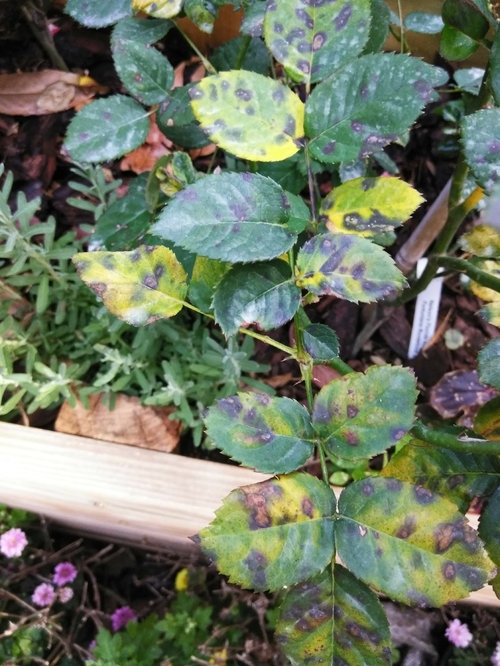
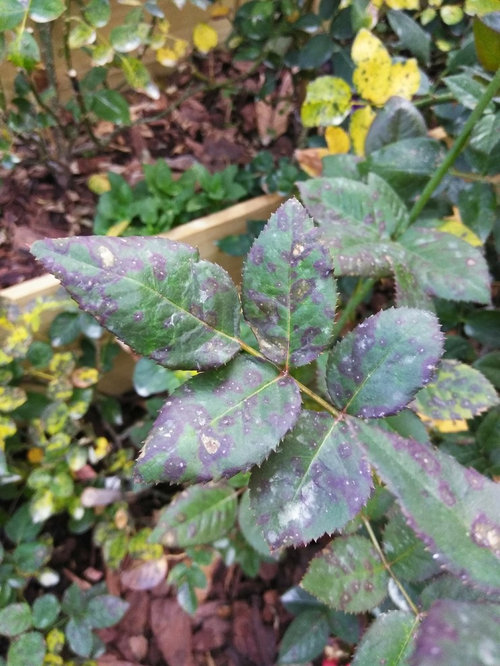
and after week three I get this:

Any Guesses on whether this is blackspot or Downy Mildew and any suggestions on what I'm doing wrong here?

Thanks,

Adrian.

Comments (18)

  • 8 years ago

    It kind of looks like a nasty combination of blackspot and mildew.. Could I suggest that you give Bayer Advanced Disease Control a shot. It should eliminate most of the problem.

    kublakan thanked Streisand Fan
  • 8 years ago

    Are those last year's leaves? If so, the rose would probably be better off if you stripped them. If I remember correctly, you're in southern Florida, and you may not have had enough "Winter" for the leaves to drop on their own. Chinas, Teas, Noisettes, and many Polyanthas are based on rose species which evolved to live with minimal to no Winter, and seem to replace leaves without a cold trigger in warm climates like yours. Hybrid Teas and Floribundas typically have just enough of their European ancestry to cause them to hang onto "senile" leaves when they grow without enough cold to finish the shedding for them. And as they hang there, they are more prone to infection.

    Of course, if those are this year's leaves, all I said means nothing, and you should listen to what other Florida people say.

    :-)

    ~Christopher

    kublakan thanked AquaEyes 7a NJ
  • 8 years ago

    What are the generic names for the 1st 2 chemicals sprayed each of the 3 weeks?

    kublakan thanked rifis (zone 6b-7a NJ)
  • 8 years ago

    And: are the cream colored blotches on the black/purple spots superimposed spray residue, or integral to the lesions?

    kublakan thanked rifis (zone 6b-7a NJ)
  • 8 years ago

    Frankly, if those leaves are relatively new, and I was in your position, I'd just avoid growing anything that looked like that after all the effort you put in. To me, zone-pushing is one thing, but keeping a plant on chemical life-support and still not being able to enjoy it is just not worth it. There are many other roses which will look much better, even without spraying, in Florida.

    :-/

    ~Christopher

    kublakan thanked AquaEyes 7a NJ
  • 8 years ago
    last modified: 8 years ago

    Adrian,

    I don't see downy mildew. Downy mildew makes big, uniformly colored purple/dark gray blotches, not roundish spots like black spot or light colored centered cercospora spots.

    The light centers of the dark spots I see indicates cercospora leaf spot fungus. It is black spot's evil cousin. They look a lot alike. Cercospora has beige or light gray centers to its black spots. Black spot is entirely black with fuzzy looking edges. I don't see black spot.

    Are those leaves last year's leaves? When did the fungus start, recently or is it old damage?

    Bayer fungicide kicks all fungi goodbye, if used regularly...first spray followed in a week by a second spray. Thereafter, spray every two weeks, generally. Sometimes every 10 days if when disease pressure is intense at those times. That should keep your foliage beautiful.

    I think the white on some leaves is spray residue, not powdery mildew. Isn't Clearys milky, light beige....results in whitish residue on leaves, thicker in leaf depressions where Clearys puddles and then dries, I recall? I haven't sprayed Clearys in almost 10 years. That's what I see, spray residue, not powdery mildew.

    Moses

    kublakan thanked Moses, Pitt PA, cold W & warm/humid S z6
  • 8 years ago

    Fan, I think I'll jump on that suggestion. I usually don't use that product since it carries an insecticide/miticide and I like to use targeted insecticides like Conserve SC instead, but I think I'll have to use it this time.

  • 8 years ago

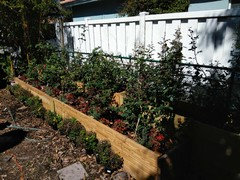
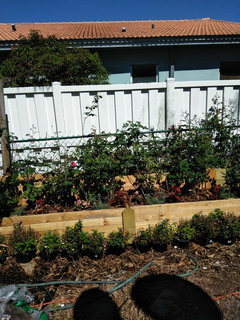
    Aqua, I wish they were aged leaves, but these are brand new to this year. I will confess that the plants are spaced much too close, but that was intentional as this is part of an experimental cut garden that I've put together. This part of my yard is protected by a fence, a wall, and trees. Furthermore, I have been using drip irrigation since the area doesn't get much air circulation, but the weather around here has shot up in the high 80s one second and then plunged into the fifties. This particular infestation occurred after some brief but heavy storms that were followed by cooler drier weather.

    -Adrian

  • 8 years ago

    Rifis,

    Propiconazole

    Azoxystrobin

    The cream colored splotches are left over chemical residue of Mancozeb. On week three I gave it a rest due to the build up I was seeing on the leaves around the yard.

    -Adrian.


  • 8 years ago

    Aqua,

    I'm a gluten for punishment. I love the big florist buds/blooms that smell great. I have given up on many varieties with time, but I've noted survivors from the past and planted those in this test garden...for the most part. This variety was planted for its unusual coloration: Black Bacara. I know of the varieties that grow like weeds down here (shoot, there are several in my garden), but nothing does it for me like the pretty, big bloomed, and smelly varieties. I'll do the spraying without protest in order to grow these.

    -Adrian.

  • 8 years ago
    last modified: 8 years ago

    the Bayer advanced disease control is also a zole, so it won't do anything that the Honor Guard did not take care of. I would remove all the affected foliage and start over. You may have had an infection prior to starting the spray program and then it seems like the spray isn't doing anything, but once the fungus takes hold, it will spread. And leaving the infected leaves on just lets it spread more.

    kublakan thanked Buford_NE_GA_7A
  • 8 years ago

    Moses,

    Thank you and Paul for the suggestion. I'm always learning, even after all these years of growing roses.

    What strikes me is that for all purposes this shouldn't have happened. I found this website by UF: Cercospora Leaf Spot of Rose

    According to what it says, I'm already using the better products to control this critter and it's kissing cousin BS. My guess is that I'm going to have to find another product to alternate with the Dithane in order to keep the fungi from developing resistances. I can understand an outbreak of this if I took a break from spraying during the summer months, but I'm currently in the most ideal time of the year for rose growing here in SoFlo. It only gets harder from this point on as the regular heat, humidity and daily rains make it near impossible to dry out the roses.

    I'll have to use a blower to clear out the infected leaves. I purchased a solar fan recently from Amazon and intend to place it at the end of the bed to aide in air circulation. Hopefully it makes a difference. I'll keep everyone posted.

    Thanks to all for your kind advice!

    -Adrian.


  • 8 years ago

    You should try to remove as many of the infected leaves as you can and put them in a plastic bag and throw them in the garbage. If you blow them around with a blower, it will just spread them to other plants. I've had instances where it is rainy and wet for days on end and susceptible plants will get disease even with spraying. It's a matter of how much disease pressure is present.

    kublakan thanked Buford_NE_GA_7A
  • 8 years ago

    Good point Buford. Thanks.

  • 8 years ago
    last modified: 8 years ago

    Adrian,

    In a hot, humid climate, air circulation keeps disease down. Planting your roses closely, especially in Florida, where roses get about as large as they can get, anywhere in the USA, works against disease control.

    Your cutting bed plan sounds great, but may not work out if you have to fight disease aggressively and constantly.

    But before you make drastic changes consider this....

    You may have had the, "Perfect Storm Syndrome," pop up. All the most horrible conditions for a serious disease outbreak converged all at once. It may not happen regularly or anywhere near as severely. Reorganizing your roses to wider spacings may really not do too much. The disease plague you experienced could have occurred no matter what.

    Why not do this, leave the bushes where they are. Prune them to grow more columnar like. Get those diseased leaves out of there. Improve the air circulation as you said. Keep up an intense spray program at first, then see how much you can relax the frequency of spraying yet keep the bushes growing nicely. See how this works for a trial run.

    Moses

    kublakan thanked Moses, Pitt PA, cold W & warm/humid S z6
  • 8 years ago
    last modified: 8 years ago

    The last picture looks like Downy Mildew to me , I think due to the weather fluctuations we were having .Downy affects top new growth while black spot usually starts with older growth .

    what is working for me these days is like burford said ,as soon as I see spotted leaves I remove them . Beginning of every month I spray :Honor Guard , Mancozeb , Floramite or Forbid , captain Jacks dead bug (weak Spinosad), (plus a sticker +1 TBS vinegar ) .Then every 10 days I spray Bayer Advance . you can use the fungicide only without the mitecide/incesticide .

    During dry weather everything is good (except an occasional spider mite infestation) . Trouble starts with our rainy season . I try to spray weekly instead of every 10 days . still I do get BS on older varieties especially . It is an ongoing battle here in FL .

    kublakan thanked Pink Rose(9b, FL )
  • 8 years ago

    Burford, from patricia43 (now patricianat), let's go to Pat Henry's open house in May. Are you game/ I have no roses now. I lost over 400 through the last few years. Well, I lied. It did not kill the shrubs they call roses (Knockout). I need to pick up a few but will never invest half my life and savings in a huge rose garden but I enjoyed it and it was like Heaven on Earth.

0