Software
Houzz Logo Print
westes

Identify Adenium Species

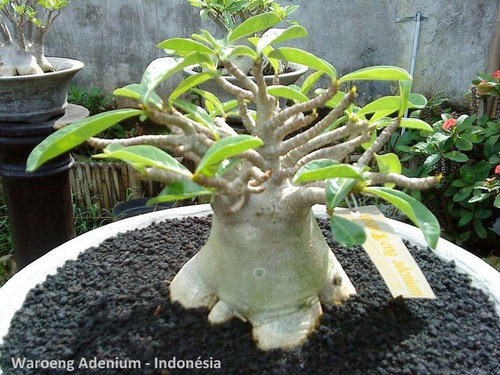
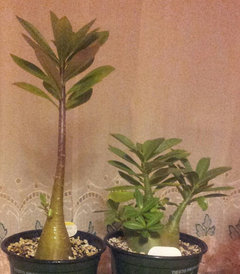
The first photo below I identify as Adenium Arabicum. These plants seem to have a fat caudex and have many short fragile limbs on top with leaves.

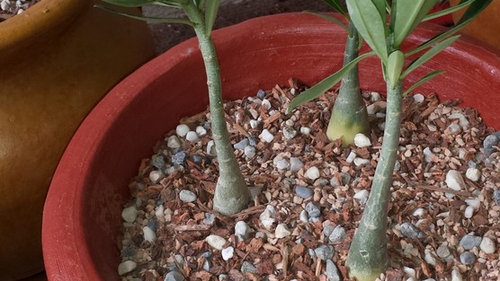
What is the Adenium subspecies in the second photo below? I see many of these sold online as Adenium Obesium, but Obesium is a species name not a subspecies. Some sites say that Adenium Arabicum is actually Adenium Obesium Arabicum, for example. The second photo shows a plant with a smaller caudex and much longer branches on the top. There are also fewer branches.

Comments (23)

  • 8 years ago
    last modified: 8 years ago

    Westes,

    You can get into quite a debate about the species, sub-species of Adeniums and still many have different ideas.

    Technically, the Taxonomists say the Adenium is the Genus, but all are considered to be Obesum. They do not consider there to be arabicum, swazicum, multiflorum, etc., as different specie forms. I once got into a debate about this and it was exhausting and I do not hold a degree in the field.

    The majority of people and sites that I frequent all name the Adenium by their different species and this is what I follow.

    The first Photo (Large plant) could be considered a Thai Socotranum, many would call Arabicum. It has the small branches coming of the main stem and top of caudex from a central area growing in a horizontal plain, typical to Thai Socotranum. Short internodes as well. Not to be mistaken by the True Socotranum.

    The Arabicum and hybrids will grow longer branches, many which grow vertically and a number of branches will form across the wide caudex.

    With all of the crossing that is going on with the Arabicum and Thai Soco's, it makes it very difficult to place an exact name on one. Obesum's are being crossed w all of the different species, making it difficult to tell. Leaving it to leaf type, bloom, etc. Unless you know of the parentage from a grower that has done all of the hybridization and or hand pollination.

    I think what most of us see now is a hybrid or cultivar name following what we know as Arabicum, Obesum, etc.

    Rick

    westes Zone 9b California SF Bay thanked rcharles_gw (Canada)
  • 8 years ago

    @rcharles_gw it is not clear what you mean. You first establish that Thai Socotranum is equal to Arabicum. Then you talk about crossing Arabicum and Socotranum as if they are different. I understand that Thai Socotranum is the smaller plant and the true Socotranum is the gigantic plant found only in part of Africa.

    The bottom line is that you are not sure what the second photo if my original post is?

  • 8 years ago
    last modified: 8 years ago

    Second pic ‘looks like’ the growth form often seen on Adenium somalense, tall slim tapering trunk with a conical base. That’s not to say any of them are.

    As Rick says, unless the parentage is known and can be proven, they could be anything.

    Gill

    edited to add.....another feature of the somalense are light coloured veins which are also seen above, especially on the left and middle plant above.

    westes Zone 9b California SF Bay thanked greenclaws UK, Zone 8a
  • 8 years ago

    @greenclaws, I think Adenium Somalense looks right and here is a nice page showing varieties of that. Mine seem to match to the nursery photo here:

    Unfortunately, an Adenium that grows like a palm tree is not the plant I wanted. Back to the drawing board.

  • 8 years ago
    last modified: 8 years ago

    It seems to me the Adenium world has a naming problem. There is a huge variation between these plants, and the existing subspecies names alone don't really capture the variety adequately.

  • 8 years ago

    @westes, what general shape are you searching for?

    westes Zone 9b California SF Bay thanked greenclaws UK, Zone 8a
  • 8 years ago

    @greenclaws I love the traditional Arabicums, with the fat caudex and the short leafy branches

  • 8 years ago
    last modified: 8 years ago

    Okay, a topic change. :) It looks like I might have immediately killed my three new Adenium "palm trees" with root rot. I feel the caudex on all three getting soft. What is the recommended acclimation procedure for juvenile plants like this?

    What I did was:

    1) I did not water at all, figuring the plant could live off its reservoir for a while

    2) I placed into dry gritty mix

    3) I did not water for two days

    4) I lightly watered once, with a plan to water again in one week.

    5) I kept the plants out of the sun, but outdoors

    I think there may have been two problems:

    a) Our night time temperatures here are still in the 40s. So this may have been a climate shock for the plant.

    b) I may have given the roots too little time to adjust to the new soil

    What should the correct acclimation procedure have been with these?

    Assuming this is actually root rot, and not just a characteristic of this subspecies to have a softer caudex, then I guess the plants are doomed. My general experience with Adeniums has been when the root rot gets to the core of the plant, it is hard to save anything. I don't really want to cut these and attempt to re-root the stems.

  • 8 years ago

    Are you sure you have root rot and they’re not showing signs of thirst? A lot depends on how much water you gave them in the dry gritty mix. I’ve never heard of softer caudexes being a feature if any Adenium species. Soft caudex is either due as you say to root rot, or dehydration.

    Gill

    westes Zone 9b California SF Bay thanked greenclaws UK, Zone 8a
  • 8 years ago
    last modified: 8 years ago

    @greenclaws, okay that is encouraging. So what should I do to test your theory of dehydration? I did not give a lot of water, maybe 10 seconds of light watering from a garden can.

    Why would a caudex grow soft under dehydration? Dehydration means less water is available, and if the caudex is hard I might guess the caudex would get even harder. What is the mechanism for the thirsty Adenium growing soft?

  • 8 years ago

    I'd be nervous about watering a lot right now if your nighttime temps are in the 40s and the plants are still acclimating. According to Tucson Cactus, temps below 50 for a few weeks can kill off the roots on somalense. How did the roots look when you potted them up?

    Is the pot as huge as it looks in the pic or can it be moved indoors at night? If not, can you cover it with something at night to keep it warmer?

    The caudex feels soft when dehydrated because the cells that hold water are no longer full of water and thus have some give. Once the cells fill up again the caudex will feel firm.

    westes Zone 9b California SF Bay thanked Liz (Virginia z6b)
  • 8 years ago

    Can any of you confirm that Arabicum will tolerate much lower temperatures than Somalense? Wow, I did not know about the 50F restriction for Somalense. That plant doesn't belong in my garden if that holds. My only defense is that I did not know I was buying Somalense so I had no way to research it. They were very cheap plants so no great loss if these die.

    The plants are wilting. If this is root rot, they are going to die no matter what I do. On the other hand, if this is starvation from lack of water, then they might be saved. Daytime temperatures in the sun are over 70F now. I could try to move to the sun for a single day, water early in the day, and let them try to drink while well lit, then move them back into the shaded area so they don't catch any rain or get too much sun. It seems like it is worth taking a risk to water them but I would appreciate advice on how to best try to do it. Every succulent I have killed has been from watering shortly after a first planting or repotting. I have gotten gunshy.

    I actually managed to keep an Arabicum in temperatures down to 39F during the Winter in a patio protected from rain, and it did splendidly, against all advice to do that. Unfortunately, I transplanted it in Winter to a different container, then watered it right after transplant, and it immediately got root rot and died. That was a hard loss and valuable learning experience with these delicate plants.

  • 8 years ago

    Westes, Being clear as you have asked. Arabicum and Thai Soco are infact treated as two separate forms. Tried to establish and not confuse as it seemed you where not sure. Thai growers would differentiate them as two forms.

    "True Socotranum" grows on the Island of Socotra (Indian Ocean) and is infact quite different than any Arabcium or Thai Soco form in it's growth habit.

    You ask about Adenium as a Genus and if you where a Taxonomist you would state that Adenium being the "Genus", Obesum being the "Species" all others being Sub-Species of the Obesum.

    If you are among the Adenium Enthusiasts around the Globe, they name all the others (Arabicum, Swazicum, etc.) as individual Species of the Adenium Genus.

    Do not know how much more I can say about this.

    My comment about crossing is and was directly in relation to your wanting confirmation as to what you had growing in the large (Red) pot in the second photo. People or hybriders from around the world are crossing every form of Adenium w one another making it very difficult for many, unless you have a trained eye and the information/knowledge to make confirmation as to exactly what you have growing.

    Westes Quote: [The bottom line is that you are not sure what the second photo if my original post is?]

    In your second photo, you could have any Adenium growing. They are not advanced enough to give a definitive answer to you as to their possible type. An obesum (seed purchased as) could and will look like this as could Arabicum, Somalense, Multiflorum. Just because of what you see now, slender trunk (caudex if you want to call it that), longer leaves. Does not mean it is not an Obesum or an Arabicum or many of the others, in fact.

    Remembering also, that what you buy as a named form, may not necessarily give you what you where expecting and this is something that is learned as one grows many different forms.

    You may have changed the topic of this thread, but I did not have a chance or have the time to reply. It is my intent here and always has been to give my opinion based on my experience growing these Adeniums. When a question is presented here, asking for information on something that you do not have an answer for. That you appreciate people taking the time to try and explain to best of their abilities.

    If you do not get what you are looking for, then politely acknowledge and move on.

    Rick


    westes Zone 9b California SF Bay thanked rcharles_gw (Canada)
  • 8 years ago

    @rcharles_gw thank you for the extra details. Because of the interbreeding, the taxonomy of all of these Adeniums is tough.

  • 8 years ago

    Westes, You are absolutely right w the Interbreeding. It seems it is all up to similarities and a number of different characteristics.

    On a different site which I have posted photo's over the years, they will not allow them to be named as species. They base everything on the taxonomists? It is not my place to argue, but I feel that the people that have been researching these plants and traveling the world to see them in their native land. Have a great deal more knowledge of them than most stating that they are all one species. There again, I need to reserve myself as I am not a scientist, hold a Phd, etc.

    Hope that yours develop into some interesting specimens for yourself.

    Rick

    westes Zone 9b California SF Bay thanked rcharles_gw (Canada)
  • 8 years ago

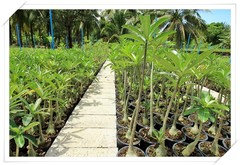
    Sorry for the horrid low light grainy picture. Just to demonstrate you cannot always judge a book by its cover, these are both KO_Adenium Arabicum Desert Night Fork grown from seed at the same time, under similar conditions. Amazing how different they are. I am waiting for blooms before pruning the tall one.

    Maria Elena

    westes Zone 9b California SF Bay thanked Maria Elena (Caribbean - USDA Zone 13a)
  • 8 years ago

    Maria Elena, It is truly amazing just how different seedlings from the same seed batch can demonstrate such different characteristics. Not surprising when you think of the differences between siblings of a one Family (humans). This is one of the things that intrigues me with growing these.

    Your plants both look so wonderful.

    Rick

    westes Zone 9b California SF Bay thanked rcharles_gw (Canada)
  • 8 years ago

    Wow, Rick ... That's exactly how I explain the differences among adeniums grown from seeds of the same pod! I compare them to sibling ... They may share basic genetic characteristics but don't always resemble each other.

    These are intriguing plants, indeed!

    westes Zone 9b California SF Bay thanked Maria Elena (Caribbean - USDA Zone 13a)
  • 8 years ago

    Maria Elena, I ordered some seeds of ko's night fork as well. I hope that I get at least one that resembles your short one, it seems to look spot on to the sale picture. Good job.

    westes Zone 9b California SF Bay thanked isde02(zone5b)
  • 8 years ago

    Oh, you will, isde02 ... Most of the KO Desert Night Forks and Brazilians resemble the short squat, multi branched one. Just let them grow as they will ... no need to pinch/prune. I kept the tall one because it actually has black skin on the upper trunk. I will be rooting the cutting. It also has centipede roots.

    I highly recommend the KO arabicums ... They are amazing fatties at such a low cost. I promise you will be very happy with the results. I will certainly be buying more.

    All the very best to you,

    Maria Elena

    westes Zone 9b California SF Bay thanked Maria Elena (Caribbean - USDA Zone 13a)
  • 8 years ago

    @LatinLady can you link us to a store that sells KO's plants? I see an eBay site where he only sells seeds.

  • 8 years ago
    last modified: 8 years ago

    Email him to see if he sells plants at this time ... I don't think so. Here's his site. The site can be a little confusing to navigate.

    You can browse all Mr. Ko's seed selection here ... Click on the seed name in blue to view blooms: http://www.adenium.com.tw/2015price%20list.htm

    Shipping is $4 per order and includes a phytosanitary certificate for customs. Email your order to: adenium@adenium.com.tw You can just copy and paste the desired seed information from the site, like this:

    Adenium Arabicum Desert Night Fork 15 seeds US$1.5

    You will receive an email confirmation and invoice from KO within a couple of days. Make payment via paypal at adenium@adenium.com.tw

    If KO is not currently selling plants, you can contact Rinoa, who used to partner with him. She does sell beautiful plants and her special hybridized seeds. This is her website: https://orient-adenium.com/

    Maria Elena

    westes Zone 9b California SF Bay thanked Maria Elena (Caribbean - USDA Zone 13a)