Software
Houzz Logo Print
trashcanman

How do you check framing quality?

8 years ago

What do you look at to see if you got a good framing job? Where do you look to see if corners were cut? What do you look for in an above average job?

Comments (30)

  • 8 years ago

    See if the framing has been laid out to square the foundation and exterior, top and bottom plates nailed or fastened securely using industry standard nailing patterns, all studs have been applied with the "crook" in the same direction, walls are plumb in both directions and have a _flat_ surface, inside corners and "butt walls" have at least one stud to allow fastening drywall. Blocking is also important look for fire blocking, ceiling to wall intersections, counter and cabinet, toilet roll, joist, edge, shower, towel bars, stair railing, closet poles, baseboard and crown corner, etc.

    habitat manual

    habitat framing and blocking

  • PRO
    8 years ago

    Well...how long do you have?

    The shorthand version is to start with the foundation on which the framing rests and should be connected. After that, simply work your way up...up the stud walls to the second floor framing; from the second floor framing to the roof framing.

    If you live an area with special conditions, i.e., seismic or high wind, etc, look for the proper use and spacing of the code-mandated special connectors to the foundation; to each floor's framing and to the roof framing. Shear panels should also be present, and those walls should have special connectors to the foundation.

    "Uneven foundation concrete wall and sill plates/framing issue" is an older thread which illustrates exactly what you should not have on a properly constructed foundation.

    Good luck on your project!

  • 8 years ago

    "Well...how long do you have?" I guess I have until the drywall goes up?

  • PRO
    8 years ago

    Sorry...I mean a full and complete description would take a very long time to type and an even longer time to read...

    If you have serious doubts, causing your posting, it would probably be worth it to buy an 1-2 hours of time of an experienced structural engineer to walk the site with you and make notes.

    Good luck!

  • 8 years ago
    last modified: 8 years ago

    @Virgil - I know what you meant... ;-) I don't have doubts, from watching these guys work and the video and photos I have taken, they seem very organized and efficient. The job site is kept neat and tidy. They don't speak English well, but they don't look or act like they were picked up in front of the local Home Depot this morning.

    Just wanted to learn a little abit about the framing so I can see and appreciate the quality for myself. I could ask the builder and probably will when I see him again out there, he loves to talk about this stuff, but as a tester I like to do my own independent analysis.

  • PRO
    8 years ago

    You probably had a structural engineer design this. That's who should take a look at it for all the joists, headers, beams, load bearing elements, connections and tie downs.

    I would also recommend a blower door test once your plumbers, electricians and mechanical contractors have finished and before insulation and drywall. This will help you identify any areas where the building envelope is leaking air before it's too late to do anything about it.

  • 8 years ago

    I had an architect design the house for me. He said he will visit the site a few times, I guess after the framing is complete.

    In my county a blower door test is required by code. I am not certain, but I think its done towards the end of the construction, after the drywall has been installed.

  • PRO
    8 years ago

    Blower door test is often required at the end of construction. EnergyStar requires an additional one prior to insulation and drywall reasoning that you can more easily fix issues. It's a good idea that I like to talk my clients into.

    Check into if you pass the requirement now, would you have to do the one at the end?

  • 8 years ago

    About how much would one expect to pay for a blower door test?

  • PRO
    8 years ago

    In our area about $750. Check with your local energy raters.

  • PRO
    8 years ago

    HandyMac I learned valuable stuff from your post. Thank you.

    I would add that it's time to field measure for cabinets and draw them on the floor to make sure everything fits. This will confirm the layout and help the electricians with outlet and light placement.

  • 8 years ago

    @HandyMac - Thanks for the great tips. Could you elaborate abit more on exactly how you do #4? Are you running the string horizontally, or vertically?

    Here's a video I took out at the site today...


  • 8 years ago
    last modified: 8 years ago

    String - horizontally from one end of the wall to the other - midway up. See if the string bows out or has huge gaps to the studs. A string is your easiest measuring tool!

  • 8 years ago

    What jannicone said. To check plumb, tie a small rock to the end of the string for a shade tree plumb bob. Also, use colored string( sold as mason's line). You can buy a 250' roll for $5 at a hardware/home improvement store.

  • 8 years ago
    This a perfectly time post for our build. I’m heading to the site this weekend and bringing string!
  • 8 years ago

    Following - our build will start soon and this is great information for the framing phase. We are also thinking about purchasing a quadcopter (drone) to video-document our build.

  • 8 years ago
    last modified: 8 years ago

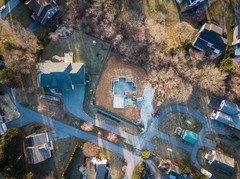
    @lindavana - I had been wanting a advanced drone for awhile, and this build was a good justification for the expense. The best part about it is that I can film/take pics while the crew is working, and not be disruptive or in their way. I can also clearly see things that I don't have easy access to, like what's going on on the 2nd story(the stairs are not built yet).

    Its also easier to bring up items with the builder when I can get clear picture of it to use. Video is great too, because I can say something like look at the wall at 23 seconds... And you will be surprised what you see once you look at the video and images on your computer monitor.

    It will take you some time to learn all of the features of the drone and be able to use it effectively, and feel confident operating it without risking a crash. I'd recommend getting it at least two weeks before you want to start filming.

  • 8 years ago

    Do you mind letting me know which drone features you like and/or what brand/model might work for this? Thanks!

  • 8 years ago

    I've been using a DJI Mavic Pro. I found a good deal on a refurbished model at Microcenter. I'd highly recommend buying local, so if there is an issue its much easier to deal with a return at a local retailer than sending it back to DJI in China, and waiting for an analysis and a return. Supposedly their customer service is not great. Just buy it from some place like best buy, microcenter, newegg, B&H photo, etc.

    The Mavic pro is nice because it will easily fly for 20 minutes per battery, folds up small, and doesn't make much noise. When its 200 ft up and there is a little background noise, no one will see or hear it. You could get an Mavic Air or Phantom 3 or 4, but those make alot more noise. The Mavic Air is smaller, but the battery is smaller and only get about about 15 or 16 minutes of flight time. The Phantom is bigger and has slightly longer flight times, but takes longer to get flying and draws more attention. All three will handle some wind with ease.

    I use the point of interest intelligent flight mode to take most of my videos and photos. It easily allows you to circle the house. They will also do panos as well, which can be really cool.

    They are an amazing piece of tech. Do read the manual thoroughly and fully understand how the drone uses its sensors/features. In ideal conditions they fly very predictably and are easy to handle. But if you are flying late in the evening in a breeze and loose GPS lock and you don't realize what is happening, it will start drifting and you will think you have lost control.

  • PRO
    8 years ago

    There's a lot more to good framing than a string line will show. Straight and plumb are fine as far as it goes. But there's so much more than that...

  • 8 years ago

    Heres' a neat trick when you're "inspecting": take the building plans and check that they're being followed. Oh, and have framed a couple of dozen homes yourself in the past. (No, not me!)

  • PRO
    8 years ago

    "Built as designed and shown on the construction documents..."

    Such a novel and intriguing idea to check...

    Almost anyone can use a nail gun to shoot a 20d nail into a 2X...but is the 2X in the right place?

    Hmmm....

    Accuracy is as important as good workmanship.

  • 8 years ago

    Correct. A tape measure and drawings to ensure things are in the right place are good tools. Tracing "loads" down and seeing how they end up being supported is a good skill.

  • PRO
    8 years ago

    The worst I ever saw was when two battered pickups pulled up to the lot next door and 8 dubious looking guys piled out, grabbed chainsaws and started throwing up a duplex. In about a week they got all the way to the roof before the owner noticed it was all messed up. The point load coming from the center of the roof that held up the entire roof was landing on plywood 3 floors down. It missed the beam because the beam pockets had been mis-located by the foundation crew. They installed it crooked even though it was off by 18 inches end to end. To make matters worse the lowest level wasn't tall enough to meet code.

    These guys got fired and it took two months for a new crew to fix the mess. Thank God it wasn't one of my projects.

  • PRO
    8 years ago

    Chainsaws on a job are always a very bad sign...

  • PRO
    8 years ago

    A Sawzall in the wrong hands is a scary thing too.

  • 8 years ago

    Quote--"There's a lot more to good framing than a string line will show"

    Absolutely!!! What I posted was a quick and dirty indicator of correct framing procedures, not a complete explanation. It takes years of experience and training to learn wood framing----and then there is commercial framing with metal, timber framing, Insulated concrete form building, prefabricated wall panel framing, and more.

  • 8 years ago

    HandyMac had great ideas. It's all in how far you want to take it. Lots of times, plumb and level at least show a certain amount of concern and attention to detail that bodes well for a well executed framing job.

    String and plumb bob, a 6' level (or even an 8' but that gets awkward), a square, a tape measure, a longer tape - 100' - for overall exterior dims or checking overall square, a laser level, comparing everything dimensioned to your plans, overall fit / finish, tracing the loads, etc. You can go from "mild to wild" - just depends on how much effort you want to invest.

  • 8 years ago

    Chainsaws on a job are always a very bad sign...

    Indeed a scary sound! (Even when it was my HVAC guy setting about planned destruction.)