

Help! Selling split level - square footage issues
Hi,
I hope you can help me figure this out. I was dismayed to find out that the square footage of the family room and bathroom of my split-level don't count in square footage. Reading about it online, I've come to wonder how "grade" is defined.
My tri-level house is built on a slope. 52% of the footprint is the lowest level. 48% of the footprint is the middle level. The upper level is above the lowest level. Shouldn't "grade" level be considered the footprint of the majority of the house?
The family room and bathroom are entirely finished, as finished as the rest of the living quarters. The family room has picture windows facing the street. It's only 5 steps down from the middle level, and does not look or feel like a basement.
One website said, don't worry about missing square footage when listing, comps will compare to other split-levels. Well, the residential real estate market here is hot, but split-levels aren't that common.
What do you think?
thanks,
creekgirl
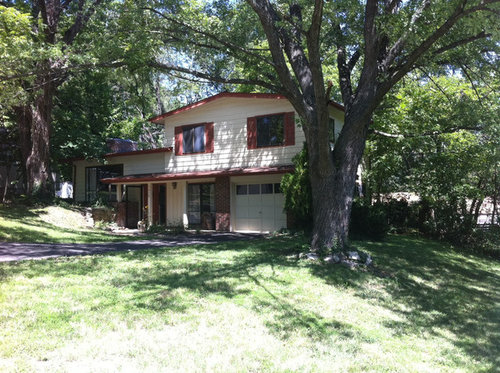
PS.....I've had a few real estate agents tour the house and not one said anything about this . I only found out about the split-level dilemma from a contractor.
Comments (56)
 8 years agolast modified: 8 years ago
Important to understand, in your local market:
--- Contractors/flippers work in constructs that have nothing to do with retail sales- only what the City/County will allow, within building envelope. Many areas have rules - impervious vs pervious space. In my area- for a builder- the calculations also include certain areas where the square footage is calculated at a 50% measure while others are 100%.
If you are selling, a contractor/flipper isn't the person to talk to. They work in "future speak"- city/county regs, to maximize their future profit. A Realtor works in the present- what is fair market value for this house, this land, today?
--- Let your Realtor negotiate the best price for you, and forget about the first two points. Unless you are looking to tear down/remodel the property, your only concerns are about real sales comps. Often, an appraisal in a hot market doesn't reflect real sales value. You couldn't care less about a flipper's "needs" right now, right?
--- Last thing- what does Fannie Mae have to do with a sales transaction? Truly interested, especially if this will go to an investor/flipper.
No disrespect- but we homeowners can often research until our eyes bleed, and still be left without understanding. Get a great Realtor, and don't look back. In a hot market, you may just find yourself in the enviable position of a bidding war- do it!
 8 years agolast modified: 8 years ago
Laurie is right.
More info that may help you:
I find that the property tax records are notoriously inaccurate. At least in my area. The inaccuracy generally is to show more taxable square footage so the owner has to pay a higher tax bill. Surprise, right?
Also, appraisers measure the property. Physically measure. The value is based on the market at the time of the appraisal and the type of appraisal. Generally an appraisal value is worthless after 6 months. Less time in a rapidly rising market.
If you select the right Realtor, they will have a handle on your neighborhood pricing and be able to show you what your home will sell for based on recent sales in the neighborhood. All these other issues side track from the main issue: your home's worth in today's market.
creekgirl thanked DenitaRelated Professionals
Petersburg General Contractors · Alexandria General Contractors · Pueblo General Contractors · Las Cruces General Contractors · Pullman General Contractors · Spokane General Contractors · Dothan Architects & Building Designers · Philadelphia Architects & Building Designers · Muncie Architects & Building Designers · Plattsburgh Architects & Building Designers · Savannah Kitchen Remodelers · Newburyport Kitchen Remodelers · Oneonta Kitchen Remodelers · Rutland Kitchen Remodelers · Sanford Kitchen Remodelers- 8 years ago
Retired real property appraiser. It's not a dilemma because it's a common occurrence.
When you go to sell it, the appraiser will compare the subject home with other available split level sales. If there aren't enough recent, nearby split level homes to complete a sales comparison, homes with basements will be used to complete the analysis. If the appraiser has to use homes with basements, they will try to use homes with partially finished basements.
Do not be distressed. It's not unusual. In your instance, there are three types of space that will be compared, above grade square footage, below grade finished square footage and below grade unfinished square footage. This means your above grade (upstairs) will be compared to above grade at other homes. You below grade (downstairs) will be compared to a finished basement at other homes. You garage space, I am assuming this is unfinished, unheated space, will be compared to similar garage space. Each of these spaces will have a different cost and finishes factor applied to their comparison. The result will be to compare similar types of spaces as much as possible.
County records are developed under a mass appraisal system and often do not match with appraisals developed for sales valuation purposes. This mass appraisal system confuses everyone and the tax assessor is the only one who understands it.
creekgirl thanked homechef59 creekgirl
Original Author8 years agoSquare footage is what can be legally listed when selling, and banks comply with Fannie Mae mortgage regulations. Advertisable square footage absolutely does matter. Buyer agents and house hunters may just glance at square footage of listings and think, too small.....and pass it over.
I don't have a real estate agent currently, but 2 years ago I had a few tour the house and a couple came up with comps. These comps were nothing like my house. They were small, ugly square boxes with basement walkouts in the back. I don't recall the real estate agents explaining the Fannie Mae regulations, but the value placed on my house was so low I decided to hold onto it.
Split levels aren't that common around here, so it would be hard to come up with comps. Even my private appraisal states this explicitly, and 2 of 3 of the appraisal comps are not really similar to my home.
A real estate agent would have to put extra effort into selling my split-level at the fair value of actual square footage, since it would be more than the square footage shown in the listing. But every real estate agent I've talked with emphasizes the importance of selling FAST.
Given percentage of commission, it really doesn't advantage a real estate agent to put in extra effort. It's better for them to sell fast and move on. But that extra $10,000 - $20,000 can make a big difference to the seller!
The housing market in my community is hot, but a lot of teardowns, clearcuts, infill McMansions that increase impervious surfacing causing run-off problems. Every week I get postcards and letters from flippers and builders wanting to buy the house fast with cash. Of course they would not want to buy the home at the same market value as an actual dweller, they're looking for profit.
For all of the above reasons, I'm wary.
- 8 years agolast modified: 8 years ago
I'm still confused about your focus.
What are you wary of? You think you can list this, on your own, and get maximum $$- with no Realtor? Then do it.
While I get that a seller might look at buyer's motivation, within offers, you seem to be going a very long way around with questions that you have no idea how to answer. Sharks swim around this sort of stuff- wait for you to list on your own, and then give you 12 reasons why your property isn't worth what you want. Without professional info, you're at a dis-advantage.
Or- go your own way. Be smarter than the market. But do ask yourself one question:
If a shark, or a Realtor, were to step into your job for a bit- how would they fare in a meaningful transaction-promotion, more money etc? Could they best you?
creekgirl thanked Laurie Schrader creekgirl
Original Author8 years agoPoint well taken, Laurie. I have tried to learn all I can, but I don't have the experience of agents, builders, etc. I don't know how I'd hold up against a savvy and experienced buyer's agent. And real estate is so hot here, it really is like a shark pool. Ack, I think I need to breathe into a paper bag......
- 8 years ago
Of course your are wary. You should be. There is some truth to the idea spilt levels and split foyers suffer in the marketplace. It's a very efficient building plan that minimizes foundation costs and uses every square foot of available space. However, people don't like their bedroom windows at ground level and they hate all of the stairs. Hence, they suffer on the market.
Given that you are in a "hot" market, it is also possible your house will be a tear down. In that case, you will probably be dealing with an investor or flipper who will pay cash. They aren't buying your square footage, they are buying your lot. They know their market and they won't be over paying.
Your below ground space is just not comparable to other homes above grade square footage. It's a fact of the market place. The age of your home will also be a huge factor. You cannot compare it to new construction. If your home was built 20 years ago, it has to be compared to other 20-year old homes.
Only you can decide if you want to sell your property or live in it. Only you can decide to accept an offer. The market place is the ultimate decision maker. If you underprice it, you will get multiple offers above the asking price. If you overprice it, it will languish on the market. The best that you can hope for is a fair price.
Should you decide to list, begin interviewing realtors and they will show you comparable sale properties adjusted for your above grade living space, location and age of structure. Believe the adjusted prices. They are providing you with adjusted valuations that reflect the kind of sales price that you can expect. Interview three agents and find the average price.
creekgirl thanked homechef59 creekgirl
Original Author8 years agoWell, that's just the thing, housechef. How do I know who is a righteous agent or buyer?
Real estate horror stories about this town:
---a builder employed a seemingly lovely young couple as shills to convince a woman to sell her family's historic landmark home. Once acquired, he found a loophole in the deed restriction to tear it down and build a McMansion.
---met a woman who has spent $40,000 trying to mitigate flooding caused by neighboring infill McMansions, and her troubles still aren't resolved.
---an acquaintance with a yard like a bird sanctuary unwittingly sold to a builder who tore it down and built a McMansion with nearly complete impervious surfacing. A 93 year old grandmother whose backyard faces the backyard of this property now has flooding problems in backyard and basement, will have to move, her home rendered worthless and will have to be torn down.
---a friend warned me that selling agents can sometimes have relationships with builders/flippers. Agents tip them off about what's coming on the market and convince sellers to "sell fast" at a low-balled price, in exchange the builder/flipper uses the agent's services to sell the new or renovated house. Win/win for the agent and builder/flipper......screws the seller.
---behind the house where I live now (not the split-level) the woods were virtually clear-cut for a McMansion and ever since my neighbor has suffered washouts of her landscaping, driveway deterioration, a laundry room that floods up to her knees. We complained to the city.....basically they said too-bad-so-sad and promised new run-off regulations were coming. That was about 5 years ago......no changes.
---the property where I live now is where I grew up. It includes a small, one-of-a-kind mid-century studio house by a creek, downhill from the split-level I've written about here. IF the split-level is torn down, and/or impervious surfacing increased, the additional run-off could destroy this precious little studio house. There is already more water coming down the creek from increasing impervious surfacing/run-off from all over town, and heavier rains in recent years (climate change = real.)
Sorry......didn't mean to write such a litany, but you see why I'm wary. The split-level is a great house, btw.....solid as can be, new roof......and no part of it is really below ground. It would be perfect for a young couple or single mom, if only I knew how to find them amidst the sharks.
creekgirl
Original Author8 years agoAgain, sorry if this is all confusing. Really I should start a new thread about run-off issues. But anyway, if you're still with me.......
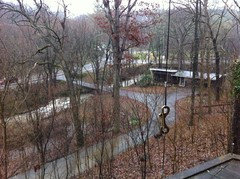
Here's a photo of the "Little House" taken today in the rain from my current home (not the split-level, which is up the street.)
As you can see, the Little House is put at risk by increased community stormwater raising creek levels. It would also be put at risk by any additional run-off from up the street where the split-level is located.
The Little House is directly between the split-level and the creek. If the split-level was torn down and footprint increased with a McMansion or even just additional impervious surfacing of an addition, the increased run-off could put the Little House at additional risk. So yep, I'm real wary.
- 8 years ago
Being an older gardener I relate to the worry that future buyers will change things. However I also know that once you sell a property it is the new owners to do with as they wish. People will buy a house for the landscape then change to suit themselves. Finding a buyer that agrees to do what you want or that suits your house is a waste of time and anguish. If you sell go for the biggest return and do not visit the old house. Accept the change. Do not be the person like the daughters of the previous owners who kept coming to see "their Mom's house" years after she had died and we purchased the house.
- 8 years agolast modified: 8 years ago
Ok, I hear your concerns about the builders and the land being "ruined" - I get it, I truly do, and wholeheartedly agree that land all over this country is being sh*tted up by all these McMansions on shoe-sized lots. But what does that have to do with you selling your house? You sell it to the highest best bidder and wash your hands of it once the transaction is complete -- what they do to the house/land is not yours to agree with nor approve of once you no longer own the property. If you don't want the house or property changed, then don't sell. Otherwise, your concerns about who buys your house should have no bearing on what should be an objective sales transaction. The way to put a stop to all this building madness is for communities to enact master plans that address it (e.g. establishing minimum lot sizes, minimum community green space, etc)
creekgirl
Original Author8 years agomaifleur01........I wouldn't care if the new owners painted the house fuschia and planted pinwheels. But if the split-level is torn down and replaced with a home with a larger footprint, the additional run-off could have destructive impact to the "Little House" in the photo by the creek.
Since city run-off ordinances are inadequate, it falls to me to protect my own holdings best I can. But really, wouldn't it be better if everybody gave consideration to neighboring properties impacted by their choices, instead of take-the-money-and-run?
Someone once said, "We all live downstream."
creekgirl
Original Author8 years agomxk3.......I'm so sorry, it probably sounds like I've run off on a run-off digression, but actually it all ties together.......
I want to sell the split-level at highest price possible, both for the money (of course) but ALSO to keep it out of the price range of builders/flippers. Because increased impervious surfacing would increase run-off that could damage my little studio house ("Little House") downhill by the creek.
(I'm just trying to save my own property! But really, we should be just as careful about the properties of others. I mean, karma, "do unto others." Not dog-eat-dog-chips-fall-where-they-may-take-the-money-and-run. Inflicting run-off damage on others......well, that just sucks.)
Anyway......
I read that builders/flippers buy properties for which they can expect a 2.3 - 3X profit.
To get the split level out of their price range, it would help if the listing could be actual square footage, not the reduced square footage that Fannie Mae might require.
I say "might" because I'm still not convinced any part of the split-level is "below grade." It's built to follow the contour of the slope.
- 8 years ago
Other than getting ordinances changed there is nothing you can do other than build a wall around your little building with a sealed rubberized gate. If you decided to change your house would you be considering your neighbors objections? If it was something you wanted probably not. Being upset with the might bes of others is a sure way to develop health and mental problems.
creekgirl
Original Author8 years agomaifleur01.......yes, some of us here are trying to get ordinances improved. The city has lagged for years, making promises. At the City Hall building department an employee said, "This is America. You can't tell people what they can do with their own property." (Ironically, this was right after Hurricane Harvey made Houston a poster child for the foolishness of lack of zoning ordinances.)
My response: your right to do what you want with your own property ends at my property line. It is not reasonable to expect to damage other peoples' property with excess run-off at their loss and expense.
- 8 years ago
Creekgirl, I appreciate your passion but I'm more confused than anything.
Backing out slowly, but frankly your issues are twisting in on each other. Either you want to sell, or not. Answer the question, and go one way or the other,
creekgirl
Original Author8 years agoLaurie......sorry, I know there are a lot of factors and it must get confusing. The split-level has sat empty for years as I've delayed this decision. If it was easy, believe me, I wouldn't have posted here.
To get back to the original question.........I'm wondering who or what actually determines the square footage of a split-level? Because the appraisal and county revenue assessment differ. Is it left to the selling agent or mortgage lender?
- 8 years agolast modified: 8 years ago
The Realtor will most likely use the square footage in the property tax records along with measuring the property. When there is a discrepancy between property tax records, physical measuring and the prior appraisal, it is put in the MLS notes to the brokers (usually). It is also listed on the sellers disclosure (usually).
The information from you regarding the appraisal would be greatly appreciated by the Realtor as then s/he can use the appraisal as a valid third party additional resource for square footage.
The lender will use the appraisal square footage generated by the new appraiser the lender selects if the buyer elects to obtain a mortgage.
creekgirl thanked Denita - creekgirl thanked Laurie Schrader
- 8 years ago
you state the city ordinances regarding run-off won't help, but what about the county or the state (either of which "might" over-ride the city) and yes, I am aware of no zoning Houston - I was born there and lived there until ten years ago - lack of zoning isn't the issue - Houston is flat as a pancake and for years builders were not forced to build retention ponds.
creekgirl
Original Author8 years agoThank you, Laurie and Denita. Tonight I went over the county revenue assessment and the 2010 appraisal with my boyfriend. When he saw the assessment gives two totally different square footage figures for "total living area" and they're both different from the appraisal's "gross living area"......well, I thought his head would explode.
So we're going over there this weekend and measuring everything ourselves. I know our measurements wouldn't mean squat in a transaction, but at least we'll have a basis of comparison.
creekgirl
Original Author8 years agobtw.......is it possible to screen buyers to those who would take out a mortgage? Just wondering, cause I've read that most mortgages prohibit destruction of the home.
 8 years ago
You can measure all you like, but the fact that the one level is "below grade" as far as appraisers and lenders are concerned, then just list it and sell it for what it is worth. That lower level is not worth the same per square foot as the levels above ground. No amount of measuring will change that.
- 8 years agolast modified: 8 years ago
In my area (Missouri Ozarks) most homes have finished walk out lower levels (we don't even call them basements) and the lower level USUALLY has the same value placed on it as the main/walk in level if it is finished. Fannie Mae makes loans on these homes and I've never had nor heard of any issues with sf below main walk in level values as long as the sf is finished and similar.
I believe that our area is not the norm though.
- 8 years ago
You could add a deed restriction that deals with run off water. You will need an attorney to draft and file it. But, it won't change the fact that whoever buys it can do whatever they want with the property. The only time you get to choose your new neighbor is if two parties are negotiating at the same time. Otherwise, you get what the market sends.
Instead of running next door to measure the house, why don't you make a couple of appointments with experienced realtors? You might learn something. I think it would be better use of your time and effort.
creekgirl
Original Author8 years agoIf the front door on one side of the house is at ground level, and the back door on the opposite side of the house is at ground level, how could ground level be considered "below grade"?
If means of entry were both below grade, there'd be no way to even get in the house.
There should be a class action suit from split-level owners who sold their homes at a lower square foot valuation than they were actually worth because of ridiculous and unfair Fannie Mae designations.
creekgirl
Original Author8 years agohomechef.......as mentioned in an above post, I've talked with real estate agents. A couple years ago I even got one or two sets of comps. I thought the comps really weren't similar and the valuations too low. I'm so glad I didn't sell at that time.
You really have to do your own research and not entirely depend on real estate agents. Researching online doesn't make me any kind of expert, but at least now I've learned something about split-level square footage evaluations. When it comes to split-levels, it really is "seller beware."
 8 years agolast modified: 8 years ago
I tried to follow this thread and your questions/reasonings/research. You seem to have many, many issues with this property, some of which are related to ANOTHER property that you have interest in.
Bottom line, the way I see it: The only way to control a property is to own it. (Sometimes even that isn't enough.) And control appears to be your ultimate goal.
creekgirl
Original Author8 years agoWell, yes, trying to avoid financial loss or damage to my property requires a bit of effort. I also consider responsibility to neighbors, and the environment. I guess all of this could be called "control."
- 8 years agolast modified: 8 years ago
Actually, it's buyer beware. You make money when you buy a home, not when you sell. Over paying is as bad as under selling.
The market changes from day to day and week to week. I can guarantee that it has changed since you last interviewed a realtor. I would encourage you to call at least three agents and ask them for comparative market analysis. You may be pleasantly surprised that the market has improved in the last couple of years.
If you want to sell, you need to either put a sign up out front and hire a real estate attorney to handled the sale details or hire a realtor to represent you. Once you sell, you can't control what is done with the property. If you hire a professional realtor, they will represent your interests. That's what they do.
You can't change the type of house that is on the property. It is only worth as much as someone is willing to pay and no more. That's market value. Market value will be based on comparable square footage.
If you don't want to sell, you may want to rent it out. An occupied property does not deteriorate as fast as an unoccupied structure. If you don't know how to do this, a property manager can help you for a fee.
If you choose to do nothing, at least you have a greater understanding of the situation and your options.
 8 years agolast modified: 8 years ago
Ask your assessor. We had a split-level and one year in paying the tax, we wondered why the assessment read "tri-level" and the real estate listing had read "split-level". So we asked. The assessor said it depends if the lower level is above or below grade. We thought it was, because you had to drive down the driveway into the garage, the lower level windows were even with the lawn, and you walked up 4 steps from the family room patio to the lawn. So he drove by, took a glance, and our assessment changed.
I would see houses just like yours when we were house-hunting, all listed as tri-levels (some were tri-level plus basement under that middle living room level!) And, your front door is on-grade, and on the same level as the family room, right? Whose front door is in the basement? No ones.
(In our current house, one year we thought the square footage upstairs was suspect. Sure enough, similar models are built out over the entire first floor, but ours is built back above two spaces, giving them gable roofs. We sent the discrepancy to the assessor, and the record was corrected.)
creekgirl thanked bpathcreekgirl
Original Author8 years agoThank you, bpathome! Yes, the front door, back door and garage are all on the lowest level. If the lowest level was below grade, the only way in would be to tunnel like a groundhog. Check out this article and comment section:
https://www.getloans.com/below-grade-square-footage-gets-erased
One commenters' bedrooms are all on the lowest level. He said he has to try to sell his house as having no bedrooms!
- 8 years ago
If you have all of these fears and emotional entangles, you really do not want to sell. So, don’t sell it.
You need to talk to someone about this. And I don’t mean a realtor. You are tied into knots over an attachment to things. Even things that have some value, like houses, are just things. And this angst is all out of proportion to the usual standard home sale. You’ve got some sorting out to do.
creekgirl
Original Author8 years agoSophie - sorry if I find the careless manner in which people treat land and property disturbing.
Here in my town teardowns, clearcuts, increase in impervious surfacing from over-sized infill residential have created run-off problems that are damaging the properties of others, and ruining the scenic creek that runs through my neighborhood with flash flooding, erosion, tree loss and bank destabilization. Those with homes at risk are currently fighting a builder's attempt at downzoning that would tear out wooded acreage to cram in as many over-sized McMansions as possible.
Even a real estate agent quoted in a local newspaper article this week said teardowns/infill have gotten out of hand around here. She deplored that "starter" homes are disappearing. The editor of the paper met with my neighborhood last week and is planning a headline story.
So you see, it's not just me, Sophie. People have had enough around here. I don't care if you think my "angst is all out of proportion to the usual standard home sale." I'm conscientious and proud of it, and I hope the tide is turning in more communities like mine. I am confident the city is going to update regulations, but in the meantime, I have a home to sell, and am trying to avoid contributing to this big deplorable mess of irresponsible land abuse.
- 8 years ago
Your selling of this house has no bearing on the city's impervious surface regulations or the lack of them, nor vice versa.
It could have been sold three times by now.
- 8 years agolast modified: 8 years ago
Creekgirl I empathize and wish that your town had the environmental regulations that could protect the wild and natural spaces, preventing properties from being developed into oblivion or in ways that aren't sensitive to the bigger picture. i see where you're coming from. But the system you live in doesn't seem to be designed that way, at least not right now. Someone earlier on this thread asked why you don't consider renting the property instead since you want to maintain control. I'm curious about that as well.
creekgirl thanked melle_sacto is hot and dry in CA Zone 9/ creekgirl
Original Author8 years agoLast night infill run-off in my town was a story on local network TV news. A woman's driveway turned into a lake because of increased impervious surfacing from a new McMansion built next door. That makes 5 examples here in my town that I know of, plus creek flooding. I know there must be more examples, and hope more homeowners speak up.
I could have sold my house three times by now? I could have sold it a dozen times by now. But until I learned about split-level square footage, it could have been at a price too low. And bait for a teardown with infill that caused run-off problems for my neighbors, and my own other property. Sorry, but I don't want to be another tragic story on the TV news.
What have you got against someone trying to be an informed seller? I want to get the best price for the house, and be responsible to the community. Insulting those aims does not speak well for your industry.
creekgirl
Original Author8 years agoThanks, melle. I wrote the comment above before yours appeared....it's not directed to you. I really appreciate your sincere concern.
Renting is a good question. I gave it a lot of thought, but the property I'm keeping, where I live, needs so many immediate repairs and maintenance. I do plan to fix up and rent that little mid-century studio house shown in the photo by the creek. It's on the same property where I live. But I don't have the financial padding that could be necessary to keep up the other house, too.
- 8 years agolast modified: 8 years ago
Again, none of that angst over the world in general, or local, has anything to do with selling a house. You aren’t emotionally detached enough here. And you need some help in sorting that out.
If you don’t want to let go of control of the property, then don’t sell it. But you have to make enough money to actually keep it, and keep up with the maintenance and repair. Which you don’t.
The reality is that you need to sell both properties. Because the sentimental attachment to the teardown cottage is the real stickler here that is interfering with clear thinking. You can’t afford to invest more money than a new build would cost in repairing and preserving it, so it will continue to deteriorate and become even more of an issue. Same with this house. Not selling isn’t a viable approach either unless you have the money to pay to keep it up properly.
You are not doing the houses or yourself any favors by holding on to either one. You are merely ensuring that someone definitely views them as bulldozer worthy by the time you do get your mind wrapped around to selling them.
If preserving the cottage is a priority, then find a sympathetic buyer for it who doesn’t mind the large expense of a restoration. That means fire sale prices for it. If it is indeed on a legally separated lot to the main house with legal access to it.
Sentimental attachment is for those with the means to indulge it. That’s not you. And your emotional attachment to the property and being unwilling to let that go is harming the property and you.
creekgirl
Original Author8 years agoSophie........the "cottage" is on the same property where I live currently. I will never sell this property.....it will stay in the family. I am selling my former house. That is the house that is at issue here.
- 8 years agolast modified: 8 years ago
If you don't like what's happening around you, why do you want to stay? What's so hot about the cottage that it has to stay in the family? It's not about the physical building, it's about the people that were in the building and the memories that were created and shared -- those will remain long after the building is sold or gone, the four walls of the physical structure neither preserve nor cherish them. Time to let get go and move on. Or stay and resign yourself to the fact that changes in your community are taking place and probably can't be stopped (slowed maybe, but probably not stopped). Either way, you need to make a choice and come to terms with it. Fretting over square footage isn't going to help you do that, it's not the root of the problem.
- 8 years ago
A couple of things about property staying in the family that many do not consider is that the family may end, I am the last direct descendent of my family, fifth cousins or further is it. No one in the family may want it after you are gone. Family members have lives that need to be lived and unless they can find suitable jobs in the area they can not stay. If you have multiple children or family members that you can will/give it to later in life unless you are planning on giving each something of equal value it will have to be sold taking it out of the family. Just things to think. Makes things confusing when you write about keeping things in the family then worry about selling other property that you no longer use.
- 8 years ago
Yes you can tell if someone needs a mortgage with the offer. There likely is a third party financing addendum or something similar as part of the offer contract.
creekgirl thanked lyfia creekgirl
Original Author8 years agoI've attempted to explain issues regarding the house I want to sell, including associated issues that figure into my decisions. The associated issues are complex, and mistaken assumptions have been made by some commenters here that are wildly off-base, offensive and inappropriate. Suffice it to say, I am not leaving this town. I am not selling the property where I live. I've joined others in my community who are fighting for responsible building regulations to stop damaging run-off. I'm sorry if some commenters don't like that, but nothing you say will change this.
It depresses me that land is considered so disrespectfully in this forum, and I wish all would consider land has more identity than just a box of cereal. Land has geographic identity.....the place on the map of this planet. Geological identity......the ancient bedrock beneath it. Biological identity.....the biodiversity of flora and fauna that call it home. Environmental identity......land and water quality. Historic identity.....the natural and social identities previously. Community identity.....as a permanent fixture in social surroundings. Tax identity.....what we owe for services that facilitate the surroundings. Personal property identity.....that which we call home.
I was raised to respect land, and it depresses me that some people see it as merely transactional, a commodity to be exploited and then move on, and who cares about the damage to the land and those who remain. I'm not anti-capitalism, but late-stage capitalism seems to have eroded all other values. It's an unsustainable mentality, unsuitable to a shrinking planet.
Besides being caretakers of land, we're caretakers of our own souls. You might even consider them one and the same.
- 8 years ago
Now I'm even more confused -- you want to sell the house but you don't want to sell the property where you live. HUH? I must have missed something in the rambling verbiage somewhere up-thread.
- 8 years ago
I believe many well meaning posters are telling you to decide for yourself what you want to do to solve your personal problems with this property. You can't take on the world (or your town), you won't solve world problems with this property. Just make a decision to move forward, many will assist when you decide your plan of action. The key word being ACTION. Don't look for the perfect answer there is none. I wish you the best
creekgirl
Original Author8 years agoThere are some comments here that are helpful, but some are not "well meaning"......they're insulting. I don't have "personal problems" with this property, I don't have emotional attachments to it, it was only my home for 7 years. But it is close enough to my current property that a teardown/infill/increased impervious surfacing could produce run-off that damages my current property, not to mention neighbors.
You bet you can take on your town! And more should if irresponsible ordinances allow over-sized infill that floods their properties and stresses stormwater channels.
In fact, today's lead story in the local paper is about a group "taking on" our town over these issues. We are taking ACTION. I'm also taking action as I prepare my former home for the market. I just don't want it to go to a builder or flipper who will cause more problems for me, my neighborhood or this town.
- 8 years ago
Once you sell the property, it's no longer your decision. The other option is to not sell the property and retain control over it's disposition. Sell or not sell. It's really that simple.








porkchop_z5b_MI