Software
Houzz Logo Print
vladimir_atryzek54

"Rooting cuttings -- Can we reduce the process to its essence? "

8 years ago
last modified: 8 years ago

I posted this on the Tropical Fruit forum:

I read this thread on a fig forum. https://www.ourfigs.com/forum/figs-home/291461-rooting-cuttings-can-we-reduce-the-process-to-its-essence
It caused me to ask the same question about rooting citrus cuttings. From this posting: Question: What are the essential components of an environment that will cause
wood to sprout? Under proper conditions, we should need no medium at
all, other than air -- a stick of fig wood suspended magically in the
air could sprout roots, if other conditions were suitable. If so, then
everything non-essential might simply complicate the process and reduce
the probability of success. The non-essentials could be eliminated,
boosting the probability of success.

The poster in this thread found that fig cuttings will root without being stuck into a
growth/rooting medium. Can this be true of citrus? In other words, what
are the essential conditions required for rooting citrus cuttings? I know that preventing drying (i.e., maintaining high humidity), light and warmth are required. Are there other essential requirements?

Report to moderator
96.230.75.51

Comments (25)

  • 8 years ago
    last modified: 8 years ago

    I would say it will work for citrus too. In fact, it should work for any plant that will readily root from cutting. Akin to aeroponics. You can even buy cloning system that provides the exact condition: humidity, oxygen, warmth, sterility, and darkness. Although, sterility is not entirely essential but desirable.

    Cheap versions of cloning devices are made out a 5 gallon bucket. The lid have holes where you insert a sponge/rockwool/other ring with the cutting in it. The sponge is there only to hold the cutting in place against the hole in the lid. The inner portion of the cutting is in air. The bucket is filled half with water and a pump in the water sprays a fine mist inside the air space.

    In my mind, any good medium should provide some of those essential components well (humidity, oxygen) and a place for the roots to hold on to. That is structural support.

    Often, for air layering, I would first wrap the area on the stem first with a black tape with or without rooting hormone. Leave that black tape for a month. And in many cases primordial roots start forming. The theory is that prolonged darkness activates the cells to differentiate to form adventitious roots. Under a lens you can tiny little bumps forming. I would air-layer right under that region (after removing the tape). And the success is much higher.

    Vladimir (Zone 5b Massachusetts) thanked tropicofcancer (6b SW-PA)
  • 8 years ago

    The question is WHY Why not put Rootone or Rotex, or whatever... if it helps,great; if not, what is the loss

    Vladimir (Zone 5b Massachusetts) thanked johnmerr
  • 8 years ago
    last modified: 8 years ago

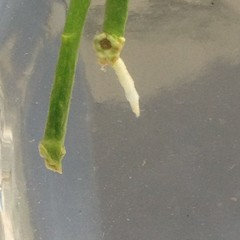
    Vladimir, I have not been successful in rooting citrus cuttings in the past, maybe only a few. Always provided the humidity, light and warmth, but citrus seems very difficult to root for me. With these Volkamer suckers from my own tree I went different way, left them in regular home temperature water in a jar, they were suspended in water and didn't touch the bottom of the jar, topped up the water from time to time, mostly neglected and after 2 months observed these calluses and potential roots:

    They were sitting on my kitchen counter and I potted them up couple of days ago. I keep a plastic bag with holes over them. We shall see how or if they pull through.

    Vladimir (Zone 5b Massachusetts) thanked sunshine (zone 6a, Ontario,Canada)
  • 8 years ago

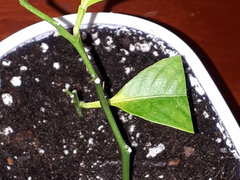
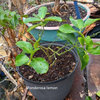
    A couple of years ago, I was able to root two trifoliate suckers in water. (See below. Both rooted.) They are now 2 and 3 feet tall. I tried doing that again with suckers from another tree and with some other citrus but they all died.

  • 8 years ago

    All those basic factors you've listed seem to be about right. I'd also include making sure the cutting is young wood. I came across an article about callus formation and regeneration in citrus and researchers recorded that the rate of regenerating tissue is much faster in young wood. There was some mature wood that hardly regenerated at all. So although you can perfectly provide the essential conditions for a cutting to root in, it may still fail depending on whether the cells within are even capable of generating/forming root structures.

    Almost everything I've tried to root were done in water and it always seemed to work. I rooted avocado pits, fig cuttings, and African violet leaves in water. Jade leaves I've rooted by laying on damp clay pellets, the ones used in hydroponics. When they get too wet though, they start to rot then mold but I haven't actually stuck them underwater. But succulents are known to inflate and explode from over absorption of water so I never dared to try.

    I always use the paper towel/ziplock method to sprout my citrus seeds. It's not submerged in water but I consider a thin damp paper towel to be an almost non-existent medium. But I haven't rooted citrus cuttings in water yet. I'm attempting to root 3 twigs that came attached to Tango mandarins I recently purchased. One is dying, one is surviving, and the last has begun to push new growth from one of the buds. I'm assuming the survival rate has been pretty good since young wood normally flowers and fruits. And so the twigs I'm attempting to root are probably very young giving them a decent chance of pulling through. It would be interesting to take cuttings from the same tree and compare how they root in different circumstances. Next time I have extra Meyer cuttings I'll be trying the water method and maybe even in plain humid air

  • 8 years ago

    Thanks so much for sharing the article! My total of three twigs have gone down to just one now. I was away from home for one night and the second twig turned grey/black. I was interested to read what else I could do for my last twig cutting since it is the one trying to push new growth. However I just potted it in its own container and saw it didn't grow any roots whatsoever even though the bud is pushing out. I'm crossing my fingers it's as the article says and is due to the lower temperatures

    Vladimir (Zone 5b Massachusetts) thanked kvetchlambkin (nyc 7b)
  • 8 years ago
    last modified: 8 years ago

    I ran out of room on my incubation shelf and graduated a bunch outside... as it turns out, too early. The cool and frosty mornings and direct sun have set them back and killed many. I learned a new way not to succeed!

    Search " "Long-Term Field Evaluation Reveals Huanglongbing Resistance in Citrus Relatives"

    I am going to be rooting and planting / trying AFL as rootstocks !

    Vladimir (Zone 5b Massachusetts) thanked uncle molewacker z9b Danville CA (E.SF Bay)
  • 8 years ago
    last modified: 8 years ago

    My impression is that there is great variability among the various citrus species in ability to root from cuttings. Am I correct? Which is the easiest and which is the most difficult to root?

    From the few scientific papers I have read, application of rooting hormone increases the probability of rooting success, at least in some citrus species. However, what is not clear to me is the optimal concentration of rooting hormones and ratio of indole acetic acid (IAA)and naphthaleneacetic (NAA) acid to use.

  • 8 years ago

    I have only done a limited number of citrus cuttings. The ones that failed frequently are young green cuttings. Semi green that have lignified partially seem to be easier to root. Air layers also work better on semi green wood. But it also works for more hardened woody branches.

    It seems reasonable that some varieties will be easier to root than others. Ficus family that is generally easy to root also show this variability for "special" edible figs. I am guessing these varieties were accidental mutations/hybrids in nature that humans liked and nurtured but are weak compared to other robust varieties. Probably also the reason that grafting is a preferred method of propagation in such cases.

    Empirically speaking I have not been able to determine effectiveness of rooting hormones. But my scale of experiments is small and not very systematic. I have tried several different ones but my observation is that it mostly does not make a difference in many cases. I do propagate many different types of plants, and citrus is a small fraction of it, so take that with a grain of salt.

    Most other plants that like to take a winter break also show variability in rooting success. Summer time after the first flush of growth seems like a good time for most plants. Often around October I will prune plants to get them ready for indoors and try to root the cuttings. Success is not that good.

    Vladimir (Zone 5b Massachusetts) thanked tropicofcancer (6b SW-PA)
  • 8 years ago
    last modified: 8 years ago

    Tropic, thank you for that input. I too am seeing greater success with green budsticks rather than semi-hardwood sticks - but my observations are all very non-scientific at this point. I am trying a bunch of variances to see if something shows greater (than terrible <10%) success rate.

    Vladimir, many rooting powders / compounds have only one of the two auxins. Some have both. There are so many variables including concentration, time of dip, and even viscosity of the solution (e.g. the gel types). It would be great to see a scientific study with a sound DOE (design of experiments) that would guide the professional and hobbyist as well. I think that at this point, the industry finds a process that works - based on industry norms such as moisture and warmth - and then tweaks it for their own use and success.

    A full - on DOE based study takes time and money. And, at this point the focus is on finding a solution to HLB before it spreads everywhere.

    Vladimir (Zone 5b Massachusetts) thanked uncle molewacker z9b Danville CA (E.SF Bay)
  • 8 years ago
    last modified: 8 years ago

    For me it was the opposite: Better success with semi-hardwood than green cuttings. So far I have done Xie Shan, Satsuma and Kaffir green cuttings. Xie Shan last year produced several tiny leaves and died. Satsuma is doing the same thing this year. In both cases the existing leaves were promptly dropped. Kaffir is interesting. I have three cuttings from green to semi-hardwood. The semi-hardwood rooted but the green ones did not show any sign of new leaves but did not drop a single leaf either.

    Commercially grafting is faster, easier. Cutting growing citrus commercially is of limited use and thus I think the research is also limited.

    Vladimir (Zone 5b Massachusetts) thanked tropicofcancer (6b SW-PA)
  • 8 years ago

    Molewacker, thanks for mentioning the other variables: time of dip & viscosity.

    Another variable is composition of the rooting mix which wold affect the porosity. I have read about using sand, Perlite, peat, etc.

    I think you are right about industrial growers use methods that work for them although the methods may need improvement.

  • 8 years ago
    last modified: 8 years ago

    Yes, there are some citrus varieties that are definitely easier to root. Some are next to impossible I have heard. Any lemon that I've tried was on the easy side. Citrandarin was easy. Some mandarins are easy. Never tried orange or grapefruit.

    I've heard that the Rooting gel is preferable to powder hormone because it provides a seal around the end. One may benefit by roughening or scoring the end of the cutting a bit in order to expose more of the cambium from which roots will grow.

    Other than that, heat, good bright light, high humidity, time of year, size of cutting, age of cutting material (1st year growth vs 2nd year growth), reducing the leaf surface area --- all contribute to success.

    Vladimir (Zone 5b Massachusetts) thanked Dave in NoVA • N. Virginia • zone 7A
  • 8 years ago
    last modified: 8 years ago

    Nice read but awfully rusted pruner: http://georgiaffa.org/curriculum/getfile.ashx?ID=3673

    AFAIK, cambium should not be roughened but cleanly exposed using sharp tools. The reasoning is that it heals better. Sort of like our skin too - it heals quicker if it is cleanly cut. In the case of plants callus cells are formed quicker from a clean cut that in turn produce roots

    I frequently use 510 without peat sometimes with extra pine or turface fines. That way I can transfer it to a 511 easily if it takes. It works well. Never used pure perlite but have used pure turface when I know I want to transfer to gritty immediately.

    Vladimir (Zone 5b Massachusetts) thanked tropicofcancer (6b SW-PA)
  • 8 years ago
    last modified: 8 years ago

    Great link tropic! It's great when people include photos in the explanation. They made a good point about using cuttings that had flowers/berries on them. I thought that might be a good thing indicating the age of the wood. But it makes more sense the cutting would lack nutrients since it's already been used for the flowers/berries. That's probably what is happening to my stem cutting. My last surviving stem cutting was scored on the bottom half inch all around the stem and still didn't grow roots even though it's pushing out new growth. The tip of the scored end started turning hard and dry too so I peeled another half inch off before repotting it

  • 8 years ago

    We will all be rooting new rootstocks at some point. Here is an interesting report which includes resistant variety observations as well as citrus relatives that can transport HLB - - yikes... its only a mater of time!


    search: "Long term field evaluation reveals HLB resistance in Citrus relatives"

    or link below:

    https://www.researchgate.net/publication/301482085_Long_term_field_evaluation_reveals_HLB_resistance_in_Citrus_relatives


    Vladimir (Zone 5b Massachusetts) thanked uncle molewacker z9b Danville CA (E.SF Bay)
  • 8 years ago
    last modified: 8 years ago

    << U.S.: Phytelligence steps up HLB fight with new citrus
    rootstock licensing deal >>

    Their process is a form of rooting in special gel

    https://www.freshfruitportal.com/news/2018/03/12/u-s-phytelligence-steps-hlb-fight-new-citrus-rootstock-licensing-deal/

    Vladimir (Zone 5b Massachusetts) thanked uncle molewacker z9b Danville CA (E.SF Bay)
  • 8 years ago

    That looks like tissue culture. Commercial orchid propagation primarily uses that method. But interesting that they are applying to citrus. Can be done at home but need some specialized lab like technology. The process is slow but one can create many copies from a small tissue sample.

  • 8 years ago
    last modified: 8 years ago

    I did a search on Beeson after reading a citrus news article and came across this Citrus stem cutting paper published last year. I believe it contains some useful information! (can view or d/l the pdf)

    Development of a Procedure to Maximize Production of Hardy Rootstocks of Citrus Using Stem Cuttings

    Vladimir (Zone 5b Massachusetts) thanked uncle molewacker z9b Danville CA (E.SF Bay)
  • 8 years ago
    last modified: 8 years ago

    Interesting!

    "Shoot maturity was most influential for success, with cuttings taken below the first 30 cm of active terminal growth producing greater root generation."

    https://www.researchgate.net/publication/320667667_Development_of_a_Procedure_to_Maximize_Production_of_Hardy_Rootstocks_of_Citrus_Using_Stem_Cuttings

    Vladimir (Zone 5b Massachusetts) thanked lucky_cloud
  • 8 years ago
    last modified: 8 years ago

    Thank you Lucky - - I corrected my earlier link... that is indeed the paper!

    Although I would have loved to see a category for leafless cuttings.. and any related alternate process (need). [CCPP ships leafless budwood sticks].

  • 8 years ago

    Wow, great article. Thanks, molewacker and lucky.

  • 7 years ago
    last modified: 7 years ago

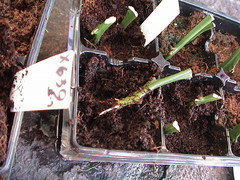
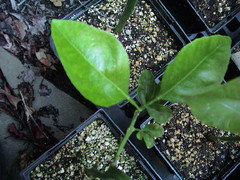
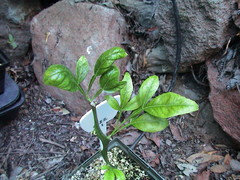
    Here are some updates on my rootings. I've used multiple auxins and soils and environments and am not getting much of any trend.... other than budstick in soil with warmth... and luck! I'll post process summaries in the future. Volk roots very easily btw.

    Kinkoji:

    x639 - rather cranky - small root - rooted May 2018:


    Here is another x639, this one rooted March 2018:


    And lastly, C22 rooted March 2018:


    ….now awaiting HLB resistant rootstocks to be released in CA by CCPP. Bring it on!

    - George

  • 7 years ago

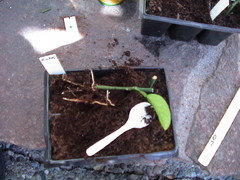
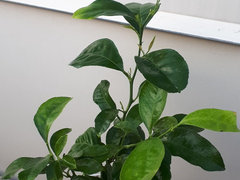
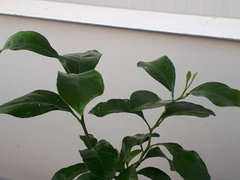
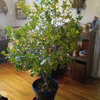
    Just a quick update on the Volkamer cuttings, that I mentioned on this post on April 15 of this year. Here they are: