Software
Houzz Logo Print
alabamaav

Armacost & Royston hybrids

8 years ago

The Magnificent Ten


Ever wondered what the original set of Saintpaulia looked like? I have and of course obtaining photographs even more difficult. However, here is a description of the originals, but no images, so use your visual imagination...


Blue Boy easy of propagation, generous flowering quality, quantity of bloom, depth of colour, flexibility for shipping – and this fine plant still holds that enviable position.


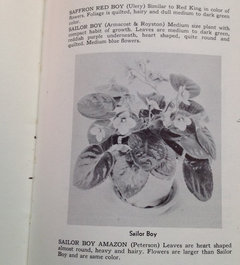
Sailor Boy particularly free-flowering with a bright sea blue blossom held well above a glossy green foliage is a very splendid African violet.


The English seed produced eight African violets that still hold their place among collections as among the best.


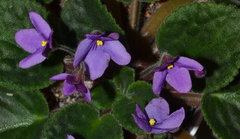
Admiral This plant has a tendency to grow flat. The leaves are a deep dull green, slightly quilted and cupped downward, ovate with slightly cordate (heart shaped) base and an almost smooth margin. Flowers are dark blue, slightly tinged with violet in clusters of from three to five produced very freely above the foliage.


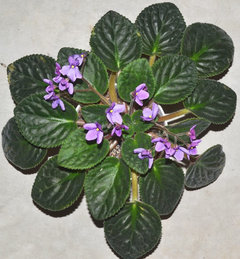
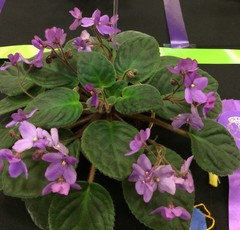
Amethyst The plant has an upright habit of growth. The leaves are medium green tinged with purple on back of leaf. The leaves are ovate, glossy, slightly quilted with toothed or dentate edge. The petioles are tinged with rose and extend to the length of 75 to 90mm. Flowers are large and bloom profusely in clusters of 6 to 8 standing well above the foliage. The top petals have a tendency to have a deeper shade.


Viking The plant has a compact, flat habit of growth. Leaves are dark green with a light streak up the centre. The underside of the leaf is a reddish purple, giving the leaf a deep rich colour. As leaves mature, they take on a glossy quilted appearance. Petioles are green flushed with purple and short forming a compact rosette. Flowers are a deep purple which many times show a slight marking around the lobes. These flowers are small but produced many flowers in clusters of from five to seven on many flower stems.


Mermaid The plant is a compact rosette. The leaves are small round and a glossy medium green, quilted on 3 to 3 ½ petioles. Flowers are a light blue, a very good bloomer. Doubt about this plant belonging to the Armacost and Royston collection has now been cleared up and though it did not appear in previous articles it was introduced by the aforesaid firm.


Norseman produced large then average blooms. Plant has a droopy compact method of growth. Leaves are ovate with almost smooth edges, acute tip and rounded bases. Leaves have a velvet appearance, glossy with quilted, overlaid with hairiness. The plant has a tendency to colour on the underside. Flowers are round clustered in 6-7 on average petioles. The flowers are the nearest true blue in a medium shade of any African violet. This plant is a very heavy bloomer and a prize in any collection.


Neptune This plant has a flat growing habit. Leaves are egg shaped, quilted and shiny; cupping upward and often very spooned. The flushing on the underside of the leaves and petioles is very deep making interesting contrast to the rich green colouring on the surface of the leaf. Flowers are medium purple. Neptune is a very distinct variety and a heavy bloomer as well.


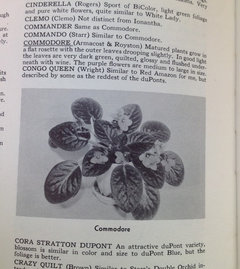
Commodore Mature plant is very large with a drooping affect. The leaves are 90mm to 95mm long and 70mm wide cupped downward. Leaves are dark green and purple beneath, quilted with darker valleys. Flowers are a rich reddish purple appearing above the foliage on short petioles in clusters of from 6 to 8. This plant is not a prolific bloomer but the richness of foliage and deep velvet blossoms makes it standout in every collection.


№ 32 A plain name for in some observer’s opinions it exceeds the others in qualities of perfection. The plant is perfect in form, mature leaves growing flat with new leaves having a tendency to stand erect. The young leaves are quite cupped and very red on the underside making a very attractive contrast to the deep rich olive green. The leaves are ovate, slightly dentate (serrated edge), always cupped with veining very definite. Flowers are orchid violet with the same round blossom appearing just above the foliage on short flower stems in clusters of 6 to 7.


https://www.waavsinc.com/the-magnificient-ten.html

Comments (15)

  • 8 years ago
    last modified: 8 years ago

    These descriptions appear to be based on an article written by Clarissa Harris of Los Angeles in the African Violet Magazine in June of 1953.

  • 8 years ago

    Would be nice to see some pics on these sometime.

    alabamaav thanked dviolet1
  • 8 years ago

    Fun! I remember reading that one of the early hybridizers who patented his breeds simply called them number xx. Indeed, that seemed very scientific. To his surprise, people wanted actual friendly-sounding names. That was a commercial move on his part that caught on. Well, think of the name of the classic perfume, Chanel No. 5. Joanne

    alabamaav thanked fortyseven_gw
  • 8 years ago

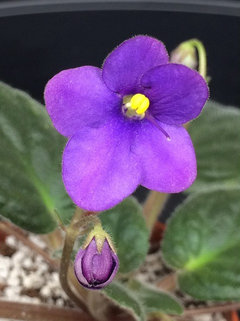
    This is a picture of Amethyst:


    alabamaav thanked cooks
  • 8 years ago

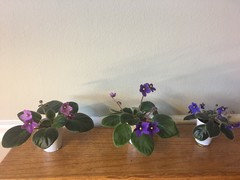
    Left to right: Amethyst, Blue Boy, and Norseman. These are all small starts from leaves I put down in November. I also have No 32 and Admiral, but I'm still after the others.

    alabamaav thanked snappyguy
  • 8 years ago

    Nice collection. Those are pretty good starter plants from leaves that were put down in just November. For me it takes at least a year till they become that big from the time I put the leaves in the soil. Blooms take another 3 months or more.

    I am impressed!

    Cooks

    alabamaav thanked cooks
  • 8 years ago

    Amethyst at the 2018 DAVS convention

  • 8 years ago

    Admiral close-up from my collection:

  • 8 years ago

    I am fortunate to own a booklet by Mary Margaret Odom entitled African Violets and Their Family. Within are pictures and descriptions of the Original Ten, except for no Mermaid photo. The author states that all Original Ten photos and descriptions were approved as correct by Walter Armacost. Sadly, I fear these two may have been lost to time.

    alabamaav thanked terrilou
  • 8 years ago

    I could google this I guess but would rather ask here -- Does the 'original set' mean that all other violets are hybrids derived from those 10 violets? What does the firm of Armacost & Royston have to do with the Magnificent 10? Were they just collectors or hybridizers, too?


    alabamaav thanked dviolet1
  • 8 years ago

    Yes, it is my understanding that most all of our African violets originate from these first ten hybrids. African violet hybrids were developed in Europe but they were only used for seed. In those days, early 1900's, if you wished to grow an African violet, you obtained seed. No plants, no cuttings. Walter Armacost visited firms in Germany and England while scouting for new orchids. He liked the violet plants he saw & thought they would make good houseplants in the US. So, he came home with seeds from these early hybrids, planted them at the A & R firm in California. About a thousand seeds resulted from which 100 were selected for final testing and from those, 10 were chosen as superior and thus we have the Original 10; they were released to the public about 1936. The main greenhouse manager, (would have to look up his name,) was given the honor of choosing and naming his "pick of the litter," for all his efforts in raising and testing the plants. He chose his favorite and named it Blue Boy.

    Other growers obtained seeds from England and grew plants and later other species were introduced to develop trailers, but these Original 10 were the first in the U.S. to be named and distributed.

    Terri


    alabamaav thanked terrilou
  • 8 years ago

    That's so interesting Terri, kind of put this thread in a whole new light for me. Now I would love to see if all 10 colors photos could be found. Has to be easier to collect photos than it would be these plants -- I give you lots of credit, @Snappyguy, for trying!

    alabamaav thanked dviolet1
  • 8 years ago

    Thank you Terri for the excellent photos and informative analysis! I enjoy reading about African Violet history and thinking about what varieties were grown in the early years. Moreover, have you noticed some species hold their flowers better than others? It seems S. confusa does not drop flowers much even when they start wilting and S. orbicularis (light blue clone) drops its flowers readily.

    Dviolet, some hybridizers have used other Saintpaulia species in their crosses. Jeff Smith's Yesterday series come to mind. Also it is suspected that the late Jimmy Dates used species (S. Velutina perhaps) to produce some of his unique hybrids. Additionally, George McDonald used species in some of his crosses. There may be others of which I am not aware.

  • 8 years ago

    Great information! Thanks! Rosie

    alabamaav thanked Rosie1949
0