Software
Houzz Logo Print
javiwa

Milkweed (?) ID from seeds & dried stalk?

8 years ago
last modified: 8 years ago
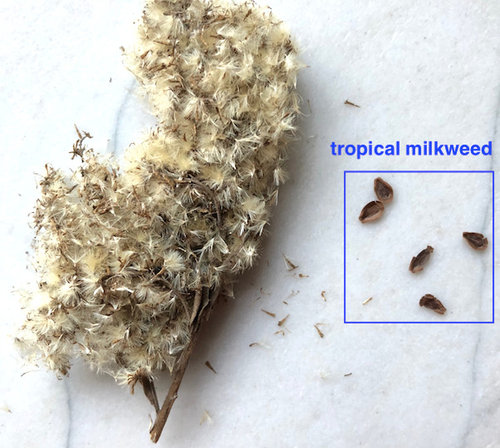
I visited my son in Austin,TX in January, and noticed a dead plant in the corner of his driveway (rental house w/ three other roommates, so who knows if this was intentionally planted or a volunteer). It looked awfully 'milkweed-ish', so I snapped off the top stalk and rolled it all up into a paper towel -- pretty much forgot about it until now. I've got tropical and incarnata MW seedlings sprouted right now, and I'd love to know if I have a third variety.

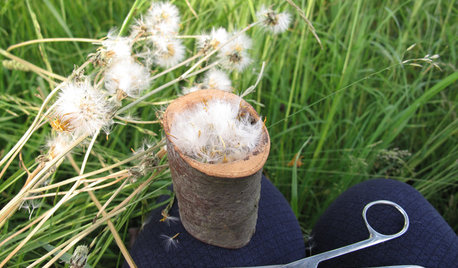
First pic has tropical MW seeds for size reference. That piece shown is ~ 4", if I uncurl the very top:

The whole thing's very brittle and fluffy -- at the merest touch, I've got fluff and frass all over.

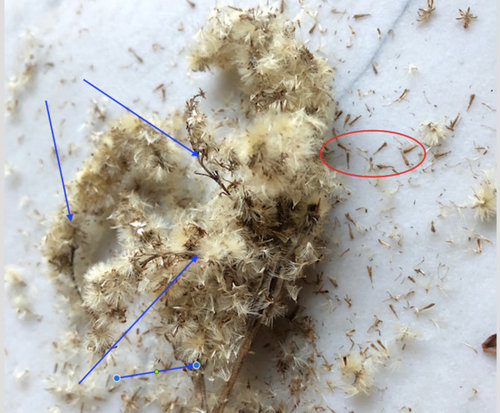
Here's a closeup. What I snapped off is basically the top of the plant, with several arching branches of what once were flowers -- and the very top seems to be the final arched branch. Blue arrows point to side branches. Circled in red are maybe seeds...?

Can anyone tell me if this is a milkweed (and, if so, what variety?)? I can Google from there.

If this helps, the plant is situated on the north side of the house; watering is likely very hit or miss (mostly miss, I'd guess). My son just checked and reported that the plant has come back from the freezes! No flowers yet, but he says the leaves are slender and pointy, very much resembling either tropical or tuberosa MW. (He doesn't have a camera, so no pics...and the plants not blooming yet, either.)

Thanks for any help with this.

Comments (14)

  • 8 years ago

    I'll go ahead and post this on the Texas Gardening forum. If anyone has input, please provide it there, with my sincere thanks.

  • 8 years ago

    Maybe an aster of some sort? Doesn't look like any milkweed I know of. Could be goldenrod?

    Martha

    javiwa thanked docmom_gw
  • 8 years ago
    last modified: 8 years ago
    Interesting, oksandy48 -- someone on the TX forum also mentioned ironweed. However, ironweed flowers seem to cluster at the ends of stalks and aren't feather-like.

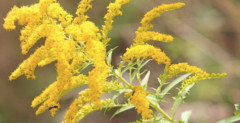
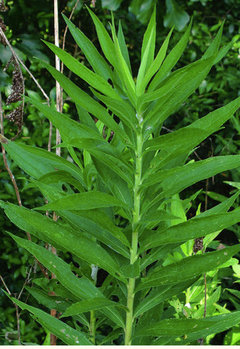
    Likely not an aster, Martha, from the pictures I saw. Asters tend to be bushy, and this my plant (IIRC) was tall and slender/stalky. Goldenrod is very likely! The flower plumage has the right shape (at least this TX variety), and I can see how the leaves resemble a MW's:

    Disheartening is coming across words/phrases such as 'invasive' and 'keep this out of your garden'. I'd really hoped I could add another type of milkweed to my butterfly garden arsenal. :)

    Thanks again....at least when the plant blooms, my son can report back.

  • 8 years ago

    These are definitely goldenrod

    javiwa thanked Stephen Powell
  • 8 years ago
    last modified: 8 years ago

    Thanks for confirming, Stephen. I'd half expected sprouts all over my yard when the tiny seeds blew about, but haven't seen any signs. And as easily as these grow, from my reading, I found it odd (but gratefully so!) that the tray of seeds I tried germinating showed no signs of life after a couple of weeks.

    I've got plenty of milkweed and pollinators in my garden now to keep me (and the butterflies and bees) plenty happy for this summer.

  • 8 years ago
    last modified: 8 years ago

    Not to look providence in the mouth (free plants), but the best bet on milkweeds is to purchase them (either plants or seeds (if you are good at seed propagation, because milkweeds require a few specialized techniques, as a general rule)).

    javiwa thanked dbarron
  • 8 years ago

    Thanks for your input, dbarron. A couple of very generous GWers were giving away seeds (curassavica and incarnata) a couple of years ago, so those have gotten a good start. (That said, I was raising 19 monarch caterpillars earlier this spring and couldn't keep up with their appetite -- ended up having to purchase four more curassavica's at the local nursery, and found taking cuttings from those is much easier/faster than starting from seed.)

    I did recently purchase A. speciosa and A. syriaca seeds online for a terrific price, and have read these two varieties require cold stratification. If I can't stop my impatient ol' self, I'll toss a few into the fridge (moist paper towel in baggie method) for a few weeks and see if I can't germinate some for later this summer. My biggest challenge may be discerning between the two types of seeds.

  • 8 years ago

    I've had generally bad luck with the transition from a growing season old milkweed (ie germinated in spring and grown well in a pot), to planting in early/mid fall in the garden. Generally those species require more like 90 days stratification, which is why I usually winter sow and let Nature do the stratification.

    A thing of note is many/most milkweeds are tap rooted and resent disturbance to the point of death, especially if you break the taproot when transplanting. Thus I transplant at the earliest possible opportunity (at the appearance of the first true leaves) and the plants have almost all transplanted well. However, delicateness of touch and deftness of replanting tiny seedlings is a mastered art. That being said, I still lost scads of speciosa, perennis, and variegata when transplanting to the ground in Sept/Oct. I don't know if it was abrupt cold snap (we had that) or too much moisture in winter.

    javiwa thanked dbarron
  • 8 years ago

    Do you find the speciosa grows okay in the South, dbarron? (I'm just outside of Houston.) I tried putting the incarnata seeds through a two- to three-month cold stratification for two springs, and none germinated. This spring, I got frustrated and just tossed a few into yogurt cups, then set them outside. They sprouted....the unpredictability that is Mother Nature!

  • 8 years ago

    I personally haven't seen speciosa in the wild south of NW Arkansas, but I think that's because as things get hot and humid it gets going, it's more of a western native...and we're on the eastern fringe of it's range....that may make it a challenge.

    Syriaca on the other hand seems to be everywhere, but I can't get it to grow to save my life. My current yard is swamplike in late winter/spring and then possibly habitable by milkweeds other than incarnata (which I have) the rest of the time. So...I have tried to play tricks and plant milkweeds where it's drier, but no far no luck here.

    At my previous residence in Oklahoma, I had purpurascens, tuberosa, incarnata (6 - 7 foot in pond verge under some river birch), asperula, quadrifolia, and viridis. And I've seen most of them thrive in what was a sandy but quite wet soil (exuding bubbling water in spring/early summer). I think the key was it was dry in winter.

    javiwa thanked dbarron
  • 8 years ago

    Sheesh...I may have to start a spreadsheet for my milkweeds. ;)

  • 8 years ago

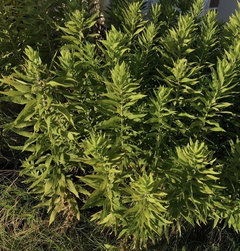
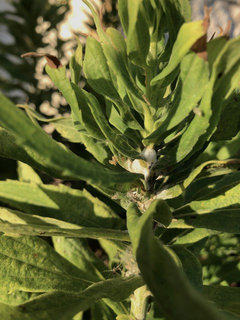
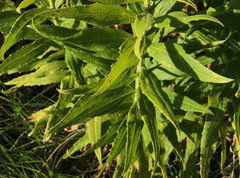
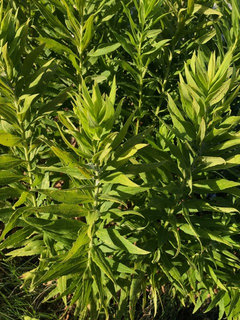
    Made a trip to Austin this weekend and was able to snap a few quick picks (sorry, short on time and it was blisteringly hot/sunny when I took these). Oddly, by mid-June none of these is blooming at all. They're bushy and stand about 2-1/2' tall:

    Are we still thinking goldenrod? Just idle curiosity at this point.

  • 8 years ago

    Definitely goldenrod

    javiwa thanked Stephen Powell
Sponsored