Software
Houzz Logo Print
caleb_lau20

How to select citrus trees at the nursery

8 years ago

I’m in the market for some new citrus trees and have noticed that the trees I’ve been seeing in nurseries come in different shapes and sizes, some with oddly unbalanced or lanky limbs; others seem really short and stumpy, etc. It’s been difficult for me to find what I think to be a well shaped and balanced tree straight from the nursery. Is this normal?


Additionally, what are some tips or suggestions on what to look for when selecting the best specimens at nurseries for container citrus (other than healthy leaves, disease/pest free, etc).


For example, what is the effect of different rootstocks in a containerized environment (standard vs semi-dwarf vs true dwarf rootstocks)?


How does the initial tree shape at the nursery effect the mature tree shape (tall central leader vs short with low branching)? How much does this matter?


5g vs 15g, is the larger starting size worth the head start?


When is the best time of year to have the best selection of trees available at nurseries? Is my difficulty finding well shaped trees because all the well shaped ones have already been picked out by others?


Any other suggestions?


Thanks!


(FYI...I'm in Southern California, Zone 10a)

Comments (15)

  • 8 years ago

    Citrus trees at the store rarely look nice. There is no such thing as a dwarf citrus tree in the united states. They are just labeled as dwarf to get them sold. You can buy dwarfs in New Zealand.

    Check ot these rootstock stats


  • 8 years ago

    I can't speak for California, though here in Louisiana retail garden centers typically receive citrus trees in the early spring (Feb - March), and when the sell out they are gone for the year. This is also the best time to plant Citrus in ground where I live (on the 8b/9a line) so they can get as much growth as possible before chance of freezing weather the following winter.

    As to what I look for, the first thing is the graft union, a poorly formed graft union is a death sentence to a citrus tree, the only question is when. Beyond that I want the graft union to be relatively low, a high graft union means more root stock visible with more potential for root stock shoots to form. I also try to avoid trees that bifurcate too near the graft union.


    In general I don't worry about lanky limbs on citrus, many varieties of young citrus are prone to long lanky limbs growing in all directions, they generally grow out of it without need to prune. I feel one should only prune citrus as a last resort when the limbs may droop to the ground, etc.


    Of course avoid trees which may be root bound, and watch out for ones in black pots at the edge of rows in full sun where the pots may have been over heated on one side killing those roots.

  • 8 years ago

    When I go shopping, I first look at the graft to see how straight the attached trunk is and how it will form as it matures. Then I look at symmetry and fullness. How many branches there are to set the foundation for future growth. For me, having at least 3 evenly spaced, facing upward branches is ideal, but hard to find. Of course having new growth sprouting is a plus because that tells me the tree is healthy. I pull out every tree of the variety I am interested in and compare each and every one against the other. If your heart is set on a citrus, all you can do is go through the group and find the best you can. They will all grow. When you mail order, you have no choice with what you get.

    This year our citrus trees came early in our area which was the beginning of March. Usually they arrive around Mother's day when the weather has warmed up.

    If I had a choice between a 5 gallon vs. a 15 gallon, I would go with the 5. Sure the larger one would look nice and produce more fruit right away, but there is always the possibility of the tree going into shock when planting. The smaller one will adapt easier and spread its roots further into the ground and catch up to the 15 gallon in a few years. Of course, cost of the trees is a big factor for me and I cannot see paying $100 for a large tree.

    If you purchase a standard tree, you can count on root pruning or repotting at least every 2 years. That is my experience with the trees I have purchased at my local Lowes which carry the Saxon, Becnel & Sons trees. Now the trees purchased at my local Home Depot have been the opposite. They carry standard trees by Record Buck Farms. I do not know of any nursery other than Four Winds Growers offering semi dwarf trees. I just recently found out they converted from dwarf to semi dwarf rootstock because all my tags are showing since last September and confirmed it with the nursery this week. How they grow compared to trees I purchased from them in the past is a wait and see.


  • 8 years ago

    Thanks for all the great tips everyone! Evdesert, your trees look great and the pictures really help me to get a better idea of the growth rate of the trees. I'm located in San Diego and while I'd love to plant in the ground, I currently only have access to limited patio space. I'd like to grow in pots so that if/when I move in the future, I can bring my trees with me.

    Some additional questions to keep the discussion going:

    1. How do you guys know what specific rootstock your trees are grown on? The tags I've seen at the nurseries don't typically mention anything more than "dwarf", "semi-dwarf", or "standard".

    2. Do you guys do any pruning on nursery trees to improve shape early on? Or do you wait for it to grow a couple seasons and settle in before pruning/training?

    3. I currently have 2 semi-dwarf mandarin trees with low lateral scaffolding branching (~6" from soil line) and no central leader. How will this affect the mature shape of the tree, especially if the different lateral branches are growing in different directions (e.g. one looks good and is growing out and up, while another is just growing out and drooping)? Any tips?


    Thanks!

  • 8 years ago

    Look for the nursery tag (commonly yellow; a band at the base of the tree); it should name the date and rootstock. If you get trees with the same date and rootstock from the same nursery, they will likely be genetically identical; so whatever they look like now, they will soon enough look the same.

  • 8 years ago

    John Could you show us a tag that goes out with one of your trees so we know how to read it.

  • 8 years ago

    Around here few if any retail nursery tags show root stock, so in the past I have emailed the grower (found on the tag), and inquired about type of root stock they use. This has worked most of the time on citrus, though on one occasion it was inconclusive as they were in the process of transitioning from one root stock to another, both closely related and very similar in traits. Another potential way of narrowing it down is to let one of the rootstock shoots grow out enough to form leaves, the shape of the leaves can often narrow down the type of root stock used.


    I don't grow container citrus, so can't comment on that side of things, but for in ground citrus I strongly believe in NEVER PRUNE CITRUS unless you are forced to (limbs drooping to the ground). Citrus is not a deciduous fruit tree, so the common pruning rules for deciduous trees does not apply (vase shape, modified central leader, etc.) Pruning citrus will often encourage even more vegetative growth, often in directions you may not want, and may delay fruit development.

    Commercial citrus growers may shape hedge rows of citrus, this is done for easier picking access with ladders, etc, not for tree fruit support structure as is done with traditional pruning.

  • 8 years ago
    last modified: 8 years ago

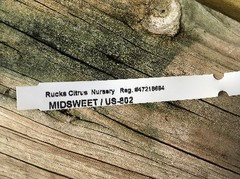
    Here is a typical tag, showing grower, variety (Midsweet), and rootstock (US-802)

  • 8 years ago


    Pixie mandarin planted 5/22/16 · More Info

    Some tags are bar codes on the side of the pot, like this.

  • 8 years ago
    last modified: 8 years ago

    Call me a cynic if you like; but I still prefer the tree tag; if for no other reason than at one location or another the original may have died and something else put into the pot. Beside that, when you transplant the tree you can still keep the tree tag... at least until the trunk outgrows it.

  • 8 years ago

    That’s funny John, I’m the opposite. I don’t trust the tree tags hanging because I see them laying on the ground at the nurseries all the time. Who’s to say one of the employees doesn’t pick it up and just put it on a random tree just so it has a label. I’ve noticed lately that these pot bar codes have dates when they sell to places like HD on them.

  • 8 years ago

    If you’re a costco member it’s hard to pass up on the citrus they have right now for the price. I like the 5 gallon size since I don’t like digging. As been stated the 5g trees end up catching the bigger trees and saves you money. Just knock any fruit off the first year and let the tree concentrate on growth instead of fruit production.

  • 8 years ago

    Ev,

    That is a "T" date; when the trees are contracted to a wholesale buyer, it is the nursery's best estimate of when that tree will be ready to ship.