Software
Houzz Logo Print
homegirlnh

Critique my plan, please!

8 years ago
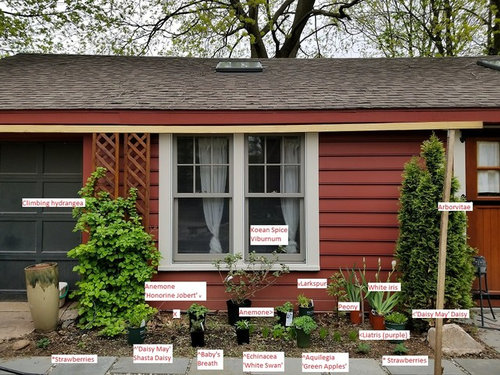
This is my first time ever planting a garden aside from a raised-bed veggie garden. This is new construction and I want to plant a small foundation garden by the path leading to the front door. The plot is about 15ft long and 4ft deep, sandy soil (I've added bagged garden soil, compost etc), and gets afternoon sun. (It faces west, and the sun comes sort of diagonally over the building--only the building's right side gets morning light.) I'm in Zone 7 by the water, so warmer? I'm adapting a moon garden planting plan that a local nursery was offering: Strawberries across the front and then the other plants behind. I did dabble with putting a couple things in last year and some are still there: The climbing hydrangea, bunch of purple liatris and a peony. I may relocate the liatris since it's purple, and I want to add white liatris and a white delphinium, approximately where I put an X. Do any more experienced gardeners see anything to worry about? This is my small space--I need a Monte Don!


Comments (7)

  • 8 years ago

    I'm not a garden designer or anything, but my concern is that you've got iris and peony right next to each other. Iris's spread like weeds and peony grows big and bushy. I'm looking at the comment above and see that the iris have completely obliterated the peony. Perhaps they would be better off at opposite ends of the garden. Leave room for the plants to grow. Maybe choose fewer plants for the smaller space.

    homegirlnh thanked Sue G
  • 8 years ago

    Oh my gosh, Doug, thank you so much for your rendition! It was exactly what I needed without even knowing it. I'm told the arborvitae won't do well where we planted them--not enough sun, apparently--so I will end up replacing them. I will use your suggestion. Sue, thank you so much for your comment, too: Exactly what I need to know. Maybe I clear out those liatris, move the irises over to the other side where I'd been planning to plant *more*, and call it a day. And I clearly need to replace the viburnum because it will get too tall in front of that window.

  • 8 years ago

    I wouldn't put anything edible right next to the sidewalk! Or at least I wouldn't EAT anything right next to a sidewalk!

    Dogs do like to their thing on plants right next to the sidewalk!

  • 8 years ago
    Lol! It's an internal garden, so no dogs, but good point!
  • 8 years ago

    When you plant the iris, make sure to think about which direction you want them to grow ... Bearded iris grow on a rhizome, so they'll move over time in the direction of the leaves (kind-of like leaving a tail behind them). You don't want to plant the leaf end right next to a wall or another plant, or they'll be crashing into whatever it is ... point the other end of the rhizome towards whatever you don't want them getting closer to.

  • 8 years ago

    Landscape design does best if the whole home and landscape are in the picture, so a photo or three panning across the front of the whole property from one side to the other would be helpful. For instance, it looks like you might have a patio to the right of the door? What is between the walk and the street?

    Others have critiqued the perennial spacing, so I will do so with the woody plants. You really need to do a to-scale plan so you can see that things are currently pie-in-the-sky as to sizes and spacing. Take graph paper (I use 1/4" graph paper and do 4 squares to a foot, but you can use what you want) and actually map out the plants with their mature size. A good place to look up sizes is the Missouri Botanical Garden PlantFinder, which will give you mature size as opposed to plant tags or nursery sites which often give 5 years for shrubs.

    The climbing hydrangea, once in place and settled in for a bit, in my garden grows several inches to a foot a year. It wants to be a 40' vine, and I have to prune mine at least once a year to keep it from outgrowing a 12' tall x 15' wide masonry wall. You really need to move yours because you can't reasonably expect to restrain it to a 2'x8' space and still see flowers and a healthy plant. If you have a large tree, it will happily grow up the trunk, or up masonry wall. If you don't have the space, give or sell it to someone who does because it will quickly overwhelm the relatively tiny space you have allotted it. Replace with a smaller summer blooming clematis.

    You really don't want something large right next to the door looming over visitors. Most Arborvitae/Thuja and Cryptomeria will be far too large for the space unless you find one of the dwarf varieties, and be sure to look up the mature size. I would place the peony there instead, since I try to keep plants near the doorway under waist high. The smallest Cryptomeria I found were 4'x4' and 12'x2', though I know virtually nothing about them.

    Likewise, my Korean Spice Viburnum/Viburnum Carlesii got to 7' in all directions which would cover half your window along with your walkway, and even the narrowest are 4' wide and tall which would fill your bed front to back. They have flowers with a lovely wafting scent and nice autumn foliage, so would be a great addition to your property if you have a larger spot for it, but unless you want a shrub to fill 1/4 of your planting bed, it is too large. IME, trying to keep a woody plant that wants to be large small via pruning is something of an exercise in futility. Timing has to be right so that flower buds aren't removed, and maintaining a pleasing shape in a plant that wants to regrow to its genetically predetermined size is an art that most folks don't have.

    If there are funds and space to move the front walk farther away from the building, you might try that. There are a very few flowering shrubs that can stay quite small such as some of the rhododendron and azalea cultivars or some of the really dwarf conifers, but in both cases you will need to do research and also find a way to keep the perennials from overwhelming the immature shrubs. If this were my space, I would most likely either enlarge the bed, or plant smaller shrubs by the house and perennials on the street side of the walkway, or choose one or the other for the current garden.