Software
Houzz Logo Print
bimbomstudios

underlayment for a floating cork floor?

8 years ago

A few specifics about this project:


- Space is total about 350-400 sq. ft (kitchen + bedroom, and small hallway in between)


- Total added height floor should not be more than 1"


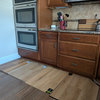
- existing floor is vinyl, and we don't want to glue on it. We rent the space, and although plan on being there for some time, we would rather not do anything irreversible.


- floor has a lot of imperfections and dips/bumps in many places. There are also some squeaky locations, though I don't think this is going to help much with that (have to live with it).


Main concerns for me are sound absorption qualities as we have a little recording studio setup in the bedroom, and for the wife, comfort. She does not like walking on a cold floor. I am also selling her on the idea of a natural floor.


I am by no means very knowledgable about flooring, but after some research it seems that this project is possible without having to glue anything to the existing floor. I have found possible underlayments which all look like possible options:


1. https://www.amazon.com/Roberts-70-193-Underlayment-360-Feet-Absorbing/dp/B008N6Q7HI/

(good for patching uneven spots in the flooring?)


2. https://www.amazon.com/exec/obidos/ASIN/B004FS40TK/ezvid02-20

(highest IIC and STC rating)


3. Cork underlayment, eg. https://www.amazon.com/QEP-72003Q-4-Inch-25-Foot-Underlayment/dp/B007OSICIS/

(most natural?)


If anyone has done this before in this manner, we'd be grateful to know your advice on the process and results. Or if anyone has used these particular underlayments, also curious on the differences.


Thanks very much!


Tyler


Comments (9)

  • 8 years ago
    last modified: 8 years ago

    Has anyone here does this before?

  • 8 years ago

    Hi Tyler. I used to sell cork flooring. The most useful product under cork is more cork. I would suggest 1/4" underlayment for more sound absorption. Assuming that you are purchasing your cork floating floor from a reputable cork supplier, you can purchase the 1/4" cork at the same time.

    The Roberts is of little use as too the UltraSeal. The STC/IIC ratings are of little value as the company would have tested using an 8" - 10" concrete slab + a drop down acoustic ceiling underneath. These thin 'foam' like products 'look great' in the advertisement but the reality is they aren't much value for what you are trying to achieve.

    Try looking at www.icorkfloor.com for their cork floating flooring and cork underlayment. You might be surprised at what you find.

  • 8 years ago

    @SJ McCarthy thanks for the tip. Yes I was suspicious about those STC/IIC ratings given such a thin material. I'm not a fanatic about the sound factor, but I would like to get as much benefit from the cork as possible.


    The site you linked looks promising, and seems comparable in prices to some of the others I've looked at. On their floating cork some of them say integrated 1mm cork underlay, some 3mm. In either case, is it still necessary to buy separate underlayment to go under the floating cork tiles (which have their own integrated underlayment?)


  • 8 years ago

    @Tyler G - all cork floating floors have an integrated underlayment. The thickness will vary between price points but they all have them. The issue is the wonky subfloor. That's your biggest issue. To reduce the effects of this problem, you would want to use the 1/4" cork to get rid of *SOME of the issue. You will still have some movement in the floor (a snick of bounce when you walk over a low spot) but not as bad as when laying a floor straight over top.

    To get the most benefit out of your situation, the cork floating floor + 1/4" underlay will offer the "most for the least". That is to say the most comfort/acoustics/price advantage/longevity for the least amount of work/disturbance to your rented home.

    You can't do the work on the subfloor that is needed (it really is needed if you want the floor to live 20+ years). So you have to do as much as possible to reduce the effects of the wonky subfloor. And that means investing in a decent, rigid underlayment like cork. Even though the cork sheets are flexible, the cork itself is rather rigid. It doesn't "squish" down very much (it is actually rated for porcelain tile installation). That means it will even out the wonky subfloor - just enough to get you a cork floor that should live 15 years or so.

    Please remember to use transition strips at all doorways. This is another way to ensure your floor will get you more than a decade worth of life.

    Tyler G thanked SJ McCarthy
  • 8 years ago

    thanks SJ this was very informative. I will look for 1/4" cork underlay. It does make sense that it would even some imperfections in the floor better than a thin piece of foam.


    As for the flooring, I'm looking around and ordering samples to see what fits best in the apartment. I doubt I'll be able to get the landlord to contribute any $ toward it, so I'm trying to keep it moderately priced.

    I think I can do ~ 300 sq.ft for ~ $1000 – it seems there are a lot of vendors offering cork < $4 /sq. ft.


  • 8 years ago

    Unfinished means "raw". Technically you can FIND this (Globus cork makes unfinished cork floating flooring) but you will pay through the NOSE to get them. I mean $10-$12/sf for a 'raw' cork floating floor plank.

    They will be IMPOSSIBLE to keep clean. They will slowly turn blackish-purple. They will stain EASILY, etc. Raw cork is WORSE than raw hardwood. The staining is STRONG (dirt turns purply-black inside of 2 years). You cannot mop them. You cannot sweep up anything. It will begin to CRUMBLE inside of 5 years. It would be a complete waste of time and HUGE amounts of money.

    You can choose a finish that is more appealing in a tactile way. The super glossy finishes (like acrylic) will feel like it is covered in suran wrap. The super THICK finishes like vinyl-coated cork floors from Wicander's will feel like you are walking on vinyl. The traditional finish for cork is polyurethane - which can be refreshed every 5-10 years.

    The iCork floor products can be refreshed using the Loba 2K Supra AT. The finish is a lovely velvety feel that really brings back the feeling of "cork" to the floor. At the same time the Loba 2K Supra AT ADDS to the wear/longevity of the finish and provides extensive scratch resistance. Only Aluminum Oxide is more scratch resistant....but AO will eventually crack/haze over cork.

  • 8 years ago

    SJ thanks for this info – I can see why raw cork would be a problem. I will take a look at the Loba finish you mentioned - I see it comes from matte to glossy. Is it possible to use this on raw cork in a floating installation?


    The only floating tiles I see have HDF in the middle, and I can't help but think that 100% cork would be much softer, although without the interlock system to connect tiles. Is it not possible to glue tiles in this way together at the edges, without glueing the bottom to floor?


  • 8 years ago

    @Tyler G - I'm sorry but in a rental with existing vinyl there is only one form of cork = floating. There is NO WAY to glue the edges together AND have it safe to walk on. Or safe from ripping apart the first time you stop suddenly to turn around. No way in hades.

    Again, raw cork floating flooring = SUPER expensive. The iCork flooring is 1/4 the price of the raw cork from Globus and it allows the Loba 2K Supra AT as a finish. Win-win.

    Try not to reinvent the wheel for a rental unit. Go ahead and click together a nice cork floor, add some finish if you wish/need/it is allowed and live your life.

    Working with raw cork - of any sort - is EXTREMELY high end. Think $15M mansion anywhere in the world. Only top-end projects use raw cork that is stained and sealed on site.

    As you've stated, you don't want to pour a whole bunch of money into someone else's space. That means raw cork is out. And raw glue down cork is out. A cork floating floor is your choice.

    Actually a floating floor of ANY sort is your choice. That's all you get to play with in a rental with existing vinyl.

    Try not to swim against the current of life. The easiest way to ride the river is to drift with the current. It is SOOOOO much easier than fighting with every breath to move 1 inch up stream.

    Tyler G thanked SJ McCarthy