Software
Houzz Logo Print
gardengal48

Odd looking new growth on wild rhodies

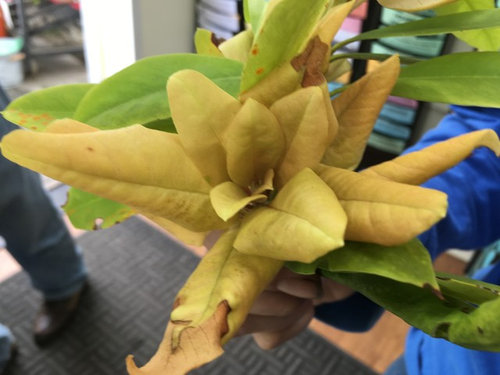
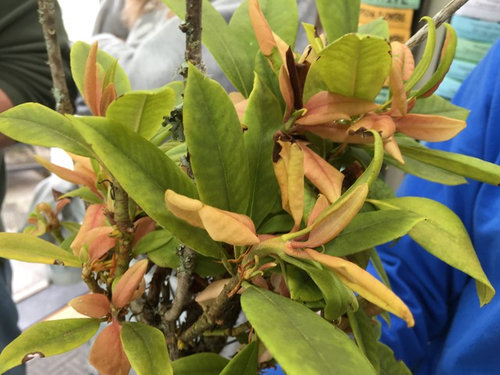
Was off on a garden consult yesterday when I encountered a grouping of wild, native rhodies (R. macrophylla) that were exhibiting some unusually colored new growth. Rather than the bright chartreuse green of typical new growth, these were producing random clusters of a pale tannish-pink color. These are growing in the woods in their natural, native habitat.......no chance of any herbicides or other chemicals affecting them. Also growing surrounded by their typical companion plants, salal and evergreen huckleberries.

I have been consulting as a horticulturist in the area for many years and have never before encountered this unusual growth and I have no idea what I am seeing. Also asked of another professional horty who worked for years at a specialty rhododendron nursery and she too had never encountered this. akamaine, David, Mike....anyone seen anything like this and know what it is?? Would love to get back to my client with some idea of what is going on.

Second shot is of a witch's broom from a neighboring plant, again with that strange yellow-pink coloration.

Hope someone can shed some light on this!!

Comments (11)

  • 8 years ago

    What has the rainfall pattern been like in the area recently? Probably a less than helpful observation, but the color is quite reminiscent of what can happen when new growth is subject to a rapid fluctuation of moisture levels. Never seen it in plants in the ground, but happens pretty commonly in potted rhododendrons not given careful watering. My experience with r. macrophylla is non-existent, but it is intriguing that the oddly colored leaves and (a single?) witch's broom have occurred in the same general area. Mutations in both cases?

    gardengal48 (PNW Z8/9) thanked akamainegrower
  • 8 years ago

    Thanks for the response, guys :-)

    For additional background information, this appeared on a rural property in an area of large properties (most 3+ acres) and each bordered from its neighbors with a 25-40' wide strip of natural vegetation. And with large chunks of mostly undisturbed forest surrounding. Lots of these native rhodies around, growing naturally (completely untended) in the wooded areas. A very common situation in this area.

    Nothing very out of the ordinary wrt to weather or rainfall. Typically very dry but cool summers and moderately wet winter and spring. Rainfall has been pretty average.

    I only saw this growth on two plants in the same general area but at some distance from each other. And they were fighting their way through the dense growth of salal and evergreen hucks. But so are all the rest of the rhodies in the area. Plant health overall looked reasonable - not pristine but nothing overwhelming. A few showing some leaf spot and now and again some rust pustules And with a bit of leaf spot on the salal and rust on the hucks....also extremely common. There were other rhodies in the same area that were unblemished.

    We were standing on a deck overlooking this wooded area when I saw this discoloration as it was only on the newest, uppermost growth and really stood out due to the color. My clients are new to this home within the last year and have not used any chemicals anywhere (18 month old daughter and like many PNW'ers, very organic in their approach to gardening).

    Without any more ideas on what this might be, I guess we will just wait to see what happens to this odd colored new growth as the season progresses. It was very random on the plants, only appearing in a couple of places. Plants were maybe 10-15 feet tall, variable spread, so quite well established and mature. Other new growth was the typical bright grassy green color you can see in the photos.

    I hate it when I can't provide an answer!!

  • 8 years ago

    I've never seen it either. I've hiked quite abit in the Olympics especially on the NE and east side and never saw anything like that. I used to drive Bon Jon Pass which goes right through where the rhodies grow the best. It's a logging main haul road that starts at Quilcene and goes all the way to Discovery Bay. In areas that have been logged R. macrophyllum is almost a solid canopy in places.


    gardengal48 (PNW Z8/9) thanked Mike McGarvey
  • 8 years ago

    Mike, since you are local and familiar with the area, this is on the opposite side of the Canal from your hiking spot, the Bangor/Silverdale/Seabeck area. So very similar growing conditions, climate and companions, including many native dogwoods and madrones.

    All the additional research I have done has turned up nothing so far......... :-(

  • 8 years ago
    last modified: 8 years ago

    I have no idea if it is the same effect, but your post reminds me of something that is happening on one of my Rhodies. After a transplant, certain leaves are turning all brown. The brown rapidly consumes individual leaves but seems to not spread to the whole plant.

    It could be that you are discovering these plants after this process has worked its way through entire sections of leaves. Do any of the plants you found have individual leaves that are splotchy and have brown and green sections, like the ones in my photo? The ones in my photo will eventually be entirely brown like the ones in your photo and it appears to affect only adjacent leaves, as in your photo.

  • 8 years ago
    last modified: 8 years ago

    Gardengal, I wonder what the background count is in that area? ;-)

  • 8 years ago
    last modified: 8 years ago

    It's azalea leaf gall. Wild living Rhododendron macrophyllum in parts of Puget Sound often have it. I personally see it most on Whidbey Island for instance.

    On rhododendrons, leaves may be
    entirely or partially chlorotic (often bleached to a creamy off-white or pinkish color)
    and may be somewhat thickened. Partially affected leaves have a distinct line between
    the healthy green and the chlorotic tissue. A white fungal growth develops on the
    underside of the leaves. A rosette of affected leaves may occur at the ends of branches.
    Blossoms and seed pods can also be affected.

    http://cru.cahe.wsu.edu/CEPublications/eb1229/eb1229.pdf

  • 8 years ago

    @Embothrium that is a great resource. Thanks for the PDF.

    So the bottom line is to remove the affected leaves or it will spread?

  • 8 years ago
    last modified: 8 years ago

    They also mention fungicidal treatments:

    Remove and destroy affected leaves. Spray with registered fungicide just
    prior to bud break and repeat two or three weeks later

    I see these procedures more as attempted elimination or at least significant reduction rather than containment. Because when I see the condition it is often already affecting multiple individuals.

    Luckily it seems in this region at least to somehow be mostly peculiar to wild living coast rhododendrons rather than cultivated specimens of the same - or other - kinds.

    It does however occur also on evergreen azaleas in local cultivation, during which the more familiar crunchy galls are produced. And I have heard it said that material should not be collected from infested wild plants and then transported to where there are plantings.

    gardengal48 (PNW Z8/9) thanked Embothrium
  • 8 years ago

    Thanks for that bit of info, Embothrium. It would never have occurred to me that was azalea leaf gall - it looks very different from what I am used to (I have an inherited planting of evergreen azaleas that get a mild case every year)!! The leaves were not the slightest bit fleshy nor was there any sign of any obvious fungal development but otherwise, was exactly as described in that publication (which I have as well), including the witch's broom.

    In 10 years of encountering and dealing with populations of wild rhodies in Kitsap and on the peninsula, this is the first time I have seen it, so maybe not a hugely significant issue..........only two plants out of maybe 2-3 dozen on the subject property were affected. And I have never seen it on a cultivated variety. Plenty of other issues, but never that!

    Now I can get back to my client and let him know. The affected plants were in an area where he was cutting back rampant salal growth and clearing out blackberries to actually provide some 'breathing room' and definition for the rhodies, so maybe pruning out the affected portions and destroying is feasible.

Sponsored
Foremost Siding & Exterior Design Solutions in Columbus