Software
Houzz Logo Print
klyons_ga8a

Tarocco Blood Orange - Pruning Experiment

8 years ago
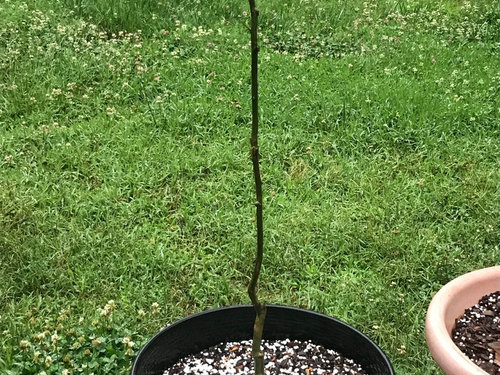
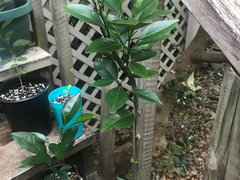
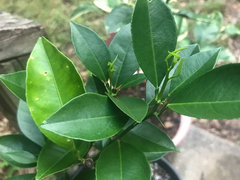
I received a Tarocco back on 5/3/18 (gift) that was covered in scale and white flies. After much deliberation, I decided to chop the canopy and removed the remaining scale from the trunk (and treated). I repotted and sat the tree in full sun. I figured that if it didn’t make it, it wouldn’t be a huge loss since my first inclination was to toss the tree anyway.


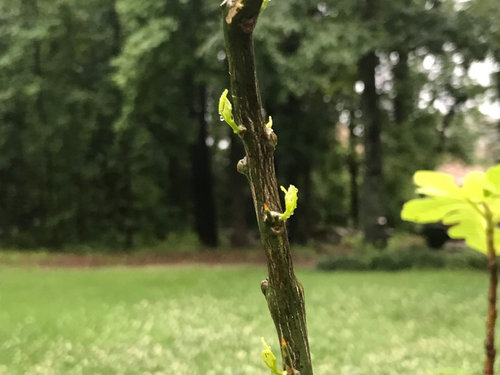
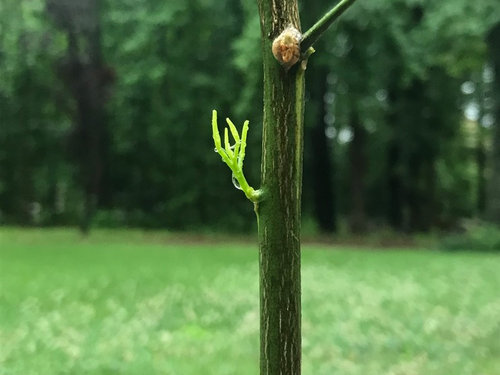
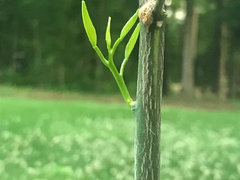
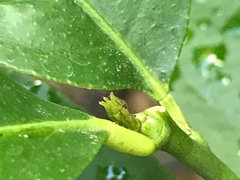
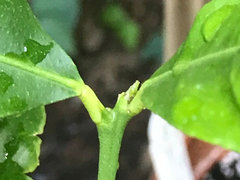
After only a few weeks, there is new growth along the entire trunk above the graft line and no sign of scale (I’m sure I will see them come winter). I’m hoping the tree will now have better branching than when it first arrived.


Comments (34)

  • 8 years ago

    Wow! So chopping off the entire canopy does not kill the tree, as I assumed it would. Kelley, thanks for posting.

    Kelley_GA8a thanked Vladimir (Zone 5b Massachusetts)
  • PRO
    8 years ago
    last modified: 8 years ago

    The bud sites on the main stem perform photosynthesis. The tree will rapidly regrow the canopy if the root mass was large before the chopping. Just be careful not to chop too close the the graft.

    Kelley_GA8a thanked Tropical Paradise
  • 8 years ago

    Thanks Vladimir! I was surprised that the leaves appeared so quickly! It seems as if everything with these tree is slow lol.

    Thanks for the info, Tropical! The root system was large and healthy. I’m glad it worked in my favor.

  • 8 years ago

    I suppose it’s no different than a tree dropping all of its leaves, except your tree is healthier to start out, so more capable of flushing. My ST is 4 weeks post barerooting and is just started to show signs of pushing new growth. Fingers crossed she makes a come back.

    Please post pictures of updates on this thread. I’m interested to see how it regrows in terms of shape and the timeframe. Monthly might be helpful or just whenever it flushes. Good luck.

    Kelley_GA8a thanked Alanna Migliacci
  • 8 years ago
    last modified: 8 years ago

    Alanna, I absolutely will. My Bearss Lemon has yet to put out any new growth after losing the newest growth when I bare rooted. It’s looking more stable, however. We had several hours of sun in between showers and the leaves/branches appear to be forming nicely thus far (Tarocco). I suspect by next week it will have fully formed stems and leaves. Good luck with your ST! Mine hasn’t done anything yet.

  • 8 years ago

    It’s been 4 weeks since I barerooted and transferred to 511. My Bearss Lemon has done nothing as well. It didn’t really look too traumatized after barerooting, just some droppiness. It’s about to drop a few leaves (turning yellow first) and there’s no signs of growth. My Shiranui dropped half its leaves with still more to go. Also no signs of new growth, but it looks less miserable. My ST dropped all its leaves and had some branch die back. I cut the branches a little, but left most of the original branching. Now, there’s a few tiny little buds about to pop out. I’m really hoping, she makes a comeback. The rest of mine looked unhappy after barerooting, but look normal now. Still no new growth and there still quite unstable in the pots. I didn’t except it to be such a long transition. I’m trying not to panick that I’m missing out on the growing season. Fortunately, it’s been very mild and rainy this May, so there’s not much to miss out on. Next time I bareroot, I’ll do things a little differently.

    Kelley_GA8a thanked Alanna Migliacci
  • 8 years ago
    last modified: 8 years ago

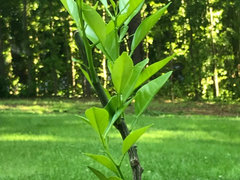
    I know it’s only been a few days, but here’s an update:

    Tropic, should I prune the leaves now or let them grow a bit first?

    Alanna, I spoke too soon. My ST is finally pushing out new growth:

  • 8 years ago

    citrus are amazingly resilient... good luck

    Kelley_GA8a thanked johnmerr
  • 8 years ago

    Leave them alone to grow till you you have a few mature leaves on each new branch. It looks good now. You do not have any dense cluster of new branches from close proximity. Citrus, in my limited experience, do not do that. In your case you may consider tip pruning if you like a bushier look with more branching. Lower branches strengthen the main stem and so you should let them grow. Upper branches will tend to grow faster and straight up. I will be inclined to tip prune them to make those branch. But at this point wait till you have some mature leaves. They are far too young now.

    Kelley_GA8a thanked tropicofcancer (6b SW-PA)
  • 8 years ago

    Leaves (and thorns) are getting bigger!

  • 8 years ago

    Ooohh it's looking so beautiful now Kelley! It'll be so pretty when it grows large enough to produce blood oranges for you! I've seen Silica mention in the past to keep the branches growing lower on the trunk even if you want to prune them for a more tree like form. As the branches grow, the girth of the entire trunk up to where the branch comes out will also increase/thicken. I love seeing photos of people's trees where the trunks are 1+ inches thick so I intend to do that if my trees want to grow some lower branches :)

    Kelley_GA8a thanked kvetchlambkin (nyc 7b)
  • 8 years ago

    Looking great Kelley! It looks like you now will have yourself a beautiful and healthy tree. I have pruned almost like that before and the tree has bounced back just fine. Pranab, thank you for the info. I had not thought of it that way before. My daughter has a bonsai that was in bad shape after winter and we hacked it back quite a bit a few weeks ago. It looks great now. I may let it go a little longer and then root prune it some. It was not hacked back completely though and it still has a nice canopy. Kelley, i wish i had hacked my tarocco a bit before it filled out. It was gangly and now remains that way but with fruit...perhaps next year.

    Kelley_GA8a thanked Laura LaRosa (7b)
  • 8 years ago
    last modified: 8 years ago

    Looking good Kelley - pretty much a textbook response. You can let a few more leaves to grow and then tip prune to get more branching. Citrus has alternate leaves so if you are pruning tips prune to a leaf that is facing outwards. Leave a little branch stub. The node will produce a branch facing outwards and you do it again if you feel like it. If you let the branch grow without pruning then the internode distance will keep increasing and so will the leaf size. That is each new leaf will be a tad bit bigger than the previous one and the internode distance will be too. It is up to you to decide what you like/want. Increase fertilizer as it produces more leaves.

    Kelley_GA8a thanked tropicofcancer (6b SW-PA)
  • 8 years ago

    Laura, what kind of plant (bonsai one) your daughter has? Stores usually sell ficus and they can take good amount of root and branch pruning. Recently acquired a dwarf hongkong kumquat and should soon have a micro dwarf finger lime - as you know my target is really bonsai. These are natural dwarfs and not grafted. The calamondin and the lemonquat you gave me (thanks again) should one day become nice bonsai. Right now they are busy making roots and not much else.

  • 8 years ago

    Pranab, I don’t know what it is, but it is not a ficus. I have a variegated ficus bonsai. I don’t want to hijack this thread so maybe I can send you a pic for ID? ;) it has tiny leaves and flowers...very pretty.

  • 8 years ago
    Laura, you guys feel free to continue on the bonsai topic - I’m interested as well :)
  • 8 years ago

    Just got back in town. Laura please feel free to send pic for ID. Since Kelley is interested too you can post it here also if you wish. I suspect from the description it may be a Snow Rose (Serissa family). They are quite pretty indeed.

    Besides the aesthetics aspects of bonsai, it is not different from container culture in many ways. As you may already know the word "bonsai" translates to "plant in a pot". In a way bonsai tries to take it to the extreme - to support the largest plant in the smallest pot. All the fussing with container soil, root pruning etc is basically aimed at that. Top pruning/shaping is aimed at aesthetics and balance.

  • 8 years ago

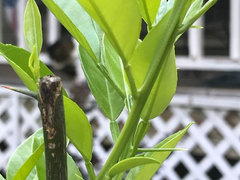
    Update:

  • 8 years ago

    Congrats Kelley! That looks great! :-D

    Kelley_GA8a thanked jenny_in_se_pa
  • 8 years ago

    Beautiful, Kelley!

    Kelley_GA8a thanked sunshine (zone 6a, Ontario,Canada)
  • 8 years ago
    last modified: 8 years ago

    It looks great! I wouldn't have the courage to completely cut off every leaf and limb on any tree. The fear of it going into shock or dying is what prevents me from doing it on my Owari because they need to have some filling in.

    Kelley_GA8a thanked Dee
  • 8 years ago

    Well don Kelley I did the same on a lime and Moro tree with the same results.

    Brian

    Kelley_GA8a thanked nulesm
  • 8 years ago

    Wow! I can’t believe how much growth you’ve had in less than 2 months. As long as the roots are healthy, it looks like the trees can withstand a whole lot

    Kelley_GA8a thanked Alanna Migliacci
  • 8 years ago

    Wow that's amazing! I went back to your first photo to get a refresher on how it first looked like. Forgot that it was just a leafless stick! You've done a great job nurturing the canopy back to life

    Kelley_GA8a thanked kvetchlambkin (nyc 7b)
  • 8 years ago

    Thank you for the kind words, everyone! Unfortunately, the scale came back >:(. I just gave it its second treatment this morning with neem. This tree seems to be an absolute pest magnet.

  • 8 years ago

    I used HO in the winter on my meyers and within days the scale dried up and fell off. You also have to make follow up treatments because the crawlers will be back soon and you cant see them with the naked eye. (I actually saw a few crawling out of a scale shell once, using a magnifying glass). Then once they make their shell its back to square one.

    I'm assuming crawlers can be killed without having to resort to HO or neem.

  • 8 years ago
    last modified: 8 years ago

    Kelley, Jaydub is right, do several treatments and you can get rid of the scale, I had to do 4 -5 treatments for my rescued lemon tree in the winter and spring, now the tree is free of scale.

  • 8 years ago

    Kelley - As another suggestion since I recently discovered ants on my Tango farming scale, is the oft-uttered statement from johnmerr about "controlling the ants". So after a couple alcohol wipes of the leaves and stems last week (it's generally been too hot and/or rainy to do HO), I was able to do a quick spray of FE (dries faster than HO in the evening), I added some pelleted ant control product and yesterday positioned some cotton balls soaked in borax/sugar solution around the surface of 3 of the citrus where I saw the ants (although the scale was only visible on the Tango). The hope is that by getting rid of the ants, that will help any future HO treatments to catch what was already brought to the trees (and eventually get all stages with multiple sprays) without having new ones redeposited and nurtured by ants. Because of the rain forecast for this week here, I will need to refresh the cotton balls a bit more often but that's fine.

    I know last year in spring, I had a terrible early infestation of aphids on my honeysuckle just as it was waking up and starting to bloom and I discovered a trail of ants all around and in that container. I sprayed with insecticidal soap first and once I started using the borax/sugar solution, it took a couple weeks and several refreshes of the cotton balls, but they were finally eradicated out of the honeysuckle's pot. And the next flush of honeysuckle growth and blooms were aphid-free. Hoping I can try the same with my milkweed (to reduce or eliminate oleander aphids.

  • 8 years ago
    last modified: 8 years ago

    Jenny: Borax is not good for the plants. Boron toxicity can quickly bring a plant down. Not to mention that fruits will absorb boron too and not much good for humans too. Put them near the pots but not on the soil.

    Boron is a micro nutrient but is needed in extremely small quantities. Most garden soil have it and sometimes tap water has enough for plants.

    Presence of ants is not always a good indicator of pests. They also search for nectar from flowers and ripe fruits. Plus they like to make their nests in the soil too - provides a perfect environment for their eggs especially if it is not highly compacted or soggy soil. Although I do not like them in my pots but I take it as an indication that the soil mix is pretty good. By Fall as it gets colder they leave the pots and go hibernate somewhere deep in the yard.

  • 8 years ago

    Looking really good, Kelley! Hope you get the scale under control. It seems a number of us have certain trees that are scale magnets. One of my ST lemons is that way and I ended up cutting the branches way back and it has been sprouting and pushing out some good growth . Luckily this tree had a good rootstock system.

  • 8 years ago

    tropicofcancer - I am a recently-retired chemist after 30+ years in the field. These little trees are not producing fruit at this time and borax is not boron. There is only a small amount of the actual element in the formulation which is in turn diluted in the sugar solution.

    As I noted in my post, I saw the trail of ants literally farming the scale on my Tango and their pathway has been along that tree and 2 adjacent pots. Once they take the solution back to their nest they will hopefully be goners. And since we have heavy rain forecast on and off the entire week, whatever is in the soil (including fertilizers too) will be completely washed out. Unfortunately I don't have a "deep yard". I have a patio that is 10ft deep by 17ft wide, with a somewhat centered 8ft x 9ft concrete slab bordered by a 3ft x 10ft long "strip" of soil on one side and a 5ft by 7ft "strip" of soil (truncated by a central air unit that is on a 3ft x 3ft slab) on the other.

    Ants were the cause of the aphids on my honeysuckle and milkweed last year and I plan to make sure that they stay away from those. I have seen occasional other types of foraging ants on my container plumeria and container peonies and they don't bother anything (and the peonies stay outside all year with the other temperates).

  • 8 years ago

    jenny: I am not sure what you mean by "borax is not boron". It is some form of sodium borate with about 11% boron content and water soluble. A single application may be a small amount and unlikely to cause any harm. Used frequently has the possibility to increase boron levels beyond tolerance. Citrus, figs, peaches, etc are particularly sensitive. In any case, my point is why take a chance when it is as effective when applied outside the pot. I use bottle caps as small containers of the bait and place them near the pots and they do not seem to have no trouble finding it.

  • 8 years ago

    jenny: I am not sure what you mean by "borax is not boron". It is some
    form of sodium borate with about 11% boron content and water soluble. A
    single application may be a small amount and unlikely to cause any harm.
    Used frequently has the possibility to increase boron levels beyond
    tolerance.

    This is not drenching the soil with it. It is few small cottonballs of a dilute solution placed near the ant trails against the pot edge and on the rim. Within a few weeks, bye bye ants. This is not an every day, all-summer long operation. We are getting rain on and off all this week (they are even calling for potential flash floods) so bottle caps or lids are going to get washed out and would lose their effectiveness, as well as get swamped by all the slugs I have here (the slugs have even crawled up the side of my bird bath and jumped in to take a swim... UGH), whereas some solution will remain in the cottonball, hopefully long enough for them to get the stuff back to the queen.

    I can't let them get established in the pots.

Sponsored
Peabody Landscape Group
Average rating: 3.5 out of 5 stars8 Reviews
Columbus' Reliable Landscape Design & Contracting