Software
Houzz Logo Print
kbeggs79

Tempered Low e window haze

8 years ago
last modified: 8 years ago

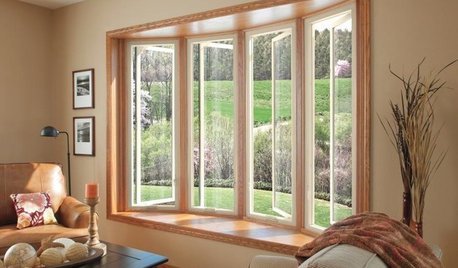
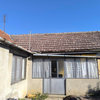
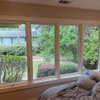
We recently moved into a view property that we are fixing up. The large picture windows in the living room had seals that had gone bad and were foggy and needed to be replaced. .... The picture right below is of the windows AFTER they had been replace. (I can't figure out how to move it out of the body of this post...sorry!)

We had a couple of companies come out and bid replacing the glass. We decided to go with low e, tempered glass with a gray tint as we have a western exposure and the sun pours into the house during the afternoons.

Right after installation, we noticed that the glass just didn't seem clear. In addition, when the sun hits the glass in the afternoons, it looks like there are "ghosts" in the windows. It's awful, worse than our old windows.

I contacted the company and the salesman said he would contact the manufacturer. The response he got from the manufacturer is that this is a common problem with low e glass and sent a PDF explaining why.

I have searched and searched and found very few mentions of any type of problem like this. I called other glass companies and they say they haven't heard of it. Even the salesman said he hadn't heard of it, nor had his boss.

He is now "offering" to replace the four large picture windows, but not the eight smaller windows, saying that he's "guessing" that it has to do with the tempering. So he'd replace it with tempered glass but not low e.

Does this make ANY sense to anyone in the industry? I'm at my wits end!

Thanks for any advice and suggestions!


Comments (5)

  • PRO
    8 years ago

    Umm...no. We install a whole mess of tempered and Low-e glass and I don't know of a single instance in which this happened. There can be "interference fringes" in the triple pane units, but I have never seen this in a double pane unit.

    kbeggs79 thanked Windows on Washington Ltd
  • 8 years ago
    last modified: 8 years ago

    Thank you! Here's the response we got from the manufacturer...along with a PDF that is well over 5 years old.

    Please see the attachment. This will explain why they are seeing the
    haze with in the IGU's. I just got off of the phone with my Sales
    manager and QC manager and there is nothing we can
    do to remove this. It's what happens to the glass once it is coated.
    The haziness goes away when the sunlight shifts and The awning is
    apparently the cause. This is all explained in the document. Call me if
    you have any other questions.

    (We do not have an awning)

    The following is the information contained in the PDF...

    Pilkington North America, Inc.
    811 Madison Avenue, Toledo, Ohio 43604-5684
    Telephone 800 221 0444 Fax 419 247 451
    Technical Bulletin
    ATS-137-4
    2013-01-15
    NEW IMPROVEMENTS IN THE APPEARANCE OF INSTALLED
    Pilkington Energy Advantage™ Low-E Glass
    Pilkington Energy Advantage™ is made of an extremely fine polycrystalline hard material that cannot be seen under most lighting and viewing conditions. It is possible to discern the presence of the coating under certain lighting conditions, such as when bright sunlight shines directly onto partly shaded, coated glass and there is deep shade on both sides of the glass.

    P a g e 2

    Using extreme lighting conditions for the reflected images of a typical window, the residual haze of the older (2010 and earlier) product can be seen in the left hand IG unit of the following photo. A studio spotlight simulates direct sunlight (with the same set-up as in the photo above), and eliminating (with black velvet) the distracting transmitted and reflected images of a typical window, the residual haze of the older (2010 and earlier) product can be
    seen in the left hand IG unit of the following photo. The IG unit on the right hand side of the original photo below barely shows the miniscule amount of haze that can be found in 2011 production of 2.5, 3.0 and 4.0 mm thick Pilkington Energy Advantage™.
    Pilkington Energy Advantage™ pyrolytic coatings are made by the chemical vapor deposition (CVD) process, creating a hard polycrystalline layer of tin oxide over color suppression underlayers. In an electron microscope picture, the polycrystalline structure of the surface of the tin oxide top coat can be seen as a layer of closely packed grains. Daylight can easily pass, with less than 1% scattering, through this coating because each grain is actually smaller than the wavelength of visible light.
    The illustration below shows the surface of the coating magnified 20,000 times.

    P a g e 3

    Fig.1. Typical grain structure, magnified 20,000 times.
    The extremely small size of the grains makes them invisible in most lighting conditions.
    The following electron microscope image shows a cross-section through the Pilkington Energy Advantage™ coating. The polycrystalline nature of the coating contrasts with the non-crystalline ‘super-cooled liquid’ nature of the solid glass underneath the coating.
    Fig.2. Cross-section showing coating uniformity, magnified 50,000 times.
    ← Air
    ← Low-E Coating
    ← Glass

    P a g e 4

    It is possible to discern the presence of the coating under certain lighting conditions, such as when bright sunlight shines directly onto partly shaded, Low-E coated glass and there is deep shade on both sides of the glass. When looking out through the glass towards a deeply shaded background, the short wavelength component (blue) of the sunlight appears slightly scattered. This gives the coating a uniform, very faint blue appearance visible in the sunlit area. Longer wavelength red light is less scattered. In the 2003 photo below the haze was made more noticeable by the complete lack of any visible haze in any contrasting glass shaded areas, such as in the diagonal shadow on the glass.
    Since this product was first made in 1988 there have been continual manufacturing improvements to its properties. The coating was first made thicker to further lower the emissivity by about 33% from its initial value. At the same time the initial haze of just over 1% was cut in half. Recent (2010) developments have cut this haze value in half again. It is now reduced to a level where it is difficult to perceive under typical installation conditions. In conjunction with significantly reduced haze, its once noticeable blue tint has been eliminated. This results in the final coating being even less perceptible to the human eye.
    Haze only becomes visible when its brightness is significant relative to that of the transmitted and reflected images viewed in the glass at the same time. The worst case is when 0.5% of the sun’s light (say 10,000 lumens) = 50 lumens, is scattered if the sun is shining through the glass, almost directly into the viewer’s eye. This could be easily noticed when compared to the dim light coming from a deeply shaded area, say about 1/1000 as bright as sunlight or 10 lumens. It should be noted that the light scattering (haze) from normal dirt, on an average window before cleaning, is around 1% to 2%, so haze from dirt is far more visible than from the coating, even in the worst case lighting condition described above.
    Haze is only visible when direct sunlight shines on the glass. With typical lighting on most Low-E coated windows, and for the greater part of the day, there is no haze visible.
    The following photo is an example with no visible haze, even in the sunlit Pilkington Energy Advantage™ Low-E Glass (pre 2011 production), because there is no deep shade beyond the glass.

    P a g e 5

    Before a light of low-e coated glass is glazed into a frame, sunlight, or a bright light, shining
    directly onto the glass cut edge can internally reflect within the body of the glass and produce a
    series of faint parallel lines a few inches from the glass edge where some reflected light is
    scattered by the coating. The photo below shows these lines. They are more visible on the left
    hand side of the glass where there is a dark background behind the glass. This effect
    completely disappears when the glass edges are shaded by being glazed into a normal sash or
    frame.
    Fig.3. Temporary or Transient Lines caused by sunlight on an exposed glass edge

    P a g e 6

    An alternate way to achieve the very high thermal insulation provided by the pyrolytic ‘hard’
    Low-E coating in a double glazed unit, is to use a ‘soft’ sputtered coating produced off-line in a
    vacuum chamber. Such coatings must be protected from humidity by being sealed into an IG
    unit. The sputtered coating is typically removed or ground off at the perimeter to allow effective
    insulating glass sealant adhesion. Sputter coatings usually have some reflected color as seen in
    the left hand glass (1).
    Sputter coat IG reflected color of a grey sky. The same sky reflected in adjacent clear glass IG
    Viewed in transmission, in the photo below, the top IG unit (1) is sputter coated low-e, the
    lower left unit (2) is Pilkington Energy Advantage™, and the lower right IG unit (3) is clear
    glass with no low-e.
    (1)
    (2)
    (3)

    P a g e 7

    The use of three lites of plain glass in a triple glazed unit can also give insulation values similar
    to a double glazed unit with a low-e coating. But this involves a thicker and heavier window
    unit, with increased reflectivity, and more distortion in the reflected images when weather
    changes cause greater expansion and contraction of the wider total air space. There is an
    increased risk of breakage with improperly balanced air spaces, compared to sealed double
    glazing.

    The information contained in this bulletin is offered for assistance in the application of
    Pilkington North America Inc. flat glass products, but IT DOES NOT CONSTITUTE A
    WARRANTY OF MERCHANTABILITY OR FITNESS FOR ANY PARTICULAR PURPOSE.
    Actual performance may vary in particular applications.


  • 8 years ago
    last modified: 8 years ago
    • kbeggs,

    As pointed out in your post, there are two types of LowE coatings...pyrolytic (hard coat) and sputter (soft coat). Hard coats tend to have more haze than do soft coats. As also pointed out in your post, Energy Advantage is a hard coat, although by hard coat standards, EA has relatively less haze, but its still hazier than a soft coat.

    The information contained in the PDF about sun angle and so forth is accurate, if not particularly helpful. I think it could have been written so that it's a lot easier to read, IMO.

    When I look at your pictures, I am seeing pretty typical hard coat haze in the portions of the window in full sunlight and reasonably clear glass in the portions of the windows where they are in shade from the trees.

    Glass haze in mixed sun and shade becomes more obvious - and this is true even with uncoated glass - it's just that the hard coat is going to show it more because the coating is inherently hazy and the contrast really shows off the haze.

    IMO, this is a pyrolytic coating characteristic, and probably not specifically related the glass being tempered.

    Haze issue aside for the moment, you also mentioned that you selected windows with a LowE coating because of solar heat gain on your west facing windows. As a general rule, hard coats are high solar gain coatings and are not suitable for use in a solar heat blocking application.

    From google for Pilkington EA website:

    Pilkington Energy Advantage™Pilkington Energy Advantage™ is a pyrolitically on-line coated low-emissivity glass. ... It is also characterized by high solar heat gain, which means that as well as retaining heating warmth in a room, it allows high level of solar energy to enter, for warmer and brighter interiors, and reduced heating and lighting costs.

    https://www.pilkington.com/en/us/products/product.../pilkington-energy-advantage

    kbeggs79 thanked oberon476
  • 8 years ago

    Thank you! It sounds like our salesperson may have sold us the incorrect product.

  • 8 years ago

    maximum benefit for west facing windows, where your primary concern is solar heat gain, is a triple silver soft coat LowE coating.

    Energy advantage is definitely not what you want.


    kbeggs79 thanked oberon476