Software
Houzz Logo Print
simmtalker

Paint Stripping

8 years ago

I want to strip the paint off an old dry sink, and have a couple questions. (If the first piece goes well, I have more pieces to strip :).)

Any stripper recommendations?? I thought I may try one of the orange stripping products, but I am all for chemicals, if they work!!

While reading the reviews of the orange stripping products, some people suggest wrapping the item with plastic wrap after applying stripper, as it helps the product to work better. Would warehouse pallet type plastic work for this purpose?? (Not wrapped tightly, as that would squish the stripper off the wood!)

Any help is appreciated -- thank you!!


Comments (21)

  • 8 years ago

    Generally the orange type strippers are n-methyl-2-pyrrolidone (NMP). They work but less well and slower than Methylene Chloride (MC). In either case, I just use sheet plastic sheets to cover to keep them from drying out. Don't believe the labels, "works in N minutes," let it have plenty of time to work Other items:
    - work in a well-ventilated area, outdoors in the shade or garage with door open

    - wear solvent resistant gloves, eye protection, and if you have it an apron

    - don't be afraid to re-apply a second round

    Be aware that the EPA is about to ban MC strippers and some stores are not ordering any more. So buy enough for current and near-future projects.

    Also, if it's old, be aware there may be lead paint on it (banned in late '70s)

    simmtalker thanked bobismyuncle
  • 8 years ago

    Thank you very much for the post!!

    I have a nice, covered outside area where I can work, so ventilation will be safe for chemicals. I'll be sure to wear eye and skin protection.

    I will be careful, it may have lead in there somewhere. It was my grandmother's, not sure how old it is, but it was an old, used piece in the 1940's, to give you an idea. It has multiple paint layers (how many??? I have no idea!!), going back through the decades, but I don't think it was painted within my lifetime, and I'm 39.

    Thanks again for the information!!!

  • 8 years ago

    I'm not trying to discourage you but while the plastic is almost neccessary,there's risk of stripper desolving hide glue in an old piece. If that happen's,come back here for advice on how to address it. Another issue I think it's wise to talk about before starting to strip,how much less than perfect can you be happy with. What a person think's the end product should look like is widly subjective. One might prefer like the day it was new,another could want past repair and refinishing attempts to show and others somewhere in between. Personally,I prefer the end result on pieces that old to show age and use. What can happen is when 75% of old finishes are gone,the flat and easy to sand (esp with DA sander) areas are sanded and cleaned to brite new wood. The carcks,curves,corners and other hard to reach often take three times the time,expertise and effort to look new than the first 75% did. Staining and/or clear coating at that point can look bad. Point is that it serve's well to know from the onset what the goal is and work with that in mind instead of "painting one's self into a corner". Congratulations on having a piece with family history and can fit into any decorating style. I dare say dry sink is one of if not the most sought after pieces amoung old furniture.

    simmtalker thanked klem1
  • PRO
    8 years ago

    Figure out what it is you're taking off. You can tailor the choice of chemical based on the old finish. If it's authentic dry sink, first paint layer may be milk paint, which all the soygel in the world probably won't touch. Imagine being able to return to an old original finish. If you have to remove original milk paint, you will need ammonia or lye, both of which will discolor many woods, oak and pine in particular.

    Casey

    simmtalker thanked Sombreuil
  • 8 years ago

    Klem, thanks so much for the post!! Hide glue?? Didn't know about that potential issue, but thank you for giving me the heads up, so I don't panic!!

    Expectations... Well, BEST CASE scenario, when finished, I will have a wood piece that shows its age and many decades daily use, but without the hideous paint! It has the dings and dents of usage, but doors, hinges, hardware, etc., are all in perfect working order.

    WORST CASE scenario, if I cannot get a nice, clean wood surface, I hope I can get it to a good enough point for a new paint job.

    Since this is my first refinishing attempt, I would be surprised if I am able to attain best case results, but hope to hit somewhere in the middle. I have been blessed in life to have participated in various activities, and understand that something such as beautifully refinishing furniture requires a great deal of experience and special skill set!! I have neither, but, I am trying to do my homework and be as prepared as possible.

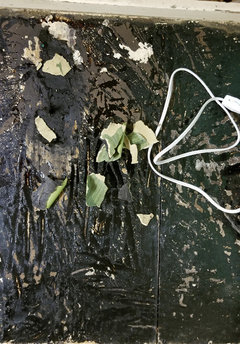
    A potential issue is an adhesive applied to the top about 65 years ago. My Mom told me the story that she remembers her dad gluing linoleum to the top of the dry sink using a very think, black, gunky adhesive. From doing internet research, I think there's a good chance that it was mastic flooring glue...which, given the time frame, might have asbestos. (If it's still there, I'll be careful when removing it!) My uncle replaced the linoleum with contact paper about 30-35 years ago, but I doubt he thoroughly removed all of the black gunk.

    Geoffrey, thank you very much for the tips and link!!


  • 8 years ago

    Milk paint....something else new to me. Thanks Casey, I will start to research that!!

  • 8 years ago
    last modified: 8 years ago

    There is also a product called 'Peel Away' - it's thick - brush it on - cover with their plasticized film - and wait a day or so. It's lye based - no fumes. I have removed several coats of paint from old radiators. Do not let it dry!

    Multi-Strip

    Peel Away

    simmtalker thanked geoffrey_b
  • 8 years ago

    Ahh milk paint and floor mastic. I'm glad this came before you started stripping. I suspect the reason uncle Jim covered the top is because laminate separated and chipped. Look at edge of top to see if it was originally laminated. Clean an area on front to see if you like wood grain enough to go for clear coating. Based on your decisions,we will work with you to fix it up.

    simmtalker thanked klem1
  • 8 years ago

    I hope to have a chance this week to take a better look at the dry sink (it's at a different property, not at home), and determine what is under that contact paper on the top. I'll be back to this thread.

    Everyone, thanks again for the help!!!

  • 8 years ago

    I hope to have a chance this week to take a better look at the dry sink (it's at a different property, not at home), and determine what is under that contact paper on the top. I'll be back to this thread.

    Everyone, thanks again for the help!!!

  • 8 years ago

    Neither the lead or the asbestos should be a problem as long as you're not sanding it when dry. That's one nice thing about stripper, you don't have to worry about dust. Just dispose of the scrapings in the trash and you'll be fine.

    Thanks to whoever posted about the MeCl2 regulatory issue, I had not heard about that. I like the stuff - it sure does work on old finishes where the newer/safer stuff does not. I keep it around.

  • 8 years ago

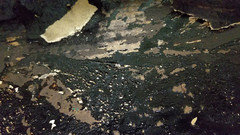
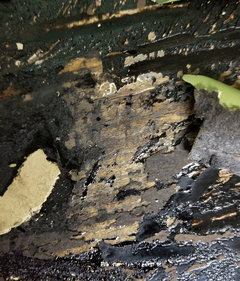
    I looked at the dry sink more closely, and examined the top. Turns out the linoleum was still on there!! It came off without much trouble, and some of the black gunk was still tacky. It's more tar like than I was expecting, so maybe it isn't flooring mastic, just some type of tarrish substance. Good news is there's no laminate, just wood under there.

    The grain is slightly raised on top, but not badly. Not sure if the black gunk did that, or just use for years as a dry sink.

    Should I try a paint stripping product on the gunk, to see if it loosens it??


  • 8 years ago

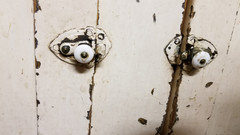
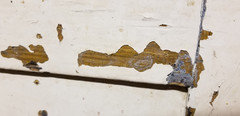
    Some more good news, there are fewer layers of paint than I thought -- looking where it's chipped down to wood, really only looks like two layers, maybe three.

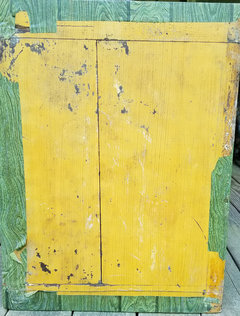
    The piece of board covering the lowered section on top seems to have a different finish (the yellow boards with green wood contact paper around edges). Not sure what that yellow is, but it looks quite brown - not sure if brown paint or a brown stain - is under it.

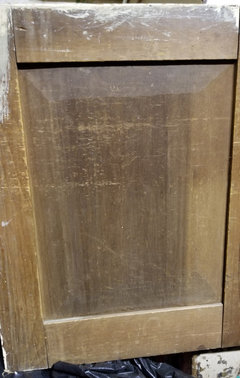
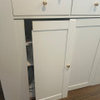
    The inside of one of the doors shows the wood without the paint. I thought it was pine, but I am not good at wood identification!! It seems very odd they would place a RAISED panel on the inside of the door....makes me think this is a Frankensink!! Maybe assembled from various other pieces to make a needed item.


  • 8 years ago

    Those pics along with your comments are a great help. The door isn't wrong side out or anything,it's a "primitive" version of "shaker"style which was very common for the period you trace the piece back to. I feel the piece should be preserved as a "primitive" and prominatly displayed if you can appreciate it. If you simple don't like the look alongside your furnishings,I suggest preserving it and using it for storage in an out of the way place. I don't think it possible to restore to "as new",so I wouldn't even try removing 100% of paint. The value based on family history is priceless but if you aren't deep into that,have a knowing collector or dealer appraise it before touching it other than cleaning black goop off top. Black stuff might wipe off with rags wet with paint thinner. I believe the wood will be stained regardless of what is used to remove black substance. Let's see what the consensus is before tackling it other than getting black substance off. Did I mention how much I like the piece,not to mention the history? (:

    simmtalker thanked klem1
  • 8 years ago

    You can try the mineral spirits and that may work. If not you might need stripper. I'd wet a rag and let the min spirits sit there on it for awhile to soak in.

    simmtalker thanked toxcrusadr
  • PRO
    8 years ago

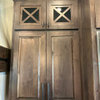
    The paneled doors are poplar; under the chipped white paint is old or original faux wood graining in an oak color.

    simmtalker thanked Sombreuil
  • 8 years ago

    klem - Thank you, and glad someone likes the old dry sink :)!! Primitive shaker, I'm learning so much. I never looked at it closely before, and the raised panel on the inside certainly had me scratching my head. I pulled out its drawer -- it has very utilitarian dove tails, and, what looks like to me, handmade nails. Very heavy wood throughout, and all parts I can see are in perfect working order. Not sure if I'll encounter any issues when I am able to remove it from its place along a wall, but I'm sure it has many years of use left in it.

    Sombreuil -- Thank you very much for the information!! I would have never guessed poplar. I'm going to Google the faux wood graining, see what I can learn about it.

    I hope to have an opportunity this coming week to try the paint thinner on the black gunk -- I will update thread with results.

    Thanks again!!

  • 8 years ago

    I was browsing the pictures again to admire your sink WHEN,I noticed for the first time the view of inside door without paint is indeed raised panel. For some reason the panel looked flat when I looked at it before. You are correct,that panel is not original to the piece and certainly was an improvisation repair. Just add's another chapter to the family history wondering who made the repair.

  • 8 years ago

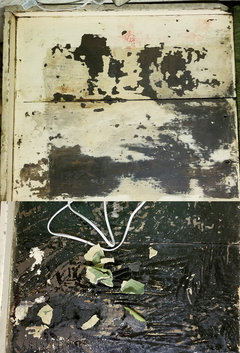
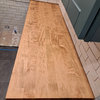
    Today I tried the mineral spirits on the black gunk on the top, and it worked fantastically!!!

    Here's a before/after pic of the black gunk....well, actually, it's an after/before pic :)


  • 8 years ago

    Happy to hear you were able to get that black mess off.