Software
Houzz Logo Print
sigrida

Hydrangea tree died

8 years ago

I had 3 hydrangea trees that have white blooms in late summer that turn a lovely light maroon as they age. If I cut them, the blooms will last all winter indoors with no water. They came with the house, I doubt the former owner, who had the house for 10 years planted them. My take is they are probably 20 years old, as I know an owner in the late 90s put a lot into the house, but they could be much older.

We've had the house for 7 years. They've always had some dead branches that I've been slowly pruning, but would look great in the spring. One didn't leaf out this year. I'd noticed some loose or peeling bark near the base. I doubt it was either too much or too little water.

Was it just age? Anyone have ideas? How long to tree hydrangeas last? Are they something that should have lasted 50-100 years? Or something that it's not that surprising conked out after 20 years?

Comments (16)

  • 8 years ago
    last modified: 8 years ago

    Hard to make a "forensic analysis" via the Internet.

    Some hydrangeas have been known to last 50 years or more so I cannot tell what happened.

    Why are you considering a watering issue? Was winter dry, wet? Did temps fluctuate greatly in a single day? Was it warm for many days and then temps crashed down?

    Where are you located?

    Anything unusual happened since you last saw signs of life last year?

    If you are in some really cold zones, you could give it one more week or scratch some stems looking for green. But if the others leafed out, it does not sound good.

    Any signs of pests in the ground killing or eating roots? Anything else near that is behaving unlike prior years?

    Sigrid thanked luis_pr
  • 8 years ago

    Tree hydrangeas are typically one of the medium to larger cultivars of H. paniculata AKA panicled hydrangeas. IME they can live for a long time, so I wouldn’t expect one to die after 20 years. My grandmother had a set still growing well something like 50 years after they were planted near Binghamton, NY, but at that point the house was sold, so I don’t know beyond that. Many of the current selections haven’t been in existence that long, but I don’t have any reason to assume that they would have shorter lives. IME they are pretty resiliant plants, but since we don’t know anything about where you are or your growing conditions or what the plant currently looks like, it is difficult to assess what might have gone wrong. The fact that they consistently have dead branches which my younger plants don’t might be a hint that they aren’t totally happy, but it might just be lower branches getting shaded out.

    Possible issues besides those already listed include:

    damage to roots or lower stem from critters burrowing (chipmunks or moles), eating roots (voles), chewing bark (mice,rabbits, and voles) or an over enthusiastic person with a spade or weedwhacker

    Disease that has effected the roots or the main stem, though I see no disease issues on these in my area

    change in growing conditions such as saline driveway runoff from snowmelt drainage, or even just too much or too little water if flow was changed by reforming of other areas of the yard or road, or differing weather patterns such as severe drought, or too much shade from trees growing larger

    What is your soil like? Mulched? Water? Specific growing conditions of this plant and your other ones? Your general location? Photo of the dead plant and the similar live ones? Any changes at all made to the house, yard or nearby road or even to one of the adjoining neighbors’ yards?

    With more info, we might be able to help, but sometimes it isn’t possible to figure out the problem.

    Sigrid thanked NHBabs z4b-5a NH
  • 8 years ago

    The winter was pretty typical. The tree is far enough from the driveway that I don't think it was that. There was extensive tunneling in the lawn near it. Probably more than last year, but the tunneling seemed to stop in the lawn and not go into the bed around the tree.

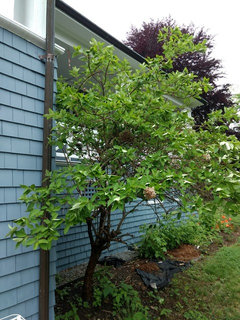
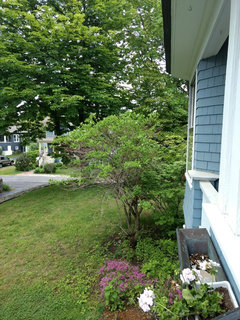
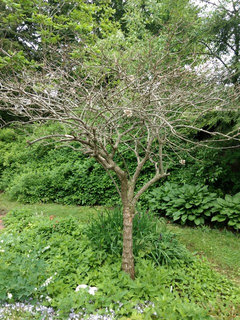
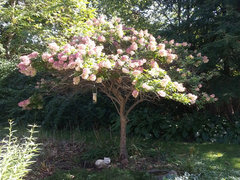
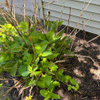
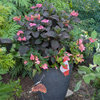
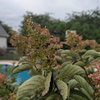
    The first two pics are my other 2 hydrangeas. They look reasonably good, but have some dead branches. I have a lot of garden to get back into shape. I pruned out some, but not all dead wood from the first one last year. I haven't pruned the second one at all. So, I don't know how much dead wood has been there for years. I did prune the one that died. As you can see, most of the branches were fine last year.

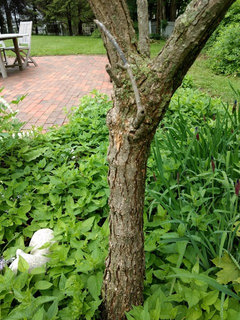
    The trunk is from the dead tree. I noticed a bit of bark issues over the last few years, but the rest of the tree looked fine, so I didn't pay much attention to it. And frankly, I'm not sure how hydrangea bark is supposed to look.

    As you can see, no weedwhacker has been near my tree. I planted a few very small things in the bed, but very carefully around any roots. While the dead tree isn't against the house, like the others, it's not far from the house on one side, the garage on another, a fence on the other. In the trunk photo, you can see the farthest distance from any kind of protection, so it's fairly protected from the wind. Besides, I'm pretty sure it's been in that spot for at least 20 years, if not far more. My house is about 100 years old and we figure the copper beech, visible in the back of the first pic is 100 years old. The hydrangeas? Who knows?

    No changes that were likely to affect the tree happened. I'm not that big on watering, but I planted some things and kept them watered, so the dead tree got more water than the others. My soil is fast-draining, so too wet is never an issue.

    I'm in Maine, just south of Portland, fairly close to the shore, but on the Pacific side of Shore Road (local joke).

  • 8 years ago
    last modified: 8 years ago

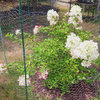
    Oh, and this is the dead tree in 2016. It looked pretty much the same last year.

    You can see why I loved it and am unhappy about its probable demise. Oh, and the dried blooms match my dining room and last all winter.

  • 8 years ago

    I might well push on the soil in the bed around the tree to see if there are tunnels. I do see an injury on the bark near the tree’s base on the last photo you posted of the tree in bloom, but don’t have any suggestions as to cause. Here in the Northeast, they do fine without supplemental water IME even if we don’t have rain for a month as long as they are established as yours obviously are, so water in a reasonably well drained soil wouldn’t have been an issue. I don’t see a large portion of dead branches on mine as yours seem to have, so I would guess that something may be a problem for all of them, though I don’t know what.

    I do notice some landscape fabric going down in one of your photos and would discourage you from doing this and encourage removal of any you have already put down. Better to add a few layers of newspaper under the mulch than fabric, which tends to interfere with movement of nutrients, water, and air into the soil, doesn’t prevent weeds, and makes them harder to pull as the roots tangle in the fabric. Or even just use the mulch without the fabric.

  • 8 years ago
    last modified: 8 years ago

    Since the pic was from 2016, whatever happened occured after the picture was taken. What kind of trees do you have growing around in all directions from the Pee Gee Tree? I could not ID them... ;o(

    It sure looks mighty fine in the picture, does it not?

    Sigrid thanked luis_pr
  • 8 years ago

    @Luis_pr, the tree right visible in the flowering pic right, behind the hydrangea is a young butternut. To the side, there are overgrown forsythias and some hemlock and cedars, too. Behind the butternut, in my neighbor's yard are a ton of Norway maples, threatening the 100 year old butternut on our lot line.

  • 8 years ago

    @NHBabs

    I have a bit of landscape fabric in my fruit bed, because I need to kill the weeds. I don't have a lot of it. The idea is to get rid of the hostas and daylily thugs and the weeds and then to not need it. None was around the hydrangea that died.

  • 8 years ago
    last modified: 8 years ago

    Butternut is a relative of black walnut. Black Walnut & Butternut have roots/parts that contain a chemical that can kill all kinds of shrubbery, including hydrangeas if they are exposed to any parts (juglone is the name of the stuff I am talking about). Butternut has juglone in some parts (roots) so, if the juglone in the roots got into proximity to the Pee Gee, it may have, thru the years, injured/killed the Pee Gee.

  • 8 years ago

    I think that Luis has most likely IDed the problem. As the butternut grew, it spread roots and branches and dropped leaves in the fall, enough so that juglone killed off the Hydrangea.

  • 8 years ago

    Why didn't it kill the damned forsythia instead! The forsythia is a lot closer.

  • 8 years ago

    I am having the exact same problem; tree hydrangea established more than 20 years; never any problems. Leafed out on schedule, a few dead twigs to trim after winter (normal) and everything FINE until a week ago. It was showing some stress and we watered it; we went away for a few days and came back to find 2/3 of hydrangea dead-looking. We are in Zone 5 in northern Illinois; winter was nothing unusual for us. I read the previous comments and the only thing different is last spring we planted a dwarf magnolia 10-12 feet away. We have no mole problem and nothing else nearby (grape arbor, hostas, ligularia) has been at all affected. I am sick at the thought of losing this little tree; it is a visual divider from the neighbor's yard. Thanks anyone for help.

  • 8 years ago
    last modified: 8 years ago

    It can be difficult to try to guess via the Internet. Can you clarify/elaborate on two things you said?

    "it was showing some stress and we watered it." What were the stress symptoms? How long were you away?

    It is "2/3 dead looking". Can you elaborate?

    Also, where are you and what is your zone? Was the soil dry, moist or wet during this time of problems (or now if you do not know)?

  • 7 years ago

    I have the same exact problem with my tree where is leafed out at the top but didn't leaf out very health of underneath. I got a few small blooms. Just last year it was magnificent as it has performed for the last 20 years. Some one said it was because we didn't have much snow but lots of winds causing extreme cold with no insulation. I also lost 2 established rosa of sharons that were only 12 feel away. Regardless, is there anything we can do at this point? A specific fertilizer?

  • 7 years ago
    last modified: 7 years ago

    Cathy Carmody, a question is likely to get more attention if you start a new thread rather than adding to an old thread. However, here are some thoughts:

    Is this a tree form hydrangea? You just said tree.

    Fertilizer won’t help injured or damaged plants, especially at this time of year because new growth won’t have time to harden off before winter.

    Watching that the plant is getting the right amount of water (if it is a tree hydrangea) is a good idea. Particularly going into winter you want the plant to not be totally dry but also not soggy soil.

    If there is grass at its feet, remove that and replace it with mulch out to the drip line but not right against the trunk to decrease competition from grass.

    Add photos that show the problem close up and the whole plant as well as the plant in its surroundings.

    Tell us where you are such as nearest large city and what USDA growing zone you are in.

    Unless you are somewhere that winter temperatures reach below -40F or so, panicled hydrangeas should be winter hardy. Rose of Sharon are far less hardy and can be damaged at far less cold temperatures, around -20F to -25F.

    Look for clues around the plant. For instance sawdust on the ground might mean some type of borers is bothering the plant, or holes and collapsing tunnels might mean burrowing rodents such as voles or moles are disrupting roots. Look at the trunk to see if it was gnawed by hungry rodents last winter. Has drainage or water changed in this part of the yard due to new paved areas anywhere?