

An Architect Defends the Suburbs
Thought many on here might find this article about suburban mass hombuilders interesting. No paywall.
https://www.theatlantic.com/technology/archive/2018/06/a-defense-of-the-suburbs/562136/
Comments (27)
 PRO8 years ago
I read it. I was left with a "so what's the point of the article" sort of feeling. The author leans this way, veers that way, turns here, reverses there, makes some error-filled statements, and, in the end, has a weak and inconclusive conclusion, IMO...!
Related Professionals
Asheville Architects & Building Designers · Milwaukee Architects & Building Designers · Las Vegas Architects & Building Designers · Indianapolis Design-Build Firms · Zanesville Design-Build Firms · Ottawa Design-Build Firms · Sebring Home Builders · Winston-Salem Home Builders · Champaign Home Builders · North Adams Home Builders · Plymouth Home Builders · Edison Home Builders · Palm Desert Home Builders · Bismarck Home Builders · Bronx Home Builders 8 years agolast modified: 8 years ago
Thanks for posting. Yes, the author meanders, but I don't think it is all that bad and I can relate to a lot of it, in particular some of the reasons the author suggests for why people make the choice to build in a suburb, with a production builder.
Now I am going to do some leaning, veering, turning, reversing....;)
I am not in U.S. (in Canada) but am building a pre-sale production home with a mid-sized local/regional builder in a city subdivision (development with 3-4 builders). A large enough builder that they have 7-10 homes (both spec and pre-sale) on the go at anytime, but small enough I have met the owner.
We chose this route after looking on the resale market, as well as investigating of going custom (including finding a lot here that allows your own build) and honestly, it just made sense for us to go this route when we considered our chosen budget, and priorities.
We have a rather decent household income, and we don't have a "small" budget for our house but a dollar does not go as far here as elsewhere for either lot or house. I am building what I personally think is a large house, but compared to many posted on here, it is not at all (under 2,000 sq feet, plus full unfinished basement).
Many of the larger and "best lots" available for building your own here are already $200k-$300k leaving little left over for an actual house if you have a more modest budget (by circumstance or choice). Some of these pricier lots are rather plain Jane lots, though some of the higher priced ones do have spectacular views of our interesting landscape here...but that view comes at a price, and for some (including me) I am happy to take advantage of the free public spaces to see that view instead of double my mortgage. In the subdivisions, on the other hand, you can get lots for $90k-$130k depending on size, location, view, walkout versus non-walkout.
For me, the fixed price contract was attractive, and we managed to limit our overages to about 5%. This allows me to ensure that I can do a conventional (non-insured mortgage) which is my preference and keep my mortgage well within what I am comfortable paying from my net income each month. Our builder has been rather great to work with. Not as flexible as full custom of course, but let us move walls around (no cost), and make other layout changes as we wished for a reasonable cost. We chose our particular builder as not only did they have layouts we preferred, but they had a higher "base" for their standard finishes, and looking at several parades homes, and specs, we knew they had better overall finishing, compared to other production builders around here.
Though we are a childfree couple on either side of 40, we are going into a community that is a little more family oriented, but has many parks/green spaces, walking trails, a community garden, an elementary school (and a new high school very near by), is very close to shops and other services, and close enough to the road that takes me on my 5-8 minute commute to work (important for me with my hours). We are very close by a couple new rec centres going in (pool, ice rink) and a library. Many of these are within reasonable walking distance. I do drive (used to commute only by bicycle, but no longer practical with my job!) but there is a transit system in and out of the community as well.
We got a pie lot in a quiet side cul de sac - one of first houses going in on that street, but funnily enough turns out we know our neighbours already by chance, which is good as we are within touching distance from each other, ha. We definitely don't have a big lot (though bigger than many around here...low density residential is a bit of a misnomer!) but that works for us as we want something rather maintenance free anyway, and there are other spaces to enjoy outdoors nearby. We have also met a couple of the other "soon to be neighbours", which seem to be a good mix of people so far, and feel good about our little neighbourhood within a neighbourhood at this point.
As to the aesthetics pointed out in the article, I readily admit our house is a little boring and box-like and has no real "architecture". It has a snout garage (I have lived in places with very cold winters all my life and have tried to get by with a detached garage or no garage at all for the last couple decades....I want my attached, heated garage back!). Other subdivisions near us have architectural controls that require either a Prairie, Modern, or Tudor influence, but our subdivision overall has more lax architectural controls and more of a general aesthetic (the incongruous motif perhaps mentioned in the article). Our own house is, as I said, rather plain on the outside. But it works for us, particularly inside, and we plan it to be a long term home for us. I actually rather like it's plain appearance.
Overall, and this is something personal I wanted to add to the points raised in the article, and I think what attracts me to the subdivision we are building in, and even the home we are building, is a familiarity with the community as well as just a sense of what things are important to me (or not). While I am make a decent income as a professional, my roots (along with my husband's) are much more modest and that is something I can't, and don't want, to forget or shake off. I take pride in making my home feel like a welcoming home, but my home is not something I am concerned about being a display of success or "impressive" to others. I want something where I feel safe, and cozy, and be close to my husband and our cute kitty (even if not in same room), and at a budget that leaves us enough for bigger priorities for us in life (financial security, travel, etc). I truly appreciate nice things, and enjoy looking at the beautiful custom homes and fine details others show on here. But for me personally, having an exterior elevation, or a kitchen, or high ceilings, or whatever else, that others lust over or that gets pinned to Pinterest just isn't a priority, and would not be appreciated or fully utilized by me.
A friend of mine, another professional, is right now building a custom home on an interior city lot (they demolished the decrepit building that was there). Her house is going to be beautiful, with lovely details that will lend it to fit into her older, well treed neighbourhood. But I don't envy the costs, or stress, or all the details she has had to plan along with her day job and caring for her family. It may not be for everyone, but I did like that I could go to a design centre and see everything in one place. I like that our home will be ready in 4-5 months total, compared to her 12-16 months (plus 1-2 years of design!). Quite frankly, I also would not want to live where she is building. Yes, it is established, and treed, but also has significant issues related to crime that are much lower where we are building. I understand the argument that revitalization has an effect on diminishing these issues, but I don't want to be one of the pioneers, not with my own schedule and activities. I spent many years living downtown and in the "core" in another city, and while I enjoyed it when I was young and single, I feel I know what I didn't know then, ha.
I don't believe, or try to convince myself, my future home is a pinnacle of architectural design. I know it is not. But it is still going to be my home. I do find it peculiar how many (including on here) will make snobby (in my opinion) critical judgments of the homes that many, many people call home, or aspire to call home. So many in the world are not as fortunate to even consider the opportunity to live in a "builder-grade" home.
- 8 years agolast modified: 8 years ago
There is a thesis statement... Whether supported or not, his point seems pretty clear.
My experience here tells me the guy may be on to something, even if it is a pretty broad generalization.
- PRO8 years ago
Well...I hate to ask...but what is the "something" the guy is on to...?
 8 years ago
My profession is marginal in society compared to others, like medicine or law. Architects build few of the homes people occupy.
Convinced me.
- 8 years ago
what is the "something" the guy is on to...?
----
I am not trying to be rude, but I don't know if this is some sort of passive aggression, or you really are struggling to identify the author's thesis statement.
I know there must be some point to your posts, as any college professor should be able to point to a thesis statement when it is in the traditional locations.
I am not challenging your issue so much as I am missing it.
- PRO8 years ago
Worthy, it's true, as far as it goes. As I understand it, however, the practice of architecture does not have similar legal requirements for use as do medicine or law, for example, making the use of physicians and attorneys a rather different scope of practice and requirement for use, whereas the use of an architect is strictly voluntary when it comes to single family residences in many jurisdictions. Someone will correct me I'm sure...
- 8 years ago
Reconceptualizing zoning: HA! never gonna happen.
The article reminds me of another article re: abortion. It went like this:
this is why it s/b legal; this is what it s/n/b legal. In not in favor but I don’t judge those in favor. So dude: what are you saying?
I found article hollow but I find you nice for sharing and inviting discussion.
- PRO8 years agolast modified: 8 years ago
"...I am not challenging your issue so much as I am missing it..."
Nope...no catch. I'm asking a simple, open-ended question.
I honestly don't understand the point of all his ramblings, unless it's in the final, concluding paragraph where he makes the statement to effect that it's..."valuable to have a dialog...!"
Is that the point of the article...a dialog about surburbia and builder's subdivisions?
If that's the case, how in the world could he overlook and make no reference to the New Town efforts of the 1960s? What about Levittown--what did we learn? There's lots of examples to specificially examine and from which to learn, and lots of pro and con lessons there for important discussions...and not the generalized rambling of the article...
Really, what can we take away from the article that's new, useful or insightful information?
Sorry, but it just seems so superficial...and unfocused...
- PRO8 years ago
Or...are suburban developments successful simply because, like buying a car, a consumer can just go look at several in a desirable location with reasonable schools, and pick a Ford, Chevy or Dodge of their choice?
Do you really think suburban developers are really "in touch" with their buyers as the article suggests?
There's an old saying in the car sales business, "There's a butt out there for every car...", meaning someone somewhere sometime will buy just about every car on the lot. Is that really being "in touch"?
Just wondering...not arguing! :-)
- 8 years agolast modified: 8 years ago
Well, I would agree that there's a butt out there for every car, because what is one person's jalopy is another person's dream car, and vice versa.
So I am not sure that saying really provides any conclusion to either cars or suburban developments, except that not everyone has the same priorities or constraints as others do. The person looking at buying a Ferrari is probably not going to be spending a lot of time at the Ford dealership, and vice versa.
The suburban developers can still be "in touch" with those who have those priorities and constraints that lead them to the suburban developments.
- 8 years ago
I wonder if the title of the piece was determined by editors and not by the author? What confused me about the piece was the content was not a full throated defense of suburbs, which the title suggested it would be. I was also scratching my head at the statement that people criticize suburban architecture because they want it to be modern. That's news to me...
- PRO8 years agolast modified: 8 years ago
"...The suburban developers can still be "in touch" with those who have those priorities and constraints that lead them to the suburban developments..."
Good point, and I agree. Someone, somewhere is going to like a suburban development builder's house enough to purchase it. But...does that really mean the developer/builder is "in touch", or does it simply mean that sooner or later almost every new house in a reasonable location will sell? Two very different things!
My experience is that many (not all, by any means) developers and builders are not innovative or "in touch" at all. Rather they tend to build and rebuild what they last built. Disagree? Look at what all the large tract developers and builders do. Maybe there's some superficial changes to the exterior finish materials and colors. Maybe there's some change to a few interior partitions and the appliances. But do developers and builders really innovate? Do they really change what they have done based on consumer surveys and preferences...Just how "in touch" are developers and builders, really...?
I'm really interested in the responses. I'm not being argumentative.
- PRO8 years ago
"...people criticize suburban architecture because they want it to be modern..."
I thought that was a very odd part and presumptive part of his presentation, since very few consumers even know what Modern design and architecture are. Ask about the Bauhaus, and about the only thing one often gets is blank stares...
- 8 years agolast modified: 8 years ago
Maybe writer meant modern as in having Alexa turn on the lights, ha. Of course, this isn’t modern and of course writer didn’t elaborate on what he meant by modern, as he should have.
freeoscar
Original Author8 years agoClearly homes have changed over the years - the newly built suburban homes are much different than Levittown developments or even the homes of the 90s. Building/Lot ratios have dramatically increased, You have open plan kitchens, great rooms, multi-car garages, huge master bed/baths, higher ceilings to name a few. Tract builders aren't haute-couture designers, they are following what consumers want, not driving it.
One of his defenses I found interesting and in direct contrast to the conventional wisdom here on GW is that the build quality of homes has improved.
I think when he says 'people criticize it because it's not modern' he means the people (architects, "sophisticates") who do know what modern is. I see some validity to his point there - for the most part suburban architecture hasn't really progressed from a stylistic standpoint, but that's because, as his argument points out, the people buying those homes don't want it.
- 8 years agolast modified: 8 years ago
The "suburbs", the word that no downtown aesthete for the last 70 years can't speak without curling their lips in disdain, rolling their eyes and their joints. Get over it Prof!
Lining up to see a model home in Levitttown, N.Y.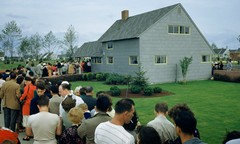
Photograph: B Anthony Stewart/National Geographic Creative/Corbis
A Long Islander at heart, I remember the first Levittown in person. Within a decade, sociologists were pointing out that things had changed. Architects are evidently slower on the uptake.
 8 years ago
Virgil - to answer your question, yes, I do think many (certainly not all) suburban developers may be more in touch. They understand that lots of people see a home as what it basically is - shelter - rather than art - and beyond having basic expectations for that shelter (number of bedrooms, bathrooms, kitchens and a roof that doesn't leak) many folks don't really care so much about elegant design as they do about putting away money for their kids' education. The 'burbs offer a lot to those who want a decent starter home with a bit of space for the kids to play (the "backyard cricket" mantra still holds strong here in Australia!)
Your car analogy is exactly right: people who buy Fords or Chevvies are buying transport, not a motoring experience, and there's a very big market for that. Architects, or at least the smaller ones, offer tailored, custom house design which is generally superior to anything a suburban developer can offer, but I suspect the majority of people would put customization of their home (and I'm not talking selecting countertops here) fairly far down their list of real life priorities. Cookie cutter homes are fine for them because they get the shelter they need at an affordable price.
As to being "in touch," I'll give you a little example. Where we live, there's a lot of brownfield development going on - older, generally undistinguished houses on big lots being torn down and replaced by two or three or even four two-story houses, often with common walls and a shared driveway. Our builder (a small local builder who uses - gasp - a local design and drafting firm for his plans) did a teardown but instead of maximizing potential profit by cramming in multiple two-story houses on the lot, he put in two single story houses instead. His reasoning: the tides are changing, the local population is aging, and the demand for single-story homes is growing. He reckons he can sell a single much faster than a double because that's what a significant proportion of the populations wants. Not everyone, but enough to make moving away from the "box house" model worthwhile for him. And interestingly, I've noticed in the last year or so that builders are starting to put up two doubles and one single on their developments to address that demand.
Now our builder's reasoning is obviously not the same as an architect's because he's building for and selling to a popular, not a custom, market. But if he doesn't gauge that popular market correctly, he's out of business. That's less important for an architect who isn't reliant on a mass product.
- PRO8 years ago
Excellent comments! Worthy, I just don't understand what you are saying...
- 8 years ago
There are some interesting points in the article, but I have a different take on some of them.
I don't think that this is a matter of architectural critics wanting something different than the consumer--that there is an elite group of critics and tastemakers who don't have their finger on the pulse of what the average American suburban development buyer wants--at least not to the extent I interpreted from the article.
One, I don't think all architectural critics promote modernism only and that the average suburban buyer hates modernism; I think that's a bit simplistic. At least where I live, there are a lot of urbanites who buy in the city who then either keep these houses as rental properties or sell them when their kids need to go to better public schools. What they are buying in the city consists mostly of very modern looking new construction with mostly transitional kitchens and baths. I don't think their style sensibility shifts so much when the move to the suburbs that they reject modernism.
My thesis is that most people buy for Location, Square Footage (or Cubic Footage lately), and Amenities, and the Last thing a lot of people look at is what the outside looks like. If it meets the other criteria, they don't care so much. The last couple people I've looked at houses with could have cared less what the exterior looked like as long as it checked the other boxes and to some extent, as long as it looked like what everybody else in their demographic was buying.
So I don't think a lot of people actively like these overwrought exteriors as much as this is what they are used to seeing and they do not want to stray too far outside the norm when it comes to buying something themselves because sooner rather than later they will have to sell it. I am not sure people actively dislike these houses that much though, either. Most people don't have a particular individual taste. Their taste varies directly with what the current culture tells them they should like at any given point.
People want to fit in, for the most part, and this sort of pressure seems to be stronger in the burbs where you are compelled (By some committee) to have a certain percentage of identical building materials and limited colors on the outside of your house whether you want it or not. And we all know what design by committee and polling and questionaire leads to. The Edsel is a good example. It wasn't that the car was that much more hideous than many others of the period, it's that it tried to be too many things and ended up not having a market niche.
However people are more free to reject a car, because the car goes with them. If the development is in the right place and the houses are the right price and check the size and amenities boxes, you're pretty much stuck taking it or leaving it.
- 8 years agolast modified: 8 years ago
The gentleman's thesis, and he does have one, is simply. "Open-minded curiosity can also teach much about another foreigner in our midst: the American suburb."
You can see it again at the end of the piece, "Looking at the suburbs, therefore, provides a way of understanding a vast segment of the public without the need to endorse or slander their homes."
Both are in the exact places you would look for a thesis statement in any paper. He has both a thesis and a thesis statement (I don't understand how you can have a thesis statement without a thesis). What he is trying to say seems obvious to me, a large part of the population has moved away from well designed homes and architects should spend some time trying to understand why more than simply noting it happened. I suspect were you to buy his book he would posit that architecture will continue towards irrelevance without an understanding of the motivation of most Americans. That is the point that I believe is on to something, it isn't earth shattering or anything, but that doesn't mean it can't be correct.
-------
Now as for support... meh. He doesn't really offer any evidence to support the claim, but then again his goal is to sell the book. This is one of those teaser things where he wants you to buy his book so you can put it all together. He may or he may not, but I have worn those pants before so I am not judging.
--------
Finally, I am not sure that I agree that suburban developers are more in touch with consumers. It isn't simply that anyone will buy some car, it is that everyone's drive is different, and thus their priorities might be different.
I think the architecture problem is mostly a financial problem. Homes are more fluid, loan costs are down and people move through houses like kids move through shoes, each house is simply a step to the next house.
Additionally, in any kind of marginal cost analysis architects are a tough sell and people are better at marginal cost analysis than we suspect. The value that an architect brings to a house are a combination of intangibles and possible overall cost reductions, but those values are largely not reflected dollar for dollar in appraisal. Simultaneously, architect fees are largely not deferrable in a situation where equity is already tight. Simply put, fewer people have enough money to pay architect fees in addition to covering equity shortages (all too common in building) and down payments.
Suburban production builders have largely responded to loan and appraisal market to create a profitable environment. I suspect the biggest reason for the bad suburbs are bad loans and bad appraisals.
Just my 2 cents...
ETA: I am packing to head to China for a week or two of work. I doubt very seriously that I will be participating further in this conversation.
Good luck.
- PRO8 years agolast modified: 8 years ago
Yes, I agree..."...studying the suburbs has taught me how satisfying it can be for an architect to open a dialogue about how people live and to discuss the potential life available to them..." it seems clear that his call for a "dialogue" (whatever that means) is his purpose for writing. But what is a dialogue?
His call for dialogue might be more convincing if he himself lived in the surburbs and was committed to the advantages thereof.
His closing comments, "...My personal taste doesn’t conform to the architecture of suburbs. I don’t uncritically condone how they look or function. I don’t choose to live there..." seems to pretty much undermine his comment and his call for "dialogue"...
Thus, one has to wonder why he is writing about something he chooses to avoid and doesn't care for.
- PRO8 years ago
Bry911, good luck on your travel and time in China. The Chinese are wonderful hosts and make invited visitors feel very welcome. I hope your trip is enjoyable, as I'm sure it will be.
- 8 years ago
The issue with suburbs is not housing quality or lack of style, but the sprawl and non-stop people. I like cities and country, but not the watered-down compromises sprawling for miles and requiring endless highways for going anywhere. You're not close enough to anything to walk, but you are packed in cheek-to-jowl with humanity. I find more privacy in the middle of a large city than in the suburbs.
If I were forced back into civilization, I suppose I could handle the city, but I would NEVER move to the suburbs.
- 8 years ago
Depends on the suburbs, I think. I lived in Canberra for a couple of years - a city purpose built to be the capital of Australia, so planned from the get-go (by an American architect, no less). Although his plan was never fully implemented, key elements are there to this day. The core of the city was (and still is) a business and shopping area, with an artificial lake in the centre. Then, the oldest of the planned suburbs radiate out from the centre. Each of these original suburbs is sort of circular or semi circular in shape, with a set of shops in the center, and streets circling around. Most have their own schools, green areas and playgrounds. It's actually a very good concept to live in (except for driving in endless semi-circles trying to get anywhere!) Lots of green space, a core shopping area, and relatively easy to get between suburbs and the center (once you find your way out of the circular streets.)
Urban sprawl is happening, but the old plan still holds. Each new land release and suburb has its own central shopping core and easy access to the main highways.
If Canberra had a better climate and had been closer to the sea, I'd probably still be there :)






jmm1837