Software
Houzz Logo Print
matt_barnett67

Money Tree Internode Length

8 years ago
Hello all.


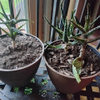
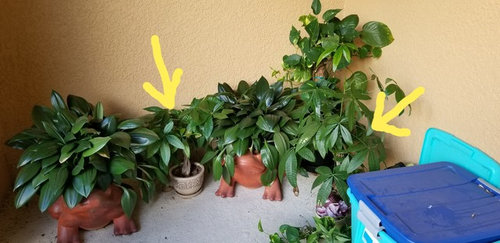
Some months ago, before the growing season kicked in, I was looking for a solution to my money tree's growth being abnormal. I have two of the plants. One is growing normal, with normal internode length, and the other is behaving abnormally, and all the nodes are clustered together, limiting the size of the plant. The plants grow in the same patio, very close together. I live in Florida, and the temperature is going down to 75 at night and up into the 90s during the day. The patio is facing South, and both plants get about half an hour of direct sun filtered through a screen, and bright indirect light throughout the day. They both are putting out healthy, well-formed leaves. The pic shows the plants among their neighbors.


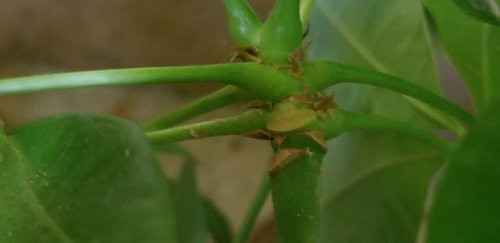
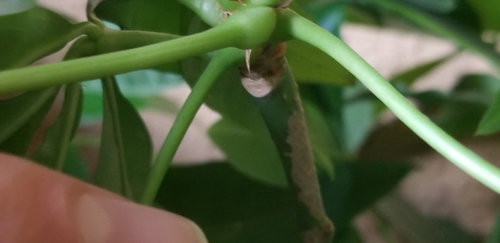
The plant to the left is the one that has the problem. There are 5 growing trunks, each terminates in a knot of nodes that are all packed together. There is no stem between each new leaf stalk. The plant is much smaller, and is not growing in size like the other. The pics shows all the leaves clumped together on two of the stems.


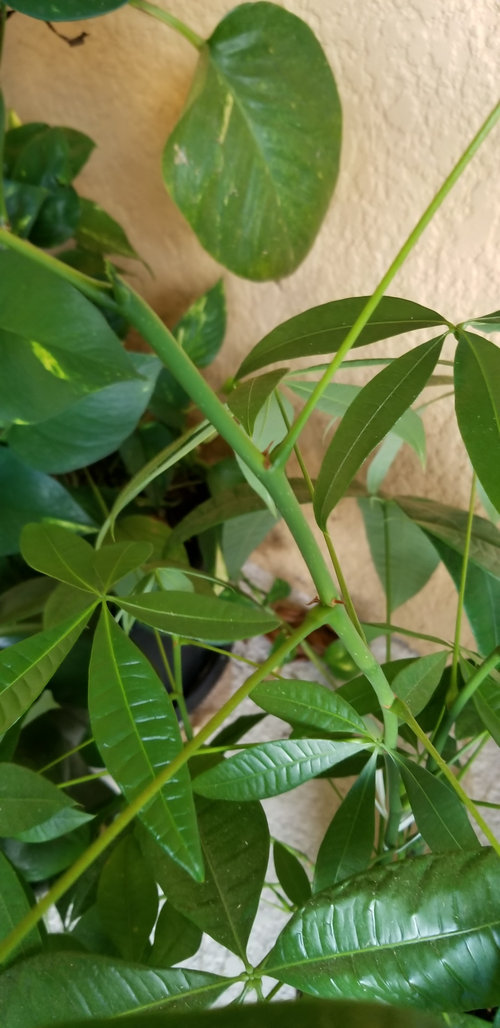
The plant to the right has a normal growth pattern for a money tree. The internode length is not too leggy or dense, and the plant is growing in size as it should. You can see the normal growth in this last pic.


What can I do to help the first plant grow normally? I can see from the old growth near the bottom of the trunks that it grew normally at one time. Should I prune the node cluster off one of the trunks to see if it will start a new branch with normal growth?

Comments (9)

  • 8 years ago

    Plants require energy (sunlight) in order to grow. Your plant is simply focusing on putting out foliage in order to take up more sunlight and carry out more photosynthesis. Cutting it back right now would only set it back and your money tree would have to refocus on growing more foliage all over again, which would use up even more of its energy reserves.

    If it were mine, I would just leave the foliage as it already is. Let it store up the energy it needs to grow even more. Not only that, but I would also give it access to more sunlight. These plants love full, direct sun shining down on them. That would really give your money trees the energy that they're craving, and both of them would be even more robust and vigorous.

    However, if you do decide on giving them more sunlight, do so gradually. Place them in a spot that gets some early morning or late evening sun, but keeps them shaded from any direct afternoon sun bearing down on them. They'll need time to acclimate to receiving that much intense sun. After about a couple weeks, you could move them further into the sunlight. Before you know it, it'll be soaking up direct sun like there's no tomorrow.

    With the increase in sunlight, your money trees will need to get watered much more often. Mine get direct sunlight all day long, and I've been having to water them roughly every other day. But they reward me for my efforts by growing like weeds.

  • 8 years ago

    Ok, I have always read that the money trees do best with bright, yet indirect light, so that's what I have been giving them. I suppose could try bringing them into more light gradually. What I don't get is why the marked difference in the growing characteristics of the two plants sharing the same location, watering, fertilization and lighting?

  • 8 years ago

    Mine has done this before in the past. It's nothing to worry about. Your plants look happy and healthy to me. Though, a gradual increase in sunlight will definitely make them even happier. Your plant will take off with new growth when it's ready.

  • 8 years ago

    Having a compact tree beats it scraping against the 11 foot ceiling of the patio, but they can always be pruned down, never pruned "up". If there is no internode length at all, the plant will never grow bigger than it is now.

    The only really spindly money trees I have seen are in lower light conditions like inside our local Asian food market. Shouldn't it be that if they have enough light, temperatures are good, and they are in the appropriate pot size, they should keep a relatively normal growth pattern? It's confusing to me that the two plants that were bought together are sitting right next to each other in the same conditions are so different.

    I did completely repot this plant last season, in an effort to trick it into normal growth.

    I fertilize all my plants every month or so with the Foliage Pro stuff.

  • 8 years ago

    Check your tree for rootbound conditions, which can severely limit extension of branches. You can actually walk up to potted trees and 'see' how long it's been since they were repotted by observing internode length. When you repot, the internode length will lengthen considerably, then start to decrease as root congestion increases, then increase again after the next repot. Repotting and potting up are different. Repotting removes limitations imposed by root congestion, putting up ensures the limitations become permanent ...... at least until the point in time when you get your hands into the root mass and correct congestion and problem roots.

    Also, if you're flushing the soil when you water, you're almost certainly not fertilizing enough. I can't be more specific w/o knowing more about your soil choice and watering habits, but FWIW, I do flush the soil when I water, and fertilize weekly with a dose of 9-3-6 that's much stronger than recommended rates. You might not be able to do that indoors (all my indoor plants are outdoors for the summer), but following the directions for 'maintenance' levels of care isn't enough in the summer.

    Al

  • 8 years ago

    The tree wa as repotted (not potted up) last year, and the normal one was left alone. I repotted in an attempt to correct the situation with the internode length. When i repotted, the roots were not tight at all, so I got rid of the old soil and trimmed the roots back a bit and replanted it. Both trees are watered and fertilized identically, although i never flush them. What is the difference between flushing and overwatering? How is it done properly?

  • 8 years ago

    Over-watering occurs when the plant is asked to endure root conditions it's not genetically programmed to tolerate, namely, extended periods of soil saturation to the degree there is too much water and not enough air to allow normal root function.

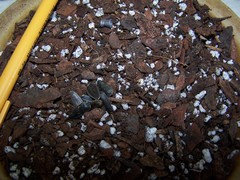
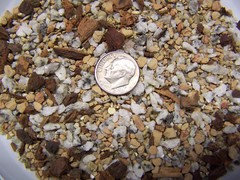
    Flushing might or might not be followed by a period during which the soil is overly wet. If your soil is made of a very large fraction of coarse materials (like the following),


    Soil saturation after watering isn't an issue, unless you work hard to make it one.

    Because of soil choice, many plantings support a layer of saturated soil at the bottom of the pot after a thorough watering. If roots can't get the oxygen needed to drive root metabolic processes, roots die. The plant can't generate new roots until that water evaporates or is used by the plant. Before air returns to the bottom of the pot, you might have already watered, setting the timer at the starting point again. Learning how to water, though simple sounding, is a very important part of caring for plants. Knowing when the plant actually NEEDS water, and withholding water until that point, is the best course.

    If you don't flush regularly, dissolved solids (salts) from tapwater and fertilizer solutions accumulate in the soil. High levels of salts limits water and nutrient uptake. By not flushing, you also allow the ratio of nutrients in the soil to become badly skewed. Plants do best when there is a level of nutrients in the soil that closely mimics the ratio at which the plant uses nutrients. When the ratio becomes unbalanced, an over-supply of nutrient A can cause a deficiency of nutrient B. These are called antagonistic deficiencies.

    About Flushing the Soil.

    Al

  • 8 years ago

    I very much agree with Al. Fertilize much more.
    I am fertilizing my tree double-strength Foliage Pro, just about once a week. I also have Osmocote in the container.

    Josh