Software
Houzz Logo Print
schoolhouse_gw

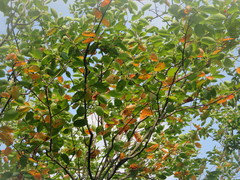
Serviceberry leaves turning color and dropping already

8 years ago

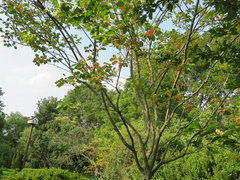
In mid-June? Normally I wouldn't see this until August. The leaves are turning orange/red and dropping. Right now it's just here and there, but still unusual. There has been plenty of rain this Spring so I don't suspect dryness. One thing I am curious about tho. For the last several years I've permitted perennials like wild geranium and bloodwort to grow at the bases. One has the herb Tangy which I haven't pulled back yet. Could this be something the shrubs don't like? Any other reasons for stress?


These are mature service berry trees and a shrub, good sized. Never a problem in the past.


Comments (14)

  • 8 years ago
    last modified: 8 years ago

    What? Sorry, I thought I posted this in Shrubs!

    ETA: Oh, I see it did post there too. hmmm.

  • 8 years ago

    I just looked at mine this morning. It has green leaves and berries on it right now.


  • 8 years ago

    Check and see if any of the plants under the serviceberry are carriers of rust. My serviceberries have rust every year but it doesn't affect their spring blooms. In my area cedars trees also suffer from rust, and serviceberries are the carrier.

  • 8 years ago

    I'll go check for rust. The berries are red now, what's left of them that is, the birds devour them as fast as they ripen and even when green.

  • 8 years ago

    I see no rust, but I see even more affected leaves then there were this morning. Could it be the heat and humidity? All three serviceberries in the courtyard garden are like this. The large one in the orchard is showing some of this leaf color, but not nearly as bad -yet.


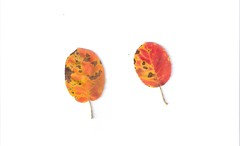
    I scanned two leaves. Looks like insect damage? I didn't see any sign of bugs or bark damage.

  • 8 years ago

    Check that green shrub below it ... I think I see some galls on it ... it could be the evergreen host for Cedar-Hawthorn rust; the galls on the shrub would be balls with orange fingery things. It won't hurt the evergreen; how it would affect the serviceberry would depend on the maturity and size of the tree.


    The best way to end the cycle is to go through and remove all of the galls from the evergreen before they get to the orange fingery state (spore release), when they are still just brown balls.

  • 8 years ago

    You mean in the second pic? That is a juniper hedge that has grown there for many years. It has die back, then recovers in some areas, but it is old. I don't see the galls you are referring to unless you are seeing orange leaves from the serviceberry laying on/in it.

    I'm betting on rust also. Now that I think about it , this Spring I have noticed a lot of brown on my mature DeGroot Spires in the orchard area and also on a young Pencil Point juniper planted last summer. It was healthy until this Spring. The bottom at ground level is yellow/brown and seems to be going up the shrub. It sits in the courtyard garden as well, not far from the serviceberry. ugh. I have done nothing different in terms of mulch. Perhaps I've introduced a diseased juniper (the pencil point).


  • 8 years ago

    Update on Serviceberry: Whatever the problem was, it seems to have resolved itself. Normal amount of healthy (looking) green foliage now on all three in the garden.

  • 8 years ago
    last modified: 8 years ago

    Tree in above shots is very thin (see through, transparent). If you had a severe weather episode last year that may have affected your trees and conifers, resulting in the differences in their appearance and behavior you have been seeing this year.

  • 8 years ago

    It looks similar to what I had going on with a hedge. It was very rainy and humid and probably some type of fungus. I was really concerned about losing the hedge. I took some leaves into a garden store, one I support by buying stuff from them rather than a big box store. Instead of selling me some fungicide she said it's the weather and probably will resolve itself when weather changes, she was right, no treatment needed.

  • 8 years ago

    Serviceberries belong to the rose family, a group of plants plagued with insect and disease problems. I've got lots of serviceberries on my place, many of which look like the image. I attribute that to various diseases common to junipers (redcedars) and members of the rose family. Some of my trees will be completely bare by late summer, others not so much. It is mostly a cosmetic issue, and does no real damage to the plants. Infections vary from year to year and weather conditions. I've got bunches of hairy fruits that nothing will touch this year lol.

  • 8 years ago

    Serviceberries related to roses! I didn't know that, but I guess I really never research them. I planted one about 6 years ago but rabbits chewed on trunk almost all the way around after it's second winter with deep snow. By all rights it should have died but I've babied, and sheilded and kept the scar clean and surround with chicken wire. It is full of healthy berries for the first time. Even tasted them myself, yes a hint of the same flàvor as rosehips!!

  • 8 years ago

    I planted 5 Serviceberry trees about 10 years ago. I planted them mainly for the birds, but really the birds have little interest in them. I even picked a bunch and laid them out where it would be easy for the birds to get them. Still little interest from them. Today I did see 2 squirrels after them. The berries do make a decent pie, and jam. Lots of recipes on line.

    My trees do suffer a good bit of leaf loss from mid summer on. As noted by another post above it seems to be of little concern other than cosmetic.