Software
Houzz Logo Print
erin_costellobaker

Avoiding a Giant Island Range Hood

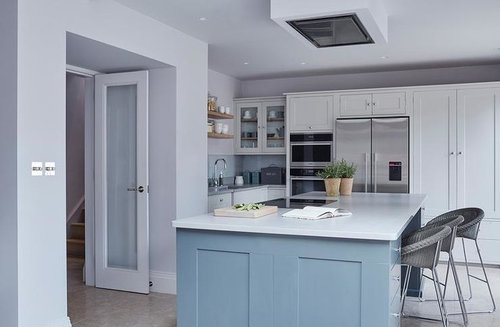
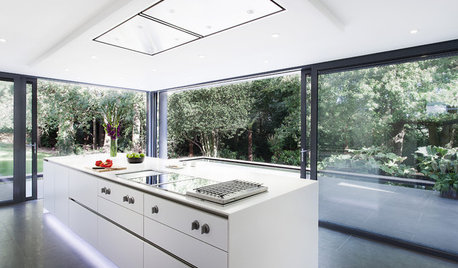
I'm trying to avoid mounting a giant range hood over my island, where I'll have an induction cooktop over a built in oven. Apparently a downdraft vent won't work. So I've found the below image as a reference for something I'd love to execute. Only I'm not sure how, and my contractor isn't either. Does anyone know what we'd need to purchase? I'm hoping it's not one of those new $3k flush mount ceiling hoods. Would love some advice!


Comments (41)

  • 8 years ago

    There's no hood, just an insert, it seems. You get an island insert and build an enclosure to surround it.

    Just as an FYI, that insert is not only very high off the cooktop but also off-centre. Along with the design, something like that isn't going to be very effective if it's not low and wide enough. Cooking vapours don't straight rise up and can easily be displaced where you don't want it to go by someone walking around or even just moving arms.

  • 8 years ago

    Thanks zneret - do you think there's any way to make it work with enough CFMs?


  • 8 years ago
    last modified: 8 years ago

    There is too much opportunity for smoke and grease to escape between the cooktop and the height of that exhaust. That is why the correct distance from a cooktop to the bottom of the hood is 30-36”. With the ceiling exhaust you’ve pictured, you’ll be spending a lot of money on something with poor effectiveness from the getgo.

    Your life would be SO much easier if you moved the cooktop off the island, and put it on the perimeter. That way you’d also get a lovely uninterrupted expanse of island to work at, sit at, and enjoy the appearance of.

  • 8 years ago

    That’s useless. The best option for venting, and for kitchen flow, is to get the cooktop off of the island. Unless it’s 8’ long, and the cooktop is off center, an island doesn’t have enough room to have the Prep Zone beside the Cooking Zone. And you spend FAR more time prepping than you do cooking.

  • 8 years ago

    Others much more knowledgeable than I am will chime in but... if you do install a huge high-capacity fan and if it was truly working at, say 1,000 cfm unit, that's enough to completely replace the air in a 600 s.f. kitchen in 6 minutes. That has to come from somewhere so that the fan's effective (they don't work too good when there's a differential in atmospheric pressure). Either leaks from your house's envelope or, opening door or window. This could make it chilly depending in the season and climate you're in. Better to capture all the cooking vapours in a hood and exhaust it with a low fan setting than to have it disperse everywhere (it'll deposit a layer of grease as it cools), than to have a high CFM fan trying to capture all the vapours once it has dispersed.

    And..... downdrafts don't work very well (an huge understatement if using gas). They might be o.k. if you mainly boil, braise or simmer but not if you saute and fry. If you could and really have to use one, get one that rises high, higher than 14" or more.


  • 8 years ago

    An effective island hood can be low, large, and obtrusive, or high, giant, and perhaps less intrusive -- sight line wise. This is because the rising effluent plumes from the cooktop expand as they rise, and are progressively more easily disturbed by cross drafts. A quasi-commercial hood with its entry aperture at 7 ft above the floor could work reasonably well if it was about 2 ft wider and 2 ft deeper (front-to-back) than the cooktop.

    For an 18 x 36 induction unit, say, this would impose an aperture of 5 ft by 3.5 ft. Actual flow rate needed by this aperture should be roughly 1600 CFM (1200 might work with induction), and the blower should probably be rated at 2400 CFM at zero static pressure (1800 CFM with induction). The MUA system would require a similar flow rate. If cold MUA heating is envisioned, the required BTU/h rate can be expected to range from 100k to 200k, depending on temperature rise needed.

    Accessing and removing the baffles for cleaning might require some care so that nothing hard accidentally impacts the cooktop or counter, and concentrated human weight is not applied to stone where it is insufficiently supported.

    If one imagines this hood being adjustable in aperture area to evaluate the smallest size that will meet the owner's sniff test, the required CFM will decrease with aperture, but the risk of escaping effluent (odor, grease vapor, water vapor) will commensurately increase. If wokking, grilling, searing, and other high plume velocity tasks will not be performed, then the CFM can be reduced significantly, but the intake aperture size should remain "giant." Such a hood may be expected to require an 18-inch height, constraining the minimum room ceiling height or the penetration into the ceiling joist area.

    Another option is to follow the approach of poser kitchens in magazines: No hood, no cooking.

  • 8 years ago

    Would not recommend induction stove in island.

  • 8 years ago

    artistsharonvalinked https://serendipitysocial.com/case-hiding-range-hood/

    This article repeats a common misconception, and it does so more than once. Hoods that anyone could stand to be near without ear protection cannot suck up effluent from the cooktop (ref. flow plots in Chapter 30, 2003 ASHRAE Handbook, HVAC Applications); rather, kitchen ventilation systems depend on the naturally rising hot cooking plumes to make it to the vicinity of the hood where the air flow ensures that the plumes enter the baffle slots instead of bouncing off of the sheet metal and spilling out of the hood.

    Also, many of the illustrations at the linked site show hood apertures that do not overlap the cooking zone as much as is desirable.


  • 8 years ago

    why?


  • 8 years ago
    last modified: 8 years ago

    Several more folks that have gone without...

    [https://www.houzz.com/discussions/any-concerns-about-the-cooktop-without-ventilation-dsvw-vd~290738[(https://www.houzz.com/discussions/any-concerns-about-the-cooktop-without-ventilation-dsvw-vd~290738)

    If I was bound and determined to have a cooktop on an island (which I would never do personally) I would have some sort of ventilation system in the ceiling - not a hood. A hood is not required over a cooktop, and they look horrible over an island. But, I would require a ventilation system up there, just for those times when someone burned the bacon!

  • 8 years ago

    For a downdraft the Cattura is one.


  • 8 years ago
    last modified: 8 years ago

    We have a downdraft. We don't do a great deal of frying or sauteeing and have induction. If you're going with a downdraft, be sure your cooktop has whatever burner you're going to fry with - probably the largest - near the back closest to the downdraft. We used a wide pipe with no turns and a tall downdraft - it's works fine for us.

    There's a new downdraft I've seen on the web that is supposed to be really efficient. Research your options - sorry I can't remember the name. ETA - the Cattura might be it.

  • 8 years ago

    Get a better design. The time space continuum can’t be violated to have 3 things fit in the place of 1.

  • 8 years ago
    last modified: 8 years ago

    Post your layout. I bet there's more functional layout to be had. Not venting is not an option. Unless you want a dirty smelly house.

  • 8 years ago

    I would never have a stove top in an island, just for the reasons mentioned. I'd redo your design and put it back against the wall. Otherwise, you're going to get the big ass vent hood. Or a ton of grease if you choose not to.

  • 8 years ago

    Or, use the pretty island cooktop in the real pretty inside show kitchen just to heat boil in a bag food if anything at all. The real cooking can be done in the outside wet kitchen (my sister reportedly has that set up).

  • 8 years ago

    In my city it is not up to code to not have an exterior vented hood. If you're getting permits for the remodel or if you're doing a new build then you must have a hood. The bad flipper who remodeled my house left me without a vented hood. I do all the smelly cooking outdoors on the grill and CANT WAIT to get a working exterior vent. It is SO critical to have a properly sized, properly placed, working hood. You will hate yourself if you don't sort this out functionally not just asthetically.

  • 8 years ago

    It is interesting to see how some people value form over function. I am in the opposite.

  • 8 years ago

    @fidlfreek

    "In my city it is not up to code to not have an exterior vented hood. If
    you're getting permits for the remodel or if you're doing a new build
    then you must have a hood."

    Yes indeed, that is the case in most places these days. I would definitely look into your local building code to see if they have minimum requirements for venting in a kitchen.

    Here's the lowdown @Erin Costello Baker, unless you almost never cook you're going to need something to vent the cooking fumes. Downdrafts are useless because they're attempting to work against basic physics (heat/smoke/steam rises, so trying to pull it downward is a losing battle). And on an island the issue is that there are no walls anywhere around the cooktop to help contain and direct the effluent upwards so it spreads out much easier. You also need to have the ventilation low enough over the cooktop that it can actually capture the rising fumes. Usually the maximum they recommend is 36" (which is about 72" above the floor typically). The good news is that your cooktop is induction so you don't have the same requirements of a full gas range and oven where you need to vent the combustion fumes.

    Now, your cooking style will drive your options...if you cook a ton with multiple burners going you're going to need more power to vent the fumes, if you cook at high heat (like stir fry on a wok for example) that needs more aggressive venting too. If you're a causal cook or you lean towards slow cooked one-pan meals and the like then you can probably get by with a more minimal design.

    Finally, your layout will drive some of this. Many of these hoods they'll try to sell you have built-in blowers to suck out the fumes, they work fine, but they're noisy as hell. If you have the option to install either an inline blower (installed not in the hood liner itself but further up the ductwork) or an external blower (mounted on a roof or exterior wall) you can dramatically lower the noise factor which is especially handy with an island cooktop.

    How big is your cooktop? How high are your ceilings? These are things we'd need to know to offer good advice.


  • 8 years ago

    fidlfreek

    In my city it is not up to code to not have an exterior vented hood.


    What city is that??

  • 8 years ago

    Thanks for the input about redesigning the layout but it just isn't possible. The layout is what it is. Just looking for solutions for the current layout. Thanks though.


  • 8 years ago

    I think most here will understand working with what you already have to minimize cost. You might have to bite the proverbial bullet and buy an oversized insert and liner and have your contractor hide it in an enclosure like in one of the links above, Might look quite nice, limited somewhat by your imagination and not necessarily budget only.

  • 8 years ago

    Thanks @zneret - which links/execution are you referring to? sorry, I'm so confused...my brain is a scrambled mess of downdrafts, hoods, vents, etc. It's been weeks of trying to figure out how to avoid a giant hood :/


  • 8 years ago
    last modified: 8 years ago

    https://serendipitysocial.com/case-hiding-range-hood/

    A few more here:

    https://www.houzz.com/discussions/any-concerns-about-the-cooktop-without-ventilation-dsvw-vd~290738

    Making Cajun (or more correctly, Paul Prudhomme) blackened port chops tomorrow. Dare anyone to cook them inside without a good hood.

  • 8 years ago
    last modified: 8 years ago

    If you don’t post your layout, you won’t know what might have been. Not everything creative costs big bucks. But, flush mount range hoods cost big bucks, and are useless. So that’s the daily double there.

  • 8 years ago

    No idea how well they work, and yup they are big bucks.

  • 8 years ago

    I love my induction range in my island, and I'm happy with my island range hood......yes, it is visible, but not large or ugly, and it's worth it in exchange for a) not facing the wall when I cook and b) prepping next to my stove, not with my back to the stove. I would do it again this way in a heartbeat.

  • 8 years ago
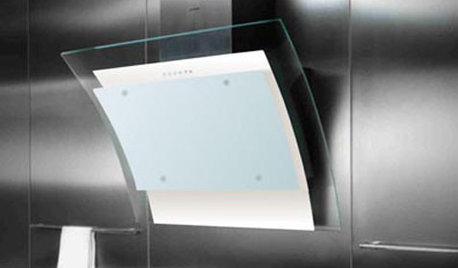
    I think something like this is nice, slimline and efficient.
  • 8 years ago

    After reading eveyrthing about hoods here (not that I considered anything but the VentaHood that I ended up getting), I will venture a guess that the above may look real purty but doesn't work worth a d**n. Maybe works even less than a flush-mount.

  • 8 years ago

    Lynn Oxenford wrote: I think something like this is nice, slimline and efficient.

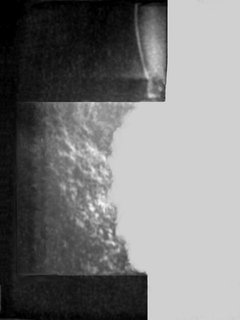
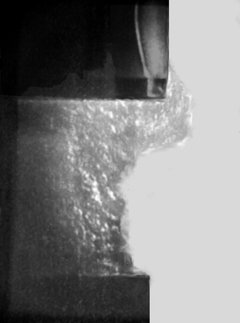
    Pretty yes, slimline yes, efficient no. The capture area is actually small (just the filter area) because there is no blockage at front and back (and barely any at the sides) to direct/constrain the impinging plumes from spilling out everywhere. What one needs is both a capture volume with low enough reflection properties that the plumes are contained, and a containment zone that the capture volume feeds. Even with commercial hoods with their usually excellent capture configurations, if there isn't enough flow rate over the aperture area there will be spillage. See schlieren photos below.


  • 8 years ago

    There is nothing unobtrusive about that hood above. OP, can you do as Sophie has suggested and post the design plan? You really don't know what you don't know, at this point.

  • 8 years ago

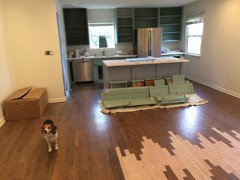
    I'm not at home, this is the best I can do right now...the latest photo I have - I know it's at a distance. The oven will be built in underneath the cooktop. As you can see, it's a very small kitchen and we're quite deep into our renovation and at the end of our budget. Not really a whole lot we can do at this point to rearrange things. We aren't unhappy with the arrangements per se. And I think we may have found a downdraft that will work in the Decor Renaissance model.

  • 8 years ago
    last modified: 8 years ago

    You can not physically fit a downdraft, wall oven, and cooktop into that space. And it’s about 3x-5x the cost of doing a range with an overhead hood. That island is too small for a cooking zone and prep zone.

    The fridge breaks up a run of a counter. That is a giant NO NO. The range should go where you have the fridge.

    The fridge should go to the right of the window on the right. Then your island can be smaller, and be nothing but a work zone.

  • 8 years ago

    @sophie wheeler - why would I put the fridge by the window on the right all by itself and have it block my way around the island? Seems very strange.


  • 8 years ago
    last modified: 8 years ago

    Why would it block your way around an island if you leave an appropriate traffic path open there?

    Putting a range where the fridge is will greatly simplify venting. And make it loads cheaper. It can go straight out the wall to the outside.

  • PRO
    8 years ago


    I agree that the refrigerator would be best relocated and a range should go on the back wall where it is now.

    Finding a home for the fridge needs more information. What’s the door to the left? Can you post a measured diagram of the space and the adjacent spaces?

  • 5 years ago

    Erin, I can see why you didn’t push the fridge so that it overlapped the window trim. That would have been a a terrible move. I’m sure your kitchen turned out great. I have a kitchen very similar to this and it works great.