Software
Houzz Logo Print
heberling_ryan

Electrical and Gas questions for new home build

8 years ago
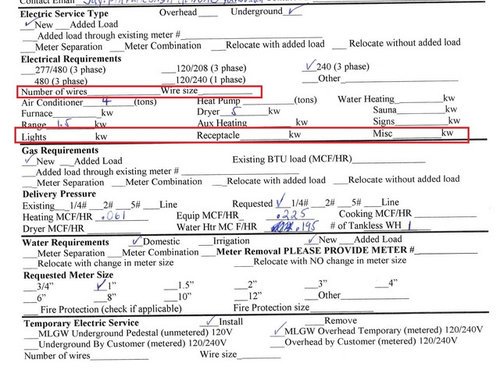
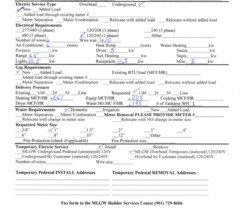
I have been working on purchasing a property near me to build a 4 bed 4 bath (3100 sq ft) home on. Just before we were about to put an offer on the property, I thought to call the utility company to get a quote to run utilities, and they "ballpark quoted" me $30,000 to $45,000. It seemed high to me but even with that cost, the property might be worth it, so I would like to move forward with getting an actual quote. This requires me to submit a "work request form" to the utility company. I talked with a few friends who are builders etc... and got most of it completed, but I have some electrical questions remaining.


The first one is "Number of wires and Wire Size". I asked the guy at the utility company to elaborate and he replied with "We are needing to know what size wire and how many will be connected into our pedestal."


The second part is an estimated kw for lights, receptacle, and misc (future shop)


Any input on these remaining items, and other items I have already completed, would be greatly appreciated.


Thanks in advance,


Ryan


Comments (24)

  • 8 years ago
  • PRO
    8 years ago
    There are residential load calc spreadsheets available online that will help you. They're in the format that most of my local building departments want.

    I wouldn't be comfortable except that I have worked with both my electrical contractor and plumbing contractor to back check me the 1st couple of times I've done these.

    The online excel spreadsheets require manual math checks to make sure you've made all the adjustments as they aren't 100% automated.

    I suggest you find a couple you trust.

    The homes I'm building right now several in the 4000-5000' range all have 400 amp panels, however they're all calcing right around 200 amps. In California we use a lot of breakers for safety so I use a couple of sub panels in every house for breaker space.

    Heat, water heating and ranges are gas. usually 500-800 BTUs total.
  • 8 years ago

    Location might be helpful as it might bring out some folks who have dealt with the same thing in your area.

    Might also find out if there is a savings by not doing gas. It is pretty easy nowadays to get gas use so low that propane makes more sense to avoid the install charge.

  • PRO
    8 years ago

    What state are you in? Remind me not to build there. :-)

    All utility companies run they services to the house for free. The only thing they charge me is for the street opening permit which never exceeded $1000.

    The Gas company gives a similar paper to fill out and only asks for the total BTU for all appliances and Electrical they only ask what size service is going in.

  • 8 years ago

    I find it strange the utility company is asking the size of the wire and the number of conductors on their request form for a residential home. I would have thought the utility's engineers should figure that out.

    I have never made a utility request, and I am not an expert, but I will give you my comments.

    Why are you requesting a 3 phase power requirement? Are planning to install big motors in your house? I could be wrong but I believe 120/240 (1 phase) is the correct requirement for a house.

    I think a 200 amp service line would be sufficient. I believe the wire size for copper would be 2/0 with 3 wires (2 hot, 1 neutral). In some areas the code may allow you to go to down a wire size for the neutral wire. I that seems risky to me so for a little more money I would keep all wires the same size.

    If you are getting a gas line then why are you specifying an electric clothes dryer? Wouldn't you want to use gas? Same thing for the cooking range, unless you have a preference for an electric stove.

    A tankless hot water heater usually has an input of 200,000 BTUs versus a tank which is 40K-50K BTUs. I personally don't think tankless water heaters are worth the extra money and maintenance, but that is my opinion.

  • 8 years ago
    last modified: 8 years ago

    Jeffrey, could you link me to one of those calculators?

    Emerald, I do have a builder (who obviously would have an elec. contractor), but every builder around here is so busy, and this guy doesnt seem to want to give me the time of day until I own the lot etc... Part of the reason is that he builds further south. He really didnt even want to build for me because its pretty far out for him, but said he would if he could build 2 houses, and I have an other guy going in with me to split this parcel and build a home as well. At first, you might say that I should pick another builder, but I contacted 25 builders... only 6 responded... 3 only build their own plans on their own lots, 1 was too expensive, 1 wouldnt build that far out, and the other is the one that I picked, because he actually responded, was affordable, and has built the plan I want about 7 times.

    I sent my builder the work order form several weeks ago and bugged him for 3 weeks. Finally I just called him and he seemed annoyed and just kinda read out some of the answers and said he didnt know the rest so I am trying to figure it out on my own.

    GN Builders, yea its pretty ridiculous. I live in the Memphis area and our utility company is MLGW which is the largest utility in the country, and they handle all utilities other than sewer. Its a government mandated monopoly, so theres not much choice... The guy I talked to at MLGW even flat out told me not to build in shelby county. He said he lives in fayette county and if I built there the utility company there would run it for free. the reason it is so expensive is because they have to install my own transformer, run 1200 feet of primary, and then loop it back 1200 ft to where it came from.

    Mike, yes I plan on having a shop with welders and cnc machines. I also do home brew as a hobby and would like to brew on 240. Its also what the builder recommended. We have always used electric clothes dryers. We have a 2 and 3 year old so I just like the idea of an electric cooktop vs gas for safety reasons. My wife also isnt the best house keeper, so a smooth cooktop is less work to keep clean. As for the water heater, sure it uses 4 times the btu, but it also doesnt have to maintain temperature for an entire tank of water. My friend who builds 6000+ sq ft homes in nashville highly recommended a particular tankless heater that recirculates and he said its well worth it.


  • 8 years ago

    I live in rural PA and to run to my home site is about 1500' from property line... My quotes are about the same as yours for underground- and I have to provide the trench and the conduit! Doing poles and above ground, they will cover the first 500' here which saves quite a bit.

  • 8 years ago

    doc5md, yea see i still have another 500 to 700 to run service AFTER the utility company bends me over to get the utilities to the entrance of my property :(

  • PRO
    8 years ago

    Ryan, you don’t need 3phase to run welders, or a lathe etc. 3 phase is for industrial level machinery and use level. One or two 3phase pieces of equipment can run on phase converters just fine for home use. We have 3 phase band saw, milling machine, and lathe, and they do just fine with a converter. The welders are just straight 240.

    You will need more than a 200 amp service. Likely 200-400 for the house and a 100-200 subpanel for the shop, if you want a hobbyist shop. A hobbyist isn’t going to run all of that at once.

    Gas tankless will need a larger main service than they usually drop. Especially if your home plumbing setup needs two tankless, as is often the case. Large homes often do. We ran 1” pipe to feed ours.

    But, I think you may have picked up a commercial form. Not residential. MLGW is not noted for their customer service or accuracy.

    DeSoto county is much friendlier to new construction. Much friendlier. As is any county outside Shelby. They are better long term investments too.

  • 8 years ago
    last modified: 8 years ago

    A lot of the spiffier lathes these day use VFD to generate three phase at different frequencies than the standard 60Hz. They're fed just fine by 240V single fphase.

    If you've got a relatively efficient heating and cooling plant AND gas hot water, you may be able to get by on 200A. I've got 400A service but the load meter I have shows even running my biggest tools in the shop (the planar or the table saw in concert with the 3HP dust colelctor) the total house load doesn't get anywhere near maxing out.

    Welders are usually inherently single phase things anyhow. You actually get more bang running them on a single phase 240 than the 208 you will often get if you have three phase service.

  • 8 years ago

    Small world! We are building an edited version of this plan in TN. 2-3 weeks out...and we also switched to brick and wood exterior. We made some changes but are so happy with what we have!

  • 8 years ago

    given a choice between 120/208 3-phase and 240v 3-phase, you'll chose 120/208v. You are not going to run 240v throughout your house.

    Agree with 400amp service if you're going to run a shop.

    If gas is available, a tankless electric WH would be stupid. Use gas. But then remember you'll probably need a larger than 'standard residential' supply line.

    With gas, you can flip a coin about electric or gas dryer, or cooktop/oven.


  • 8 years ago
    last modified: 8 years ago

    April nice. Yea I had seen pintail construction (the builder im going with) post it on their facebook page a while back and I liked it. At the time, they said they wouldnt build for us because its too far out for them. They call it their "coal" plan. However, after he said he wouldnt build for us, I went plan shopping and found the exact same plan... Its pretty much everything we needed, i.e. 4 bed 3/4 bath, walk in pantry, open kitchen to den, and the wife wanted porches and a big closet.

    What part of TN are you building in? Got any pics of your build?

  • 8 years ago

    Here is an update on the progress of the form. I believe it is complete and i went ahead and submitted it. I am sure that the util company can adjust on the fly if needed. Check it out and let me know what you guys think.

    I worked with multiple friends that are builders in other parts of the state, and worked with another buddy who is an electrical engineer.

    He suggested 120/240 1 phase, 6 wires 4/0 in parallel for 400 amp service, then suggested just running a a sub off the main panel for the shop. He said it should be plenty, unless i built a huge 40x60 shop and hvac'd it all, but even then it would still probably cover it.

  • 8 years ago

    I was going to suggest going off grid electric, but given the power demands for the hobbies, that is a lot of panels. Still, I'd do the calculations. Is that a good wind area? If you can do it, you might flip David's suggestion of one utility around. Going back at least a decade, there are plenty of people out there that got disgusted with the cost of brining in electricity and went off grid instead. If you have nat gat, genset manufacturers have finally come around to making DC gensets for that application. (You really need a generator to equalize batteries by my understanding. That may well be, however, for flooded cell batteries only.)

    How come 3 ph is not a better way than single? You'd get 50% more power adding a third conductor of the same size. If you can get the POCO to give you 3 ph open delta, you can have 3 ph and 240V. That said,as Mike pointed out, with the cost of VFDs so low, what's the point? I was shocked when I looked at costs online a few months back. Note that you have to be careful about how the utility bills other than residential 124/240 too. The local utilities commission regulates that and some make sure that commercial and industrial users pay more by charging lots more/kWh for anything 3 phase.

    If you build efficiently, your costs other than the shop, hobby and domestic hot water can be be nil. Tankless and recirc seems like a weird match to me. You have a system that provides hot water on demand so you have no standby losses, then you connect it to a system with standby losses. Is the recirc going to be on a timer or controlled with occupancy sensors? If I have gas and need a new water heater, I'd buy a Westinghouse WGR060NG076 or larger tank and never look back. That goes especially with hard water unless you plan to install a water softener. Have you done the well research yet or maybe drilled already?

    I'd go with induction for your cooking hobs if you want easy clean-up. There is nothing easier. If you are not sure about it, buy a plug-in unit and see if you like it. You may save a lot of AC costs in addition to the straight savings at the cooktop. Ideally, I'd like one resistance hob for simmering. They suffer from the same drawbacks of the duty-cycle controlled power output as thermostatic resistance heating devices. I don't know if inverter powered induction is theoretically possible or practical as it is for microwave ovens, but it might work well if it is.

  • 8 years ago

    I couldn't figure out how to just message them to you but here are a few older ones from instagram:

    https://www.instagram.com/amherron21/

  • 8 years ago

    One of my tankless systems is a recirc. It is on a timer and it actually isn't too bad if the pipes are insulated. Most of the time, you're just running the hot water slightly cooled through the system but periodically the heater has to fire up for a minute or so to rewarm the water. In addition mine passes through a Desuperheater which also uses some of the waste heat from the airconditioner to bring up the temperature of the water.

  • 8 years ago

    Ron, you are using a desuperheater to heat DHW with no storage (tankless)? I have to be that is not the case since it is a missed opportunity.

    If running the larger capacity utilities required for tankless is adding a lot of cost, that might be a good enough reason to avoid tankless water heating. What is being used to heat the house, a furnace or boiler? If the latter, an indirect tank will serve you well.

    Weedmeister, the trouble with 208/120 in residential service is that residential equipment that uses 240 for resistance heating is going to be slower at 208. For tank water heaters that problem can easily be avoided by using commercial water heaters. They do cost more. Kitchen ranges and ovens are another problem that might be solved with commercial equipment at considerable cost sometimes. Motors are very often dual rated. Electric clothes dryers are a problem. This is what three phase "high leg" (open or closed) delta is provided for. For a period it was not unusual in some places for residential, but has largely fallen from favor. I think it is still common in light industrial and commercial applications. I can drive down streets all the time and see transformer installations that are apparently designed for this. In an area with primarily single phase it is easy to spot because the poles will have two or three transformers rather than one. Often one of the transformers will be smaller than the other(s) since that one is only used for the limited three-phase. Around here, it is hooked to homes that had the earliest central air conditioning.

  • 8 years ago

    Perhaps I missed it, but what about getting rid of gas altogether?
    Use a heat pump water heater - it would be less than the gas tankless and you wouldn't have the cost of running gas or the monthly fixed charge for gas.

  • 8 years ago

    So here's the thing... I'd seriously consider if I needed 3 phase or if I could do with standard single phase 400 amp service or possibly 200 amp even.

    It's not only the initial cost, it's the monthly ongoing costs that will be excessive.

    Get rid of the gas altogether. This is new construction, in the south, and bringing in gas is expensive. That's the combo for using heat pump, hybrid water heater and electric appliances and no gas.


  • 8 years ago

    Jake The Wonderdog I am debating getting rid of gas, because its probably going to cost me around $10,000.

  • 8 years ago

    Here, gas, elec, sewer and water are all at the street and builder/homeowner is responsible for getting from the street to the house.

    Agree with skipping NG if cooking on gas is not a priority. We cook a lot and have a couple of commercial countertop induction plates and have induction in Florida but much prefer a gas range in our main house.

    My 3-phase Northland bandsaw is quite happy running off an inverter. Also, I believe the only 3-phase available in our area (and possibly yours?) is a 208v bastard leg so effectively the same as standard 240v unless you have 208v lighting or other needs.

    Make sure to include enough electrical for car/truck charging.

    Solar may be a cost effective alternative to offset some ongoing costs and allow you to go w/ a smaller service entrance.


  • 8 years ago

    opaone, I don't understand what you mean when you say high leg delta power is "effectively the same as standard 240V...." They provide three phase that looks to your equipment, like any other three phase. They also provide 120/240 single phase that looks like any other common residential singe phase connection to your equipment. I look at it as two service types layered into one. You choose your layer and work with it ignoring the other one. One day you have three hot legs and the next, two hots and a neutral.