Software
Houzz Logo Print
jaxo_gw

How to fix drip line?

8 years ago
last modified: 8 years ago
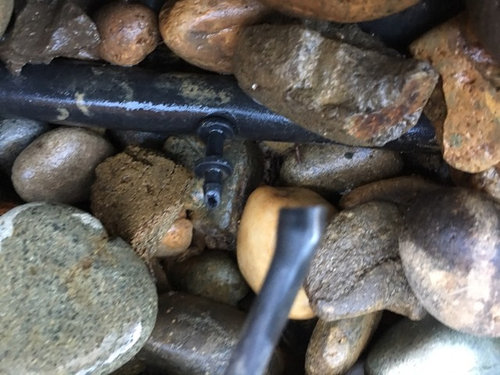
Water started spraying from my drip irrigation as shown in the photo.

Of course, I tried popping it back on, but when the water was turned on, it immediately popped off again.

How can it be repaired?

What kind of irrigation can can I get that’s more robust? This installation is only a couple of years old and I don’t want to keep repairing it or have it break while I’m out of town.

This seems way too precarious, delicate and unreliable.


Comments (15)

  • 8 years ago

    Several reasons for such unexpected disconnections:

    1. The pressure is too high. (ie: Faucet turned on too far and/or needs a pressure reducer at the head of the line.)

    2. Using several different brands of components. [Believe it or not -- Half-inch (etc) isn't the same from one brand to another.]

  • 8 years ago

    You are using 1/4" tubing, make a fresh cut and put it back on the barb and also what Jean says, you need a pressure regulator.

  • 8 years ago
    last modified: 8 years ago

    There is a pressure regulator already installed.

    I had a sprinkle repair contractor come out and take a look and they said the pressure seems normal and that these spaghetti lines wear out periodically.

    The only suggestions they had were to replace the line with a new one with built-in emitters at each tree instead of using spaghetti lines or else to use a soaker line.

    I don't like the idea of using the soaker line because then there would be water going where there are no plants and that would encourage weed growth plus waste some water.

    I'm thinking of going with the first option. I suppose I could also proactively have the spaghetti lines replaced every year so they never break unexpectedly, but that's a lot of ongoing maintenance.

    Is there a particular type of irrigation line that is more robust than others? I want this to be the last time I ever fix this other than replace the valve and timer box when they eventually wear out.

    I want minimal maintenance possible. I would pull the irrigation out completely and plant drought resistant plants that will survive without irrigation, but I haven't seen anything narrow enough to fit in the constrained area that will also grow tall enough to provide privacy.

    The Dwarf Italian Cypress trees planted along the fence fit and will eventually grow into the the privacy shield I want, but they need irrigation to survive in this area. At least they don't need pruning and don't shed leaves, so they are low maintenance otherwise.

  • 8 years ago

    Depending upon what kind of pressure regulator is in place -- especially the inexpensive kind for homeowner kits -- excess incoming pressure can over come it.

  • 8 years ago

    I have a complex drip irrigation system with many kinds of lines and zones and I have never had a line pop off like that. My supply lines are all regulated to about 30 psi by the irrigation valves and their pressure reducers. What type of pressure regulator are you using and what pressure is it supposed to be controlling to? And have you checked the pressure downstream of the regulator with a gauge? If your pressure is too high, you could get some hose fittings for the 1/2" tubing and install one of these inline: 25 PSI pressure reducer

    It also looks like the spaghetti lines you are using are the hard plastic ones, and I never use those with a fitting like that. All of my drip lines are the softer, 1/4" vinyl variety, and, once the fitting gets inserted in those, they are not going to slip off. Try using this kind of drip line for a better result: 1/4" vinyl microtubing

    As for the explanation you were given that the lines "wear out periodically," that sounds like baloney to me. I have some lines that are 15 years old and none of them have worn out.


  • 8 years ago

    Your pressure may be good for a sprinkler system, but too high for drip irrigation. Also, I think all drip irrigation will always need some maintenance. They (Orbit) have 1/4" clamps you can purchase to tighten the tubing over the fittings. And soaker hose comes in the same sizes as a poly tubing to go with it. Hence putting the poly where you don't want water. Any drip you install, if the pressure is too high, it will blow things off. Get a gauge and check it. Also if your 1/4" line is vinyl, it will stretch more easily than a 1/4" poly. My opinion only, as Kudzu thinks the vinyl is better, which is fine. 30 psi is fine for drip irrigation.

  • 8 years ago

    So, the pressure should be 30 PSI or 25 PSI for drip irrigation? How do I verify that's what the pressure is and that the emitters are watering at their rated amount at that pressure?

  • 8 years ago
    last modified: 8 years ago

    The the spaghetti lines are not hard plastic, but the one that popped off wouldn't stay on when I turned the system back on.

    The contractor fixed the single broken drip line and will be coming back in a couple weeks to redo the whole thing without any spaghetti line microtubing. The emitters will come directly out of the main line directly at each plant.

    I can also have them add pressure reducers if needed.

  • 8 years ago
    last modified: 8 years ago

    jaxo-

    It’s hard to tell from your description what you have. When I said “hard plastic” I didn’t mean totally rigid...I just meant that some types of microtubing aren't as soft as the kind I showed you, and is not clear what you are using. I'd like to give you mire advice, but I need to understand what you have. What is the drip system connected to? Is it connected to a hose? To an inground irrigation system with a timer and valves? Where is the pressure reducer that it's supposed to be connected to? Are you now planning to insert all drippers into 1/2" black poly in a straight line? A better explanation would help to give you better advice....

  • 8 years ago
    last modified: 8 years ago

    The whole point of drip lines is to minimize water use by applying it as a little dribble instead of a big spray, if you want to see a bunch of water being applied in a short period of time these are not for you. I have a commercially installed drip line on one of my plantings here, I was told it has to run for 45 minutes to do the job. Due to it being on the other side of my drive from the nearest water source it is fed by connecting a garden hose to it which is in turn connected to a faucet, I have to watch how much I turn the faucet on otherwise part of the line comes apart near where the hose is connected to it.

  • 8 years ago
    last modified: 8 years ago

    iI thought you meant rigid lines. I can squeeze the microtubing line easily with my fingers.

    I know it's supposed to drip and not spray, but I wanted to know if it requires a certain amount of water pressure to drip at the nozzle's rated flow rate. It should be able to flow out onto the ground without spraying into the air, but still not take forever to water these plants.

    It is attached to an in ground irrigation system with a timer, not a garden hose. The sprinkler repair company is going to replace the irrigation line and I'll ask them to add pressure reducers on top of the regulator attached to the timer if necessary, but I don't know how to tell if that will be necessary.

  • 8 years ago

    Embothrium-

    Attaching it directly to the hose means you have to worry about the high pressure. The way to fix this is to get a $5 pressure reducer, like the one I linked to in my post above, which will limit the pressure to 25 psi. Even better would be to have an Electronic Timer attached to the faucet followed by the pressure reducer. You could put a brass Y on the faucet and have a regular hose on one leg and the timer/pressure reducer/hose/dripper on the other. That way you could leave everything connected and have a dripper that came on automatically and wouldn't get blown off.

    As far as the 45 minutes, that is not fixed in stone. It depends on the particular plant, the volume the dripper delivers, the frequency, and the weather. Most of my drippers are 1 gph and are on in the summer for about 20 minutes, 3 times a week. Some of the bigger plants/trees have 2 gph drippers, and some of the smaller ones have 1/2 gph drippers. I vary things if it gets too hot or too rainy. I also have my system come on in the early morning, rather than the heat of the day.

  • 8 years ago

    This is what the irrigation equipment looks like.

  • 8 years ago

    jaxo-

    Okay...maybe we are talking about the same type of 1/4" line. I just looked at your picture and saw the smaller, black, out-of-focus line and it didn't look like standard dripper line to me. Can you post a clearer picture of a drip line connected to a fitting? It's still not clear to me why a line would pop off if the pressure was low enough for drip line (25-30 psi). Many, but not all, valves have a pressure reducer screwed directly to them, but they can go bad over time. Or maybe you don't have one. If you have one attached to a valve it might look like this:

    Another problem is that, if you have pop-up sprayers, you want full line pressure, and if you have drippers you don't. That means that you don't want to have both on the same line. You want separate lines so you can have the appropriate pressures for each. As far as measuring the pressure, you'd need a water pressure gauge which you can get for $10 at a big box store. It has hose threads, and would allow you to measure what the water pressure is at your faucet. If you wanted to measure what the pressure is for the drip line, you'd need to cut the 1/2" poly at a point before any of the drippers and mount a plastic male hose fitting on the line. The you could attach the gauge and see how much pressure you have when the system comes on. You could fix the break by putting a female hose fitting on the remaining cut end, and then screw the line back together.

  • 8 years ago

    jaxo-

    In the picture you just posted, I suspect the round shape with the black cap that is in front of the valve is the pressure reducer. Definitely have the irrigation guy look at that and see if he thinks it's working ok.

    Good luck. I'd be interested to hear what you have to report after the system gets repaired.

Sponsored
Hope Restoration & General Contracting
Average rating: 4.7 out of 5 stars35 Reviews
Columbus Design-Build, Kitchen & Bath Remodeling, Historic Renovations