Software
Houzz Logo Print
lemonbug

Shrubs brownin quickly

8 years ago
last modified: 8 years ago

Hi-

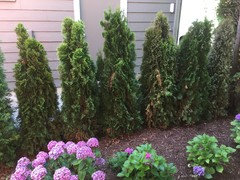
We live in Seatle and these shrubs we have were planted by landscapers last Nov because the previous ones were dead. We also moved into this house at that time. It has been normal here up until last week when temps have been 90 a few days. Since then one shrub is dead and the others have a lot of brown spots forming very quickly. Up until this time we have not watered the shrubs at all but have had what I consider to be regular rain.

I have been watering each plant for several minutes each once a day lately assuming it was too hot. Our neighborhood has these all over the place and they all look good except for ours.

Are these shrubs not getting enough water? Any thoughts are appreciated.


Comments (14)

  • 8 years ago

    Can you post a picture or two? It would be helpful.

  • 8 years ago
    last modified: 8 years ago

    Spring starts in Feb. here, for months after that the precipitation gradually becomes completely inadequate* - you should have started attending this planting some time ago, by now we are well into the very driest time of the year. Poke around in the original potting- or field soil root masses they came with last fall to see if you are getting these moist. And if there isn't a nice mulch layer shading the soil around them, get that corrected also - the sun bakes the moisture right out of exposed soil.

    Recently planted stock may need ample watering for at least one summer, even when consisting of otherwise drought adapted kinds. This set of shrubs you have going in in November may mean it did not root out that much before winter started. So that it may be not much more independent at this point than a spring planting.

    Otherwise if these plants look like this

    https://www.bing.com/images/search?q=smaragd+arborvitae&qpvt=smaragd+arborvitae&FORM=IGRE

    many existing hedges of this cultivar have been having dying out of a percentage of individual specimens here in recent years. As this variety is unusually prone to root rot for the species that probably has something to do with it part of the time. Otherwise I think people aren't watering them enough for the summer weather we have been having. And some of them may be getting taken out by heavy mite infestations, plant sucking mites thrive during hot dry weather - and I have seen some specific instances of these plants being discolored by mites in past years. Not sure I've ever seen one I was certain had been sucked dry, but I have seen some significant effects (large sections of dull looking foliage, clearly heavily infested by mites when examined closely).

    *Less than one inch per week of rain = time to water, except for fully established specimens of drought adapted or tolerant kinds

  • 8 years ago

    SOrry. Don’t know what happened to my picture. It was attached. Will submit when I get home. You can’t help without knowing what plant we are taking about ;)

  • 8 years ago

    Weird. It never posts the photos I put in my original post. Even if I go back it puts a greyed out pic then doesnt post it. Anyhow, here is what we are dealing with. These suckers are ALL over the neighborhood and flourishing. Don't know if we have bugs over here or too much light?

  • 8 years ago

    Well, they're certainly much too close together.

  • 8 years ago

    Keep an eye on soil moisture by actually checking by putting your fingers into the original potting soil as well as the surrounding soil several inches down. You want moist, not dry or soggy. The reason yours look more stressed than others in the neighborhood is because they are new and don’t have established root systems that have extended much beyond the original root ball. The really tight planting may look fine now, but will be an issue once they grow because you haven’t left room for them to get wider.

    lemonbug thanked NHBabs z4b-5a NH
  • 8 years ago

    Up until this time we have not watered the shrubs at all .....
    I have been watering each plant for several minutes each once a day lately assuming it was too hot.


    ==>> insufficient water for an UNestablished large transplant ...


    dig a few 3 to 6 inch holes.. and i bet you find out.. there is no water down at root level ...


    most likely .. they all need the hose put on trickle ... and a good long DEEP drink ..


    ken

    see section on watering

    https://sites.google.com/site/tnarboretum/Home/planting-a-tree-or-shrub

  • 8 years ago

    Thanks everyone. Will the brown spots recover on these plants if I get them adequate water or are they going to have permanent damage spots?

  • 8 years ago

    I will try and save them. We are new to the PNW and they seem to have these plants very close together here. I must say that the more mature ones in the neighborhood look very nice, almost like a wall the way they have them trimmed.

  • 8 years ago

    These don't get wide - Smaragd's will only spread to about 3', which is why they are planted closely to develop into a solid green screen or hedge. Lord knows I've spec'd or designed dozens of these for clients over the years and the spacing IS tight for just that reason!

    As to how well the existing plants will do is up for some speculation. A few exhibit a grayish cast which can be an indication that a lack of water has gone too far. If they do make it with regular deep watering, eventually some newer growth will help to disguise the brown patches but the dead portions at the base of the plants will remain.

  • 8 years ago

    Thanks. We messed up. The one on the right is dead for sure.

  • 8 years ago
    last modified: 8 years ago

    >It's not bugs<

    I happened to drive by a specific 'Smaragd' planting where I noticed a clearly discernible mite infestation in a previous summer, there is now completely dead plants here and there in this same grouping. So it seems mites - thriving in the hot and dry periods of recent summers - may actually have quite a bit to do with the large number of local plantings - including long established ones - of this much used cultivar that have a percentage of dead or dying specimens.

  • 8 years ago

    Very little chance - I would say none at all - that arbs planed in November would develop a mite infestation over our wettest time of year!!

    And unless there is some bizarre bug problem that exists on the east side of the Sound but not on the west, spider mites affecting arborvitae to that extent in the Puget Sound area are just not an issue. I encounter massed arb plantings on a pretty much a daily basis in my business and the overwhelming problem is improper watering....either too much or not enough. And deer predation.

Sponsored