Software
Houzz Logo Print
superman859

Dying Pieris - Overwatered Possibly?

8 years ago
Hello all,


I'm new to gardening and am trying to build out a woodland garden in shade area. I had a landscape company provide a design which included pieris, but they aren't doing very well at all. I've only had them 3 months and one has dropped nearly all leaves, another is dropping leaves as well.


I have irrigation run for 10 minutes several times a week which has worked fine historically for other plants in area. Soil feels moist and meter says it's moist. I applied slightly acidic fertilizer as well.


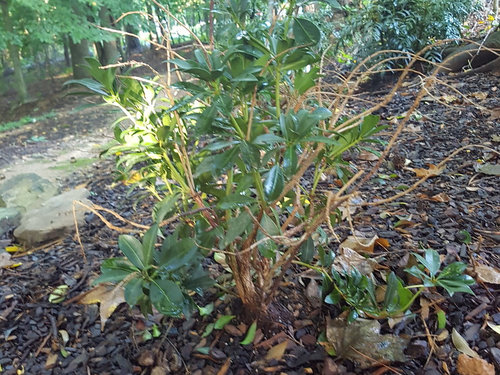
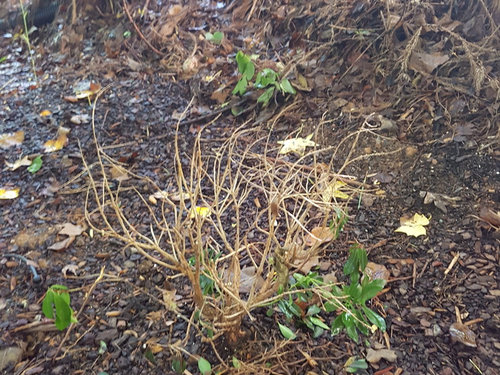
Primary thing I noticed besides leaf drop is the leaves are browning starting at stem, not all throughout the leaf. They drop still mostly green. Included below picture of plant that has lost nearly all leaves in a few months and the other which is losing them as well but still has a fair amount.


Is this over watering? Is the worse one saveable? A lot of the stems do still have some green if scraped, although no leaves.


Comments (4)

  • 8 years ago

    i am glad to hear.. someone actually tested the soil.. to determine water content ...


    but you might go one step further.. and dig a couple 3 to 6 inch holes.. near the media gob planted .... with a hand trowel .. and find out how much moisture is further down in the root mass ... just to make sure ... both in the gob.. and surrounding soil ....


    you mention historically 10 mins is enough water.. do you mean on recent transplants.. or plants that have been there for years .... its the transplant stresses we are dealing with ...


    i would NEVER fert a transplant.. or any shrub for that matter ... the plants are stressed.. not hungry .... lets not do that again ... imo ....


    i am wondering about stock grown in sun.. then put into a shade ... i am wondering about lack of light .. as a stressor ... they may full well adjust with new leaves... but the older leaves.. those that fell off.. might be stressed not only from the transplant.. but the sudden change in light levels ...


    if you are going to hang around .. plz go back to your members page.. and add your location so it shows in all your posts.. in the meantime... where are you ...


    what is your native soil ... and does it drain ... if it does... and your soil is moist.. rather than sodden.. then i might rule out over watering ...


    as long as they hold leaves ... they will probably recover ... but that might take a year or 3 ....


    but if you have a warranty ... you might want to talk to your seller.. and replace the worst of the lot ... like the one in the first pic.. the second pic.. look ok to me...


    ken


  • 8 years ago

    Thanks for the info. I did check moisture content fairly deep and it seems pretty wet. We've also had more rain than usual here in Atlanta GA this year (I purchased a rain sensor not too long ago to start keeping better track). Currently we seem to be getting 1-2" of rain per week for the past 3 weeks since I've been tracking. Historical watering is a mix of older plants and recent ones. I have several old and new mahonias and they all seem to do pretty well.


    The soil is somewhat clay like, although I mixed in shrub planting mix about a month ago and it seems to have softened it up quite a bit and made it a lot less clumpy (ie it's pretty easy to stick my moisture probe into the ground even 6-8" with little effort).


    I did further investigation yesterday and on the worst one most of the limbs were actually dead without green. I pulled it out and looked at the root ball after reading a bit more and it looked over watered (I think). Most of the roots were very small and different from many videos about root rot (usually fresh / larger plants with larger roots that were either mushy brown (bad) or white (good)). However, there were a few larger roots in there that were pretty soft and brown, but a few that were not too soft and still had some white left.


    Below is a picture of the wad of roots, mostly visible are all the really small fuzzy roots that seem to come out of larger ones, so it's a bit hard to see (again, none of the videos online seemed to have all these small roots, so idk if it is this particular plant or something else I don't understand).


    I ended up pruning off all the dead limbs and a little bit of the roots that seemed too mushy where possible and putting in a pot for now so I can keep a closer eye on moisture. There isn't much left to the top of the plant and many of the roots on bottom may or may not still be good, but we will see. I doubt it will make it.


    I inspected the roots of the better plant as well and they seem to be a little better, but likely overwatered as well. It does look better than the first, but in the second pic above you can clearly see many empty stems - 3 months ago those were all full of leaves. I've shut off irrigation to it for now and will start keeping a closer eye on watering back there and checking moisture content every few days until I get a better feel for how much watering is actually needed. I'm hoping adjusting watering for that plant will be enough to let it start growing again.


    Lastly, the plants do have a "lifetime guarantee" but there is a note stating it doesn't cover improper watering....How does this work? I've never tried to return a plant. Based off what I can tell, I'd guess it was improperly watered (over watered), but I could be wrong. Is that something the store would immediately recognize if I tried to return? It seems improper watering (too much or too little) is likely the cause of 90% of plants not surviving, so I'm not sure if that warranty is good or bad.

  • 8 years ago

    These kinds of shrubs -- acid-loving evergreens with masses of fibrous roots -- simply don't do well in some conditions. The only plants I've ever lost were pieris, kalmia and azaleas transplanted from nursery pots into my garden soil. Azaleas planted in containers have done great.

    Well-draining soil is a must. Otherwise they are susceptible to root rot caused by phytophthora occurring naturally in some soils. I hope your pieris comes back but I'm afraid chances are slim at this point.

  • 8 years ago
    last modified: 8 years ago

    Don't know if it applies to you but far enough south it is just too hot to get any heath family plants to not rot off other than certain hot climate adapted ones like the evergreen azaleas of certain types that have become familiar features there.

    Also where a soil may be too damp amending the planting hole back-fill much tends to make this worse, rather than better.

Sponsored
Wannemacher Interiors
Average rating: 5 out of 5 stars26 Reviews
Customized Award-Winning Interior Design Solutions in Franklin Cnty OH