

Killing a Black Walnut Tree with Roundup? Area contamination?
We have a place where two tall, but thin, Black Walnuts grew up in a grape arbor. They're definitely hurting the grapes. We'd like to girdle them and then immediately apply Roundup to the cuts to insure the whole tree, root and all die. We don't want to cut it down right now because that would hurt the grapevines during the growing season. Its an old vine and we'd rather prune it in the winter. I'd also like to use the trees once dead, which are 6-5 inches diameter and at least 25 feet tall, as intact poles to attach a wire shortwave antenna that would run from the house, even though the dead trees might only last 3-5 years for that purpose.
- So my question is: would the Roundup going into the tree roots potentially hurt the roots of the grapevine which are no doubt entangled. Or would the Roundup essentially stay within the roots of the trees without hurting the grapevine roots? I know that Roundup usually breaks down fast. Advice please. Thanks.
Comments (39)
 8 years ago
The Round up should not. I always worry about it contaminating across root grafts myself.
- 8 years ago
Why on earth would you want to apply that product to those trees? Girdling will kill without using a product that is not an acceptable organic material. An even quicker method of killing them is to cut them down without girdling them.
iowariver thanked kimmq Related Professionals
Mobile Landscape Architects & Landscape Designers · Allentown Landscape Architects & Landscape Designers · Hagerstown Landscape Contractors · Annapolis Architects & Building Designers · Elkton Architects & Building Designers · Victoria Landscape Architects & Landscape Designers · Sarasota Landscape Contractors · Fort Wayne Landscape Contractors · Keene Landscape Contractors · Daytona Beach Home Additions · Concord Home Additions · Fredericksburg Home Additions · Joplin Landscape Contractors · Edmonton Landscape Contractors · Kenosha Architects & Building Designers- 8 years ago
i have applied undiluted RU to many plants [usually bird sown trees] that were growing up thru the middle of a plant i did not want to kill .. with no adverse effect on the wanted plant ... [RU is labeled as a stump killer ... at least it was back when i read the label for this purpose]
you would use it to kill the root mass ... many plants.. many trees.. will not die.. simply due to being cut down ...
you would paint it on ... this is NOT A SPRAY application ... especially not diluted spray ...
in terms of tree time .... i dont really see the difference between doing it now.. or at the end of grape season.... but that is personal choice ....
keniowariver thanked ken_adrian Adrian MI cold Z5  8 years agolast modified: 8 years ago
"Girdling will kill without using a product that is not an acceptable organic material."
Not true. Girdling will kill the top growth of a tree above where it is girdled, but not not the roots and lower trunk. These will re-sprout or send out suckers. In most cases, the proper application of an herbicide can stop both of those from happening.
Another option that works besides girdling and frilling, which can be a bit tedious, is the drilling of holes several inches apart in a ring around the diameter of the trunk; 3/8" drill bit a useful all purpose size for these sort of applications. Drill down at the most acute angle possible, as far as possible, without just having the drill bit get burred in the bark. Then fill with concentrated herbicide. The tree will die.
- 8 years agolast modified: 8 years ago
The following was stated: "i have applied undiluted RU to many plants [usually bird sown trees] that were growing up thru the middle of a plant i did not want to kill .. with no adverse effect on the wanted plant "
H.Kuska comment: this not the first comment of that type, yet there are reports of uptake of glyphosate in the soil to neighboring roots.
https://homeguides.sfgate.com/effect-glyphosate-tree-roots-29076.html
Please note the 5 references in the cited article.
-------------------------------------------------------------
Also, please see:
https://www.stopogm.net/sites/stopogm.net/files/RGTNTPVR.PDF
- 8 years agolast modified: 8 years ago
"Please note the 5 references in the cited article."
Not a single one of which worked.
At any rate, it's up to people to decide themselves what sources of information to use. Many people say here, and the general experience of gardeners for decades has been, that properly applied glyphosate doesn't demonstrably affect nearby plants. Studies, in many cases, can demonstrate whatever the principal investigator wants them to demonstrate.
- 8 years agolast modified: 8 years ago
The following was stated: "Not a single one of which worked."
H.Kuska comment: ????????? For example, the first one.
https://utahpests.usu.edu/files/up-newsletter/2010/UtahPests-Newsletter-fall10.pdf
------------------------------------------------------------------------------
The second one:
https://permaculture.com.au/glyphosate-toxicity-impacts-on-the-environment-and-non-target-species/
-----------------------------------------------------------------
The following was stated: "Studies, in many cases, can demonstrate whatever the principal investigator wants them to demonstrate."
H.Kuska comment: I hope this is not a common view concerning U.S. agricultural science.
AND
"Many people say here, and the general experience of gardeners for decades has been, that properly applied glyphosate doesn't demonstrably affect nearby plants."
H.Kuska comment: The following was in a 6-21-2016 EPA document.
"Precautions, Restrictions: Do not make cut stump application when the roots of adjacent desirable trees may be grafted to the roots of the cut stump. Injury resulting from root grafting may occur in adjacent trees. Some sprouts, stems, or trees may share the same root system. Adjacent trees having similar age, height, and spacing may signal shared roots. Whether grafted or shared, injury is likely to occur to non-treated stems/trees when one or more trees sharing common roots are treated. "
https://www3.epa.gov/pesticides/chem_search/ppls/091543-00001-20160621.pdf
H.Kuska comment: Are the observed effects due to only actual root grafting or also due to root to soil to root transfer?
- 8 years ago
I would think a normal application of glysophate wouldn't penetrate the soil beyond the surface. Root grafting usually only pertains to like or very closely related species. Walnuts and grapes are genetically far apart and a root graft occurring would be highly unlikely IMO.
- 8 years ago
Mike the glyphosate travels down the treated plant to the roots where it is released into the soil. Roots of a second plant then absorb the glyphosate from the soil.
https://link.springer.com/article/10.1007/s11104-007-9387-1#
The above paper used "sandy loam" soil. This is a very common type soil sold for home garden use as it drains easily
http://www.gardenguides.com/113913-sandy-loam-soil.html
------------------------------------------------------------------------------
"The results suggest that re-mobilization of glyphosate may represent an additional transfer pathway for glyphosate to non-target plants which is strongly influenced by soil characteristics such as P fixation potential, content of plant-available iron, pH, cation exchange capacity, sand content and soil organic matter."
https://link.springer.com/article/10.1007%2Fs11104-010-0689-3------------------------------------------------------------------
This is the model that the link below proposes to explain their experimental results:
"In most plant species, glyphosate is not readily metabolized and is preferentially translocated to young growing tissues of roots and shoots, where it can accumulate in millimolar concentrations (Reddy et al., 2004;Monsanto, personal communication). In soil-grown target plants, this non-homogeneous distribution of glyphosate within the root tissues may lead to the formation of hot spots of root residues in soils, containing high levels of glyphosate, which is subsequently released during microbial degradation of the plant material. Without a fast immobilization of glyphosate by adsorption on the soil matrix, glyphosate toxicity to non-target plants may be induced by root contact with these hot spots. The non-homogeneous distribution of glyphosate-contaminated plant material in the soil could also explain the much higher variation of the data on sunflower biomass production, shikimate accumulation and Mn-nutritional status after glyphosate application to the rye grass pre-culture as compared to direct soil application (Fig. 2 but also Tables 1 and 2, Figs. 3–5). Since toxic effects can be expected only after direct root contact of the non-target plants with one of the hot spots of glyphosate-contaminated plant residues, sunflower seedlings without contact to the hot spots remained unaffected. In contrast, direct soil application of glyphosate resulted in a homogeneous distribution and lower bio-availability due to adsorption of the herbicide over the investigated soil profile."
https://www.researchgate.net/publication/222401936_Glyphosate_in_the_rhizosphere-Role_of_waiting_times_and_different_glyphosate_binding_forms_in_soils_for_phytotoxicity_to_non-target_plants
- 8 years ago
This thread may be of interest to those reading the present thread:
- 8 years ago
My 2 cents. I used commercial farm use Glyphosate 41% on some Siberian Elm trees that I removed from inside my lilac hedges. Poured it on right from a bottle and brushed it with a paint brush to evenly apply it around the inner bark layer of the stumps. I didn't let much run over the outside of the stump and did this to several trees growing in the hedge. This was end of August last season.
Later in the fall, when the leaves were off the lilacs, I noticed an area around where I cut off a Box Elder tree around 4" dia. at the ground, where the winter buds on the lilacs looked shriveled and dead brown. I looked around and it didn't look that way in all the places that I treated the Elms but there was one other area where one large Elm was cut and treated, that had dead looking buds.
This spring I have an 8 ft long part of the lilac hedge that's dead with no leaves that came this spring. And the area around the large Elm has dead lilacs around it too with some lilacs that have deformed leaves growing on them.
There are some places where I treated cut Elms and the lilacs look fine with no dead lilacs around the treated stumps and they are toward the outside of the hedge so maybe didn't have much for roots inside the hedge?
I have no way to tell for sure what happened. Could be some sort of lilac disease in some weird coincidence that attacked those lilacs that are dead?
The lilacs are already starting to fill in from the ground and sides but I'm sure going to be more careful to where I used the 41% undiluted Glyphosate method in the future.One Elm I cut and treated in a grassy area growing next to a phone hook up station show no collateral damage to the grass at all. Lilac roots go deeper than grass and I'm sure intermix with tree roots like the Elms.
- 8 years ago
Oh an after thought, earlier last season I cut off and treated some 1/2" diameter European Buckthorne that were growing in my lilac hedge on the other side of the yard. These were onlly 1/2" diameter stems. Never saw any adverse effects from those treatments.
The Large siberian elm was more like 14" diameter so a large root system and larger amount of Glyphoste used in that case.
- 8 years agolast modified: 8 years ago
Thanks for linking to that, henry.
It's good to see there was another poster on gardenweb refuting anti-glyphosate hysteria before I was! I upvoted all of his posts, and saved the thread in case something happens to it!Best statement in there:
One study about a particular characteristic of a substance in particular
situations does not instantly change the basic understanding about how
that substance acts in every other situation.You can have studies that try to demonstrate a certain thing can happen in very controlled conditions, and they demonstrate it can happen. Surprise, surprise. I worked in pharmaceutical research for a while. I know things about how real science works that most people don't.
In practice, MILLIONS of gardeners and agronomists have simply found this "root to root transfer scenario" is not an issue. Including myself. I am sure I have killed HUNDREDS of tree seedlings DIRECTLY ADJACENT to various highly desirable ornamentals with glyphosate, and had absolutely NO sign of injury. Sometimes the stems were less than 1 inch away!!! In many cases, the ornamental plant that was beset with tree seedlings starts growing FASTER, because it no longer has root competition or allelopathic inhibition!
OTOH, I will be the first to say gardeners have to be INCREDIBLY careful with imazapyr (the real professional form, not some watered down HD cr-p) and in fact I would recommend most people avoid using it unless a dire situation requires its use. Different molecule, totally different characteristics.
- 8 years ago
BTW, I am assuming correct use of the material. I'm not going to waste a bunch of glyphosate to find out, but if a large amount of concentrate is over-applied and runs into the nearby soil, yes I suppose that could cause a problem. The incorrect use of anything could cause a problem - should we ban gasoline because people can use it for self-immolation? That's one reason I like my drill and fill method, I can be sure all of it absorbs into the target plant. (for me it's more about thriftiness than concern for anything nearby) I would wonder if that happened in Bill's case...sounds to me like he might have applied more than needed. At any rate, that's literally the first plausible anecdote I've seen at these forums, going back 15 years, if even the POSSIBILITY of such damage. And we still don't know for sure. Maybe the death of the weed tree caused some change in the local biome that signaled to a pest, that then attacked the lilac.
- 8 years ago
" I would wonder if that happened in Bill's case...sounds to me like he might have applied more than needed. "
I won't argue with that because I did slather it on liberally. The large Elm was the least affected area with little dead shoots and only a few with deformed leaves this season. It was a large tree and the lilacs were thin in that area from the shade of the tree.
The worst was around the Box Elder stump. Everything was dead for 4 ft. around but the stump was not really dead center.
Possible that some was spilled directly onto the root area or rain washed excess into the soil, I really can't say. I don't think I spilled any and can't remember how long afterwards before we had rain.
The Elm area is filling in the best. The Box Elder area had a couple shoots coming from the ground but is really, really dead the entire width of the hedge and 6 ft. or so along the length.
Not far away there are two other Elms, about a 6" diameter stump and one that was laid flat in the bushes and rooted, sending up 3 shoots along the trunk, a few inches in diameter. Both areas show no damage at all. And none of the trees/stumps show any sign of life.
- 8 years agolast modified: 8 years ago
The following was stated: " I am sure I have killed HUNDREDS of tree seedlings DIRECTLY ADJACENT to various highly desirable ornamentals with glyphosate, and had absolutely NO sign of injury."
Also (by the same poster): "In many cases, the ornamental plant that was beset with tree seedlings starts growing FASTER, because it no longer has root competition or allelopathic inhibition!"
H.Kuska comment: At low concentrations glyphosate stimulates plant growth. This is called "hormesis".
-------------------------------------------------------------------
The question in this thread (in my mind) is does someone want to risk having grapes contaminated with glyphosate.
-------------------------------------------------------------------
Regarding published reviewed agriculture scientific papers. The paper is submitted to an agricultural journal. The editor send it out to peers of the authors for review. He than makes the decision to publish, require changes, or reject. Once a paper is published others can publish follow up papers citing that paper. Google and Google Scholar tell how many times and which papers have cited a particular paper. An interested reader can then use Google or Google Scholar to read what was stated about the original paper and passed the review test.
- 8 years agolast modified: 8 years ago
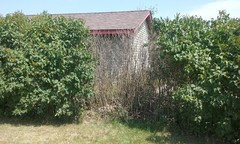
Just for the record. I just took this picture and looked things over pretty good. The large elm appears to be 16" across the butt/stump. And what little damage there is could possibly be from the lilacs diminishing from the trees shade and shade from the adjacent garage.
But the Box Elder tree does appear to be death by Glyophosate, either because that particular tree sloughs off the chemical through the roots or possibly over application getting down into the roots of the lilacs after a rain but it looks almost too wide spread to be that. fwiw:. The BE stump is close to center of the damage. In any event, I'm going to be a lot more careful in the future.
Close up of Box Elder stump (center). White substance on ground is Perlite/Peat mix recently discarded from rooting Hemlocks trial.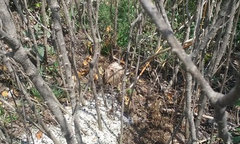
- 8 years ago
Often only the abstract of a scientific research paper is available to the general public. Fortunately, the full paper is available at the link below (published April 15, 2018):
https://www.sciencedirect.com/science/article/pii/S0048969717327973?via%3Dihub
This is part of the conclusion:
"Finally, despite its limitations, the results of this study are concerning; high levels of glyphosate and of its main metabolite AMPA have been often detected in agricultural soils across the EU. The presence of glyphosate and AMPA in agricultural soils may not only form a risk for soil health but also a potential risk of further spreading of these compounds across land, water, and air domains. Indeed, besides potential effects on local edaphic communities and on humans, that can be exposed to these substances by inhalation of contaminated dust particles, dermal contact or ingestion of contaminated surface water, wind and water erosion have the potential to transport contaminants to all the environmental compartments: atmosphere, other soils and surface waters."
- 8 years ago
I recommend the precautionary principle when evidence is present of a possible danger.
AND
- 8 years ago
More importantly, you need to do research on what Roundup actually does to the human body. I would not use it around anything that is edible or near ground water or well!!
- 8 years agolast modified: 8 years ago
Hopefully this website has security measures in place to prevent sock puppet accounts. Sure looks like someone could be bumping a thread they already participated in...
More importantly, you need to do research on what Roundup actually does to the human body.
I'm envisioning a hilarious Onion headline:
"Area Soccer Mom Recruiting Local Volunteers for Glyphosate Ingestion Studies".
I know what you mean is to read research, but it created a hilarious image in my mind. Since 95% of anti-glyphosate hysteria basically reads like an Onion story anyhow. And yes, the EPA which has banned THOUSANDS of other industrial chemicals including herbicides, has "done research"...and determined it isn't something to worry about, provided people don't start adding it to their iced tea. Personally, I try to avoid GMO crops, but more because there's probably a negative outcome associated between the foods that tend to contain GMO (junk and/or low-quality, usually) and poor health.
- 8 years ago
Oh, btw, I just decided to like my own comment, instead of creating a sock puppet account! So much more convenient!
- 8 years ago
If, as some here seem to believe, glyphosate does not transfer from where it is sprayed and get into to the food we eat and the water we drink why are there news stories today that state that? More and more evidence is accumulating that shows glyphosate products are as dangerous as many of us here have stated over the years and that the manufacturers of those products hid the research that showed that.
Glyphosate products are not acceptable to an organic grower.
- 8 years agolast modified: 8 years ago
"Glyphosate products are not acceptable to an organic grower."
Yeah so why did they show up in an organic product...is the detection limit so low that runoff or overspray from a non-organic field reached the organic field? I don't buy into the anti-GlyPO madness but from a scientific point of view, it's important to know why! BTW, I at least never said it didn't get into food, or water. But as I pointed out...all SORTS of things get into our food and water that technically don't belong there. Issue is how dangerous they actually are at those nanogram quantities? I'd say many other things are far more proven to be dangerous, like chlorination byproducts.
At any rate, it will wend its way through the court system, but I am very confident the inane California verdict will be overturned. I bet that guy had 10 other lifestyle factors FAR more provably connected to cancer. Even if he didn't...still no proof the GlyPO actually caused his. Again, most people don't actually understand what scientific proof is...fortunately most appellate judges probably do, even in California.
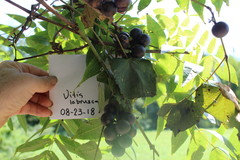
- 8 years agoFox grapes today in b. walnut tree. As I mentioned earlier these two are natural companions. Only problem is the best grapes are out of reach. The other problem with wild grapes is that some vines are non-fruiting. BTW the fox grape has a thick skin, many seeded, but who cares. The flavor of Concord comes no where close.
- 7 years ago
davidrt28
I have to agree that the court ruling will get overturned. Most cancers are lifestyle related.
But to go back to your earlier point, it's interesting that if we completely ceased using herbicides / pesticides, the volume of agricultural produce would decrease considerably and the quality of produce in the store would suffer dramatically.
My wife and I attended a large agricultural fair and we spoke to many farmers. One farmer told us if you put a conventionally farmed apple next to an organic one without any labels to indicate how they were grown, which one would the consumer buy?
Overwhelmingly, consumers will always migrate to the "pretty" apple that has been conventionally farmed using pesticides. Unfortunately, a lot of produce that is labelled as organic really isn't, and the consumer is being hoodwinked in buying produce that likely has traces of pesticides in it. - 7 years ago
I would not use Roundup , stuff is dangerous to every5hing and should be banned
 7 years agolast modified: 7 years ago
"More importantly, you need to do research on what Roundup actually does to the human body."
Well, the most damaging genetic mutations caused by glyphosate will likely be in your grandchildren and onward:
dramatic increases in pathologies in the F2 generation grand-offspring, and F3 transgenerational great-grand-offspring were observed. The transgenerational pathologies observed include prostate disease, obesity, kidney disease, ovarian disease, and parturition (birth) abnormalities. Epigenetic analysis of the F1, F2 and F3 generation sperm identified differential DNA methylation regions (DMRs). A number of DMR associated genes were identified and previously shown to be involved in pathologies. Therefore, we propose glyphosate can induce the transgenerational inheritance of disease and germline (e.g. sperm) epimutations. Observations suggest the generational toxicology of glyphosate needs to be considered in the disease etiology of future generations.
How's that for a multigenerational time bomb?? But hey, that's a small price to pay for a misguided attempt to grow some better grapes, right! Cheers!
- 7 years agolast modified: 7 years ago
blakrab Centex
Please site your source of info.
Your commentary is without basis without creditable sources/citations.
- 7 years agolast modified: 7 years ago
joeimo 6b-7a
Please site your source of info.
Your commentary is without basis without credible sources/citations.
- 7 years agolast modified: 7 years ago
Harvest, do you not see the link in blakrab Centex's post? I am making no claim either way regarding the validity of either the post or the linked article, but the link is there. Also, I don't see any comment here by joeimo. Maybe it was deleted?
Another thing I noticed is the statement that "... commentary is without basis without credible sources/citations." This is a judgment without basis, as far as I can tell. Sure, it's good to provide sources and data. But, not doing so does not in any way ensure lack of basis for a comment. Providing backing can add credibility, but not doing so does not negate validity.
- 7 years ago
^ Thank you for stating the obvious (or so I thought)!
BTW, the hyperlinked, scientific source describes itself thusly:
Nature is a weekly international journal publishing the finest peer-reviewed research in all fields of science and technology on the basis of its originality, importance, interdisciplinary interest, timeliness, accessibility, elegance and surprising conclusions. Nature also provides rapid, authoritative, insightful and arresting news and interpretation of topical and coming trends affecting science, scientists and the wider public.First, to serve scientists through prompt publication of significant advances in any branch of science, and to provide a forum for the reporting and discussion of news and issues concerning science. Second, to ensure that the results of science are rapidly disseminated to the public throughout the world, in a fashion that conveys their significance for knowledge, culture and daily life.
...since 1869
- 7 years agolast modified: 7 years ago
I'm going to unsubscribe to this thread soon, because it's getting tiresome...but, some adult in the room needs to remind a lot of people here, you simply don't completely understand what you're talking about. The level of glyphosate-o-phobia we've reached is just the latest trendy pseudoscientific hoax, like EMFs from powerlines in the 1980s. This IS NOT to say the stuff is completely innocuous - consider the stupid juror who asked the Monsanto lawyer to drink a glass of it. In a trial for the safety of household bleach and ammonia, would we ask people to drink glass fulls of those chemicals? No, of course not. Drinking a glass of any three of those would be a bad idea! (and btw this is not to say a test couldn't be designed to show it is ACTUALLY carcinogenic in some context...you could design a test to demonstrate that, about all sorts of substances that have not caused a mass triggering of Mencken's "booboisie"!)
But insofar as I can stomach reading about these ambulance chasing lawsuits...every person claiming to be terminally affected by roundup (just going to use the trademark name from now on, because it's easier to type) has some other factors far more likely to have contributed to their cancer. One guy had not one, but two long-term hepatitis infections! One of them being Hep C, which is linked to NHL. Or the one who had some kind of gross misuse of the product...was it spraying it on himself to stay cool? I can't remember such banality.
I worked in pharma research for a couple years after graduation. Even at a junior level, I realized that studies can and are designed to prove whatever the investigator wants them to prove. This is not some occult, cabalistic mystery...it's a widely known truth. https://bigthink.com/neurobonkers/believe-it-or-not-most-published-research-findings-are-probably-falseThis paper https://enveurope.springeropen.com/articles/10.1186/s12302-018-0184-7
states that "IARC concludes there is 'strong evidence' that exposure to glyphosate is genotoxic through at least two mechanisms known to be associated with human carcinogens (DNA damage, oxidative stress). "
(my emphasis)
but look at this report about bleach in water, from guess who, IARC: "Sodium hypochlorite induced genotoxic effects in bacteria. In single studies, chromosomal aberrations were observed in cultured mammalian cells, whereas sister chromatid exchange but no chromosomal aberration was seen in cultured human cells". So, it too causes 'mechanisms known to be associated with carcinogens'...but, elsewhere in the summary, "did not increase the proportion of rats or mice with tumours." I see nothing in the first summary (of roundup) about conclusive studies of actual carcinogenicity; i.e., how many rats or mice get tumors vs. controls.
________________________
The amount used in home gardens contribute probably like 0.001% of the human "bioburden". So I hope everyone who freaks out about a suggestion to properly use roundup to kill stumps, is eating 100% organic foods. And that means 100%. Don't think because something isn't genetically engineered, it won't have roundup in it. I was surprised myself, to find out that oats...not genetically engineered, yet - are sprayed with roundup at harvest, to force the crop to die and dry faster!
If roundup is carcinogenic, it's no more carcinogenic than scads of other things not facing multi-billion dollar lawsuits: red meat, dairy, high sugar diets, high fat diets for some populations, alcohol, certain legal food additives, etc. etc. etc.
- 7 years ago
Completely agreed David. Sorry to see you leave but I understand. I will likely do the same as many here commenting are most likely paid by some of the tree hugging organizations and this is their only employment. Cheers.
- 7 years agolast modified: 7 years ago
davidrt28 - So basically, yes, you admit that glyphosate is genotoxic and likely carcinogenic...just like every other industrialized food products and byproducts. But odd that while we actually agree on that - you find that comforting, while I find it alarming, lol.
BTW, it has been well-known that various DBPs are extremely toxic and carcinogenic...and this is not just based upon 1 study.
Anyhow, no need to go, nothing wrong with a reasonable debate right?
- 7 years agolast modified: 7 years ago
that was a misunderstanding on your part, blakrab.
I cited the IARC meta-analysis showing some studies indicating it was genotoxic. This isn't 'admitting' anything since I never said it wasn't genotoxic...IN SOME ASSAYS. Likewise, I said another set of IARC cited studies show that bleach, a common household substance, can be shown to be genotoxic AS WELL. Yet, doesn't officially CAUSE cancer, per the IARC's own determination. One could probably design a study showing glyphosate to be carcinogenic, and another one showing it to not be. Easy peasy. As you could with hundreds of other substances that people are routinely exposed to.
The problem is one of scientific illiteracy and semantics. People assume exposure to a given "carcinogen" cause every case of cancer. It doesn't work that way. You yourself point out, that practically everyone is exposed to "carcinogens"...ones proven to be WAY more dangerous than roundup...via municipal tap water. Where are the billion dollar lawsuits there? Honestly in anyone getting cancer "From" roundup, roundup might account for no more than 5% of that outcome. If that...I am assuming a worst case outcome. Let's say tap water disinfection byproducts is 50%. Should they be suing Monsanto* for 1 billion and their water company for 10 billion? If they drank alcohol...I can almost guarantee you that was the balance...so...9 billion dollar lawsuit against the liquor wine and beer industry?
(* - a company I think is basically awful, btw - but that doesn't mean to enact revenge against them by suing a product they invented out of existence)




sam_md