Software
Houzz Logo Print
hellkitchenguy

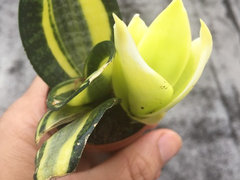
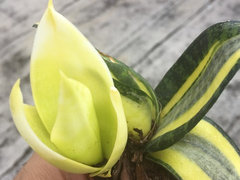
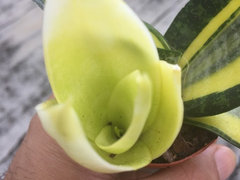
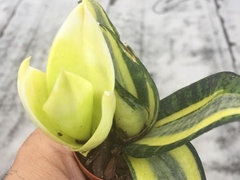
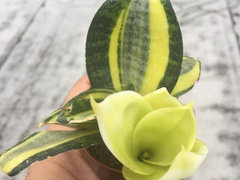
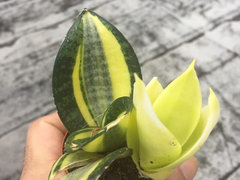
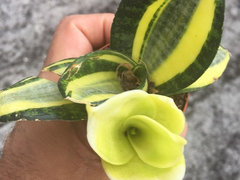
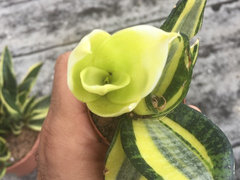
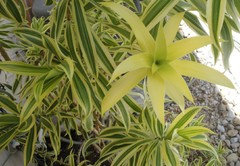
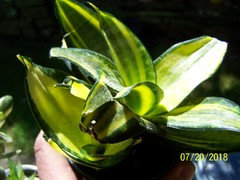
New (albino?) Hahnii

I know it's not albino, but I needed a heading. Also, I tried posting pictures with my thread, and it's not letting me do that, so pictures will be in the comment.

I bought this very light Hahnii for $2.50 I keep it on my North facing fire escape, where it receives sun until about 11am, and bright light after. I've been watering it from the bottom. It's a tiny pot, and it soaks up water very quickly.

Should I bare-root it, and repot it now, or wait until next Spring? The "albino" baby actually has a very, very faint tinge of green in some parts, though it's barely visible.

Pictures coming up in the comments

Comments (19)

  • 8 years ago

  • 8 years ago

  • 8 years ago

    Nice looking plants! I would be afraid to detach the albino.

  • 8 years ago

    Looks great! Isn't it fun to find a white sport in the middle of an otherwise pretty plant? I agree with Aloebot. I'd be afraid to remove it.

    I just found an albino head on my Dracaena reflexa. It's not small, so I don't know how I missed it for so long!


    I look forward to seeing yours all grown up, Manuel. Love it!

  • 8 years ago

    I understand that there is a photosynthetic chemical to deal with many wavelengths of light. I have a Gymnocalycium that is red and it stays red, its putting up a bud right now. And for an 'albino' I don't know.

  • 8 years ago

    I definitely intend to keep it attached to the mother plant. I was just wondering if I should bare root it now, which is what I usually do, or wait until next Spring. Other option would be to do what most amateurs do, just plant it in a bigger pot with some new soil around the existing one


  • 8 years ago
    last modified: 8 years ago

    I never seen an albino from a pup from a plant. I only seen them from the white section of rooted leaves. Still, above is right, keep it attached to the mother plant. In time some leaves may develop some green in them.

    I have the next best thing. Called 'Solid Gold'. Also from a pup from Gold Hahnii.

    Only the leaf edges are green with the full center being yellow.

    I would have bought that one myself. Good find. And for $2.50 was a steal.

    hellkitchenguy Manuel thanked Stush2049 Pitts. PA, zone 6
  • 8 years ago

    I know that sometimes when shifted up/bare rooted, they tend to slow down and have a stunted period. Depending on the amount of "growing season" you have left where you are and what kind of media it's currently in, I would say to just wait til spring. I believe Karen(?) may be in the same zone/area as you and she might be able to weigh in on how late is too late for bare rooting.

    hellkitchenguy Manuel thanked Robdb8
  • 8 years ago

    I'm in Manhattan, NYC. As far as media, I have plenty of pumice, and turface. Also have succulent soil and an orchid bark mix, both from RepotMe.

  • 8 years ago

    I don't believe in bare rooting a plant unless there is a problem. Myself, I would just re-pot into a slightly larger container and fill in between. Most plants purchased in the big box stores are in a peaty mix and when I de-pot them, they have a huge beautiful root system. Peat is okay as long as you watch watering. I am starting to change my beliefs on a gritty mix for sans.

    hellkitchenguy Manuel thanked Stush2049 Pitts. PA, zone 6
  • 8 years ago
    last modified: 8 years ago

    Stush, I I have a tall Sansevieria that I almost killed over the winter. I thought they were indestructible. After many years of no new growth (except it flowered once), I repotted it in a bunch of used potting soil with some added perlite and small stones. Now it's growing new shoots like I can't believe. I wasn't going to use all of my gritty mix ingredients for a half dead plant in the largest pot I have, and I read that the soil isn't that important (partly from Karen to give credit) , so I thought I'd see what happens. You're much more experienced than I am, but I thought I'd mention it.

    hellkitchenguy Manuel thanked Jeff (5b)
  • 8 years ago

    Jeff, what you described -- repurposed potting soil with added perlite, and in my case a handful of poultry grit -- is what I use too. I pretty much do what Stush says -- repot and if the existing roots are good, add repurposed soil and perlite. I have a few Gasterias and Haws in a real gritty mix, but all my Sans are in what you described and they are doing much better. I think I may have first learned about using previously used potting soil from Rina.

  • 8 years ago
    last modified: 8 years ago

    A few months ago I talked to a gardener about his selfsufficent full yellow variegated Sansevierias. He told me that they are able to grow on their own when the leave color has inverted. By inverted I mean, yellow on the outside, green on the inside. I thought this was rather interesting. Nice plant!

  • 8 years ago

    Oyster, Great news. Could you include some pictures from his plant. I know the older they get and larger increase their survival. Mine started to have a faint green cast to it and a very thin green edge to one newer leaf but was too small and when the leaf it was growing off of died, so did it.

    Jeff, the bigger the plant, the stronger they are. They are considered indestructible due to the fact that if you forget about them (neglect) they continue to thrive. When we love them too much like over watering and over fertilize they die.

    Still working on mixes. All plants need air around their roots. We use grit to increase the air and aid to remove excess water. Plants grown in the ground mostly have a clay base and little air, so what gives?

    I think that's why my Bantal's Sensation grew the best one year in wet soggy soil filled with tinny black ants. They had tunnels every where in the soil.

  • 8 years ago
    last modified: 8 years ago

    Haven't got pictures unfortunately, but you can find them regularly all across Ebay for example. They are just regular full yellows, but selfsufficient. There is always some sort of green tinge visible somewhere. I can also see it in my "curious Sans offset" about which I have posted recently.

    I have the same theory about oxygen around the roots. And it works perfectly. I haven't got a single issue with any of my sans.

    Nice to see you around on fb sansevieria groups Manuel! I recognized your photos from over here.


  • 8 years ago

    Oyster: Good seeing you here also. Facebook is great for sharing pictures and enjoying everyone else's. This forum is where I come for serious advice from plant geeks like me. We experiment with all sorts of soil mixes, stress about screening to the correct size, etc. We can spend dozens of threads discussing oxygen around the roots, soil structure, etc. There are also a few people on Facebook whom I adore and whose advice I take seriously, because they are dedicated, but there's also a lot of "noise" on facebook.


  • 8 years ago

    I’m the opposite. I always remove all the old soil. So far, my plants seem to handle it. BUT, and this is an important caveat, I have *vastly* different growing conditions than most (although certainly not all) of you, so I may just be fairly that climate makes up for poor practices on my part.

  • 8 years ago

    That's the point I always made. Local conditions will dictate what soil is best for what type of plant. Huge difference between growing a hahnii or tall stiff desert type. Someone in Australia showed me a picture of common S. tri. hahnii growing in a small stream. Said it was an abandon farm house. Or some grow stem cuttings in water and leave them that way for years. Temp has all to do with this. Sans can grow down to 50 degrees but when up to 90 degrees they explode with growth and vigor. At the lower temps, water and mix has all to do with growing successfully.

0
Sponsored