Software
Houzz Logo Print
lavenderandchamomile

what tool determines if a basement floor is flat enough?

8 years ago
last modified: 8 years ago

Hi!

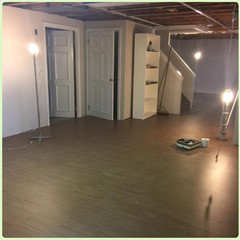
We would like to cover our 50 year old concrete basement floor with a click tile like Forbo marmoleum or vinyl tile. Before investing in the flooring, we'd like to see if any remedies are needed. we want to know what we are in for. It will likely be DIY.

For these flooring options, I believe that the floor has to be within 3/16" inch flat over 8 feet. We have a four foot plastic level, and as I move it around over the floor i am not seeing a change in the level bubble, but I don't think I'd know if it isn't good enough. And its four feet not eight.

What tool can be rented? Is there a laser I should shine over the floor? We have home depot / ace/ sunbelt/ lowes/ taylor rental etc all within a few miles.

yes, there is 1970s armstrong exelon tile that contains absestos in it, that isn't chipped or cracked and is well adhered, and we don't intend to remove it. It will be covered. But that is a totally different discussion and we just want to figure out if it is flat enough,

Thanks very much-

Comments (23)

  • 8 years ago

    HandyMac is on it. Use the 8ft or 10ft long plank to sweep across the floor. You are looking for 'hills and valleys'. With an 8ft plank, you will quickly find any valleys or hills. I also like to use a 3mm thick piece of cork underlay (you can order samples on line if you like). The 3mm thickness is VERY close to 3/16". You can use the cork sample to see how much of a variation (in height) you have. If the cork sample slips underneath the wood plank, then you have a spot that needs to be fixed. If it does NOT fit under the plank, then you are OK to leave it alone.

    Just remember to use a vapour barrier underneath the click marmoleum. Basement slabs require a vapour barrier underneath a floating floor - regardless of what the floor product is.

  • 8 years ago
    last modified: 8 years ago

    Just to be clear, you shouldn't be using a piece of solid wood, which will invariably have some lack of flatness, but the strip of plywood as HandyMac described. Also be aware that even if you had a good quality level of the right length (preferably 8'), the fact that the bubble was off a bit isn't as much of a concern as the absolute flatness of the floor.

  • PRO
    8 years ago

    Use a chalk line, stretch it out from wall to wall and measure your variance. Check corners to corners, middle, along width, length and diagonally.

  • 8 years ago

    An alternative to G&S's approach is to set a laser (<$10) on a couple of pieces of tile or similar and use a Story Stick or similar and check out the room

  • 8 years ago
    Of interest is what to do if the OP finds it isn't flat enough. Will floor leveling compound work over the preinstalled floor, or is there a different way?
  • 8 years ago

    +1 on what SaltDawg stated.


    You can not bend a laser beam like you can have with string.

    The Bosh GLL30 Self Leveling Laser (around $70) is a great device for checking floor levels.


    I like to use one and a paint stick. Place the laser on a piece of flooring that you plan to use. Then place the paint stick in front of the laser approx 3" and mark where the line hits the stick.. Then above and below that mark make marks3/16" (you will end up with three lines on the stick). You can work all around the room taking measurements about every eight feet using your Go-NoGo stick.


    Tip I use.. Take masking tape and a sharpie if you find a high spot (below the mark on the stick) or low spot (above the mark) tag that spot with a piece of tape stating high or low.


  • PRO
    8 years ago

    The laser and story stick is good if, you are installing a wood subfloor. It helps determine shim thickness or sleeper height. For slabs, the string is quick. You just need to determine whether the flatness is in or out. If out, you are grinding and screeding skim coat or leveling compound. The variance isn't important in this situation.

  • 7 years ago
    So I took our four foot level and used metal rods we had to extend it further on the ends. It did not seem to sag in any spots more than the allowance, and was level over the run. I really liked the laser idea but couldn’t figure out how to buy a no clearance laser cheap enough. I probably should have done the chalk line.

    So, we bought the last of green building supply’s fresh walnut forbo marmoleum/cork tiles. We are putting it in now over the old asbestos tile floor. We will update you if we have success! ( and I may hide if we don’t, or just ask fir more advice.)

    Thank you all for your advice.
  • 7 years ago
    last modified: 7 years ago

    For the future, be aware that you don't need a zero clearance laser. In fact, it wouldn't work well because the beam would be stopped by any point on the floor that was a hair higher than the beam.

    My laser beam is about 2" higher than the base. If I wanted to check the floor variation, I would get a wood block about 3" high, put a mark at the laser level, and just slide the block around the floor to see what the deviation was from the mark.

  • 7 years ago

    As discussed above in a few posts.

  • 7 years ago

    SaltiDawg-

    Agreed. In fact, I posted about it earlier, but it looked like it needed repeating.

    lavenderandchamomile thanked kudzu9
  • 7 years ago
    To everyone—- Thanks for all your help!!

    The floor was flat enough, and no adjustments needed. Now all the Forbo fresh walnut Click 2 marmoleum tile is in, and on to figuring out ceilinglink in another post and time..
  • 7 years ago

    For future reference/other readers: I would not be surprised if rental places had laser levels for a few bucks a day, which would save buying one for a single project.

  • 7 years ago

    I found it reasonable to just buy a laser level/incline tool, since they are useful for multiple jobs around the house. One of the least expensive is $50 at Harbor Freight. I have an older version of the Harbor Freight level, which we used when I framed my basement, and for checking the level of the bed/base under a brick patio we built.

    Bruce

  • 7 years ago

    Am about to install a thousand sf of Marmoleum Clicks in my basement. The slab is a flat and level marvel. I want to use an airgap underlayment like the Delta FL or DMX 1-Step for two reasons. First, the airgap should warm the floor and, second, the gap can store water from a plumbing problem if I experience one. The seismic event last week sent several cisterns a splashin and a spillin in my neighborhood, and floors of all types paid. We had just finished demolishing our old padded wall to wall carpet the week before that 7 richter scale hit. Our luck was compounded by our removal of everything from the downstairs walls for repainting. LUCKY TIMING. Anyway, freeze-up and earthquakes both are a worry in Alaska. The Delta FL product indicates their material is fine for direct installation of laminates, all other systems should, they say, be installed over an OSB or plywood subfloor over the airgab stuff. The 3' x 1' Click panels, to my way of thinking, should behave like really wide laminate units. A sheet of OSB up here runs $30 - not cheap. Thinking of skipping it and ignoring the recommended expense. Y'all have any thoughts?

  • 7 years ago

    Clyde-

    You're more likely to get helpful answers if you start a new thread rather than piggybacking on this one. Your issue really isn't germane to this topic....

  • 7 years ago
    last modified: 7 years ago

    @Clyde - the "laminate" install is ONLY for laminate floors that do NOT have attached underlayment. I believe the Marmoleum click has CORK attached to the bottom. That means you MUST HAVE the OSB put down. Must. The Delta FL is a nice product so long as you have NO intention of installing a product with soft underlayment attached to it.

    And in Canada, OSB is $1/sf = $48/panel...Check the thickness of OSB you are planning on using. Delta FL has a minimum thickness required when installing a product with attached underlayment.

    And just for fun, you will need to use tap-cons when installing the OSB top layer. Once you start down that path, you might as well upgrade to DriCore and be done with it.

  • 7 years ago

    Thanks, SJ. I'm aware of that "attached underlayment" warning. No explanation accompanies it. The plastics these products are made out of are inert. It'd be nice to know why the manufacturers see any attached underlayment, cork or otherwise, as being somehow reactive with their product - or if there is a mechanical concern of breakdown. If the latter is the case, it raises the question of why the great thickness of OSB and not just a layer of taped together luan. Clearly my motivation is to squeeze pennies off the job; I'm a cheapskate, and it may be that in order to gain frugality and practicality peace of mind on a thousand sf install I'll just go with the laminate (though I really like that marmoleum upstairs). Never have used the dri-core, but it pops up quite a bit in searches - 250 pieces is a lot of pieces. I was gonna move this thread as @kudzu9 suggested, but it boils down to my cheapness, and that's an easily assailed and ridiculed spot for me. So I'll punt the problem to my banker and let her make the decision. Again, thanks.

  • 7 years ago

    Just received this from Dörken Systems Inc. 4655 Delta Way, Beamsville, ON L0R 1B4, Canada:


    Dear Sir,
    We do not have any specific approval from different floor manufacture. DELTA®-FL is a vapor barrier that prevents moisture from the concrete floor to enter the finished floor.
    DELTA®-FL does not change the installation of the flooring material. If the finished floor is rigid (like laminate flooring) it can be installed on top of DELTA®-FL.


    That sounds like a go-ahead and put it right on top to me.

  • 7 years ago

    https://www.dorken.com/media/docs/products/Installation-Instructions_DELTA-FL.pdf indicates the OSB is needed for "Carpet, Vinyl, Hardwood, or Other Floor Covering Requiring Rigid Substrate". Combined with the emailed response above, I can give the banker a fully informed set of proposals and place the burden of responsibility where it belongs: not on me.

  • 7 years ago

    Here's why Delta FL et. al require a substrate when working with attached underlayments: the dimples. Each dimple is a tiny hole that can and will grab, trap and then rip off the underlayment. Cork is ESPECIALLY sensitive to this. Cork crumbles with ANY form of abrasion. If you lay the Marmoleum click product over the dimples, you are putting down crumbly cork over a massive cheese grater. You will create a very expensive mess with a very expensive floor. Marmoleum click is known for its heavy price tag.


    You are welcome to go cheap....so long as your main investment - the marmoleum click floor - remains intact. With Delta FL, I would give it about a year.


    When I sold cork floating floors with the attached underlayment, I did not allow it to be installed directly over Delta FL. I required a rigid underlayment be used over the plastic cheese grater. I put it in writing. I made it clear that all warranties would be void if the client proceeded without the rigid underlayment.


    It's your call. The cork will crumble. I can guarantee that - in writing. Please reach out to Marmoleum to ensure your plan is allowed by them; the manufacturer of the floor always supersedes the recommendations of Delta FL.

  • 7 years ago

    Dorken's statement that "DELTA-FL does not change the installation of the flooring material. If the finished floor is rigid (like laminate flooring) it can be installed on top of DELTA®-FL" exposes them, I believe, if the cheese grater effect is real. Forbo underlayment or any other underlayment (foam in the case of laminate) between the clicks and the DELTA-FL would not only expose aluminum foil and/or foam to this grating effect, but the additional cushioning of another layer "thickens the mattress" and thereby unduly and unnecessarily stresses joints. There's no question going with the OSB at another buck a foot will make for a very nice floor, but, to show how eager Dorken is to sell this stuff, and to share their assertions with readers of this thread - to put a bow on the conversation, I offer my additional exchange with DELTA-FL:


    Thank you for your quick response. Just to clarify, the product I wish to install on top of DELTA-FL is rigid like laminate, but it has an attached cork underlayment. Are rigid floors with attached underlayments okay for installation directly on top of DELTA-FL? Do attached underlayments present a problem?

    Thanks again. CK

    Dear Sir,

    Rigid floors with already attached underlayment can be installed on top of DELTA®-FL.


    Krzysztof Apriasz, C. Tech. CPHC®

    Technical Service Manager

    Dörken Systems Inc.

    4655 Delta Way, Beamsville

    ON L0R 1B4, Canada