

RRD or Roundup?
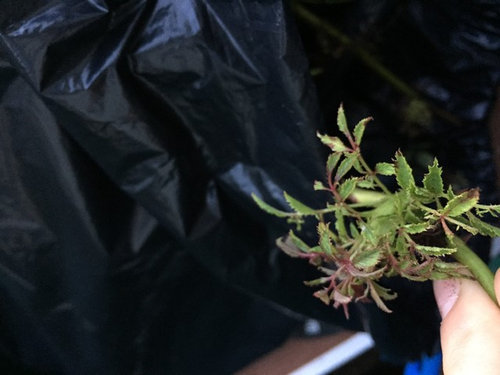
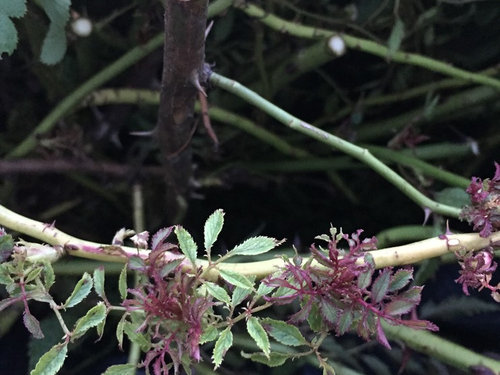
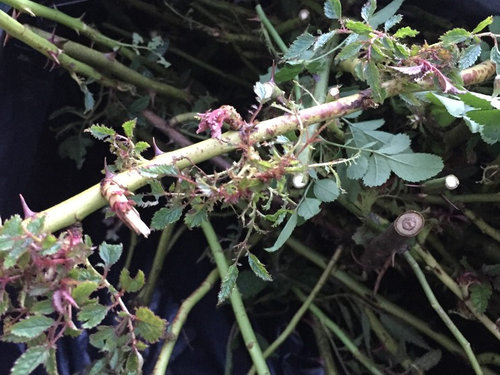
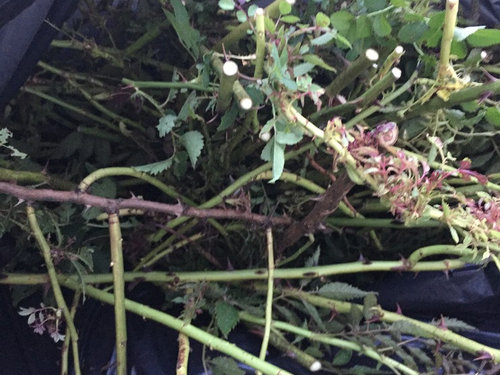
There’s a multiflora rose that is down the road from us. I noticed hideous growth on it, and immediately panicked that it was rose rosette. I hacked down as much as I could, after spraying with hairspray, and put it into a trash bag to throw away. I haven’t ever seen it in our area up till now, thankfully, so I was horrified that it was finally here. Then I began to calm down and realized there is no hyper-thorniness, not a lot of excessive redness, and scraggly growth rather than overly lush. It was on a fence line, so could this be herbicide damage rather than the dreaded virus?
Comments (9)
 8 years ago
It does look a lot like some of the roundup damage I have seen before. I will wait for others to chime in.
 8 years ago
Rose Rosette.
the last four photos have:
multiple breaks from single leaf buds.
growth so fast that cholorphyll formation can't keep up.
stems growing in semicircles because the growth is so fast that the cane is pulled down by gravity
Leaf margins are wonky
Next to last photo: especially strange in that every leaf axil has put out a new stem, when this year, there should just be compound leaves there.
At this time of the year, multiflora is not actively growing; it's real growth spurt is when it sets blooms in late spring, when long canes grow. Not in late summer.
Funny thing though, this late RRD caused growth is greatly appreciated by deer who may keep the new growth harder to notice.
In my yard, my first RRD showed up on a volunteer mutlflora I had let grow and then we removed it. Somehow we overlooked one cane. That cane, in the middle of a drought that left cracks in the ground four inches deep, that cane had new large stems emerging from every upwards facing leaf bud axil. And they were growing vigorously.
Related Professionals
Tupelo Landscape Architects & Landscape Designers · Miami Landscape Architects & Landscape Designers · Florence Landscape Architects & Landscape Designers · Waco Landscape Architects & Landscape Designers · Wenatchee Landscape Architects & Landscape Designers · Bronx Landscape Architects & Landscape Designers · Florence Landscape Contractors · Covington Landscape Contractors · Greenville Landscape Contractors · Utica Landscape Contractors · Wilmington Home Builders · Sault Ste. Marie Home Builders · Kirksville Home Builders · Spanish Fork Home Builders · Olympia Home BuildersDillybeansown (6b in the Ozarks)
Original Author8 years agoOh, dear. That doesn’t sound good. I was hoping to write it off to roundup. I will say, in defense of the new growth, that we have been in a prolonged period of drought, and recently have been receiving a large, blessed amount of rain. All of my roses are putting on new growth, some new basals. Even the once blooming Banshee rose, the most “wild” rose I have, has thrown out quite a bit of new growth. Not sure if that information affects your diagnosis or not.
Dillybeansown (6b in the Ozarks)
Original Author8 years agoPatty, thank you for the condolences. I’m very sad about this, as I only took out as much as I could get. It’s huge, and most of it is in a neighbors property, and I can’t get to it. I was able to take out all of the canes that look affected, for now, but I realize the rest of it is probably sick, too. Oh well. Here’s toasting the inevitable loss of my new rose obsession.
- 8 years ago
Hmmm..... I am not wanting to be contentious, but I think there needs to be some other input on this rose before it is said to have RRD..... I have not had it THANK GOODNESS, but have had a scare. I actually had roundup damage......... Now I am not saying this is NOT RRD, but just because you have multiple breaks or limbs developing from a single leaf node does NOT mean it is RRD...... Though that CAN be one thing to look for.... however, I have two roses, one is Gold Medal and the other is Heirloom that does the multiple limb thing from a leaf node if I have a bad case of chili thirps. What I was told is that the CT's eat where the new growth is started, but these two roses try their best to get the new limb to start that it puts extra effort into creating the limb and the result is actually multiple limbs.... Gold Medal once put out six limbs from one leaf node..... No other sighs of RRD... and I did not even know about RRD when this happened otherwise I would have yanked him out.... but though it isn't normal growth, it does in fact for other reason other than just RRD..... I have had this rose 10 years, and have had to fight CT for at least 5 ... probably longer, but did not know what a chili thrip was prior to those 5 years.... Does Anybody else who has CT damage also have to deal with this....... No cases of RRD in Floirda yet.... and no other signs, no redness, no extra thorniness, no witches broom..... So, I am just adding in my two cents, because I don't want people to just yank their roses without more thought, and hopefully more identifiers....
- 8 years ago
Sharon,
We are talking about a species rose, Rosa multiflora. We are talking about symptoms of RRD on R. multiflora, the rose on which RRD has been observed for over twenty five years. R. multiflora has a whole lot of symptons when it first sickens with RRD, and additional symtoms as the disease gets established.
You are in chili thrip country, and it hasn't been recognized there ten years ago, BUT you are fortunate that your department of agriculture has put some really great resources on line for learning about chili thrips. Even the list of alternative host plants scares the rest of us. (Are your roses on fortuniana rootstock because fortuniana tends to push massive growth when the roots are in the right soil for it and multiple basals do happen for fortuniana. )
In my garden and Ebook I look for three symptoms for doing a RRD call, not one. So far, that has been a fairly good idea.
- 8 years ago
stillanntn6b, Thank you for the info.... I did not see that they were using 3 different indicators to determine it was RRD. I thought they were using just one indicator which was the many limbs from the leaf node. That makes more sense to use just 1.... unless the 1 is the witches broom... I would think that would make it automatically be classed as RRD ... Correct? Asking....... also the roses that I have that pushes lots of branches from the leaf node if attacked by chili thrips are not on Fortuniana..... I wish they were.. but one is an own root rose. He is in the ground, and probably won't be with me more than a year or two more before he dwindles from nematodes. The other is in a pot and is Dr. Huey. I got both of these before I knew about fortuniana root stock. Thanks again for the info on RRD I appreciate it.
- 8 years ago
Quick lesson. Each leaf node on the side of a cane has one main bud. That's where the leaf is supposed to emerge. But roses come with spares. On either side of a leaf node is a back up, both smaller than the original and sometimes one is significantly smaller than the other. If the main bud doesn't mature (or gets eaten) the replacement should emerge. IF growth is vigorous enough the two replacements might have two replacments each (making four.)
I've seen some really massive witches brooms on other kinds of plants. That's a common symptom in plant diseases. On floribunda shrubs , up in Canada, I counted twenty stems emerging from a single cut on one cane. All the leaves had different margins from other canes and it was immensely ugly. Nearby, half a rose hedge had died and the next bushes in that hedge were loaded with RRD symptoms. The gardeners there knew something was wrong, but nobody knew what it was.
At a certain point, you wonder how a 'narrow' stem can support massive growth farther out the cane. There's only so much space in a cane for xylem and phloem and the physics of liquid transport has to have some limiting factor.




Patty W. zone 5a Illinois