Software
Houzz Logo Print
socalnolympia

Hybridizing Blue Poppies - about chromosome numbers

7 years ago
last modified: 7 years ago
Some of you may be familiar with the blue Meconopsis poppy. This is one of the few types of flowers in nature that has a true blue color, so it is somewhat rare and sought after. They also need cool moist climates to grow in, so the flowers typically only grow with ease in places like near the Himalaya mountains or Alaska. (Meconopsis are also perennial, if they don't die from warm dry conditions during the Summer)

There are actually two types of blue Meconopsis in the wild.
Meconopsis baileyi (formerly and still commonly known as Meconopsis betonicifolia)
Meconopsis grandis

baileyi has lighter true blue color flowers, while grandis has darker violet-blue color flowers (there's also another variation of M. grandis that has more burgundy-purple color flowers)
baileyi has 2 sets of chromosomes, while grandis has 4 sets of chromosomes.

In fact it's quite possible that M. grandis originated from M. baileyi after having spontaneously doubled its chromosome number and then begun to evolutionarily diverge (which is not uncommon in the plant world).

Many crosses between M. baileyi and M. grandis have been made, all of them are generally referred to as Meconopsis wilsonii. These crosses are sterile, so these various hybrid cultivars have to be propagated asexually, by division of clumps.
This is because when you cross a diploid (2n) with a tetraploid (4n) you get a triploid (3n), and triploids are generally sterile. (The odd chromosome set number creates problems during meosis)

However, there is one cultivar of Meconopsis wilsonii which does produce fertile seed. It is named 'Lingholm', and is a popular variety under cultivation.
It is believed that at some point, one of the hybrid garden varieties that were in circulation spontaneously doubled its chromosome set number from 3 to 6. This can happen in rare cases.
At some point someone discovered one of the Meconopsis wilsonii plants in a nursery was producing fertile seed.

Lingholm has a similar coloration to baileyi but the plants are a bit larger and has a bigger flower size. They are said to have slightly more tolerance to heat.
Lingholm is generally regarded as a superior cultivar.

The problem is, in some ways Lingholm is an evolutionary dead end. This cultivar can't really be bred much further because it has 6 chromosomes, or so that's what some people may have thought.

I think that it should be possible to cross Lingholm with baileyi. 6n x 2n should give 4n offspring, which would be fertile. The 4n offspring could then be freely bred with M. grandis.


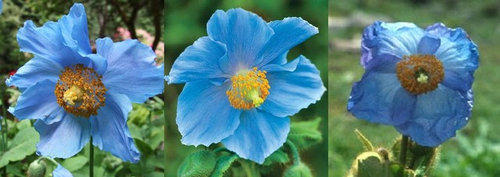
From left to right: Meconopsis baileyi, Meconopsis 'Lingholm', Meconopsis grandis growing wild in the Himalayas

The picture of M. grandis is of a blue one, it can also occur in light blue-purple varieties or a darker purple variety.

One way to tell baileyi and Lingholm apart is that Lingholm has noticeably longer pollen stamens.

There is one ambiguous complication and that is that sometimes these hybrids (including Lingholm) is sold as "M. grandis". However, all true M. grandis species do not produce the light blue color hue that Lingholm and baileyi do, so it should be easy to tell them apart. (Well actually that's not true, M. grandis can be quite heterogenous in the wild, and does occur in a true full blue color, but there is usually a slight tinge of purple hue around the very edges of the petals)

(One more little note just for complete accuracy, actually M. betonicifolia has been identified as a true separate species with some subtle differences from M. baileyi, but they are so similar that you would have great difficulty telling them apart, and the true M. betonicifolia [the one which is distinct from M. baileyi] is extremely rarely ever encountered in cultivation or commerce.)

Comments (6)

  • 7 years ago

    My neighbour added a blue poppy this year, I’m curious once it blooms to see which type it is.


    Are you already familiar of the Meconopsis Group, http://www.meconopsis.org/index.html ? I’m tempted to join for the seed exchange.


  • 7 years ago
    last modified: 7 years ago

    Hello socalnolympia,

    I am guessing that your username is based on your location. Am I right about that?

    " I think that it should be possible to cross Lingholm with baileyi. 6n x
    2n should give 4n offspring, which would be fertile. The 4n offspring
    could then be freely bred with M. grandis. "

    That all seems to be arithmetically sound. I am not sure that "The 4n offspring could then be freely bred with M. grandis" is genetically sound. In general, having the same number of chromosomes is not sufficient for interbreeding. And I know that you already know that, because your posts are quite informed.

    I know essentially nothing about poppies (zinnias are "my thing"). I do have one rather irrelevant comment to make about the color "blue". In your photos above, the Meconopsis 'Lingholm' have what is, to me, the "nicest" blue. I spent the first several decades of my life with a completely wrong idea of what the color blue was. I had always heard that "the sky is blue" and I took that to be a fact.

    As a kid I used my Blue crayon to make the sky by coloring it lightly with my Blue crayon (in the first grade we got a box of only 8 Crayola crayons). Eventually at about the 6th grade level I was able to obtain a box of 64 colors and I think I may have been in college when I finally obtained a box of 100 crayons. Some of the present day crayons may have a "Sky Blue" crayon. They should, because they have several different "blues". But I digress.

    When color TVs and computers came out, I learned that human eyes have receptors for RGB (red, green, blue) and I had a hard time accepting that yellow was a mixture of red and green. But that was an additive mixture, as opposed to the subtractive mixtures I had apparently been doing. But the real revelation was that I had been wrong about blue all those years. The B in RGB was more a blue jeans blue than a sky blue. In fact, my conceptual sky blue was more of a cyan (a color that I hadn't even heard of as a kid).

    The upshot of all this is that I consider your middle photo, the Meconopsis 'Lingholm', to be more of Cyan than a true "B" blue. The two flanking photos are better characterized as true "B" Blue. In my eyes, that is. I have been told recently that not all humans are limited to just three different color receptors on their retinas. I am still a bit skeptical about that. And I am still annoyed that I never had a crayon that was labelled as Cyan. I assume that the kids of today do have Cyan crayons. If not, there should be a Congressional investigation.

    ZM

  • 7 years ago

    I think "Azure Blue" is a more proper description of the cyan-blue color hue you're imagining.

  • 7 years ago

    I'll take that. And there should be an Azure Blue crayon.

  • 7 years ago

    I can provide an update of the hybridization project, it's not going anywhere. I got seeds online from FIVE different sources, and they all failed to germinate. Some were sowed in the soil outside, some I tried to grow in an artificial environment indoors. I think the seeds of this poppy need to be fresh.

  • 7 years ago

    I tried growing meconopsis seeds from West Coast seeds, I had about half germinate, unfortunately most seedlings have died off slowly.

Sponsored
Landscape Management Group
Average rating: 4.9 out of 5 stars33 Reviews
High Quality Landscaping Services in Columbus