Software
Houzz Logo Print
swiss_chard_fanatic

What causes thin, scraggly, spindly shrubs and trees vs full lush ones

7 years ago
last modified: 7 years ago

I have noticed while living in coastal Alabama for the past few years that some trees and bushes look like they are dying, while others are doing great. Specifically, I have wondered the following things:


1. What causes many trees to grow sideways or slanted?


2. What causes some trees to grow as though something is pushing downward on their tops? For example, the branches grow outwards in a crooked way while the trunk appears stunted. I am not talking about topped trees, which I find horrific.


3. I went to a plant nursery recently and noticed Nellie Stevens Holly, Sycamore, and other plants that just absolutely looked terrible. Is it the time of year? The Nellie Stevens Holly plants, which were about 3 feet tall, were spindly, thin and scraggly, and the Sycamore had leaf spot and other fungal infections. However, a friend nearby has a very large, beautiful Sycamore tree in his yard, without leaf spot. Why the huge difference? And why were the hollies so thin?


4. Plant nurseries online claim that Nellie Stevens Holly is very tough and can withstand any soil type, while still having "dense" foliage. But if this is the case, why were the Nellie Stevens Holly at the local nursery in such bad shape?


I was about to purchase a lot of nellie stevens for a privacy hedge on my lawn next next to a busy street, but now I'm rethinking it.

Comments (11)

  • 7 years ago

    Crowding and other poor culture issues.

  • 7 years ago

    I suggest that the nursery is the culprit. But generally speaking, plants respond to their growing environment and culture.

    Factors that can affect a plant's health are too numerous to list and it can take a bit of detective work to determine the causes of problems.

    I will say that Nellie R. Stevens is one of the easiest plants to grow in most environments, including in a nursery setting. Are you aware of how huge they can become?

  • 7 years ago

    you would really need to give us some pix ... so we could opine on the whole situation of a given plant ....


    we all know how a well planted plant.. in perfect cultural conditions should grow ...


    but to speculate on why a certain plant doesnt THRIVE .... we need to see it ...


    i would throw lack of full requisite sun in the equation .. along with those listed above ...


    the plants at the local nursery.. were probably in shock .. stressed ... either from improper treatment after field growing and potting.. or grown in the pot too long .. potting issues ...


    the real issue sounds like a nursery that doesnt know how to deal with its stock .... i would find a better source ..... perhaps even ordering in winter delivery stock.. for planting in spring ... late fall stock is often less than perfect.... unless significantly discounted ....


    ken

  • 7 years ago

    Hi everybody, thanks for those answers.

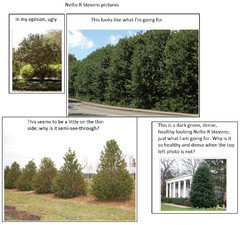
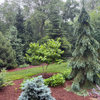
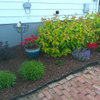
    I didn't take a picture of the plant at the nursery, but I did find some examples on the internet. These are all Nellie Stevens holly and they each look different, and I'm wondering, why do they look so different, and what can I expect if I plant it in my yard?

    My goal is to have a dense, dark-green, tough plant that will provide complete privacy year-round, that likes native clay soil, is pest- and disease-resistant, and that doesn't mind being 6 feet from a busy street. Bottom-left picture would disappoint me due to it being semi-see-through.

    If Nellie Stevens holly can't provide what I need in my area, I am open to recommendations.

  • 7 years ago
    last modified: 7 years ago

    >Why do they look so different?<

    Variations in age and site conditions.

  • 7 years ago

    I'll tell you, depending on where your at in LA the soil can differ a ton. You say you have clay, but most of LA, like 90% isn't clay but sandy loam. Similar to Florida with more rain and cool. Lack of water here that penetrates deep is the #1 culprit. How is that possible with sand and rain? Sand doesn't retain water and the rains are frequently light and only wet the top 2 inches making everything green but its referred to as green drought.

  • 7 years ago

    Also wanted to add fertilizers are a big thing not to mention plant selection. You mention Hollies which most tend to do well here given a site that has a low PH and camellia/azalea style fertilizer or pinebark/straw mixed into planting. Sycamores like the Hollies differ. Many plant breeders that specilize in trees like Sycamores don't come from the south. So a sycamore from an offspring of say one around here thats lineage has been here 300 years will be much more well adapted than say the same tree that came out of Wisconsin. Sycamores also take a little while to get going and the beginning 10 years are more important than some trees "but I would argue that with just about every tree the first years are the most important "shaping, fertilizing properly, adequate water, withholding for natural drought cycle" Granted I am trying to espalier three southern magnolias keeping them in the 12 foot range at the moment :). Also if your in COSTAL Alabama it can vary wildly. EX gulf shores is zone 9 where Bay Minette is zone 8. Bay minette is mostly piney clay with not as much wind and has vastly different climates than Gulf Shores even though they are an hour away. There are a ton of microclimates here and figuring out your yards is the key here. Ex we get more west sun most people read full sun and think full sun. Full sun here isn't often the best for most stuff. Afternoon shade is....

  • 7 years ago

    I only say this because I would love to have a couple of Sycamores on the property but have pretty darn sandy soil and a lot of wind. If I was about 5-10 more miles inland I could have a small grove, but instead I opted for cypress as they take the salt better.

  • 7 years ago
    last modified: 7 years ago

    >pinebark/straw mixed into planting<

    Apply as mulch rather than amendment, amending of soil for permanent plantings is a dis-proven practice. With the detrimental effects it produces being seen in organized experiments by the late 1960's.

    >So a sycamore from an offspring of say one around here thats lineage has been here 300 years will be much more well adapted than say the same tree that came out of Wisconsin<

    Northern grown material wouldn't necessarily have significantly different genetics. It depends on the details of the individual situation, including how much Platanus actually do vary genetically throughout their wild ranges.

Sponsored
Buckeye Basements, Inc.
Average rating: 5 out of 5 stars40 Reviews
Central Ohio's Basement Finishing ExpertsBest Of Houzz '13-'21