

Mold issue with new potting media after repotting first phal
I am a beginner with orchids and have 3 phals, and one of them had already finished blooming and its original media already had mushrooms growing on the bark so it was time to repot (original media was mostly orchid bark). Two weeks ago, I purchased Fertilome orchid media, which consists of "Canadian sphagnum peat moss chunks, orchid bark, hardwood charcoal, and lava rock." Upon cleaning and inspecting the roots, the roots looked very healthy, plump, and stiff. I also sprayed hydrogen peroxide on the roots as a disinfecting precaution read about from other orchid discussions. I repotted the orchid with the new media in a slightly larger, clear plastic pot with extra ventilation holes I created on the sides, then watered it since the roots were silvery, dry.
A little over week after that, I had come back from a trip, and noticed through the clear pot that there is white fuzzy mold growth on some part of the roots and those roots turned black/dark gray. My other untouched phals were fine, no mold growth. A week later, I'm seeing more dying roots and more visible mold inside the media. And another surprise is I recently noticed mold growth on the surface of the same exact media that is holding my bromeliad pup. I planted the pup in the same exact media 3 days after I repotted my phal. The growth looks like speckled, powdery white growth and its very visible on the black charcoal chunks and lava rock. I also see this speckled growth on the pieces within the pot of my phal.
What should I do step by step now to save my first orchid?
Note: Not sure if it matters, but the new bag of media does contain a lot of charcoal/rock dust. Was I supposed to rinse the media with any solution or plain water first?
Comments (33)
 7 years ago
Photos of the pot showing the holes you created and the mold would be very helpful. I do not use plastic pots for orchids - I use special ceramic orchid pots that have lots of holes for ventilation.
Whenever you water, you need to make sure that all the water runs out and that the roots are not submerged in water longer than it takes to get the potting medium soaked. I use vermiculite in my orchid potting mix but mostly use orchid potting bark.

pt529
Original Author7 years agolast modified: 7 years agoThanks for your response.
I have been watering my orchids correctly by letting the water fully drain out of the bottom holes since I "rescued" them a few months back. I never let any water sit at the bottom roots, even OCD enough to use a paper towel to soak up remaining amounts of water that can't flow through the holes. The watering schedule is once a week based on observation of their roots and I never let any water sit at the crown or leaves. Even though they came in plastic pots with no ventilation holes on the sides, just drainage holes, they've been doing beautifully for months. The ones I haven't repotted yet are actually still in bloom with healthy roots and leaves, and one phal orchid at my workplace is actually in bloom on a new third spike (I've trimmed the first 2 spikes already).
I've attached some pictures of the orchid in question. I tried to get the best pictures of the fuzzy mold and the speckled mold on a charcoal chunk. The new clear pot of the orchid also has drainage holes at the bottom.
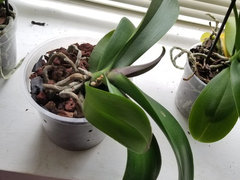
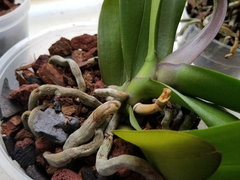
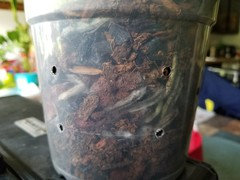
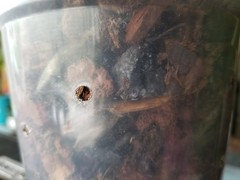
Perhaps for this new media the number of ventilation holes isn't enough? Or maybe there were mold spores in the new media I bought?Because it can't be a coincidence that there is also mold growing on the same new media of the bromeliad. And my other orchids that I always water the same way have no mold issue.
I just need to know what steps I can move forward with right now to remedy this situation quickly before I leave for a trip next week. Buy new media and repot? Trim off dead roots and disinfect live roots? Disinfect with hydrogen peroxide? Use the same media I already bought and somehow rinse it? I really do not want it to sit any longer in mold, as the roots are getting progressively worse as I've been waiting to find answers.
Related Professionals
Ardmore Landscape Architects & Landscape Designers · Plattsburgh Landscape Architects & Landscape Designers · Binghamton Landscape Contractors · Minot Architects & Building Designers · Middlesboro Landscape Architects & Landscape Designers · Charleston Landscape Architects & Landscape Designers · Zanesville Landscape Contractors · Alexandria Landscape Contractors · Albuquerque Landscape Contractors · Huntsville Interior Designers & Decorators · Aiken Interior Designers & Decorators · Amherstburg Interior Designers & Decorators · Forrest City Landscape Contractors · Rock Hill Landscape Contractors · Peoria Landscape Contractorspt529
Original Author7 years agoI've typed a full reply twice with all details but I keep getting errors with the website and my posts disappear. I'll just post pics for now.
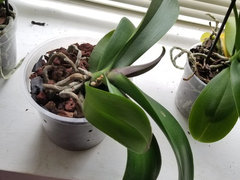
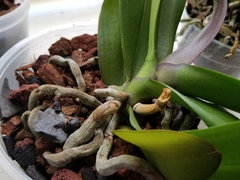
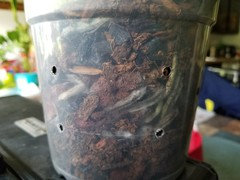
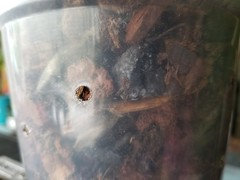
- 7 years ago
Hi everyone.
HU-247127033 - It's hard to say if the white stuff that can be seen in pic's 3 and 4 is actually mould. Personally I think it could be "Root Mealy Bug". It's a tiny insect much smaller than the usually Mealy Bug that's sometimes seen on the base of plants, and without looking at it under a magnifying glass it's hard to be sure.
I have grown orchids in the past and now grow bromeliads and I have seen this pest on both types of plants. It's more prevalent on plants that are a bit on the dry side such as here when we have watering restrictions and plants can't be watered as frequently as required.
If it is "Root Mealy Bug", these insects suck the sap from the roots and breed in dry conditions so if your plants are a bit on the dry side this could be your problem. The good news is, that it isn't hard to treat in the early stages. Any good systemic insecticide used as directed should control it.If you prefer to go down the less toxic path you can use Diatomaceous Earth (Sometimes called Fossil Flour). I fyouchose to use this it's important to used the "food grade".
See: https://en.wikipedia.org/wiki/Diatomaceous_earth
I have used this successfully on bromeliads which I found to have "Root Mealy Bug". I simply sprinkled 1/2 teaspoon over the surface of the potting mix and watered it in. On inspection after three months there was no sign of this insect pest. I now use it as a precaution on everything I re-pot. I fill the pot to three quarters with potting mix, sprinkle the Diatomaceous Earth on top and then add the remainder of the mix. I have found that any plants treated in this way have always been free of these pests after treatment.
I use black plastic pots for all my bromeliads and this clearly shows up the white root Mealy Bug as what appears to be a white powdery substance on the inside of the pot even if just in small quantities. It congregates around the area between the potting mix and the inside of the pot where the mix dries out the quickest and because it is white and the pot is black it's very obvious.It's a bit hard to explain so I'm attaching a couple of pictures; and although often the only sign is small white powdery marks on the inside of the pot, picture No.1 below depicts a more advanced infestation.
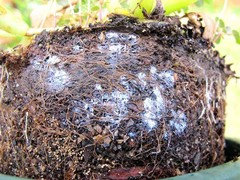
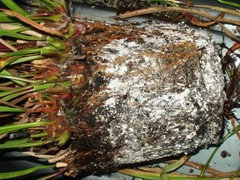
Picture 2 below shows an extremely advanced and serious infestation which has gotten well out of control because it wasn't treated in the early stages. Like all problems "A stitch in time saves nine", and if this plant had been treated in the early stages it would never have got to this.
I hope this is of some help to you.
All the best, Nev. - 7 years agolast modified: 7 years ago
Twice I've tried to type a lengthy answer (with pictures) and twice this rotten site has "eaten it up"; so sorry, no more typing for me.
All the best, Nev. pt529
Original Author7 years agoHi, Nev.
I don't know what the heck is going on with the website, but looks like my original post that had disappeared suddenly reappeared. I'm sorry the same issue happened to you but I would love to get your advice. Would you be willing to try again at your earliest convenience, and then copy/cut your entry before submitting to save it just in case? Or even screen shot your entry before submitting and just post the photo? Lol
I'm sorry, I'm desperate for answers. It's been 8 days that I've been trying to find out the right thing to do. 7 years ago
I don't believe it to be mealy bugs, but I could be wrong. I think it is a fungus/mold. My advice would be to pop one or two of the 'not' repotted phals out of their pot and see if they have the mold. If they don't, I would strongly lean towards it being the new media. If so, unpot the ones with the mold and clean them well with a good spray of water. If you want to try and reuse the new media, try baking it in the oven for 20-30 minutes and then soaking it in water prior to using again. Personally, I'd try a completely new media as far as manufacturer and where it was purchased. If the unpotted plants have the mold, you'll need to use some type of fungicide like Physan 20 and then repot with new media.
A couple of other things that have been mentioned or seen in this thread :)
1) Hydrogen peroxide does nothing to combat fungi or any other disease really, I believe Howard mentioned that in the other thread. I've read the extra oxygen molecule (H2O2) is supposed to help when watering, that makes some sense to me.
2) I grow a lot of phals in clear plastic pots and never add any side holes, works for me.
Good luck,
Bobpt529
Original Author7 years agoThank you Nev and Bob. Glad the website allowed Nev's post to reappear Haha.
I hate that there is a such thing as a root mealybugs! I already got over getting rid of the usual/traditional mealybugs that were hanging out on my blooms 1-2 months ago after they caught it from an infested nearby vine. Successfully gotten rid of them with rubbing alcohol and q-tips and removing the source plant that was infested. I compared the photos of root mealy bugs and it doesn't look like that's the case, thank goodness. Theres no tiny bug movement either.
And yes, my other orchids that have not been repotted yet have no signs of mold or odor. Just the common small mushrooms that are growing on the old decaying media. The roots are plump, green, and happy. And they've all been growing in pots with no side holes either.
For the media, I'm going to buy plain orchid bark media that a different local garden center sells. I've seen it sold as individual unmarked clear plastic bags as if it is distributed locally or by the business. Not sure if that is a risk? I'll ask where it came from.
Diatomaceous earth sounds like a good natural idea. I've actually used it before around the house. Never thought about it for house plants.
Baking!:
1. What temperature setting?
2. Let it cool completely and then soak?
3. Soak for how long? And do I have to let it dry before potting or it's ok to repot with wet media?
Also, does the heat harm the integrity the orchid bark? And just out of curiosity, what does the water soaking do post-heating?
Also I'm waiting on a new order of different pots to arrive tomorrow. They are a half inch less in diameter than the one it's in now, so maybe that will help in case I overstuffed during the first repotting.
The Bromeliad pup:
To Nev, can the pup be grown in just plain orchid bark chips as well? I read about mixing orchid mix with cactus mix so I did that the first time I rescued the pup. Seems like the peat moss is retaining moisture for way too long. As of right now, the bottom tip of the pup is darkening and I fear of rot.- 7 years ago
Hi everyone - I'm pleased to see the problem I had posting my reply seems to have been fixed and now it's been posted twice so I'll see if I can delete one without both posts disappearing. .
pt529
Original Author7 years agoYours didn't post twice on my end so I wouldn't risk it with Houzz's glitches
pt529
Original Author7 years ago(Houzz is killing me. Here's a third attempt at posting without the photos.)
Ok so I bought a bag of the orchid bark I mentioned previously. An employee said it's from the giant bags of Rexius brand ordered from BWI. After looking it up, apparently Rexius already heat treats to sterilize their bark so there's a step I don't have to worry about anymore lol.
I took my problem orchid out of its pot outside and the poor thing had so many dead, rotted roots. Luckily, all aerial roots are fine and the upper parts of some ground roots are still ok. I used a garden hose on the shower setting on gentle flow to rinse off the roots and search for any mushy tips to trim, then gave them a final few seconds of a hose blast for added measure. Hopefully no spores stayed behind! Below are the before and after pictures.Little roots, big pot?:
Now that the orchid has basically 1/4 of the roots it started with, which are now mainly aerial roots, I'm worried about the appropriate size pot right now. My order of new pots that are coming tomorrow are 5.5 inch diameter pots. The original pot size the orchids were sold in is 4.5 inch size diameter pots. You can see in the picture below that it basically fits the small styrofoam party bowl I had left to hold it lol. I'm leaving it to air dry now until I know what to do moving forward.
How can I correctly pot this orchid now without suffocating the remaining roots?
And for the bromeliad pup, is it ok to just use only the orchid bark as the potting medium? I'm getting rid of the infected potting mix now.- 7 years agolast modified: 7 years ago
As far as baking, 200-250F. The overnight soak is because after baking the media will be dry, dry, dry and have a difficult time absorbing any moisture if used for potting without the soak. Only soak what you plan on using in the very near future. I soak all of my bark based media prior to use. A 5.5" pot should be fine, you may need to anchor the plant in the pot with a rhizome clip or something similar like a wood skewer stuck through top of pot, until it establishes some roots and can 'stand' on it own. Heavily water (once a week is a good starting point) when media in pot is almost dry. That said, in the pictures I see of your newly repotted phals in the holed pots, the media looks too dry. It's unusual to see mold in that dry of an environment???
I find my orchids do as well or better when I just provide their basic needs (water, good light, temps, decent media, a little fert) and don't obsess over them. More orchids are killed with love than from negligence.
The bromeliads I've seen use a much finer media than orchids, but I do not grow broms so that's just an observation.
Bob pt529
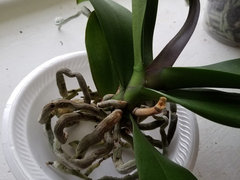
Original Author7 years agoHere is one of pictures I was trying to post yesterday. This is the root mass left :
So since my new bag of orchid bark is pre heat treated I guess I should do that soak?
I was debating on ordering a set of 4.5 inch diameter pots now that I'm paranoid of having over-stuffed the roots the first time in the 6 inch pot.
So if I use the 5.5 inch pot, do I try to pot more of the aerial roots this time? Like put the orchid slightly further into the orchid bark? Or pot it like normal and just leave all aerial roots out and continue to mist daily?- 7 years ago
That phal can definitely make it :)
I soak all bark based media prior to use. Pot up to the neck of the plant and I wouldn't stuff the aerial roots into the pot unless necessary because of depth of plant when potted.
Bob pt529
Original Author7 years agoOk, I feel relieved lol. And after you soak your bark, do you set it aside to air out, or is it ok to use it while it's still wet/damp?
- 7 years ago
Well, I for one, usually water my orchid after I pot it, so I see little reason to let it dry out (which would cancel the benefit of soaking it anyway).
- 7 years ago
I use it wet usually straight from the soak, also in my experience if you don't soak first and just water heavily the bark won't hold moisture very well.
Bob  7 years agolast modified: 7 years ago
Fungi exist all around us. No matter how much you try to sterilize your potting medium, you will never totally eradicate fungi. Even if you do bake it to kill off any existing fungi, once you begin to use it and water it regularly, fungi will always come back. Not all fungi are bad. In fact, orchids in the wild rely on beneficial fungi in order to germinate their seeds. Orchids wouldn't exist without the aid of these beneficial fungi. Rainforests wouldn't exist if it weren't for these beneficial fungi breaking down dead plant material and recycling it back into the ecosystem. When you use fungicides or extreme heat to kill off fungi, you're killing off the beneficial fungi as well. This leaves your orchid media exposed and vulnerable to pathogenic fungi that are harmful. We don't live in sterile environments, no matter how clean we are, and neither to our houseplants. I've been growing plants for well over two decades now and not once have I ever resorted to using fungicides or sterilization to grow any of my plants, especially my orchids.
Looking at your photos, I can see that your plants are not getting enough water, or they're drying out way too quickly. These are rainforest plants. In their native habitats, they get rained on on an almost daily basis. Since they grow on the trunks of trees, they get flushed with lots of water, but any excess water quickly drains away.
Like others have suggested, I soak my orchid mix for quite a while before using it. Even then, I'll even let my potted orchids soak for roughly half an hour before letting the excess water drain away. I would also advise increasing the airflow around them. When my plants are inside, I leave my ceiling fan running. This should keep any fungi growth at bay. Quit focusing on trying to eliminate fungi, you're just fighting a losing battle. Just water them more often, perhaps even giving them a good half hour soak, and increase the airflow around them. They need fresh air just as much as they need fresh water.
- 7 years ago
Hi everyone.
pt529 - After reading all of the previous comments I have a few bits and pieces on cultural practices which you may find worth considering.
Potting Mixes: There are probably as many different potting mixes as there are growers as every grower has his/her own mix which they think is the best.
The criterion for any bromeliad or orchid potting mix is that it must be well draining. We should never forget, that in nature these plants are epiphytes (Grow on trees) so the roots are continually exposed to the surrounding air and dry out almost immediately after they have been watered. The plants will also grow in an inert potting material such as scoria, gravel, polystyrene pieces, broken bits of brick, roof tiles etc. You can use anything that will hold the plant securely in the pot, but remember if using an inert media, you MUST FERTILISE as these substances have no nutritional value whatsoever and the mix is simply used to hold the plant in the pot.
I have noticed here in Australia, that many Phalaenopsis sold in nurseries are growing in live Sphagnum Moss and nothing else. They seem to grow well in this as it's long lasting, drains well and just contains sufficient moisture to meet the needs of the plants.
Phalaenopsis growing in Sphagnum Moss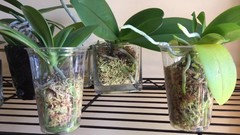
It is well known that due to its absorbing capability and acidic composition it was a popular dressing for wounds during both World Wars due to its action as an anti-bacterial agent and fungicide. It is also these anti-bacterial and fungicidal properties that make it popular to use a growing medium.
Ever since I started growing orchids some 40 years ago it has been generally accepted that by dusting any cuts where the plant has been divided with "Flowers of Sulphur" this prevents fungus entering via the plant cut. Even now I still follow the same routine when potting bromeliad plants and have never had a problem with fungus diseases.See: https://en.wikipedia.org/wiki/Flowers_of_sulfur
I use a potting mix composed of two parts of commercial "bark based orchid potting mix" mixed with one part of commercial "general purpose potting mix" and find it drains well and is a suitable mix for my bromeliads and orchids.
All the best, Nev. pt529
Original Author7 years agoThose pictures were taken right before I watered them for their regular schedule. I do make sure to check their roots and leaves daily for dessication or wetness. Our a/c has been running a little cooler than usual so if anything, any excess drying could be due to that. Also, I purposefully had a restricted watering scheduled just for the main phal in the pics due paranoia with the mold problem.
As for fungus, I'm not worried about the harmless mushroom fungus in the non-repotted phals. Those are doing fine and will be repotted when time comes and when I have my rookie repotting experience down pat, following the advices here.
The mold in the problem phal, however, took a toll on the majority of the previously healthy roots. I waited too long to take it out to rescue but during that time period, I had no idea what to do and why mold appeared in only one phal pot and a bromeliad until the responses from this thread. So the medium was thought to be the issue. I tried to post pictures of the phal roots but Houzz always gives me issues with my posts and gives me error messages. I'll try again in a new post below following this one.
And thanks Bob for soaking the tips! I just got home from work and rinsed off any dust and am soaking the brand new orchid bark I bought yesterday right now. The new 5.5 in pots also arrived. I'm keeping a close eye on the naked orchid, providing moisture when necessary while it waits for its new home. Crossing my fingers that everything works out this time.pt529
Original Author7 years agolast modified: 7 years agoNev,
Interesting idea about the flowers of sulphur powder. I've never heard of it before and not sure how I'd find it here in the U.S. A quick Google search doesn't really show any legitimate retailers. So this powder could be used to dust on the freshly cut ends of orchid roots for example? Or even at the cut end of a bromeliad pup?
For orchid fertilization, what's a method or safe brand that won't risk burning the orchid roots?
Also, anyone have thoughts on using a root stimulator/hormone for the orchid that has just lost most of its roots? Something about kelp extracts?- 7 years ago
I don't believe there's any difference chemically (could be wrong) with sulphur powder vs flowers of...we can get sulphur.
pt529
Original Author7 years agoHelp!!
If anyone can catch this in time because I'm in a time crunch with a few hours left to pack for my flight tomorrow morning.
I was getting ready to water the phal today but checked the roots first. There's that same fluffy fungus again! I gently took the plant out and the growth is on the callused tips of the roots that were trimmed of dead roots from before!
There is a bottle of Daconil concentrate at the closest store to me.How do I use it on the roots once I dilute it? Spray the dilution? Let the roots sit in the dilution?
pt529
Original Author7 years agoAlso, since the roots are dry and the phal was due for watering, what's the order of watering and treatment? Wet roots under water and then treat with Daconil and put back in pot?
- 7 years agolast modified: 7 years ago
First of all, put down the orchid and step away. You're killing it with kindness. If you want, just leave the phalaenopis unpotted until you get back from your trip. Orchids are tougher than you think. In my early years, I used to nitpick about every little detail about caring for my orchids. And I killed many of them in the process. I had to learn the hard way that they can care for themselves, just as long as you give them what they need, plenty of water and bright indirect sunlight.
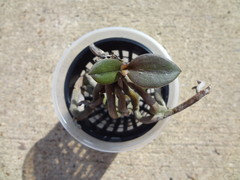
I've had this rescue phal sitting outside all summer long without a pot or any orchid mix whatsoever. It was potted up, but I didn't care for it because it lost all of its leaves and I thought that it was dead. But then I noticed this basal keiki growing off to the side of it. That's when I removed it from its old potting mix and left it completely bareroot. I did this because its roots can photosynthesize energy just like their leaves can, and I wanted it to gather as much energy as possible to help it grow. So its been like this all summer long. All I do for it is spray it down with a garden hose whenever needed. But now that it's growing its third newest leaf, I'll finally get around to potting it up today.
The vast majority of orchids are epiphytes, meaning they grow up on the trunks of trees in the rainforests. Potting them up is more for our convenience than it is theirs. Dousing your plants with fungicides won't do it any good.
pt529
Original Author7 years agoHi there. Thanks for responding.
Leaving the phal alone was what I tried the first time it had fungal issues. Then a week and a half later the fungal growth spread to nearly all of the roots and killing them in the process. Hence the major chop in roots seen in my previous posts. So I hope you can understand my paranoia now, and feeling the need to act faster haha :P
Before seeing your reply, I took it outside in my backyard and wet the roots with my garden hose. Then I "spot treated" with Daconil "ready to use" spray on the affected root tips and any freshly cut ends. It's now sitting outside, barefoot in the shade on a patio table. My climate is also very humid (85-99% humidity today). It was drizzling a little bit while I was outside as well. I will leave it out there for a while. And then put it back in it's pot. Think this is ok?- 7 years ago
Orchids love the hot and humid weather. Being outside in a shaded location will do more to keep any fungi at bay than any spray will ever do. When plants are outdoors, they get bathed with lots of ultraviolet sunlight. This is a natural defense against fungi. Which is why, when my orchids are outdoors, I never concern myself over getting them wet. Indoors, I would never do this.
pt529
Original Author7 years agoI was always tempted to take it outside cause I know they'd love the humidity. But I've hesitated because of our unpredictable and unstable climate here. It can storm at the drop of a hat or the sun can be blazing hot, which has burned even my hardiest plants in the garden. We don't have a true fall climate but the temps have been slightly more bearable today with the rainy weather. I'm actually contemplating on leaving it outdoors while I'm gone.
My backyard doesn't have a covered patio so what should I do about preventing direct sunlight and protecting from random thunderstorms? If I keep it barefoot, I can keep it leaned on it's side on the table to prevent water collecting in the core. I also have a small front porch that is covered but not a lot of sunlight hits it as much as the backyard area.- 7 years ago
I agree with PS. Leave it bareroot while you're gone and deal with it when you return. Give the roots a good soak prior to leaving.
Bob - 7 years agolast modified: 7 years ago
Don't worry about any thunderstorms. When grown outdoors, orchids love them. Arkansas is one of the rainiest states in the country. My orchids get rained on all of the time by thunderstorms. It's only when orchids are grown indoors that they shouldn't get wet.
Any shaded location outdoors will do. If the direct sun is early in the morning or late in the evening, that'll be fine, too. Just as long as it's shielded from any direct afternoon sunlight.
pt529
Original Author7 years agoThanks guys for all the input. I'm leaving it outside in an empty orchid pot with holes. It's on a perforated patio chair which should let any rain water fall through. It's in a spot that gets a bit of the early morning sunlight and shade from afternoon sunlight. I gave it a last soak in water for 20 mins and I'm calling it a day!
Again thanks so much for helping me learn.
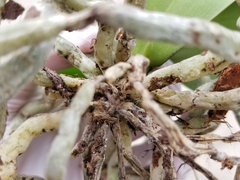
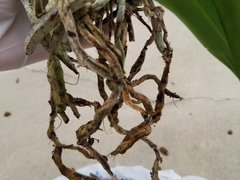
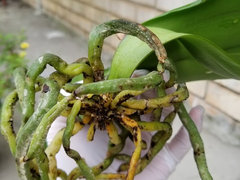











pt529Original Author