

How much is enough Make-Up Air
We are doing a kitchen renovation, got a 36" Bluestar range top, and 46" 1400 CFM vent hood (10" duct).
It is a perfect setup, and works wonderfully. However, now we are trying to figure out a proper Make-up Air (MUA) system. We have a natural (atmospherically) vented water heater, which is combo vented with the furnace, so backdrafting is a concern.
I originally intended to go the route of passive Broan automatic dampers. But using their online estimator tool, it looks like I may possibly need 2 x 10" damper/ducts. However that is with a bunch of swagged numbers (i.e. for the house leakage). So, perhaps it is enough, and maybe not. And if not, then I would need a different method, as that is getting to be too much to feasibly fit.
Is there a way to actually tell how much is enough?
Should I get a manometer to measure that the pressure drop is under the recommended limit?
Comments (35)
 7 years ago
You need as much CFM as the vent, to start. In a cold climate, you will need a HERV system.
lurker3197
Original Author7 years agoHow can you tell that you have the same CFM when using a passive system?
Related Professionals
San Jose General Contractors · Amherstburg General Contractors · Houma Bathroom Remodelers · Sioux Falls Bathroom Remodelers · Fredericksburg Kitchen & Bathroom Designers · Chicago Kitchen & Bathroom Designers · New Orleans Bathroom Remodelers · Syracuse Bathroom Remodelers · Green Bay Bathroom Remodelers · Orlando Kitchen & Bathroom Designers · Westminster Kitchen & Bathroom Designers · Garden City Kitchen & Bathroom Designers · Chatham Kitchen & Bathroom Designers · Southaven Custom Countertops · Cornwall Custom Countertops 7 years ago
The MUA needs to match vent CFM and needs to be heated in cold climate areas. Quite an expense, $3000 for the MUA unit, $3500 for installation by my the HVAC company, $400 for Electrician for breakers and CAT6 cable. This does not take cost into account for MUA feed ductwork I had HVAC guys build into the house when they installed the HVAC system and ductwork
I tuned the system myself. The MUA is a variable speed unit and I programmed it for our 4 speed hood. I tested it and it works like a charm. I designed the home to feed MUA air at the furthest end from the kitchen (some 90' away). This helps use MUA heated air to supplement our HVAC when using the kitchen hood during winter; we intend to move in within weeks.
lurker3197
Original Author7 years ago@Michelle -- thanks, looks like they are in Atlanta, and I'm in northern VA. I guess I will need to seek some professional help to do this correctly though (also thanks Sohpie)
@freeoscar -- the window is what we are currently doing. It works (however a window on the same side as the exhaust just pulls the smells back in). But we want something better and more integrated into the house. Also, if someone forgets to open the window, we backdraft the CO into the house -- bad.- 7 years agolast modified: 7 years ago
As I think we all know by now, the MUA flow rate exactly equals the exhaust vent air flow rate, counting all MUA sources (e.g. leakage) and any other exhaust ventilation in the outflow side of the equation.
Points to keep in mind: The 1400 CFM of the vent system is a nominal value, most likely the free air (zero static pressure) flow rate of the blower alone. In situ, even with perfectly balanced MUA, the flow will be expected to range between 900 and 1000 CFM.
Hence, capability of the MUA should be in that range, plus any other venting (bathroom fans, etc.) less house leakage. This may require a blower [rated] anywhere between 1200 and 2000 CFM depending on the restrictions in the MUA path. These may exceed the restrictions in the hood path if filtering down to the dust level is performed, and a HERV system at that flow rate could be large and restrictive. Electrical heaters may have less restriction than water to air heat exchangers.
The specific question about manometer usage is a YES in my view. The situation is too complex to guess at results (like I did above), and due to the combustion appliances not having their own MUA, keeping the house pressure at no less than the values in the note below is important.
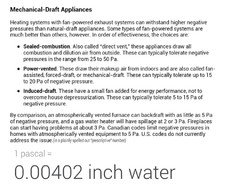
Edit: Personally, I would strive to achieve combustion appliance independent MUA to minimize the complexity of the kitchen MUA control system. - 7 years ago
I agree with Sophie; you need a specialist.
We don’t have a huge issue. We are venting a 36” Wolf gas Rangetop using a 40” Wolf hood liner in built in cabinetry.
It’s a total remodel; the foundation is the same but most everything else changed. So, there were minimal issues adding MUA.
An old friend of 20+ years owns a HVAC company. He is personally doing most of the work on our zoned system. He said the MUA works off a pressure switch. In Houston, we don’t really worry about external cold air. He said the MUA added about $2500 to bill (but I may have gotten a deal).
- 7 years ago
" looks like they are in Atlanta, and I'm in northern VA.
We are building in TN. EV can do design beyond the ATL area and often does. You just need to know the particulars they would require to perform the calculations/design. - 7 years ago
If the the duct is only 10 inches and it has one or more elbows, then I highly doubt you will get 1400 CFM of air flow. I would also think this set up would generate a lot of noise.
How did you come with the 1400 CFM air flow requirement? I think you can reduce the air flow which will reduce the make up air requirement.
- 7 years agolast modified: 7 years ago
Range hood CFM calculation example:
Kitchen (L' x W' X H' x 15)/60 = CFM required for 15 air exchanges/hr.
Add 1 CFM for each foot of pipe length
Add 25 CFM for each elbow
Add 40 CFM for roof cap
You get the idea.
Couple that with a matched MUA, then you have an amazing kitchen where you can be grilling burgers, cooking stuff etc. etc. yet don't suffocate with cooking smells etc.
- 7 years ago
Sorry, Pinebaron, but this is not an air refreshing exercise; the hood has to pull enough air to create the necessary velocity at the hood aperture to ensure capture and containment. The pressure losses for pipe length, elbows, and roof cap are small relative to that of the hood baffles, as well as due to a likely imperfect make-up air supply.
- 7 years agolast modified: 7 years ago
He does not have an MUA installed yet and that was the OPs question. A hood vent is most definitely an air refreshing excercise; please do some reading on the subject. I designed our home, yep, lots of calculations and installed an ideal and perfect solution; hence talking from experience.
Kitchen section is 25'x25'x12' which ideally needs a 1900CFM hood taking any losses into account; ours is a 54" hood rated at 1800CFM+ maximum, 200-1800CFM or more. The higher speed will primarily be used when grilling indoors on the 48" range.
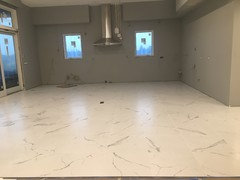
20KVA variable speed heated MUA with automatic dampers, airflow and temperature sensors and also connected to sensors at the hood to sense its speed, air flow etc. and feeds a corresponding amount of fresh Make Up Air (heated when air inlet temprature is below 50F) through the house to balance negative pressure created by the hood. It's a very large unit. I did the final calibration too.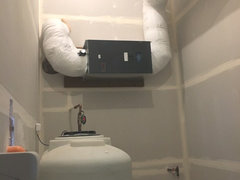
lurker3197
Original Author7 years ago@mike_home: We went by the Bluestar guideline recommendation of total BTU output of the cooktop, divided by 100, which gives us requirement of about 1200CFM. We rounded up to the closest sized blower which is 1400CFM. Also figured there would be losses due to duct length, 2 90 degree turns, and baffles. We did a remote remote blower, so its actually not that loud. We are quite pleased with the performance of both the rangetop and the vent hood. Sooo much better than the downdraft we had previously.
Back to MUA... it does sound like folks at the higher CFM levels are doing active systems. I'll need to look into that some more. If anyone has any recommended HVAC outfit in NOVA who is familiar with doing this, please let me know.
@Kas thanks for all your feedback (and not just on my thread). I've learned a ton from you going through old threads.
@Pinebaron that is quite an impressive setup. Where does your make-up air feed back to? Into the central air handler, or back to kitchen?BTW, Pine Barrens is my favorite episode of The Sopranos.
- 7 years agolast modified: 7 years ago
@lurker3197. I used to live right next to the Pine Barrens in NJ.
Makeup air feeds into a very large ceiling vent (48x16) at the opposite end of the house wrt to the kitchen. The vent is right inside the rear corridor exit door and aimed at the door to the center garage, an area some 90' away from the kitchen hood. Even at full blast (with the hood running at maximum CFM) one really needs to open the door leading to the garage, stand on the steps, to feel the air, it is extremely quiet, less than a whisper due to using very large and insulated ducts. The idea is to not feel 1800 CFM blowing through the 6' wide 29' long 9' tall corridor before it opens up into the very large wide family room and kitchen areas all with 12' ceilings. In addition there are two HVAC air return vents in the same ceiling which would also assist in neutralizing effect of air volume hence avoiding a wind tunnel effect. In any case, during colder months and during use of the kitchen hood, warm air emitted by MUA will supplement HVAC heat. Not that HVAC systems need any assistance, these are two large commercial grade Trane high efficiency furnaces. I, with some help from commercial HVAC designers (for sizing), designed entire HVAC layout, registers, returns etc. for this large home. Even though the two systems are entirely independent and cater to opposite wings of the house, key registers from each system, feed areas in the other wing; basically each system is capable of heating/cooling entire house creating redundancy. Results easily exceed my design and comfort specifications; it is simply unbelievable.
Pics of our mechanical room, still adding equipment.
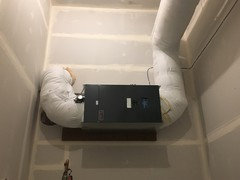
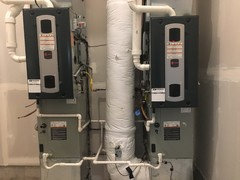
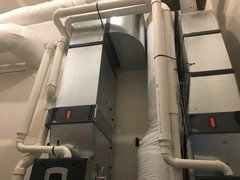
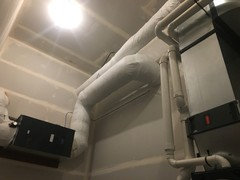
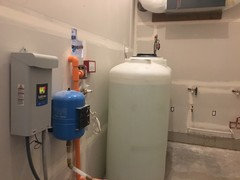
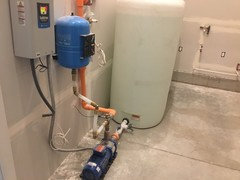
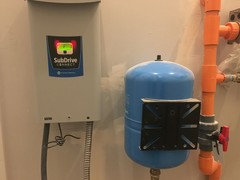
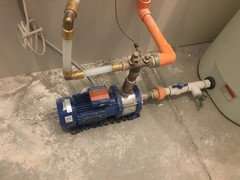
Two large tankless units will be installed soon  7 years ago
You likely want to lean towards slightly oversizing your MUA. Undersizing could result in both backdrafting of your furnace & WH and will cause humid outside air to be pulled in through leaks.
When this latter happens the interiors of your walls can become damp and produce mold growth. Given where you live your indoor air is likely to be dryer so better to push dryer interior air out than pull damp hot air in. As well, your hood blower should take up some of the overpressure slack and perform better (see @kaseki above about free air flow).
The ideal of course is for the MUA to perfectly balance all exhausting appliances at all times so that your house stays perfectly balanced with no leaks. While the tech to do that is readily available and quite simple, nobody had yet done it.
- 7 years ago
Lurker,
I am in a similar position, have a 1200 CFM hood, major renovation was finished early summer, MUA was in the plans all along. HVAC guy (through the builder) then tells me I don't need MUA because my house is leaky enough. I push back and he says that he will do it, but it is a waste of money. Specs for my hood for MUA are here and this was what he planned to do:
http://docs.zephyronline.com/docs/specs/mua_spec.pdf
A passive system dumping Chicago winter air in the furnace, counting on being pulled through the HVAC system just seemed insufficient so I said forget it, thinking I need to find someone else with more experience with residential MUA. I did test it out with no MUA as suggested and hood performance when doing things like stir fry was notably worse. So, I've been opening a window the last few months, but have reached out to my long time HVAC guy who came by over the weekend to take a look and make suggestions.
We are still kicking ideas around, but I came across this and wonder if this would do the job?
http://www.electromn.com/gen/makeup_air_ii.htm
(Yes I passed inspection months ago with a 1200 CFM hood and no MUA) - 7 years agolast modified: 7 years ago
Perhaps. See also Fantech's web site. I think they also recently started marketing complete MUA systems.
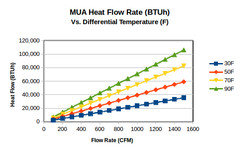
Here is a simple plot showing how much heat must be put into cold air to raise it a given amount as a function of flow rate. Note 1000 BTUh = 0.293 kW. The higher levels may require an upgrade in house electrical power.
- 7 years ago
Thank you Kas! I am liking what I see on the Fantech site. Great that they have things broken into specific applications such as residential kitchen. Knowledge level for many HVAC folks seems really hit and miss on this topic.
Lurker - I'd be interested in what direction you go. lurker3197
Original Author7 years agoOK, so I've done some experimenting and now I'm more confused.
I've learned about doing a smoke test (spill test/draft test) at the draft hood of my natural vent water heater. This seems logically like the best test (better than manometer, because it will show if the gases are being vented or not).
So, I got some incense for a good stream of smoke, and ran the test:
- crank up the water heater (so that its actively heating)
- crank up the furnace (which is combo vented out the same B-vent)
- close all the windows and doors
- Put the incense stick about an 1" away from the lip
The smoke gets pulled up nicely into the vent as expected.
Now, I turn on the 1400cfm vent hood full blast.The smoke still gets pulled into the vent! I even leave it running for 5 minutes and monitor it, and it still looks good -- no backdrafting at all.
Hmmmph. So, backdrafting was my big concern, and now it doesn't seem to be an issue?The house isn't that old (about 18 yrs), so I don't think its hugely leaky. I do see that there has always been a 4" fresh air vent to the return of the a/c unit. But is that 4" pipe enough to offset the 1400cfm?
According to local code, I will still be required to put some type of make-up air system. But maybe I really can just get away with a simple passive damper (like an 8" one). I simulated by opening a nearby window the same surface area... and of course the smoke still goes up the vent (it already does with windows closed).
Anyone have any insight as to how this makes sense?- 7 years ago
If your furnace & WH share an exhaust duct then you may have been experiencing venturi effect and not getting an accurate idea of what's happening. You could try w/ just the WH to get an idea. Even with the help of venturi it surprises me a bit though.
Possible reasons:
- Hood advertises 1400 but actually delivers massively less. What make/model of hood? Do you have the fan curve for it? Some may pull 1400 free air flow but then even the slightest bit of static pressure drops them to 300 or less.
- House is extremely leaky. 1400 is a lot though even for a very leaky house.
- Fireplace that doesn't seal up well? lurker3197
Original Author7 years agoYeah, surprises me too.
It is a Bluestar CMFR 1400 Remote Fan:
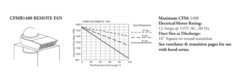
We are using 10" duct, length is around 10 ft, with 2 90 degree bends.
It's been venting some serious frying out, and working great (although so far, we've always opened a window).
Perhaps with everything closed, it drops the CFM significantly? And the 4" fresh air vent provides enough so that the water heater doesn't backdraft?
I will do some more experimenting tomorrow then. I will try what you suggest with only the WH (and leave furnace off). And maybe let it run longer to see what happens.
The house does not feel leaky/drafty. The fireplace flue is closed.- 7 years ago
Good point opaone: "If your furnace & WH share an exhaust duct then you may have been experiencing venturi effect and not getting an accurate idea of what's happening." We haven't raised this one in this forum in my recollection.
Another useful test will be to tour the house while running the hood with the windows closed to see if there is a major draft source not being accounted for.
Yet another would be to hang a tissue strip from a baffle and operate the hood with and without an open window to get an impression of changes in actual air flow.
How far removed (distance and any closed doors) are the combustion appliances from the kitchen? Perhaps there are pressure losses in that path that contribute to the combustion appliances not back-drafting.
- 7 years ago
Also, w.r.t. the fan curve above, don't forget that a major, and most likely the largest, contributor to pressure loss is the hood filter (under most circumstances). Without some guesstimate of its pressure loss vs. flow rate, we don't know where on the curve the system will operate, even with maximum open windows.
 7 years ago
Lurker,
You are in luck that blower is one of the most powerful on the residential market, I have the same one and love it. Just look how flat that pressure drop off is on the curve. A thing of beauty. You definitely need makeup air. I’ve got two 10 inch ducts with dampers that channel into a 14 inch combined duct to the outside. I left a section in the duct ready for a MUA blower if required. So far my manometer says none needed for my particular home, but wow does the inside pressure go negative quickly when I disable the dampers.
lurker3197
Original Author7 years ago@catinthehat - how did you determine you needed two 10" passive dampers? Where do you have them coming into (the return of your hvac unit)?
What does the 14" combined duct look like? Got any link to the vent you used?
- 7 years ago
Hey lurker,
Happy to help. There is a MUA calculation method you can use that satisfies code requirements in most jurisdictions that tells you how much cfm you need. This article explains it well. There is a myth on these forums that mechanical MUA is always required over a certain cfm, not true:
In our case our blowers are extremely powerful and will definitely need mechanics MUA no matter what house. Your blower and the length and bends in your system, and assuming you are using a Prizer/bluestar hood with standard baffles to match your cfmr1400, you can assume 1350 cfm actual flow rate. So your calculation will be based off 1350 cfm.
In my personal example, I had a 1000 cfm deficit, meaning my MUA system had to account for 1000 cfm. You can size a MUA in-line blower for this rate, or you can do what I did and head over to the Broan website and see what size damper you need. I forgot the result I got but I believe I oversized it because I wanted more air going through the vent than the leaks in my house. The result is I used two 10 inch dampers combining into a 14 inch duct, which vents out to the side of my house. For outside, I used an 18x18 vent grate with a MERV rated filter (I forget the rating). You can get them on amazon. I did leave a 14 inch section in the duct ready to remove if I wanted to add a noisy blower later.
My MUA vents are located on either side of my range underneath the cabinets. This does two important things:
1) This method ensures that outside air is immediately captured by the hood and thus no outside unconditioned air burdening my central air
2) This method actually improves capture area by modifying the plume direction on the range. This has been documented in many hydraulic research papers, and confirmed in my application with a smoke test. Heavy smoke that is 1 ft+ outside the hood capture area actually directs back to the hood. Due to this phenomenon, I did not need to oversize my hood. I have a 48” range and 48” hood.
Hope this helps.
- 7 years agolast modified: 7 years ago
Nice write-up catinthehat. I suggest that there are two errors in assumptions made in evaluating this particular configuration.
(a) The mere 50 CFM difference between zero static pressure flow and estimated flow suggests that only the duct losses were accounted for. The baffles pressure loss will dominate at this flow rate. I would guess that your actual flow rate would be closer to 1000 CFM when the interior house pressure is only slightly negative.
(b) The "MERV-rated filter" in the MUA path will have a pressure loss at this flow rate. Also, if the MUA vents are diffusers, or even worse, registers, there will be a further pressure loss at these devices.
So, while good (perhaps I should write excellent) hood performance is achieved, the interior house pressure at full hood operation will be lower than ambient. Whether this affects combustion appliance safety depends on other factors, including whether there are any combustion appliances.
kas
- 7 years ago
My safety recommendation to anyone operating household combustion appliances using interior house air is to measure the closed-up house pressure relative to the outside pressure with the kitchen hood on full power and compare with the list of pressures I pasted into a message earlier in this thread.
- 7 years ago
Hi kas!
Great points. Take a look at the blower curve lurker posted, the cfmr1400 really is that good ;). With a pressure loss of 70 feet equivalent length duct, this blower puts out 1350 cfm, extremely impressive and leaps and bounds ahead of its competitors. If you goto engineering toolbox and calculate the equivalent friction loss in inches of water for 1350 cfm moving through 40 feet of 10 inch duct (70 - 30 = 40, I assume 30 feet of duct including the elbow losses), you get .37 inches of water. A good conservative estimate IMO for the baffle losses.
- 7 years agolast modified: 7 years ago
I'm not sure how friction losses in ducting qualifies as a measure of pressure loss in baffles. The baffles are aerodynamically very different than ducting. For one thing, they reverse the air flow direction twice. The hood really should be measured. Measurements are not usually provided for residential hoods.
The best I have are some plots from Wolf for their (Broan's) roof blowers operating on concert with whatever hoods they chose to test them with, presumably one of the compatible hoods listed on page 117 of their design guide. The curves on one of the plots reveal, for example, that (a) the 801642 1200 CFM blower on high speed pulls about 770 CFM with 40 ft of duct plus the hood, and (b), about 850 CFM with zero feet of duct plus the hood. At 850 CFM, the hood alone is losing over 0.75 inches of water column pressure. Adding 40 ft of duct in this case drops the flow further and adds 0.2 inches of w.c.
I would assume, if I were doing your analysis, a hood pressure loss of between 0.8 and 1.0 inches, w.c. (Note that this is actually a variable that changes with flow rate, so no single value actually applies except at the flow rate achieved counting all losses.) I'd probably want to allocate 0.1 inches to MUA if unfiltered, higher if filtered per whatever filter chart might be available. If your fan curve is in feet of duct instead of the more common pressure loss, then convert 1 inch w.c. to duct length and use that on the fan curve. I think you will find that you are under 1000 CFM. Blowers may vary in quality, but generally don't have magic blade characteristics (except VaH).
- 7 years agolast modified: 7 years ago
P.S. I anyone is feeling like trying another approach than hand-waving over marginally relevant data, he might consider modeling each baffle path as a set of four 90-degree rectangular duct sections in series having the dimensions of half a baffle gap by the length of the baffle gap. If there are n baffle gaps, there are 2n of these "duct section sets." The flow rate through any "duct section" is the actual hood flow rate divided by 2n. The pressure loss of one duct section set at its fractional flow rate is the pressure loss of the entire baffle area at the full flow rate.
The hood will also suffer various transition pressure losses due to the irregular interior mating to the actual exhaust duct, but I think the baffles will greatly dominate.
- 7 years ago
Catinthehat wrote:
My MUA vents are located on either side of my range underneath the cabinets. This does two important things:1) This method ensures that outside air is immediately captured by the hood and thus no outside unconditioned air burdening my central air
I am surprised to have not read more about this MUA configuration on these forums. One of the HVAC guys that looked at my set up suggested that this is often how restaurants are set up (MUA simply dumps into the capture area, under the hood) and perhaps could have been my configuration, pre-renovation, but that ship has sailed. Cost savings relative to heated MUA integrated to the house HVAC system would be massive.
I am assuming there is a downside that is being overlooked in many/most situations? - 7 years ago
Commercial hood measurements have shown that the MUA must be introduced outside the hood, and in such a way as to replace the air at the pans and not cause significant drafts that would disturb the rising and expanding cooking plumes. Toe-kick areas are potentially OK, but as a moderately recent forum thread relates, if the air flowing out of the kick area impinges on a nearby cabinet or the cook, it can cause flow disturbances -- maybe also marriage disturbances if unheated in cold climates.
Also, the toe kick area used for this purpose should be commensurate with the hood entry aperture area. The smaller the toe kick area used, the more pressure loss and the more powerful the MUA blower will have to be, or the lower the interior house pressure will be, which has its own issues.



Michelle misses Sophie