

Anyone here uses hydrospikes in their plants?
let me know! and what kind of plant????
Comments (81)

Mike the Fiddle Leaf Fig Guy
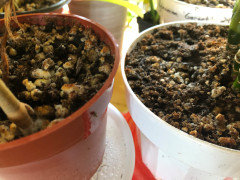
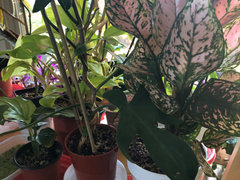
Original Author7 years agoyou think i wont stress the plant by repotting again? i went ahead and watered it. it looked like it needed water. the plants have the lower leaves curling and when I watered they started to uncurl like magic! my problem is I am going away for 3 weeks and no one is going to water the plants. having them in hydrospike would definitely help a lot but looks like they dont last 3 weeks without me watering manually 7 years agolast modified: 7 years ago
as I said your mix is too porous for wicking. if you need to use spikes you'll need to add peat to it. so you'll need to repot again - otherwise your plant will dry up in 3 weeks and die. stressed is better then dead. and they do die if they dry up completely. when in ground they can survive and regrow, but not in the pot.
otherwise the only other possibility is to set it up terrarium style: tent it in a large plastic bag, with spike in existing mix without repot and out of sunlight indoors. tenting reduces water consumption by approx. 20% (I measured on my plants).
my calatheas are in 6" pots and grow slow and consume little water: about 3 cups in 4wk per plant untented. if they are hot (above 75F) they'll take more water of course.
Related Professionals
Ocala Landscape Architects & Landscape Designers · California Landscape Architects & Landscape Designers · Jacksonville Landscape Architects & Landscape Designers · Chicago Landscape Architects & Landscape Designers · Concord Landscape Architects & Landscape Designers · Salinas Landscape Architects & Landscape Designers · Albuquerque Landscape Architects & Landscape Designers · Kalispell Landscape Architects & Landscape Designers · Chatham Landscape Architects & Landscape Designers · Annapolis Landscape Contractors · Baltimore Landscape Contractors · Saint Joseph Landscape Contractors · La Crosse Landscape Contractors · El Dorado Interior Designers & Decorators · Dover Interior Designers & Decorators 7 years ago
Petruska, TYVM for your helpful comments! I apologize, Mike, because when I posted, I did not realize the hydrospike thingie that you are using is not just a wick. I didn't mean to create a distraction in your discussion.
- 6 years ago
Wow Petruska thanks for all the info! You are so knowledgeable! Do you have an Instagram account that I can follow?
- 6 years ago
i see that u r following me here, where i post. i don't post half as much as i used to.
but if you search for my name u can get a lot of info if that's what u r interested in.
and u can see pics of my plants in idea albums.
 5 years ago
Hi Petrushka
thank you for all your info. I may be able to keep my plants alive while I’m gone for 1 month!
can you please tell me what is the purpose of the 20-30% coir chunks/bark? Can I use charcoal/gravel instead?
- 5 years ago
Coco chips and small bark (1/4 “ or at least not more then 1/2”) is to improve drainage and aeration: when soil is constantly moist on a wick it is imperative to have close to half of mix of something free draining that does not hold much water. you can use perhaps 10% of charcoal ,but both coco chips and bark also hold and slowly release moisture and some nutrients into the mix. They also wick somewhat, charcoal and gravel do not wick at all and have no nutrients. You can use reptile bark sold in pet shops. peat has some nutrients and it holds nutrients when you fertilize. Gravel and charcoal do not. so you’ll need to fertilize more .They will also compact more then coco chips/bark.
large Perlite (horticultural) is a must in any case.
- 5 years agolast modified: 5 years ago
Jasmine, if you just need to rig something for vacation, get 1/4” braided nylon rope, wash it. With a bit of soap to remove sizing to allow it to wick . And insert it from the top into the existing mix in the pot , the other end drop into any reservoir with water. If plant needs more moisture, insert wick around the perimeter, pushing it 1” deep. If plants like less water you can run it aroun half of the pot.
it works better with smaller pots, wicking is stronger, if you have standard very peaty houseplant soil mix it might get too soggy and some plants might rot: so for succulents it is better to do this with clay unglazed pots.
and It works better when the plant is under potted (pot size smaller then normally grown).
it takes practice to figure out the balance.
- 5 years ago
Hi Petrushka
When using wick watering did you ever have issues with fungus gnats or did the hydrogen peroxide you added fix it?
- 5 years ago
Newly bought plants invariably have gnats: I treat them with small dose of houseplant systemic from Bonide (It’s a weaker version then for outdoors).
a few manage to sneak in periodically and it can become a problem when you have a lot of plants.
i read that putting a layer of sand on top will deter them from laying eggs. I often put a layer of coco fiber matting on top: I think it helps too. people put drier sheets too: may be smell deters them?
but yes, when you have moist medium on top it’s a breeding ground for gnats. So u need to watch . However, when U leave the plants on wicks over a long time, the top of the mix dries up, especially in larger pots, so then it’s ok.
- 5 years ago
Hi Petrushka,
If the potting soil is also a wicking medium then does that mean my wick doesn’t have to extend very far into the pot to properly water? Say a 4-6 inch pot. Because as soon as the wick is in contact with the potting medium then the potting medium wicks water through the rest of the pot right? For >6 inches I can understand more coverage is needed.
Also, what is the max distance you’ve ever set your pot from your reservoir? I’m wondering what is the max depth of reservoir that can be used and still wick up. What are your thirstiest wicked plants? Mine so far is a butterfly syngonium.
- 5 years agolast modified: 5 years ago
how much water is wicked into mix depends on: thickness of the wick and how much it comes in contact with mix, on ratio of peaty mix to perlite ( or other non-wicking substrate used primarily for aeration), the size of pot, the distance of pot to water reservoir. all things that you mentioned :). AND how thirsty is the plant.
it's a big subject..for small 3-4" pots with 40% perlite it's ok to use 2 ply acrylic yarn and insert the yarn on the outside of mix (between the pot and the mix) with the tip extended to the top of the pot. most cuttings and plants like African violets do very well with plant pot positioned directly over the water reservoir (or pot inserted in the something that fits the bottom so there is no air in between: less evaporation).
i started wicking the AV's (there is a lot of info in AV forum) and then slowly all the rest..
for 6" pot i start lining the pots with a very thin layer of coco-fiber matting to increase aeration and wicking at the same time and use 3/8" nylon braided rope for thirsty plants threaded thru the bottom and up the side (all the way to the top, and outside of coco-matting).
Or very thin 1/8" braided rope from HD (for succulents and very 'dry' plants) inserted not thru the bottom but circled around the perimeter on top (buried .5 - 1" inside the mix).
with top wick the water-reservoir (jar) stands nearby but close..as close as u can position it . more then 4"-6" of open rope can dry up. and the rest should dangle down to the bottom of the water jar naturally :).
in general 3/8" rope will wick well about 4-6" away from water, but most of mine go into HD buckets positioned over some inset ..so wicks trail down up to 8" and are ok (inside buckets humidity is high, so they do not dry up).
i never insert wicks INSIDE the mix: that would wick too much as i usually leave my plants on wicks for extended periods of time: 4-12 weeks easily..(i travel and am between 2 locations most of the time.. with unattended plants on wicks doing fine).
- 5 years agolast modified: 5 years ago
now on thirsty-dry plant subject...
to some extent it will depend on humidity, light and temperature of yr house: the warmer and better the light levels the more they will take. in winter most of my tropicals in 66F -68F 7B location go semi-dormant: they still absorb water but much-much less. you'll need to learn from yr own set-up how much less.
my least thirsty plants are smaller plants in 4-6" pots: dieffenbachia, syngoniums, anthuriums, small calatheas, small bromeliads, small podocarpus, small aglaonemas and some smaller philos.
mediums are large hoyas and large African Masks...and larger plants that took little water when small.
my most thirsty ones in summer are begonias, aralias, spathiphyllum, crotons, large Ficuses, tropical hibiscus. some plants go outside in summer in 85-95F and then require even more..
the smaller the pot the easier and safer it is to put it on wick. but Ficus can be in 11" pot and wick just fine and 'not over-wet itself' LOL! i also have several large aralias in 8" pots.
in general wicking allows me to grow in much smaller pots for plant size, but i do feed continuously using liquid fertilizer in the water, even in winter.
I do mix my own mix for all plants and never put on wick anything with store bought mix: too peaty and will get too wet and rot the roots. unless it's for like 1 week only in temps over 75F and is at least in 6" pot and very well rooted thru the mix..
i hope you can reason out what to do for your specifics...basically it is passive hydro (but using mix to hold the roots). Most plants also develop water roots and they need to be periodically removed, they do decline, but then new roots regrow again. they do not spoil the water: but i always add 3% peroxide to it and drop pennies too for lighter containers to slow the algae growth. when the is no light the water stays fresh ..for like 6mo..really!
- 5 years agolast modified: 5 years ago
m-m.. just a few words on pots ;)..
i use plastic pots for all but succulents: aloe, jades, sansevieria, ZZ's. they all go into clay pots and on top wicks when i am away. otherwise i water by hand when i am in.
i try not to put on wicks very yound seedlings or freshly rooted cuttings that have few roots only. the key here is that roots are thru the mix and well developed.
some plants do better in wider shallow pots (like they use for bulbs, mums), others require deeper pots due to heavy roots. i do not repot very often..or as little as possible even when the roots completely fill the space.
my goal is to slow them down..but still keep them in good shape (as i ran out of space long time ago..:)).
- 5 years ago
Thank you again for the info! Do you use only food storage containers for the reservoir? I am wondering if for larger containers I can get bigger general purpose storage containers for long time vacation watering but not sure if it will be bad for the plant to take in water long term from this container which is not a food storage container type plastic
- 5 years agolast modified: 5 years ago
any plastic container will do. did i not mention that i use plastic HD buckets? they are all purpose plastic, i've used them and other plastic trash baskets without any adverse effects.
what kind of water you use is of significance due to PH and salts/chlorine. But if your plants are ok with it so far, i would not worry.
- 5 years ago
Petrushka, I was glad and surprised to read you use wick watering for your zz, jade, aloe, sansevierias! I guess the terra cotta pots help them dry out, and i'll copy your setup.
I have converted 70-80% of my indoor plants and have about 30-40 left to do. It just makes me so happy and relieved to look at them drinking from their reservoirs knowing they'll be ok when i need to travel (and i don't have to rely on a roommate and invariably return to some dead plants)
Thank you again! - 5 years ago
Wow! So u have like over a hundred plants!👍
i hope you’ll have some time prior to leaving to observe them, to make sure they won‘ t get too wet .. what’s your temps while you are away?
- 5 years ago
Im in San Diego so the temp should be warm most of the time, but night temp is around 50 for most of the year up the hill where I am
How is your wick watering for calatheas and maranta? My lemon lime maranta is my baby, and so far it seems to be doing ok with a little brown tips but not sure if they were there before. I use filtered water with these kinds of plants, but I’m wondering if just for my maranta I should use a glass or glazed ceramic reservoir instead of my usual plastic.
also, I’ve converted most of my peperomias to wick watering recently in terra cotta pots and its so weird for me to see these terra cotta pots just always slightly darker due to wicking water constantly. I’m hoping they adjust ok!
- 5 years agolast modified: 5 years ago
Clay pots will be fine, but with time salts will accumulate on the outside due to evaporation (white residue). Just wash it off.
calathea brown tips are normal in winter , it’s not the plastic container, it’s the season (they will drop older leaves in spring) . they grow in clusters : old clusters dry up and new develop. but the water is of essence: they hate salts in water, especially the softeners (Dracaena and cordyline too). Even moisture is very good for them they hate to dry up. it surely kills them.
I was asking about indoor temps, I hope most of your plants are indoors? Most of houseplants are tropical and they go semi dormant at 65f.
below that wicks would be dangerous: too moist and it will rot the roots. I am now in miami and some of mine are outside and some nights dip to 61F but days are 75-80 so it‘s ok for wicking, but once the water is exhausted i let them dry up a little before the refill. most Sensitive I bring in for the nite when it’s lower then 58F (aralias, alocasias).
by the way your indoor humidity will go up : evaporation from soil surface and leaves. it should be good for most tropicals.
- 5 years agolast modified: 5 years ago
>>a garden myth about not watering in this manner..
never heard of this garden myth.. and not sure what u mean.
I am just relating my experience of 7 years or so here, by the way. Not a myth . Have a look at my albums .. all plants grown on wicks
- 5 years agolast modified: 5 years ago
Hi Petrushka
Yes all my plants are indoors. I don’t think my indoor temperature gets lower than 60F ever since I redid my windows. All my wick watered plants are indoors. (My outdoor jungle I am going to experiment with an alternate form of plant butt chugging that involves drip irrigation and timers)
I’m 2 weeks into this experiment and I’m finding myself swapping out smaller test reservoirs for larger ones as my plants are thirstier than I expected and I’m getting lazier and lazier about individual watering and keener and keener to learn about this new way of plant care...
I do a pat test- I just lightly touch the soil surface and see if it’s slightly moist. I’m mostly concerned that it’s not wicking and it’ll get dry and hydrophobic or something. I’ve also found for my Ming aralia that it was so heavy it leaned over and pulled the wick out of the reservoir pool!!! Lol lucky I caught that before it was too late.
I’ve used a variety of ratios of spaghnum peat moss to perlite and chunky orchid bark depending on how thirsty i understand the plant to be.
For your 6 inch pots how many wicks did you add? For my 4, 6 inch pots I use one wick, 3/16 or 1/4 inch nylon. For anything more than 6 inch, and I only have a few of those, I’m using two wicks.
thanks again
- 5 years agolast modified: 5 years ago
I hope when u say shagnum peat Moss u don’t mean long fiber NZ Moss that they use for orchids? I use it in a mix for orchids on wicks! But only phals. I only have phals at this moment: they are so plentiful in FL! otherwise it’s regular peat.
For 6” pots it’s 1 fat 3/16 braided nylon with acrylic core rope: it wicks very well. Unless the plant is large and guzzles water, and still dries up fast. then of course u can use 2. But usually for me it‘s for at least 7” deeper or 8-10” pots(2 wicks). I have only 2 huge pots and u can’t put them on top of water reservoir :)). but they are ficuses and they survive with just top wicks for months.
larger heavier plants I put in all sorts of tall garbage baskets, round tall for very large plants: I either just sink them in tight or put them on reverted 6” pot inside or something , the tall basket sides hold the upper pot Straight.
but, I almost lost my best pink ag when it leaned to the light and flipped sideways..
u can stick tall bamboo stakes between basket and pot to prevent it from tilting.
I also use small bullet baskets: remove inner piece from lid, flip the top down and put the pot on that: it holds it pretty well.
- 5 years agolast modified: 5 years ago
Here’s a snapshot of some of the containers I use for pretty display, but they take a good Amt of water . Various bath baskets, the larger Ming aralia is in 10”(8.5” inside rim) pot. The African masks r in 6” . crotors r in plastic tumblers.
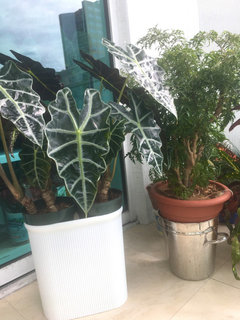
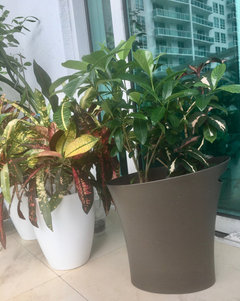
- 5 years agolast modified: 5 years ago
Wow your croton looks happy! I’m so tempted to give crotons a try again. Wick watering has changed my houseplant preferences; I used to avoid even looking at ferns, calathea and peace lily when at the hardware store because I knew they’d not do well in my home but now i find myself reconsidering them as part of this experiment because of how beautifully my angel wing begonia has bounced back after watering her on wicks.
As for the spagnum peat moss, no I don’t mean the long fiber stuff, its just loose fluffy stuff from the hardware store. I will take a pic when I’m back home.
Do you wick water any bulb plants? Eg caladium/amaryllis/clivia? I absolutely adore the above but I’m not sure about wick watering for them. I guess that during the dormant months you just lift the pot out of the reservoir and wait until they come back?
- 5 years agolast modified: 5 years ago
oh, yes! all my caladiums (indoors and out) and amaryllis too :). don't have clivia.
calatheas and Spathe 'Domino' too.
most tropicals that prefer 'even moisture'. Crotons would die if dried up a couple of times.
i had 'Petra' for 10 years, but they ran out of water last year (too long away..), but smalls are all fine. Those above in a bucket are 4 in each various, still in 12 oz tumblers..takes me awhile to pot them up (a few precious ones died after bare-rooting, so only uppot for smalls for now).
Aralias would drop leaves if dried up too. My Ming is 14 years now from a small plant. and i can leave it for 2-3 mo, imagine! well, all of them. but some are more sensitive to drying.
the Aralia in the pic above was glorious last august outside, but dried up too and dropped most leaves :O! but it regrew in FL in 3 months indoors in sunny room to what you see above.
When they are on wick unattended the top soil dries up, but the bottom stays ok. so when some plants are shallow rooted (like begonias) it's problematic. but since a lot of them go dormant they manage to survive. up to 1 mo is ok, but more then that is trouble.
Caladiums outside in heat are ok too, but if it's 65F they will go dormant, if i leave in the cooler fall-winter and they are still growing i give them only water for 1 month, then they decline until spring.
- 5 years ago
I didn't realize that when people say horticultural or chunky perlite, it was something specifically different to the average bag of perlite at HD. So none of my plants are in the super chunkous perlite people are talking about. Not sure if i should get some of that and repot everything AGAIN.
When you began this wick watering Petrushka, how did you determine whether a soil mix was too dense or too airy? i know it depends on the plant, but lets say for dracaena, philodendron, syngonium, aglaonema or monstera which make up the bulk of my wick watered plants, how did you determine (besides going on vacation for 1 month) that their soil mix and wick setup were sufficient? I have been patting the soil, but I just had my first casualty. There was a pothos i repotted for wick watering which I think already had root rot, but it was dark when i was repotting and i didn't realize at the time that the dark roots in the dark room were dark because of root rot, and so after repotting and converting to wick watering, many leaves went yellow, and i found the roots closest to the stem had rotted. I just clipped them off and am re-rooting in perlite. So i started checking moisture levels in the pot with my moisture probe. In some of my pots the moisture reading was in the 'wet' zone. I didn't want to repot, so for those ones i've pulled the wick out half way so that the wick only extends from the bottom hole halfway up the pot. I think the super shallow rooted plants (braided pachira aquatica) i can't do this. Not sure if this makes a difference to avoid soil getting too wet. Some of my plants i've also taken the wick up out of the reservoir to let them dry a little while i regroup.
One of my wicks sticking up out of the soil has algae!! Another of my wicks has turned green with algae. I need to start adding the hydrogen peroxide to my reservoir water, and a penny to the larger reservoirs. All my syngoniums and some of my philodendron have started growing roots into the space between the pot and the water surface!!! I can see that that region is super saturated with humidity and they must be loving it, or maybe this is just how roots grow in a super humid mini greenhouse.
- 5 years ago
There are always pros and cons as they say ;)..that’s why I usually go on about detail..it’s all in the detail: how thick the wick is (the thicker the wetter), how large the pot is (the larger the wetter, until it‘s over 8”..then need 2 wicks).
perhaps some Of yr pots are too large: I keep saying grow in smaller pot then normal.
or use thin rope wick or even just twisted acrylic yarn . it depends on size of the plant.
- 5 years agolast modified: 5 years ago
and you need to add about 1-1.5 tsp 3% peroxide per 1qt of water. That’s a must!
yes, algae is the bane of hydro! yes, periodically you’ll need to sort of wash off or soak the wicks (like ev mo? Or for me it can be longer): drop of soap on the napkin , wet, massage into the wick, rinse in a bucket or sink. algae don’t hurt the plants, but they grow only if there is sun/light. If reservoir is somewhat translucent they’ll grow in water, of course And on the wick If the wick is in the light..
for long periods I put reservoirs in brown grocery bags or black plastic to cut the light altogether: then no algae even after 6 mo.
Top of wick when using top wicks gets slimy , wash off periodically.
no need to agonize about it.
- 5 years agolast modified: 5 years ago
Roots into water: yes, all will grow roots: it’s ok. They do brown off and die: the water will still be ok if u have peroxide and pennies in it. Cut off the brown roots, they will regrow again. The good part is for a very long period u don’t have to worry if wicks will work : the plants will take water thru water roots.
on my largest pots 10” on trees: ficus, Ming aralia, citrus after 3-4 years the mix needs to e replaced: the plants absorb very little and might wick very little due to old root die off: I add top wicks to them then and add some mix on top...since I’m always late with repotting ..too many plants:((.. then they need to be bare rooted, roots trimmed , branches pruned.. the usual..
But that’s too far for you yet..:)?
- 5 years agolast modified: 5 years ago
braided pachira is actually P. glabra : it grows a fat tap root in the water: it loves water :).
I sprouted sev seeds and braided loosely the. Seedlings : they are in 3.5 “ pot :) , pic later. On wick of course, but roots are in water. u need to post a few pics of plants with pots for me to see.
- 5 years agolast modified: 5 years ago
In the beginning (1st 3-4 years) I only used regular perlite amd it was fine, still is fine until 6” size and thirstier plants. but now I found large horticultural perlite in FL and i use that for plants with thicker roots: like ags,
dieffs, ficus, shrubby etc. It provides better aeration In larger pots with mature plants.
absolutely a must: the roots should fill the pot! No wicking of freshly potted plants that have half the pot empty: they need to be watered by hand until they grow roots thru all the mix: I mentioned this before. Otherwise pot in smallest pot u can (if u r leaving soon..and can’t top water).
it takes at least a month or longer to fill the pot with roots, more in cooler temps.
- 5 years agolast modified: 5 years ago
Pothos is funny: I grew a bucket full in just water for a year: repotted and roots rotted. They do better with smaller shallow pots like they sell tuberous begonias in or hanging baskets: wider then deeper. They r epyphitic, so need porous mix. I’ll post my jungle mix shortly: I use both coco-chips and small bark; coir peat and AV soil and perlite : it’s good for most tropicals, doesn’t get too wet.
I usually root it in water and then xfer to pure perlite to harden. Then in mix. Better to just root in coco-chips. It can grow on wick in coco-chips too when small. i root and grow like that aloe, Haworthia, small broms, phals..
we need to review yr problematic plants : pics.
- 5 years agolast modified: 5 years ago
I hope i am not swamping u with posts :), but there is a lot of detail to cover, as u grow a large variety of plants and I am not sure what you are potting them into. The perlite has to be minimum 30% in mix with 30% medium 1/4” -1/2” bark/coco chips , so soiles mix only 40%. I do measure when I make my mix..
exception being smalls: 4” or so: they can be in 60% AV mix (already has perlite)/40% reg perlite. And no, I don’t screen perlite : cant stand dust: I pour water into it to prevent any dust what so ever.
i line all my pots with coco matting like they use for wire baskets: I split it in 2 layers for smalls. It creates a spongy airy moist layer and helps evaporation and wicking , as I grow all in plastic pots on wicks for most time : cocomatting decays fast when moist continually and I just replace it and may be put in new wick ev year instead of repotting. By the way it holds the mix together too: easy to pop out, no mess, roots love it too , grow densely to hold the mix well , easy to replace the matting or wick..just a min and no mess!
- 5 years agolast modified: 5 years ago
I‘ll give u a few examples of mine, on wicks.
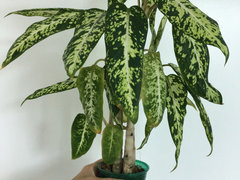
these r 4 cuttings of dieff that I air-layered last summer and then potted in 18oz tumbler. They r staying in it another year.
These r 4 cuttings of crotons about 2yr, 1st in 2 tumblers, then last yr I combined them into 1qt container together.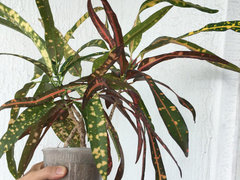
Notice heavy roots at the bottom..need to repot soon-ish..:( - 5 years agolast modified: 5 years ago
Philo Jose Buono cuttings air-layered and pitted in mix about 1.5yrs ? Ago still in 1qt pot
My lill’ pachira ..from 3 seeds jan 2020,in3 “ cup, had to cut off tap roots: they re sprouted
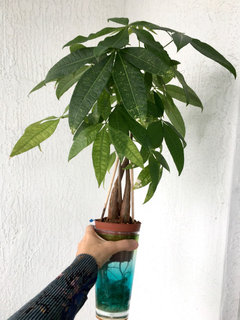
Leaves spotted : sunburned from soap spray! Now know to rinse and dry before putting back..it needs a repot to 5” pot :).pachira is Not shallow rooted: this particular 3 braid developed 1/2” fat tap roots into water in no time..but I lapsed in my vigilance and did not add peroxide to water: water roots stunk the water quickly(it was on sunny shelf). Had to rinse /soak the whole thing with strong peroxide solution; trimmed the rotted tap root by half .. watered from top keeping the roots moist inside but not touching the water.. they regrew fresh roots from fat stubs. That’s why it’s important to add peroxide: you can’t monitor every pot when u have so many plants. And they do all send out roots into water. You can cut them off of course If you wish. But standing water without roots can also foul up in 4-5 days .. for large reservoirs it is not feasible or possible to change water often.
with peroxide and pennies i clean the reservoirs say ev 3 Months? If they are clean and still have water I just add more water even after sev months.
- 5 years ago
Thank you for all the advice and pics!! I really appreciate your feedback and all your experience.
The soil mix I used for repotting depends on what I have available, similar to your case. I used 3 parts perlite, 3 parts peat moss, and a little handful of graphite and 1-2 parts clay balls. Now I use 3 parts perlite, 3 parts peat moss and 2 parts orchid bark which seems to work much better. if I vary anything it’s really the amount of orchid bark.
I think where I’ve been going wrong has been the size of the pot. I had two raphidophora tetrasperma which I combined into one larger 9” pot and one of them had a smaller root system and that was the one that rotted. I’ve cut it up to root in perlite and repotted the remaining plant back in its original 6” pot.
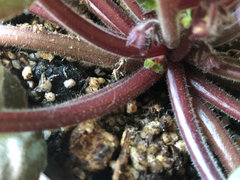
Some of my pots I see there is algae growing on the perlite on the top of the soil! Do I need to repot this with new soil or will the peroxide added to water kill the algae?
No kidding when you talk about the smaller pots, i didnt envision your pots being as small as they are from pics, just a little smaller. Let me attach some pics, I’m new to houzz forums so I’m still figuring this out.
- 5 years ago
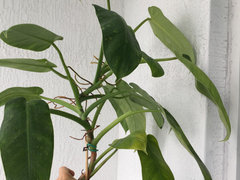
M deliciosa soil
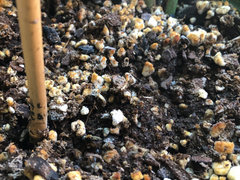
M deliciosa setup. Perhaps should downsize the pot. Also have my ficus photobomb
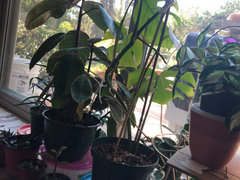
- 5 years agolast modified: 5 years ago
I should probably repot the philodendron into a smaller pot, it’s probably too wet.
ok I just repotted it back into a 4” pot. It was a plant in 4” combined with a few stems I had rooted in water and combined into a 6” but now that I see yours I realize my pot is too big
- 5 years agolast modified: 5 years ago
The last philo pot too deep as you noted. That older yellow leaf is ok: they always drop older leaves with time. Looks healthy.
Not easy to find short wide pots: 4" to 6" transfer is ok if you really stuff it and roots are deeper . or if you have longer canes like on ags or dieffs. Otherwise i use 4" halfpint deli tubs with holes 4-6 in the bottom, sincei usually have lots of cuttings and there no intermediate pots...
There r short (wide asdeep) and deep 6" pots: when u have a slow grower use the short one.
The av's look good. Ficus ok, pink thai ag should be ok provided roots go all the way thru to bottom and it has new growth happenning. Dieffs and ags cant stand being cool and moist: root rot even in very small pots. Anything below 64f is dangerous.. They need to be higher at least during the day (part sun a must).
- 5 years agolast modified: 5 years ago
M. deliciosa grows superfast and in warm temps takes a lot of water. Should be ok.
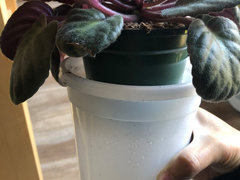
Most of yr containers are translucent, so even when not in sun will grow algae. I know it looks funny, but for yr vac for 4 weeks put them in small brown paperbags, the thicker paper the better. I pretty up my qt tubs occasionally :) by wrapping them in nice wrapping paper (best dark and thick), then they stand on sunny window and there is no algae! But still peroxide and penny as always.
Dont be so paranoid about algae, yes they can gummup the surface but there is no harm to p!ants. u Can mulch with something like pebbles or coir matting or coco-chips toblock the light on the surface.
Yes, bark or coco-chips are a must for larger then 6" pots. I use the jungle mix recommended for aroids on int aroid site (will post the link) with more perlite for most tropicals. Charcoal is not a subs for it. Bark cannot be large, best to use sterile orchid bark or reptibark from pet shop.
- 5 years ago
Strictly for vac u can use paint buckets with inset to support sev plants: quicker to set up.
I'll go search for some pics of mine to give u an idea. I dismantle the setup once i am IN..too ugly, but for long haul very convenient. I got a lot of experience since last 10 years we were travelling more and longer and finally im a snowbird ! But i still keep plenty of plants up north. The bigger and drought resistant ones..
- 5 years agolast modified: 5 years ago
your soil mix is ok, perlite is now large as i see. not sure about the size of your bark: not good to use very large bark: it does not rewet well and if it's not at least half composted it'll use more nitrogen to decompose. the more bark you have in the mix the more you'll need to feed.
here's mine:
2 parts av mix + 1 part regular pure sphag peat,
3 parts coir peat(dust) ( ..so 6 parts total 'peaty' soilless mix)
4 parts perlite + 3 parts small orchid bark mix (i usually use half small to medium coco-chips).
you can add 1 part charcoal too, but i don't since it's hard to get small size. sometimes orchid bark mix has it already...
i use MG AV or houseplants mix, as it usually contains some perlite. it's mostly peat.
i use coir-dust because it rewets easily and does not compact as much as peat, it is also PH neutral (AV's do not like it, so for them only peaty mix). and it aerates better then peat even if wet (there was research done on this).
perlite: as i said before for rooting cuttings and for plants with very fine roots regular fine perlite from HD is ok. for more airy mix for many tropicals and larger pots you'll need to use large horticultural perlite. especially for Aroids and epiphytic plants, but also bromeliads and orchids and any large woody shruby plants.
bark:
orchid bark is fir, not pine, it is sterile and comes in various grades. i always use small size and even cut it up when only medium is available: fortunately i don't need that much.
i read that people use reptibark from pet shops, it is easier to get then small orchid bark.
any bark prior to making a mix needs to be soaked overnight (at least for min 2 hours for small) to wet it, otherwise it'll repel water.
coco-chips provide better aeration then bark , need to be soaked only initially for an hour or so and they rewet instantly.
..bark uses valuable Nitrogen, so higher N needs to be used as fertilizer when the mix contains a lot of it.
.. coco-chips need to be treated with soaking solution containing Cal-Mag, otherwise they will absorb it from the soil ..alternatively you need to use fertilizer with extra Cal-mag for the first month. I do use Cal-Mag , especially for bulbs and many Aroids.
it's a complex subject and opinions differ a LOT.
and i always line all my pots with a layer of coco-matting (for smalls i separate the sheet in 2, as it's quiet thick): it needs to be replaced when it wears out: prolly once a year.
- 5 years agolast modified: 5 years ago
as a simpler very aery mix that will still wick you can use 1 soiles mix : 1 perlite: 1 small bark/coco-chips/lava rock (scoria).
bark/chips/scoria need to be presoaked before mixing.
- 5 years ago
i converted all my plants to wicking over the years, slowly...started with 40! Av's, then episcias, then smalls and cuttings...and so it went... as my journeys were initially mostly 2-4 weeks the large pots did ok as is. then i had to convert succulents and large Ficus pots to top wicks..all works like a charm. 1mo is a breeze to set up, 2mo very doable...3-4mo takes me about 4 weeks (with breaks of course..not full 10 hour :( daily). it is intense, but for me it's worth it as i am not stuck at home ..have plants ..still free to travel..
i can refill set-up for 2mo of about 70 variously sized plants in about half a day of hard work..so no problem.
- 5 years agolast modified: 5 years ago
i calibrate how much water my pots take at different temps and keep careful notes.
as an example, for winter weak dappled sun 66-68F temps 6' from window but very bright :
my pink Thai ag similar to yours in size is low-take plant: 1qt per month;
a have a dwarf Dieff 'Sparkles' about the same size and also in 6" pot: 1 qt per mo.
both have been in the same pot for 1-2 years, so very well rooted.
philo 'Brazil' in 6" pot takes even less: 3/4 qt.
Av's med size in 4" pot very well rooted blooming size about 3/4 qt in 1 month.
of course, when it's warmer and/or sunny they take more.





Lantana zone 5b/6a