Software
Houzz Logo Print
macmex

AfricanX Okra, Trial

7 years ago
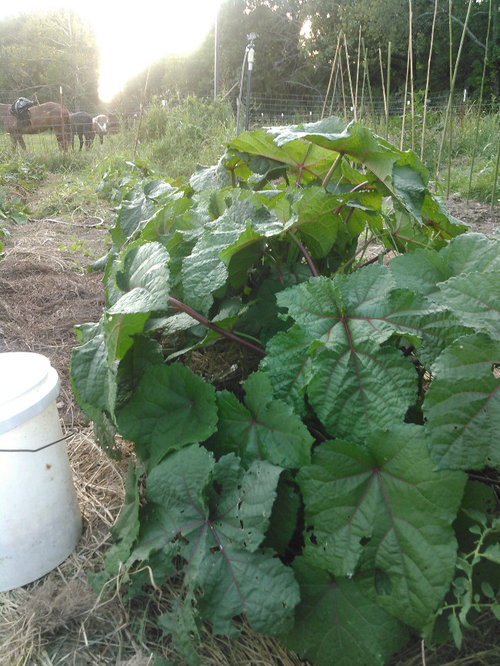
For the last four years I have trialed an experimental cross between two different species of okra. It's a cross between an African species (Abelmoschus caillei) and the more common Abelmoschus esculentus. This cross was made by Glen Hamner who lives in Panama. He sent seed to a couple of members of Green Country Seed Savers, right after he had made his first crosses, asking us to try it out in Oklahoma.


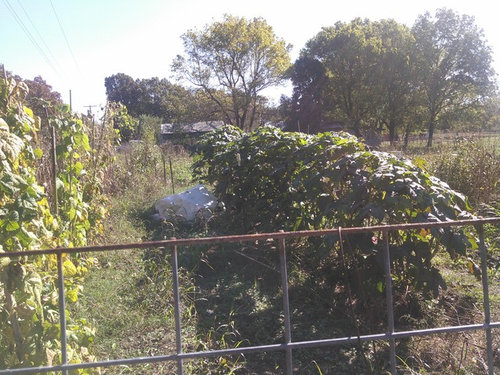
The first generation seed, I grew, differentiated quite a bit. I even had a single stalked, giant, with bright green leaves and pods. It only set pods just before frost. After selection we've ended up with these bushy plants which are green with a reddish tint to them.


This picture was taken in July.


Glen has chosen to name this variety AfricanX. WIth its Abelmoschus caillei genetics it displays a number of unique characteristics.


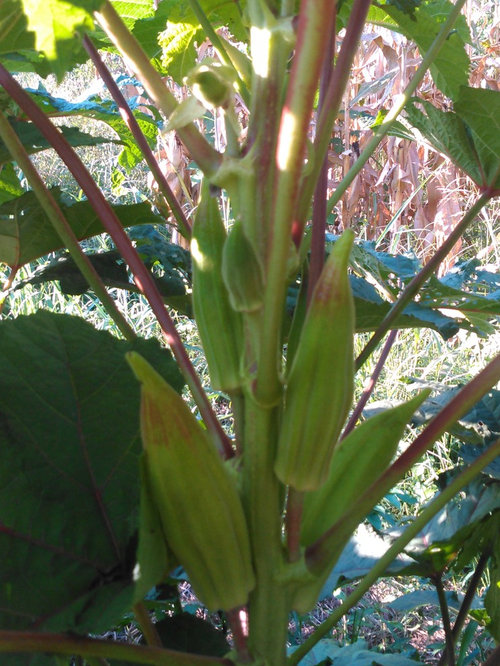
1) The leaves, stems and pods are spineless. A person can pick this okra without any protection and not itch.

2) It produces VERY late. It was the only okra I planted this year, and I would have suffered greatly if a friend hadn't given me okra from his garden. I planted on May 30, had first flower on July 30 and first picking 8/10. It didn't really kick into production until the middle of August.

3) It is more cold tolerant than most okra. Here it is, October 29, and I am STILL picking okra for supper! AfricanX won't stop producing until killed by frost. It was hit by frost about a week ago, but it has recovered and continues flowering.

4) Its pods are not as slimy as regular okra and they are thinner walled.

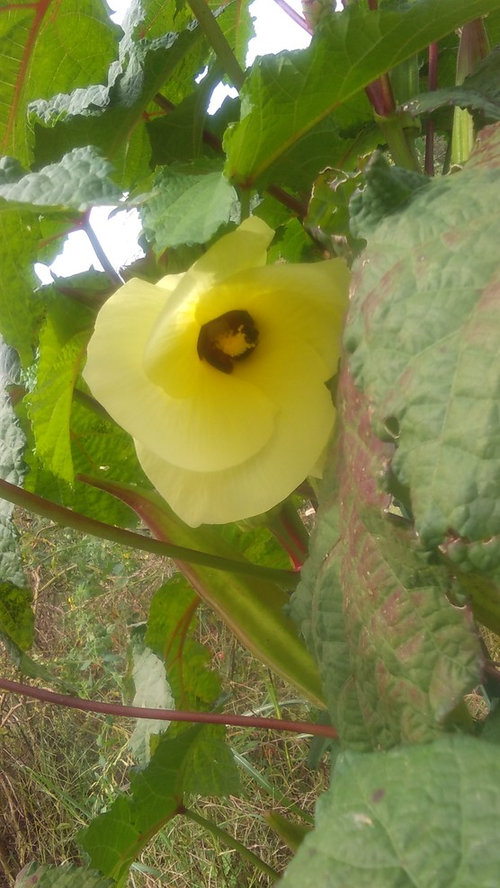
5) Flowers are larger and showy than regular okra, though they still hide in the foliage.


All in all, I am very pleased with it. Next year I will plant this AND a normal variety, so I can have a really long okra season. I believe this okra has a place in our country, even if it is late.


Right now I suspect people driving by my garden are wondering what that plant is. The leaves are glossy; plants are over 8' tall and probably 5' across.


Comments (15)

  • 7 years ago
    last modified: 7 years ago

    So do you find the taste the same or does it differ somewhat ?

    Do you fry it or use in boiled recipes?

  • 7 years ago

    George,

    It sounds awesome. Do you think it is so late to produce because it is photoperiodic? I'm just guessing that might be the case.

    Dawn

  • 7 years ago
    last modified: 7 years ago

    When cooked, I can't tell it from any other okra. I have a habit of eating pods, raw, while I'm out in the garden. Eaten raw, they're good, though there is an initial bitter taste when my tongue touches the outer skin. My theory is that they have some kind of bitter substance on the skin, probably of the entire plant, in lieu of prickers. Even raw, though, I enjoy the pods.

    Dawn, I suspect they are photoperiodic, though Glen tells me that they produce late at the equator too. I believe he said that in Africa, the African okra species is known as "fall okra." What makes me believe it's photoperiodic, is that my plants make flower buds way before they produce pods. The buds either just sit there or they fall off. Production starts slow, even thought the entire plant appears ready.

  • 7 years ago

    Thanks for the reply. That is very interesting to hear that it also is a late producer in Africa.

  • 7 years ago
    last modified: 7 years ago

    Hmm, I wonder if in a frost-free area (aka Africa), do they continue fruiting once they start? Or is the plant a true annual and it does sometime after fruiting?

    (trying to see ways to use this plant) :)

    Being as I have overwintered hot peppers (with great result), maybe that would be a way (to have a cpl in the house for the winter), maybe it can be propagated by cuttings?

  • 7 years ago

    Very interesting.

  • 7 years ago
    last modified: 7 years ago

    I pointed Glen to this thread and have encouraged him to drop in here. Just hope he can navigate Houz in order to do it. Here's one of his comments, which he messaged me.

    "...a commenter asked about keeping plants in a green house to try and over winter. Yes, this is possible. As you know, I grow all my plants in pots. I have grown them in small 6 gallon nursery pots. I have them currently growing in pots that are 18 inches wide and 12 inches tall. About 10 gallon pots. They like this size pot. If you can keep nematodes out of your pots, and of course, provide them with necessary drainage, the plants should easily over winter in a green house if you have reasonably warm conditions. This is a tropical plant, but it is also very hardy as evidenced by your plants surviving in the cold-snap you just had. AfricanX okra would make a wonderful green-house plant because of its beautiful leaves and big yellowish blooms. Probably one of the most beautiful okra variety's that most US folks have ever seen. This is a perrenial okra so it will live an extended period of time in the green house if you can keep em out of the freezing temps."

    I have no idea if it can be propagated by cuttings.

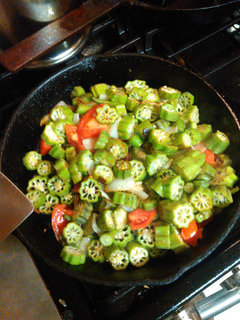
    Last night I went out and picked another mess of okra. We sauteed it with onions and the last of our tomatoes.


  • 7 years ago

    Hello everyone. My name is Glen Hamner. I am the developer of a new variety of okra called AfricanX. My blog is over at Green Country Seed savers in the okra section. Its the seed saver forum that George started. Yes, its new. I would like others to enjoy this new variety and maybe help keep it around. New variety's come and go. This is a unique variety of okra. A blend of Panamanian giant Coffee okra and Echo's African okra. Coffee okra was crossed with the African okra. The result(F1) was planted and then back-crossed with the Coffee okra. The result is a very beautiful, late season, perennial okra. Totally spineless, late season, super hardy, nematode resistant, okra. It is now stabilized. The result is better than I ever dreamed. I am ready to share this new okra with others. Especially seed savers. Seed savers will perpetuate the survival of this new okra. This okra is not meant to replace your existing favorite okra. It is meant to be a companion okra. Your A esculentus okra is early season okra. AfricanX is late season okra. Plant a row of both in your garden. You will get the normal 30 to 40 days of high paced okra picking from the early season okra. They begin to quickly wind down. The late season African X okra will then kick into high gear, and produce okra until a super-killing frost visits. This variety will do extremely well in places like Florida as this variety is a true perennial okra and will live and produce for many months. It begins to produce in 60 days, but needs 90 to begin producing on multiple branches. Plants have very stout branches usually 3 to 6. Plants grow to over 8 feet tall. In the tropics the plants can be pruned to induce further growth. Plants are very resistant to nematodes which are common in Florida for example. AfricanX loves to grow in pots also. I grow all my AfricanX in 10 gallon pots. Can be grown in smaller pots as well. Extremely ornamental and would make a wonderful addition to any green house. Pods are lime green in color with slight purple tinting on the ends. Pods are asymmetrical or ovoid in shape and are covered with a fuzz that is very soft. Pods are less slimy and thin walled. Delicious. Taste like okra to me! If you have questions please ask me. I have been at this for almost 5 years. It is time to share. Thanx

  • 7 years ago

    I noticed a question concerning whether AfricanX is photo-period sensitive. This was a question I needed to really learn about since we don't really deal with this issue if we live in the USA. A plant is considered photo-period sensitive if the plant needs a specific amount of hours of daylight in order to bloom and produce fruits. AfricanX okra blooms in short-days or long-days so it is considered Photo-period neutral. A esculentus is also photo-period neutral since I can plant it in my short-day climate and it produces okra. However, okra does perform differently depending on day length. US derived okra produces a couple of weeks faster in a short day length. First bloom comes in about 40 days. The entire cycle is only about 90 days or less in my climate, then the plant declines and dies. This was my motivation for breeding AfricanX. I needed an okra that would live longer and produce okra for a much longer time. Growers can grow early season okra(A esculentus) and Late season okra(A esculentus) at the same time and have an extended okra season. Late in the season, when rain becomes scarce, AfricanX can tolerate the dry season much better than most other variety's. Very useful in the right circumstances. If you are an okra lover, it would also be useful in the US so you get a nice full season of okra harvesting. I eat it regularly and it is a normal part of my diet.

  • 7 years ago

    I would be very interested in seeds for this variety. I was disappointed this year my okra shut down so early.

    It seems like it just barely started and then it was done.

  • 7 years ago

    Welcome, Glen! I have read your posts in the seed savers group. This is very interesting!

  • 7 years ago

    I appreciate that. Now-a-days, I am in the process of trying to distribute seed. The Peace Corps in Panama is now helping to distribute the seed. Echo, the Christian organization that has a seed bank will also be acquiring a seed sample so they can trial this seed. Things are seemingly moving along now. My main desire is to get AfricanX to folks who live in the tropics.

  • 7 years ago

    I'm going to see if I can rush the plant to maturity by starting it inside in early April. And transplanting outside probably before I would normally plant okra (relying on comments above that it seems to not be terribly frightened of cooler temperatures). The heart and soul of gardening must be experimentation.

    Thanks Glen for the seed.

  • 7 years ago

    Experimentation is fun. I am finally finished harvesting seed. From 17 plants I have saved over 8 lbs of seed. That was after eating okra for over 4 months. 8 lbs of seed is about 50 thousand seeds, maybe more. I will attempt to give the seed away to charity. In the right conditions AfricanX is extremely productive. In Panama, the seed is roasted and ground to make a kind of coffee beverage. They are not accustomed to eating the fresh pods.

Sponsored
Landscape Management Group
Average rating: 4.9 out of 5 stars33 Reviews
High Quality Landscaping Services in Columbus