Software
Houzz Logo Print
jameshtx

Alfalfa Fertilizer

8 years ago
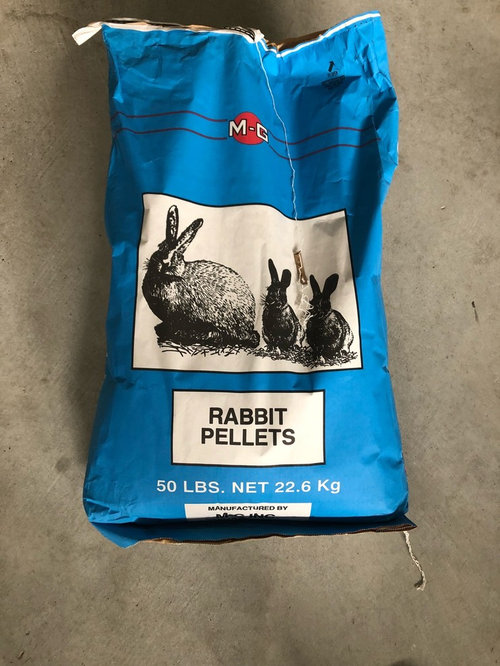
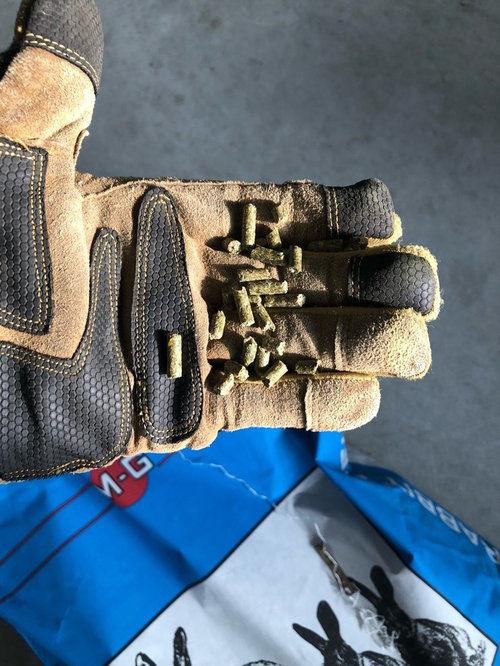
Picked this up at a local feed store. Bag says rabbit pellets but the store owner said its alfalfa. Anyone knows if this is what I’m supposed to feed my lawn/soil with? Am I going to start getting wild rabbits trying to eat this stuff?

Comments (20)

  • 8 years ago

    Rabbit feed pellets are not the same as alfalfa meal. In addition to the consistency, there are other ingredietnts included that are intended to provide the proper nutritional benefit to rabbits - not to a garden - as well as salt and binders used to create the pellet shape. Alfalfa meal is just ground up alfalfa.

    Yes, you can use it but I'd recommend smushing it up into more of a powder for a more even application. And rabbit pellets tend to be alfalfa in a more expensive form than accessing just plain alfalfa meal.

    btw, in a powdered form, it will be much less attractive to any wild bunnies and dissapate into the soil more rapidly with rain or irrigation.

  • 8 years ago

    Well I hope its still going to benefit the soil which will benefit the grass. I've already laid it down and watered it in. Next time I'll buy soybean meal

  • 8 years ago

    Yes, it will still be of benefit. And if you read the label, you will see the product contains soybean meal as well :-) It is just likely that you are not applying it in the same concentration as you would if the product was a straight meal rather than being converted into an animal feed.

  • 8 years ago

    "Wild hares and rabbits will not come running to your yard unless you are in a severe drought"
    LOL!! I think that would depend very highly on where one is located and populations of wild rabbits. Rabbit damage to gardens - droughts or no droughts - are very common complaints on many of the gardening forums. LIke deer, they tend to be omnipresent in many parts of the country in suburban and rural areas and will eat whatever they can get their little chompers on!!

    btw, have you ever raised rabbits? They adore pelletized alfalfa!! Mine would eat that just as soon as they would eat fresh greens and other veggies.

    jameshtx thanked gardengal48 (PNW Z8/9)
  • 8 years ago

    A lot of meals simply do not spread well. I would prefer alfalfa in pelletized form. That rabbit food looks good to use. I wouldn't worry about the minor ingredients in it.

    jameshtx thanked mishmosh
  • 8 years ago

    Just toss it down, I've used that plenty of times. Yes, rabbits will sometimes eat it (I have plenty living under my Thuja), but that simply means you get rabbit poo instead.


    Which is processed alfalfa and other greenery already decayed down into a nice, workable state that will easily fall into the soil.


    Yes, in rabbit food there's other stuff than alfalfa, but it's not a problem and not all that significant in terms of biological impact. And there's almost certainly filler grains (alfalfa is expensive), but those will help condition the soil just like anything else.


    Seriously, I used chinchilla food for years. It was the cheapest source of alfalfa I could get, and it worked perfectly well.

  • 8 years ago

    Meals absorb humidity in the air causing them to clump and not fall into the depths of the spreader. I used to bounce my drop spreader along the yard to get it to drop. Every time it bounced then extra meal would fall through the holes. It certainly was not perfect, but it worked for awhile. The spreader lasted about a year before it split open from my abuse. Now I scatter pellets by hand. Close is good enough for me. A broadcast spreader on a calm day should work better.

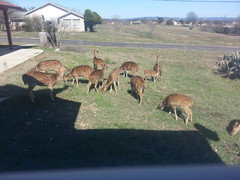
    I live in the country with jack rabbits, axis deer, white tail deer, and blackbuck antelope roaming freely in herds. The deer much prefer my pears to the alfalfa pellets. Jack rabbits never seem to come into the yard weather I bait them in with pellets or not.

    Here's a pic of the axis deer roaming through the yard before I moved my dogs in and fenced the property.

    Between the three types of deer and the jack rabbits, not much is
    safe, but still, the wild ones are not particularly drawn to my
    fertilizers.

  • 8 years ago
    last modified: 8 years ago

    WOW. Now that's something I don't see everyday. That's an awesome picture dchall


    Seems like these pellets are not easy to breakdown. Even with good rain from this morning, I can still see the pellets on grass by standing up looking down onto the lawn

  • 8 years ago

    The pellets swell up and burst open when they get moist. I drag a hose over them to knock the flakes of alfalfa down into the grass to the soil.

  • 7 years ago

    I've considered trying alfalfa pellets on my lawn. When's the best time to do it? Im guessing here in central TX around late Feb/early March?

  • 7 years ago

    You can apply alfalfa pellets any day of the year without fear of losing anything or wasting the product. In the winter, it will take longer to decompose as the soil microbes cool down and don't process as much food. But every time the soil warms, the microbes will work on it.

    When I first started with organic fertilizer I tried to come up with a schedule. What I came up with is the federal holiday schedule. Tthat was based on what I observed when using corn meal at 10 pounds per 1,000 square feet. When I noticed the grass had lost some deep green color, then I marked the calendar and looked backwards 3 weeks (because it takes 3 weeks for organic fertilizers to work). My thinking was that, had I applied corn meal 3 weeks earlier, then the grass would have remained green through the time I was now looking at it. Anyway, Washington's Birthday, Memorial Day, 4th of July, Labor Day, and Thanksgiving were the federal holidays that seemed to make sense. Of course it turns out that 10 pounds of cornmeal is not enough to feed St Augustine for an extended period, so by doubling the amount and applying half the holidays, it might work fine. But mid Feb would be a fine time to apply alfalfa pellets. They work better than corn meal anyway.

    And rather than calling your area Central Texas, which is larger than most of the eastern states, you can go ahead and say Abilene, or wherever you live. No need to keep us guessing and being more precise is more helpful to us. If you live near Austin I could send you to Dromgoole's nursery, for example, but if you live somewhere else then we have to go back and forth to figure out where you are.

  • 7 years ago

    I'll give that a shot next year, dc.


    I'm in Austin. It sounds like the Natural Gardener carries alfalfa pellets? I live about 10 minutes from there.

  • 7 years ago

    Natural Gardener has it all. You might call ahead to be sure what's in stock. Also the prices are almost always better at the feed store.

  • 7 years ago

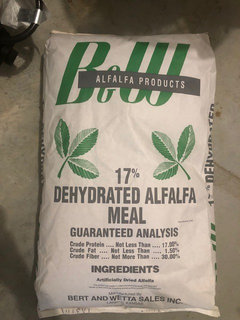
    Found alfalfa meal and was told this doesn't have any additional ingredients found in rabbit pellets. Has anyone used this before?

  • 7 years ago

    Converting the protein to nitrogen says 2.72% N.

    I prefer the pellets. Sure they have other stuff in them... but that's probably a good thing at the rates they are included. Also... the pellets run perfectly through a standard rotary spreader... once the rain hits or even enough morning dew... they fall apart. Alfalfa meal gets too dusty for me.


  • 7 years ago
    Where does it say that?
  • 7 years ago

    You can google around to look how to convert % protein of organic fertilizers into nitrogen. The proteins have to be consumed by soil dwellers first before it gets converted to usable nitrogen.

  • 7 years ago

    If you're converting protein to nitrogen, you're overthinking it. More protein means more nitrogen. The popular grain type protein sources scale down from highest protein to lowest as corn gluten meal, soybean meal, and alfalfa with cornmeal and used coffee grounds tied for last at the bottom of the list. I still like ordinary cornmeal, so if that's all you can find at the feed store, get it. Urea, which is an organic chemical derived in bulk from natural gas, has no protein but extremely high nitrogen content at about 43%. Other possible ingredients found in organic fertilizer include feather meal (very high protein but glacially slow to decompose), and various animal and fish byproducts. Blood meal is very high in protein and very fast to decompose. In fact it will decompose so quickly the process will burn the roots of plants. If you want to try and get a fast acting organic fertilizer, you could mix about 5 pounds of blood into 50 pounds of a meal type material and apply at 15 to 20 pounds per 1,000 square feet. Water it well immediately afterwards to dilute the blood and wash it into the soil.

    I live in the country now. Apparently the local feed stores jack up their prices over the downtown San Antonio feed stores. I happened to be in SA last weekend and got two bags for $20. Here in Bandera it's $20 per bag. I understand raising prices to account for transportation costs, but the feed mills where the corn is ground are closer to me than SA. Maybe they buy in different volumes. Still, 100% difference seems like a lot. That's why I always suggest people call ahead for availability and cost.

  • 7 years ago

    Ha... i agree doing any conversion is overthinking... just don't know if poster was interested in it. Knowing the general order of products does just fine.