

Has anyone reverted to the 18th century?
As my kitchen slowly emerges and I have a sink, I’m finding myself making even more food from scratch because of weight gain from the American diet.
I’ve always done homemade stock and food but now I’m doing things that I associated with the 18th century or 3rd world countries.
So far I’ve done the following:
beef jerky
fermenting vegetables
making yogurt, cheese, salad dressing
make detergent
make cleaning solutions
I’m contemplating:
canning
spinning (lol it seems fun)
hunting (ie asking hunter friends for their organ meats)
Brewing
making bread
Bulk sauces
Most of these activities are caused by the massive amount of sugar that’s prevalent and California’s ridiculous policies that steadily eliminated most of the fresh handmade food that I used to buy from my Asian grocers. 20g of sugar for 13g of protein in jerky is just not acceptable (that was a 6oz bag at a health food store).
I just returned a bag of raw fermented probiotics sauerkraut to Sprouts when it tastes like candy. Upon reading the ingredient, sugar was the second on the list with cabbage being the first. I found out that pickling means sugar to American tastes.
I have to go to crazy lengths like importing baby eggplants from outside the country to pickle vs. scooping them from vats in the store.
Comments (79)
 7 years ago
Beachem, I am getting more and more into the "make it yourself" mode. This is one reason I'm now homesteading. Next year I'll be setting up my raised beds, but this year I've started growing my own chickens for meat and for eggs (alas, they're holding tight onto the latter - but they should overwhelm me with eggs come spring).
I've started canning and dehydrating, although this past year getting settled in has limited such activities, though I did get my herb garden growing happily, and asparagus is planted. I hit farmer's markets & roadside stands as often as possible.
I may not make my own bread often (I eat fairly Paleo - with limits!), but when I buy it, I get it from a on-site baking bakery. If I'm passing by the place where I can buy it, I pick up non-homogenized (it is lightly Pasteurized) milks from a dairy. I want to start cheese making this winter, and I have a yogurt maker I've yet to use.
The problem in my rural community is both a blessing and a difficulty - there are four different weekly get togethers, all centered around food. The community center supplies a lunch and a dinner once a week, the Senior center supplies another lunch, and there's a Sunday morning dump run caffee clatch with coffee and muffins. It is very good to get to know and socialize with people in town, but there are so many hidden (and not so hidden) starches and sugars in these foods.
Indeed, I lost about 40 pounds when working primarily by switching from eating cafeteria food five lunches a week to bringing in my own food (which pretty much matched what I was already eating on weekends and for dinner). This even though the cafeteria had its own "heart healthy" line of food to choose from! And that I seldom ate dessert anyway!
- 7 years agolast modified: 7 years ago
writersblock, I went to a sheep and wool festival last summer, and picked up some cheap wool, and a drop spindle. I plan to learn how to use it this winter on some blizzardy nights! They were also going to sell me a video on how to use it, but... YouTube is my friend...
I attended a workshop there on making natural dyes... this truly sounds like fun. Although the sheep I intend to get will come already in a few colors and tones...
I hope to raise Shetland sheep here, starting in 2020 - this winter I plan on laying out where everything will go, what I might potentially want to do beyond that, and build a couple structures for them and a tractor, during 2019.
Related Professionals
Orlando Kitchen & Bathroom Designers · Emporia Kitchen & Bathroom Designers · DeRidder Kitchen & Bathroom Designers · Cambridge Kitchen & Bathroom Designers · Virginia Beach Kitchen & Bathroom Designers · Morgantown Kitchen & Bathroom Designers · Duluth Kitchen & Bathroom Designers · Olean Kitchen & Bathroom Designers · Spokane Kitchen & Bathroom Designers · Newport News Kitchen Remodelers · Athens Custom Countertops · Brainerd Custom Countertops · Harrisburg Custom Countertops · San Angelo Custom Countertops · Queens Custom Countertops- 7 years agolast modified: 7 years ago
Pillog is right about organic. Edit: In college in the 70's I railed against the term, "organic" to mean healthy... I mean, I'd just taken Organic Chemistry, and that stuff was primarily the antithesis of anything you'd want around the yard! Lost that battle!
It's not usually the first criteria about what I buy. I do plan to grow plants here organically -- but not because there's less sugars. It just is better long term for the soil and sustainability once you get the system going - healthy microrhizomes and such. There IS a learning curve, and you do have to deal with blemishes that do not affect food quality. I especially do not want to plant GMO seeds - not because I'm opposed to GMO per se, but because of the things GMO is primarily being used for - Round Up tolerance or inherent Round-Up, and the like. (I think the notion of Golden Rice is awesome, frankly.)
On the other paw, technically I won't BE organic -- I'm NOT going through the paperwork! In some states there are alternatives to the USDA label of organic, which involve less paperwork, and may in some cases require things that go beyond USDA standards for organic. But, my veggies will be for all intents and purposes, raised under organic principles. (Meat and eggs not so much... there's too much a logistical nightmare doing that. The chickens are getting organic layer feed, but also kitchen scraps some of which weren't designated organic, for one...) And if they get sick, I'll treat them as I have to up to and including non-organic treatments, and when they are healthy enough to return to the flock (if they had to be separated) I'm not waiting the period of time necessary to re-introduce them by organic requirements. Don't got the facilities for that!
- 7 years ago
Since I'm too lazy to search online right now, just curious - don't you have to constantly keep sheep on the move so that they don't tear the grass up by the roots? Or do people feed them hay nowadays? I don't know a thing about sheep-keeping, obviously. But I always thought that was the reason why there had to be full-time shepherds to keep them moving across the fields and meadows.
- 7 years agolast modified: 7 years ago
I especially do not want to plant GMO seeds
it sounds like you have lots of space, so do you also have enough crop space to have been eligible to buy GMO seeds if you wanted them? Just curious. I agree that I also want nothing to do with the currently available GMOs, but then I just have a small hydroponic system and wouldn't be allowed to purchase them if I did wish to.
How cool that you can have sheep. I don't even have enough space for chickens here. Of course, FL isn't the best place for sheep, but if I had acreage I've always thought it would be fun to put in a very little of the old naturally-colored heritage cottons, although raising cotton is a very miserable job. And I believe it's supposed to be even harder to spin well than flax.
- 7 years ago
North Americans really have a sweet tooth! I don't even need to look at the ingredient lists -- I can just taste that many salad dressings, sauces and salsas, for instance, are too sweet for my taste. (even potato chip flavours!) But making a lot of that stuff is just too time consuming and the work is not worth the reward (I've tried making my own beef jerky, tzadziki, bread, and salad dressing).
My solutions are: 1) buy non-major brands that have less sugar and taste better, and 2) adjust the products that I can't buy in a less sweet option, in order to alter the taste and sweetness. For instance, I add mustard (powdered) to BBQ sauce these days because they're all too sweet -- but I don't use BBQ sauce enough that I want to go through the trouble and mess of making my own. Likewise, I've dramatically cut down on the amount of bread I eat, so making my own wouldn't be a useful or helpful thing to do, nor would it be any better than the bread from my favourite bakery (I still use my bread maker for pizza dough from time to time). I live alone, so even though I cook for myself all the time, the volume is less than for those with a larger family.
The idea of "organic" isn't important to me, though I do like the idea of supporting small businesses (which includes small farmers).
 7 years agolast modified: 7 years ago
I have been stuck in the 18th century, or at least the 19th, for most of my life. I grew up on a farm in a very poor family, and we made nearly everything ourselves. After going through a period where I bought everything, because I could, I realized I didn't like all the sweet foods and throwaway packaging.
After being a vegetarian during my buy-everything years, I am now a hunter, and my husband has followed my lead and occasionally hunts as well. Our motivation is feeling close to the land (we hunt on public land) and to get food. Trophies are inconsequential. We butcher the elk, venison, or pronghorn ourselves, and turn some of it into sausage and jerky.
I have been making yogurt for about 15 years. It started when I realized that the main source of trash/recycling in my kitchen consisted of plastic yogurt containers (I have a smoothie every day, no sugar added except for the whole fruit). We grow peaches, raspberries, and rhubarb for the smoothies. About 10 years ago, we tried an experiment where we ate only local food (produced within North America) - but we could not give up our coffee and bananas. About 5 years ago, I got rid of my yogurt maker - which keeps the milk at a finicky 110 degrees - and switched to heirloom yogurt cultures that thrive at room temperature. So even my yogurt-making has regressed!
We have a small but amazingly productive garden. We never buy tomatoes or salsa because we can enough each year for ourselves and for gifts (mainly hot sauce for Christmas). In autumn 2017, as our kitchen was being remodeled, dear hubs did all the canning on our patio on a propane burner.
On the other hand, we're backcountry hikers and skiers - we both have day jobs and run a side business where we maintain backcountry yurts that we rent to skiers and snowboarders in the winter. So we spend a lot of weekends hauling propane tanks and chopping firewood for winter. But we also buy lots of synthetic clothing to wear while we ski! I do wish that more outdoor gear companies made 100% wool clothing. For years we both wore old Swiss army wool pants to ski, until we could no longer get replacements when they wore out.
ETA: I am also making our kitchen cabinets. Most of them are finished, installed, and in use, and I'm slowly finishing the last 3 uppers. As I mentioned, we have day jobs and a side business. Plus I'm a PhD student. So it's not like I really have time for all this stuff, but I consider it as the work of daily living. In that regard my life is very similar to my grandmother's, though she never worked outside the home and never finished high school but knew how to do what she called "important things" - and I like that.
 7 years ago
All of the above and then some. Like Annie I don't think of it as 18th century. It is just what we've done for years. The garden went in 20+years ago. It has evolved, after trial and error, into what we like to grow and can't get otherwise even living/working in such a large city. Climate is a factor. Food value is important. Grapes, apples and pears in abundance. Citrus obviously we buy. Just not that much.
A lot of trading. A friend has ducks so we get an endless supply of eggs. Another spends weekends deep sea fishing. Another has an organic dairy farm and makes cheese. Etc. A friend who has bees just gave me a big block of his beeswax. I'll make a big batch of hand salve and lip balm tomorrow. A friend that gives us moose knows within 24 hours he will have a few packages of meatballs for his freezer.
We make all our own spice mixes and condiments. Dressings, stocks, three different curry recipes in the freezer.
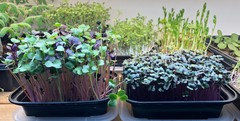
The friend that raises ducks will be getting a few trays of my macro greens the Wednesday before thanksgiving. (he will flip!). Just started them last night while I started my own. I grow my salads year round.
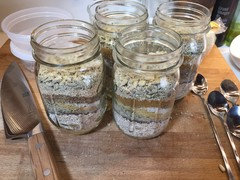
We don't eat a lot of breads but do make our own. Mostly soups and chowders in the fall and have plenty of bread in the freezer for croutons. My cracker recipe has so many ingredients I make kits. The last big batch is in baggies and just about out so I'll restock that soon. Prepping ahead in 'kits' lets me know what ingredients I'm running low. I've adjusted the recipe so a batch fits perfectly in one of my sheet pans. (the ball jars were gifts). I do the same for my brown bread and corn cake. Last batch of granola in the freezer so I'll do a Sunday soon to prep all that.
- 7 years ago
North Americans really have a sweet tooth!
That's largely because they got used to excess sugar in everything during the many years of the low-fat-is-better nonsense. In order to make low fat palatable, it's usually chock-full of sugar.  7 years ago
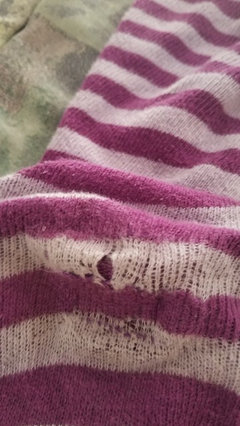
I have some beautiful and blissfully comfortable knee socks. I have only been able to find them at Renaissance festivals, at a booth called Swan Lace. They are, unfortunately, a bit prone to acquiring holes through regular wear, so I have taken up darning to make them last a bit longer. Here you can see where I've darned a little, and where another hole has developed above the darned area (darn it!).
beachem
Original Author7 years agoIt’s so lovely to read everyone’s stories. Thank you for sharing.
As to time consuming, I’ve come up with tricks to do things fast. Salad dressing like blue cheese is made once a week and thrown in the fridge. Salad vinaigrette takes me two minutes at most to make so I tend to eat that more.
I make my yogurt simply by boiling milk, add in a bit of honey or condensed milk and old yogurt (has to be live and wait til temp is at 120 before adding) then the covered containers are placed in a warm pan of water overnight. This is Vietnamese yogurt. Result will be a slightly tart/sweet firm yogurt full of probiotics. No special equipment needed.
I cheat on beef jerky by having the butcher slice my meat, mix it in a bowl with my chosen condiments, leave it in fridge for 24 hrs, bake in oven for 10 minutes at 210 (kill any possible bacteria) then throw on the dehydrator for 6 hrs and done. The slicing is the killer. I used to take up to 6 hrs to slice the frozen hunks.
@slevendog. I make kits as well for baking or soups. Love the time saving.
- 7 years agolast modified: 7 years ago
" That's largely because they got used to excess sugar in everything during the many years of the low-fat-is-better nonsense. In order to make low fat palatable, it's usually chock-full of sugar."
I think it goes back far, far further than that (to promoting products from colonies), and it wouldn't surprise me if there's a genetic component too (to people's tastes and brain chemistry). Mostly, I think there's a political component -- some of it is 100 years old, promoting products imported from politically-favoured countries and colonies, and some is more recent, with sugar producers (and beet, corn, and cane producers) supporting politicians to support their business interests (much like Big Tobacco did in getting agencies to, at worst, turn a blind eye).
 7 years ago
Elaine, thanks for sharing your socks! My mother taught me how to darn as a kid, but I've never had occasion to do so because I don't wear socks! Lovely that you're mending your favored ones.
I live in an urbanish area and most of my food comes from grocery stores. I've never cared for overly sweet foods, though I dislike sugared drinks so much I'd rather have candy and water if I'm looking for sugar. If I want to sweeten tomato based things like spaghetti sauce, I add carrots. Rolled oats taste sweet to me, and I don't at all mind eating them raw. I DO, however, read labels, both the ingredients (knowing which are code for sugar) and the breakdown percentages.
We really can't blame the government for sugar! They're the ones mandating the labelling so we can avoid sugar. I do buy some prepared condiments--I know ketchup is tomato flavored sugar, but I do like it in moderation, and I won't let anybody condiment-shame me out of it, but I avoid sugar in other things besides barbecue and sweet and sour, which are also sugary by definition. It's not that hard to do. Keep a magnifier in your wallet if you need one.
There is some blame for those 20th C. parties who paid for "scientific research" that said that sugar was harmless. For the rest, there has always been opportunity to make choices.
Or almost. I really resented as a powerless kid or trapped young adult, when organized Summer hikes had "refreshments" that were sugary drinks rather than plentiful water. Inevitably, it would be where there was no alternative and it was drink sugar or get dehydrated. Bleeech.
 7 years ago
Elaine: Knitting your own wool socks is easy and fun. I can see why you enjoyed the pair in your photo. Often sock yarn can be found locally that is spun at home by local crafts-people. It generally is not cheap. Centuries ago sock knitting was delegated to children in Ireland as it was easy, utilitarian and taught them all the basic stitches and shaping they might need for other projects. Today's wool's are machine washable, do not shrink and do not itch. You probably know that wool is the only fiber that will keep you warm even it it get wet. Lots of help available on www.ravelry.com- 7 years ago
" We really can't blame the government for sugar! They're the ones mandating the labelling so we can avoid sugar. "
That doesn't change what they've done for hundreds of years, or even 20 years ago. You really should read about the cultural history of food - it's a fascinating look at how culture (including politics) has affected what and how we eat, going back centuries.
- 7 years ago
I actually do know quite a bit about food history. That doesn't mean that there is no free will or that there hasn't always also been a counter culture that promoted healthy eating. Even the Michigan sanitarium wackadoodles were actually onto something with their worries about gut health and love of fiber, even if their reasoning was kind of in outer space, and current scientific knowledge makes a lot more sense. You have the right to be a sheep, blindly following the bellwether into the beyond, or you can be conscious of your own health and food choices.
- 7 years ago
And you can believe you have free will if you're blind to the forces around you that create it.
There's a pithy saying for every opinion, including opinions that insult those that don't agree with you :) - 7 years ago
I have done the following that other people have already mentioned: beef jerky ... fermenting vegetables ... making yogurt ... cheese ... make detergent ... make cleaning solutions ... canning ... Brewing (okay, I really just assist my husband) ... making bread ... Bulk sauces
Things I'll add to that list: bulk cook lots of things and freeze them ... grow fruit trees and blueberry bushes ... mend clothing instead of replacing it ... save bits of leftover candles /melt into new candles ... grow and dry herbs ... make homemade sausage ... make quilts ... needlepoint /a couple other decorative techniques ... make rag rugs and hooked rugs ...
Things I do not do /have failed in attempting: anything dealing with knitting or crocheting (well, I can do a little, but I'm not good at it) ... and I would never try wool because I'm allergic ...
Did you know that MacDonalds puts sugar in everything? That's including their fries and salads! IT sucks.
I overhear my students say offbeat things constantly, but recently I heard one girl say, "No way, I don't eat any vegetable unless it has sugar in it. And I put sugar on spaghetti too. It's so good that way." ICK!
I think I'll draw the line at spinning, mostly because I can't stand
wool next to my skin, I live in Florida and I don't knit or crochet.My great-great-great aunt taught me to card cotton. That's real work. She told me I couldn't get married until I'd carded enough cotton to fill a shoe -- that struck me as very odd because I was in elementary school. She was born in the late 1800s.
Dry clothes on the line!
I despise hanging clothes and clothes that are rock hard because they were dried on the line.
Hmmm, well, I guess I'm old fashioned because I've done a lot of those
things most of my life, it comes from growing up on a farm.Me too.
- 7 years agolast modified: 7 years ago
Mrs. Pete, that's so interesting about carding cotton. Was it ginned first, or did you you have to seed it, too?
- 7 years ago
I think I may be a little weird because I love hanging clothes out to dry on the clothesline in my backyard on a lovely sunny day! I find it relaxing to be out in the fresh air listening to birdsong, and I feel a little bit self-righteous about saving a bit of electricity by not using the dryer as much.
beachem
Original Author7 years ago@mrs Pete. I was grossed out a few months ago when I had breakfast with my MiL. The woman sitting next to us ate her bacon liberally dipped in syrup. It was dripping whenever she ate her bacon. She only just stopped herself from drinking the syrup straight up.
I lost my appetite watching her eat a rasher of bacon on top of the bacon that came with her pancakes. I love bacon but all that sugar turned me off.
- 7 years ago
I hang my clothes to dry over a rarely used bathtub not to save money but to save the clothes! If you use a mild detergent and don't have hard water, the cloths won't get hard once they're free of residues from other laundry supplies. If you have hard water, however, it might be hard to get the minerals from the water itself out. If you're interested, there are knowledgeable people in the Laundry Forum.
Writersblock, I had to deseed raw cotton as a kid! Just a softball's size of it. I'd totally forgotten that. What a thankless and stupid chore. Heaven bless Eli Whitney! I only have my child's opinion of it, but I thought carding cotton was a lot easier than wool. I'm still kind of at sea about how they made linen in pre-industrial times. I mean the part between retting and fiber ready for spinning.
Beachem, that's some story! But considering the current fad for chocolate covered bacon and glazed pork belly, I'm not surprised. OTOH, people are rediscovering carrots glazed and onions caramelized in their own sugars. :) It takes a bit longer to make, but is far more delicious and doesn't require anything added but a little water.
 7 years ago
Being a child of the 60s & 70s, I grew up enjoying a lot of DIY efforts. We had all the Foxfire books too. I was enamored w/ herbalism, and home beauty recipes too. I still make my own skin balm w/ beeswax & olive oil, and do home facials. Also growing lots of edibles for many years.
Been baking bread and making lots of other foods from scratch for most of my life now. It's fun!
- 7 years agolast modified: 7 years ago
I'm still kind of at sea about how they made linen in pre-industrial times. I mean the part between retting and fiber ready for spinning.
You mean braking, scutching and and hackling? It's always amazed me that anyone ever figured out linen. Essentially you dry the retted fiber, use a brake to break it up more and then scutching and hackling are the flax equivalent of carding, but quite labor-intensive, compared to carding wool.
Hans Anderson has a very little-known story that tells the story of the life of a flax plant from being a pretty blue flower to linen rags used for paper. I'll see if I can find a link online somewhere.
I loved the Foxfire books, carolb!
ETA Oops, found the flax story but it's not as detailed as I remembered. Anyway, if you google "flax to linen workshops" there are several places where you can see all the details.Flax story, if anyone's interested:
- 7 years ago
I guess I'm not reverting back to the 18th century. I don't think I would have done well back then. There are so few things on that list that I care for. Don't care for canned goods, not a hunter, although I don't have a problem with those that hunt for food and not sport. Don't care for jerky, or fermented foods or pickled with the odd exception.
But I do love baking bread.
- 7 years ago
Jerky is like candy to me. I have a little dehydrator and tried making my own with ground beef - once. It came out very tasty, but I calculated that basically cost me the same as the organic jerky @ Trader Joe's, so not really worth it.
 7 years ago
Even though it has sugar in it, I make homemade syrup (various flavors) for those times when we have crepes and waffles. I haven't bought syrup from the store in years. I also make salad dressings and dip for veggies, kombucha tea, BBQ, teriyaki and various other sauces and marinades from scratch.
I'd do a lot more from scratch but it's an issue of time for me. I think a lot of condiments and sauces contain too much junk, and making them myself is easy to do, and I'm able to adjust the flavors to my family's liking.
Carolb, my sister has a dehydrator and has concluded the same--by the time you buy the meat and go through the motions, it's not much of a cost savings but rather a fun hobby for her.
 7 years agolast modified: 7 years ago
I finished making bulk hot sauce yesterday, and I had to use chocolate Habanero chilies that I had bought at the farmers' market because the ones on the one plant I have this year are not ripe yet, and I've been out of my sauce for three days! This year I decided to make it completely outdoors. We had already grilled the chilies with some garlic and red bell pepper, and then yesterday I took all the ingredients outside along with the blender from the garage and the bowls and utensils I needed, including my food mill. I did make the vinegar/salt brine indoors, and then I took that outside and added it to the blender with the chilies. I always wear rubber gloves when making this, and I pulled the stems off the chilies and just threw the stems into the yard, which made getting rid of them easier. After I processed the sauce through the food mill, I rinsed that off in the yard as well, thus avoiding bringing fumes into the house. When I made it in the house, I had to wear a swim mask and snorkel, but that was not necessary when I made it outside. I did not make as large a batch this year as I usually do, but I will make another one when my own chocolate Habanero plant has more ripe chilies. I was upset with the batch of seeds that I got this year, and next year I will use seeds that I saved.
I read the flax story - thanks for posting that link. It reminds me of being in the first grade when we were all asked to write a story about the life of a penny (or maybe a nickel). My story was the longest - I got a bit carried away with it.
beachem
Original Author7 years agoInteresting, I buy the meat either at Costco, on sale at Sprouts or my local butcher. It came out to huge savings for me as $20 of prime beef equals five weeks of jerky with hubby chowing down half a sandwich bag a day.
I actually had to scale back on the meat amount because some of the jerky went bad when we didn’t eat it fast enough. I only make enough for two weeks now and it’s about $5 (2lbs).
As I am facing my gorgeous sink (Kohler 45), I realize I will not miss hand washIng dishes once the dishwasher gets installed. Right now, I do 3 huge loads of dishes a day and it’s just two of us. I’m not sure how we generated so many dirty dishes.- 7 years agoThanks for posting the link to the flax story, Writersblock! It made me think of reusing, repurposing, recycling, and reincarnation. It made me feel hopeful.
- 7 years ago
Beachem, I bet you have all those dirty dishes because you were doing all that scratch cooking! Pre-made and pre-prepped foods push a lot of the dishwashing, as well as the labor, onto other people so you never see them. That's what's behind yourfriends who say, "Dishes? I only run the dishwasher once a week!" And, "What's the big deal about saving dishwashing water? It's not that much!" Of course, if you were living at your same economic level in the 18th C., you'd have a scullery maid and/or a pot boy.
Writersblock, thanks for the link. Yes, I was asking about those processes as they were performed by hand. I've seen the demonstrations, but haven't internalized it. Probably because we didn't have to do it when we were kids! :D I know what you mean about how they figured it out. I often think about things like that, like nixtamalization, and other foods released by using caustic chemicals. For the foods, I have to think it's trial and error fueled by hunger. With flax, it must be something like gosh, this is strong, how do we make strong rope out of it, and from there on to cloth.
AnnT, you'd have done fine in the 18th C. Maybe not on the frontier, where if you wanted anything you had no choice but to do it yourself, but your bread skills in a settlement would make for excellent trade with those who do like preserving foods, etc. And if you didn't like pickles, you'd have held your nose and eaten them if there were no other vegetables to eat in the winter. You might even get to like them if all you had were roots. I remember Laura Ingalls Wilder talking about how they ate the seed corn when they ran out of food. They being the characters, because I think that was in Pony Boy. ;) But if you lived in a town, you could have turned that seed into bread and traded for pickles. :)
- 7 years agolast modified: 7 years ago
I remember Laura Ingalls Wilder talking about how they ate the seed corn when they ran out of food. They being the characters, because I think that was in Pony Boy. ;) But if you lived in a town, you could have turned that seed into bread and traded for pickles. :)
Actually, they were in town when they ate the seed wheat. The hard winter of 1885 (I think it was) took everyone by surprise. Contrary to the myth of the rugged self-sufficient pioneer, the vast majority of the people desperate enough to take a homestead were the urban poor, so not nearly so well-equipped with frontier survival skills. They kind of made it up as they went along, and most were partly supported by relatives back east.
The town relied on the trains for its food supply and the trains couldn't run in the blizzards, so they ate the seed wheat, since it was all they could get. No pickles to trade for after a month or so.
LIW grew up in a pretty constant state of semi-starvation, if you read Pioneer Girl (her non-fiction autobiography) or the books written by her daughter/co-author, Rose Wilder Lane. Pa wasn't very employable--he had congestive heart failure and after he proved up on the homestead they sold it and lived in town, mostly on the produce from Ma's vegetable garden.
ETA The seed wheat eating book was The Long Winter because the publisher wouldn't allow the original title The Hard Winter, because things shouldn't be presented to children as "hard." - 7 years agolast modified: 7 years ago
Mrs. Pete, that's so interesting about carding cotton. Was it ginned first, or did you you have to seed it, too?
I remember the cards, that it was hard work, and -- yes -- I think I remember seeds.
I lost my appetite watching her eat a rasher of bacon on top of the bacon that came with her pancakes. I love bacon but all that sugar turned me off.
Might've been my student.
Being a child of the 60s & 70s, I grew up enjoying a lot of DIY efforts. We had all the Foxfire books too.
Yeah, we had those books too! In fact, we had loads of DIY books of all types, and I loved them.
It's always amazed me that anyone ever figured out linen.
My husband always says he wonders who first chose to eat lobster and shrimp. They are pretty scary looking.
Carolb, my sister has a dehydrator and has concluded the same--by the time you buy the meat and go through the motions, it's not much of a cost savings but rather a fun hobby for her.
I do not like jerky myself, but my husband greatly prefers the homemade stuff -- and if you buy a roast on sale, it's definitely cheaper than store-bought. We just slice it thinly and sprinkle on some spices -- no real work.
Of course, if you were living at your same economic level in the 18th C., you'd have a scullery maid and/or a pot boy.
I think realistically, if all of us were all living in the 18th century, most of us would BE scullery maids or pot boys.
I remember Laura Ingalls Wilder talking about how they ate the seed corn when they ran out of food. They being the characters, because I think that was in Pony Boy. ;)
I remember that -- but do I remember it from the book or the TV show? I'm not sure. Laura's book about her husband's childhood was Farmer Boy. Pony Boy was a character in HE Hinton's The Outsiders.
- 7 years ago
I remember the cards, that it was hard work, and -- yes -- I think I remember seeds.
That would certainly explain the difference between your experience carding cotton and plllog's. Seeding cotton has to be one of the worst jobs there is.
- 7 years ago
LOL! Thanks, Mrs. Pete, for the correction! I read all those books, including the "true" one when I was young, but unlike many, I only read them once, and obviously have half forgotten the titles as well as most of the details. Thanks, Writersblock for the correct story. I thought it was the boy's family, not the Ingalls--my visual memory is better, and I have this image of them stuck in the house and taking the seed corn out of the walls where it was stored (if that part is even right). What I remember about the books was that, how excited the little girls were to get one tin cup to share between the two of them, that she rode around with her fiance for years with no (admitted) physical contact, and that he spent a year or something like that making a custom fitted kitchen for his bride and having it all knocked flat. And that's all I remember!
Re scullery maids, that's why I said at the same economic level. Most of us here at middle class. Granted there was hardly any middle class in the 18th C., but even so, most had a few servants (whereas we have machines) and teenage servants (scullery maids, pot boys, stable/garden lads) weren't as expensive as adults. You'd have to be rich to have a skuttle girl or a slops girl, in addition to your regular maids, though. :)
I just read on Wikipedia that Eli Whitney was commissioned to make the gin, and was inspired to the method by watching a cat trying to pull a chicken through a fence. I've no idea if it's true, but it's a great story!
- 7 years ago
I thought it was the boy's family,
Well, it was the boy--he didn't want people eating up his seed wheat so he made a hidden bin in a wall. In the book Pa Ingalls notices the inside of the room is too small for the outside and finds the wheat that way.
BTW, as far as scullery maids, that's what they really rented Laura out for from the time she was about ten. But she'd had a lot of housekeeping experience already, since she and her older sister had to take care of the house the whole time they were in Plum Creek, since Ma was ill in bed for nearly a year (although that's not in the children's books).
It's not that I'm obsessed with these books, but I live in a place with a library with a fiction collection fully worthy of the book/magazine section at CVS. However, since this is big homeschool territory, they do acquire every single book published that has any bearing on the Little House books or her life. So if I want to read print rather than an e-reader, I read a lot more about her than I really care to. - 7 years agolast modified: 7 years ago
Writersblock: it sounds like you have lots of space, so do you also have enough crop space to have been eligible to buy GMO seeds if you wanted them? No idea how much space is required to get them. Indeed, I wasn't aware there's a space limit!
Rita: Yes, sheep have to stay on the move, but the space they need depends on where you are in the country. You can raise a few sheep on a half acre, in the northeast. but need more space in the arid southwest. Winter here I'd have to give them hay, but summer they'd "free"-range (with moveable fences to keep them home, and predators OUT).
Salex: Next year I plan to get both a fishing and a gun license for fish (obviously) and deer. I do love venison! About 5 years ago, I got rid of my yogurt maker - which keeps the milk at a finicky 110 degrees - and switched to heirloom yogurt cultures that thrive at room temperature. So even my yogurt-making has regressed! I certainly have to look into this! Thanks for the heads up. And, I am really impressed you are making your own cabinets, all while earning a PhD!!
Toronto: Yep, we Americans seem to have more of a sweet tooth than I understand!
Sleevendog: Yes, to making spice mixes and dressings! While I have a couple very barely-sweetened salad dressings from Annie's, I do prefer to make my own. I recently made up a batch of Harissa which needs replenishing - what a nice Moroccan mixture!
Mrs Pete: Drying clothing on the line.... I love it on the line! The only thing that doesn't work for me being hung outdoors are bath towels. They do need to be fluffed up, even if it is towards the end when they are just slightly damp, in the dryer. Back living in CT I'd hang all the hangables off of an overgrown Japanese maple tree branches. I find it cheerful to do.
Beachem: I hear you... I cannot stand sugary or candied bacon. Yikes!!!
Feathers: One reason I still use the dehydrator is that I'm not adding sugars to any of it. I bought dehydrated kale at a farmer's market once and it was so tainted with whatever "sweet" the guy liked, I had to throw it out. I made lamb jerky once, in a marinate of my OWN design, and it turned out good. Most of the time when I've bought beef jerky it's been too sweet, or hot, or tough, or otherwise funkified... No thanks.
- 7 years agolast modified: 7 years ago
No idea how much space is required to get them. Indeed, I wasn't aware there's a space limit!
Yes, I thought this might be the case. You needn't worry about GMO seeds unless you are a big farmer. The last thing monsanto et al want is for you to be able to buy their seeds unless you have huge acreage to plant and a profitable contract with them.
There are no GMO seeds available in the consumer market, so any seeds you can buy from any place that sells seeds by the packet are no-worry versions. It's illegal to sell you GMO seeds.
 7 years ago
Ah, clothes lines. I understand that laundry dried outside is too stiff for some, but the scent of sun-dried clothes... takes me back to my childhood : ) I still love clothes dried on a line. Especially sheets. I can't do it where I live now.... stupid restrictions! The only place I could get away with it would be our screened in porch, but we use it too often to take up the room. Saves money, saves clothes, but honestly, it's that fresh sunny scent... and I never minded the few little bugs that i had to shake off.
- 7 years agolast modified: 7 years ago
That would certainly explain the difference between your experience carding cotton and plllog's. Seeding cotton has to be one of the worst jobs there is.
Also, I was a small child. I was at my great-great-great aunt's house ... and she moved in with us when I was in 1st grade (no kindergarten, so I assume I was 6-7 years old).
I have this image of them stuck in the house and taking the seed corn out of the walls where it was stored (if that part is even right). What I remember about the books was that, how excited the little girls were to get one tin cup to share between the two of them,
Yes, I remember that too -- but I'm not clear on whether I remember it from the books or the TV series. I remember that they had a narrow "compartment" in the back wall of their house -- a false wall -- and the corn was stored in that. Thinking about it now, I don't know why anyone would have gone to so much trouble for seed corn. I mean,
farmers didn't have the technology to build anything except small houses, so why would you use any of your precious living space for seed corn? My family has been on the same property since the 1700s, and we have more sheds "than you can shake a stick at" ... some of them open, some of them quite secure. Seems to me that seed corn would've been kept in one of the secure sheds.that she rode around with her fiance for years
Now that part I remember clearly: Laura had been hired to teach school in a neighboring town, and she "boarded" with a family who didn't like her much /she didn't like them much. The mother of the family didn't like living in the West and threatened suicide, saying she'd go home one way or another. I remember being genuinely afraid for Laura staying in that house.
At the end of her first week with them, Laura was dreading the weekend /no escape to school ... and suddenly Almonzo appeared (unannounced) at the door with his light sleigh, saying he'd arranged with her father that he'd provide her with transportation home for the weekends. She literally ran to get her things. It was clear from the first ride that Almonzo was interested in Laura, but she didn't catch on for a while.
Re scullery maids, that's why I said at the same economic level. Most of us here at middle class. Granted there was hardly any middle class in the 18th
Yeah, the hardly-any-middle-class-existed and few people were rich ... that is why I said most of us would've been the scullery girls.
Has anyone here watched those videos that were popular a decade or so ago in which a modern family posed as an 1800 (?) family ... and another in which a small group of people posed as American pioneers and lived for a time using those skills?
I just read on Wikipedia that Eli Whitney was commissioned to make the gin, and was inspired to the method by watching a cat trying to pull a chicken through a fence. I've no idea if it's true, but it's a great story.
Some people say he didn't invent it at all; rather, it was a slave on the plantation who invented it, and since neither the slave nor his female owner (was the husband dead?) had any way to market the creation, they claimed that Whitney -- the children's live-in tutor -- had invented it.
I'm not purporting this as truth. Obviously, I have no personal knowledge, though it does seem that a slave would've been closer to the cotton-work and would've had time /motivation to think on how to do it better. It's just something I read or heard somewhere.
Well, it was the boy--he didn't want people eating up his seed wheat so he made a hidden bin in a wall. In the book Pa Ingalls notices the inside of the room is too small for the outside and finds the wheat that way.
Yes, that's what I remember too ... but he not a boy; Almonzo and his adult brother were sharing a cabin and were essentially "hoarding" the seed corn, and when Pa Ingalls confronted them, they said, "We didn't realize people were starving," and they gladly shared it.
I'm thinking I remember this from the TV movie. They really did "play up" Pa as hero-of-all-things, and he did solve all sorts of problems about town. In real life, Pa didn't make such good choices for his family; I remember studying these books as a part of a Children's Literature class in college, and I really "saw" Pa for the first time through adult eyes -- he was a bit of a disappointment. I think Almonzo was a better husband; he and Laura floundered a bit /were beset by serious troubles in their younger years, but then they found "their place" and stuck to it through thick and thin. Pa Ingalls always had his eyes set somewhere else.
It's not that I'm obsessed with these books
I was obsessed with them as a child. Now I'm a literature teacher, and I have a very good memory for books -- even things I haven't read in years.
- 7 years agolast modified: 7 years ago
Thinking about it now, I don't know why anyone would have gone to so much trouble for seed corn.
FWIW, in the book he did it after it became clear that his brother, the grain dealer, would sell his seed wheat if he was offered a high enough price when Almanzo wasn't around to stop him.
Yes, real life Pa was a disappointment, and one who brought on many of his own troubles. He wasn't above doing a bunk in the middle of the night to avoid the landlord, for instance. And at the end of Little House on the Prairie when he hauls them away from the cabin in Indian territory, in real life Ma had had a baby that week but he shoved her into the wagon and went, when if he'd let her have a week to recover he would have found out that the land was open to settlement and they could have stayed. In real life there was a family named Masters who kind of made the Ingalls family their personal charity and were always offering Pa jobs, but he never stuck.
On a cooking note, I still want to know about those vanity cakes that Ma made for the party on Plum Creek. They are described as being made from flour and egg, deep fried into crisp, hollow little bubbles that melt as soon as you bite them, but all the attempts to recreate them are plain old doughnuts, which they obviously were not. - 7 years ago
Thanks, Mrs Pete and Writersblock for this illuminating digression. BTW, I just had another memory from the books. I think it was the first one. The rigidity of the Sabbath restrictions. Really really strict. My orthodox Jewish friends are religiously strict, but still have lots of joy and liveliness on the Sabbath.
Writersblock, I've actually made something like that. I've made a couple different versions of sonhos, which are a Portuguese fried pastry, and one came out a lot like that. It's a kind of fried Pâte à Choux. I bet you can make a kind of choux dough without the butter, too. I can't get into my recipes computer right now (I need to fix it) to say what's different. Regular fried choux is a churro, which is dense and chewy. The one kind of sonhos were light and crisp and hollow. "Sonhos" means dreams. :)
 7 years agolast modified: 7 years ago
I am fascinated, impressed and entertained by all of your experiences and skills!
I am an urban boy. Born in Manhattan, grew up in Paris and Los Angeles, Vancouver and San Francisco, the closest thing to rural I ever lived in was New Jersey (there's a joke in there somewhere). My self-sufficiency skills are more oriented to machines. I grew up helping my dad fix our VW vans and Ford cars because we couldn't afford mechanics, now I'm teaching my son to fix our VW van with the Ford car engine because, turns out, if you transplant a Ford engine into a VW no actual mechanic will work on it regardless of whether you can pay. I do handyman duty around the house, install electrical circuits and repair furniture, fix everyone's computers and bicycles.
Don't hunt, did fish but always catch-and-release, used to backpack a lot but always wearing synthetics and eating freeze-dried meals cooked with a high tech ultra-light stove. I would certainly starve if required to live off the land unless the land is in a Whole Foods.
So cooking from scratch is the closest I can come to being 18th century :-(
Still, I remember as a boy and young man reading various Euell Gibbons and Foxfire books, as well as any number of wilderness survival guides, and thinking how cool it would be to live from nature's bounty in some (idealized) woods. Then we'd go backpacking in the High Sierras and I'd think "there's no shoots or berries here, only pine and rock, and the last water was 10 miles back, what the heck is Euell taking about".
When I was flyfishing a lot, that was in theory catching food, but the calories caught per day were probably a fifth of the calories expended, and anyway the ethos of the sport required rescucitating a hooked fish by any means including mouth-to-mouth, not thumping it on the head and frying it. So once again, my living off the land skills basically involved hiking out of the mountains and then driving into town where we'd skillfully track and devour the wild burrito.
I do grow tomatoes, lettuce, chard and herbs. We are proudly self sufficient in lettuce. For six months of the year. Being someone who doesn't actually eat a lot of salad.
I guess I'll have to go on living vicariously in the 18th century through you guys (gals)!
 7 years ago
artemis, if it helps, I use my dehydrator to make yogurt, and just use the last of the prior batch to start the new batch. I do have one of those big square Excaliber dehydrators, so I can get 8 quarts in there, but that's too much, it spoils in the fridge before I can use it, so I usually make a gallon at a time.
I like clothing dried on the line, especially sheets and bedding. They smell so fresh and nice.
Writersblock, Monsanto bought Seminis, which provides seeds to a lot of seed companies. They may or may not be GMO seed products, but anything that Monsanto is involved in is something I'm inherently suspicious of. I do save my own seeds, bio-diversity is a big issue for me. Here are lists, although I don't know how up to date they are, of companies that are afiliated with Seminis and some who are not.
http://12160.info/profiles/blogs/a-list-of-some-seed-companies-owned-by-monsanto-or-sell-monsanto
Annie
- 7 years agolast modified: 7 years ago
Hi, Annie. Yes, I was very upset when Monsanto bought Seminis because Ichiban was by far my favorite eggplant and now it's only available as a start through Bonnie--gah.
But believe me, they are extermely protective of their GMOs, to the point that if you are a commercial farmer trying to grow non-GMO, open--pollinated crops in a monsanto area, they will come after you. The last thing they want is for the hoi polloi to have access to their super-special products, even via inadvertent cross-pollination.
But yeah, I don't buy corn anymore no matter who grows it around here--don't trust it anymore.
Plllog, thanks for the sonhos suggestion. I have to say that once, many years ago, I did try deep-frying pâte à choux and my results were just like those reported by Betty McDonald in The Egg and I---lovely puffy balls of pastry that were completely filled with grease when they cold.
- 7 years agolast modified: 7 years ago
FWIW, in the book he did it after it became clear that his brother, the grain dealer, would sell his seed wheat if he was offered a high enough price when Almanzo wasn't around to stop him.
Yes, I do remember that now!
On a cooking note, I still want to know about those vanity cakes that Ma made for the party on Plum Creek.
I have never attempted to cook these, but I googled and found a recipe with pictures: http://littlehouseontheprairie.com/vanity-cakes-recipe/
... and another of a family who looks to be having great fun: http://www.readingrockets.org/blogs/book-life/bubble-burst-truth-about-vanity-cakes
I wonder if these vanity cakes were kind of like Beignets from New Orleans?
- 7 years agolast modified: 7 years ago
Yeah, see, that's just what I mean, Mrs. Pete. They had no sugar at all to spare, certainly not for little girls, so they were not sweetened in any way. They would buy a tiny sack of white sugar once a year, to keep for adult company (although Ma did put a sprinkle some on cakes she made for the stockings one year when they had no way to get the girls presents.)
I don't think they were in the least like beignets--they are described as hollow bubbles that just flaked into bits in the mouth. That's why they were called vanity cakes--because they had no substance.
Perhaps Rose made them up--Laura didn't really have a great recollection about many things in her childhood and was always writing to relatives to ask about this and that when they were putting a book together.
- 7 years ago
Yes, the sonhos I made were hollow flaky bubbles. I don't know if they were anything like vanity cakes, but the fit the description well. I probably achieved it because I wasn't trying. I think I put dabs of jam inside or maybe creme anglaise (or some of each). For Hanukkah. Because they're fried. There was no sugar in the pastry. Bland--the flavor comes from the jam--but to palates train up on bear and venison and hardly ever something sweet unless maybe an apple, the texture would be delightful enough. I'm not expert enough in frying to know why your fried choux was full of grease, but I think maybe the oil was the wrong temperature.
John, I love the image of you foraging in Whole Foods. :)
beachem
Original Author7 years agoI just started making kefir and it’s so easy. Our grains that I bought are hungry critters though. We can barely keep up with the production. I’ve run out of room in the fridge and have no place for the crème fraîche, yogurt and chutneys that I plan to make.









Nancy R z5 Chicagoland