Software
Houzz Logo Print
janecoleman24

Just Installed Viatera Soprano Back Splash -- Is something wrong?

7 years ago

Last week, our countertop fabricator installed a full quartz (Viatera Soprano) back splash in our small (12' x 12') almost completely renovated kitchen. The back splash runs along two walls, the first approximately 9 feet and the second approximately 12 feet. He advised two seams along the longer wall: the first would be horizontal and almost entirely covered by the oven range hood; the second would be vertical about 2/3 of the way down the wall, close to the oven. The alternative would have been two seams along either side of the oven, each fully visible). We think he made a good call.


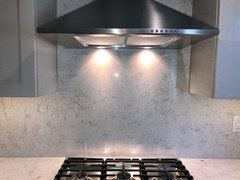
However, as he was working, I noticed that the vein patterning on the second slab (i.e., along the seam) seems (yes) to take a right turn. That is, all the other "veins" run almost entirely North to South (so to speak), while the veins in the second slab run East to West:


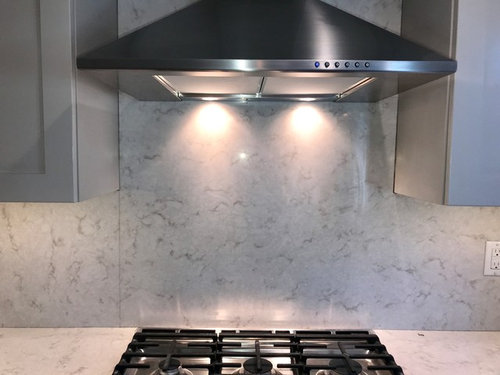
Here is a closer picture focusing on the area over the oven:


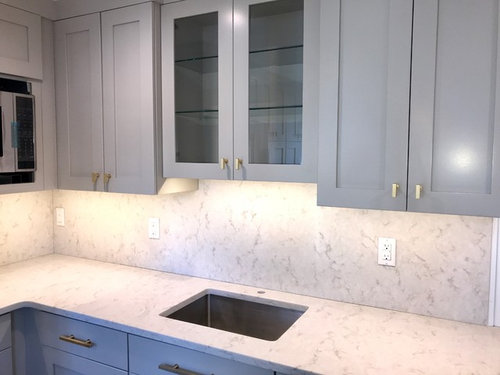
For further comparison, here is a picture of the other wall, which I love:


When I asked him about it, he said it was just part of the normal variation in the slab, so I let it go at that.


Days (and hours of staring at the walls) later, I'm not convinced. The wall above looks coherent; the other one look like it was turned sideways halfway down middle.


What's to be done? If (big "if") the fabricator will work with us on the price, is it feasible to take out one piece and reinstall?


As always, we're very grateful for any insights and advice from fellow Houzzers.


Comments (58)

  • 7 years ago
    Yes, it’s definitely turned. Maybe they can take it off and turn it the right way?
    Jane C. thanked K R
  • 7 years ago
    last modified: 7 years ago

    I really don't think it's noticeable at all. Although now that you've pointed it out, I can see that it would look more intentional if they had done a seam on the right side of the range, as well. Or if they could make the seam on the left less noticeable.

    Sorry, I don't know anything about how difficult it would be to take the splash down.


    Jane C. thanked daisychain Zn3b
  • 7 years ago
    last modified: 7 years ago

    Using a slab for the backsplash looks best when there is a definite vein direction. One where you could absolutely not get away with turning a piece another direction.


    Jane C. thanked leelee
  • 7 years ago

    Thank you to all who responded -- even if it wasn't what I wanted to hear!


    Spoke to the fabricator about an hour ago, and also heard what I didn't want to hear: He said we burned through all the slabs in the particular lot I was using; turning to a new lot would entail a real risk that the slab might not match the existing pattern and color. So, even if money were no object (it's not!), a localized fix is probably not an option. He is going to come take a look, nonetheless.


    I don't know what I could have done differently, in retrospect. We researched him thoroughly. He comes highly recommended both by customers and one supplier we spoke to, and he was very professional, start to finish.


    He did say that all the slabs were cut in the same direction, but I'm not sure if that means they were also installed in the right direction.

  • 7 years ago

    Lean a cutting board or place a tall vase right in front of the seam. No one will notice the change in direction because there will be something to distract from it.

    Jane C. thanked lucky998877
  • 7 years ago

    The seam is what I notice because it’s dark and a continuation of the line formed by the cabinet above. If that seam could be blended better, I don’t think you’d notice the difference in pattern nearly as much.

    Jane C. thanked shead
  • PRO
    7 years ago
    last modified: 7 years ago

    You DIDN'T have enough material. As Beth above. And that should have been apparent at the point of laser template. It's a beautiful kitchen. Much will depend on if you want to replace the entire side, counter top and all . Despite a usual consistency in quartz materials, I would not risk a match in splash to an already installed top. It would be a do over of that whole cook side of the kitchen. Based on a CHECK for a "perfect" match to the other side.

    An easier fix, would be a custom stainless sheet at the cook/hood area only. A visual break, and just as good looking. : ) I have done it with real marble as the other material, just to avoid the seal/stain/etch in the most "abused" area.

    Jane C. thanked JAN MOYER
  • 7 years ago
    I would totally notice the difference, and it would bug me. I would take the piece behind the hood down and use something else if it isn’t possible to fix it with the existing material. It’s unfortunate, but it’s something that would always annoy me in that space.
    Jane C. thanked Rachel Lee
  • 7 years ago

    You probably paid a lot for this kitchen renovation. Why should you have to live with a mistake? The pattern is obviously turned.....the installer screwed up. You should either get a sizable discount or he should do over.

    Jane C. thanked creekgirl
  • 7 years ago

    i see exactly what u are talking about... Maybe??!! if they can lighten the seam, it won't be as noticeable ???

    it would def bug me. Good luck i hope u get it resolved to your liking...

    Jane C. thanked sprtphntc7a
  • 7 years ago

    Jane C. " I don't know what I could have done differently, in retrospect. "


    Did you not approve the template layout?

    Jane C. thanked Chessie
  • 7 years ago

    I saw the change in direction but only because you pointed it out. I wonder if the fabricator can remove the area right at the back of the range and you can put some different tile there instead? I think the area to the right of the range is small enough that the direction change isn't noticeable.

    Jane C. thanked chocolatebunny123
  • 7 years ago

    Hi Chessie -- I went to the warehouse in Elizabeth New Jersey and approved the slabs. I thought that was the extent of my due diligence. As to the template layout, I was never shown one and -- not ever having done this before obviously -- had no idea that that was protocol.

  • PRO
    7 years ago
    last modified: 7 years ago

    Live and learn, is an oft repeated scenario. Most very good fabricators will insist you sign off on both laser template, and seams before a cut and polish. .......... but even that still requires on site presence and the written words regarding veins, pattern matches etc.

    Another unfortunate truth is an assumption sometimes made by a fabricator, that CONSERVING material will be your first concern, when the opposite, in terms of a final result may be more important to a given customer.

    Talk, talk, write, sign and talk some more. There almost can not BE too much conversation. : ) I DO think the stainless sheet could alleviate this, AND look great.

    Jane C. thanked JAN MOYER
  • 7 years ago

    I would gladly have paid a little extra (in proportion to the overall cost) to get this done right and avoid this result.

  • 7 years ago
    I have Soprano, and I’d never noticed it til you mentioned it, but there is a “grain.” I don’t know how obvious it is in this pic, but it’s running “east-west.” So if you intend to try to get the vendor to make changes, they will need to acknowledge that this grain does exist.

    By the way, there is a seam in this pic, just past the flowers. You can see a little bit of it in the window reflection on the left. I’d never say it’s invisible by any means, but it’s less noticeable than the one in your pic. I had to have the quartz people come redo it, as it was originally too dark. They said they used the recommended color, but it more matched the darkest gray swirlies than the whiter tones. After they matched the white, it receded much more.
    Jane C. thanked Blueostrich
  • 7 years ago

    The grout will disappear more if you use dabs of gray in spots and dabs of white in others. It's the solid line that makes it stand out against the pattern of the quartz. You could experiment, maybe use two colors of gray and one of a white that will blend with the background.

    Jane C. thanked leelee
  • 7 years ago

    I’m surprised your fabricator didn’t tell you their wasn’t enough material to install the backsplash correctly. he should of notified you before proceeding, it’s way too big of an issue to ignore. Hope he will work something out for you.

    Jane C. thanked User
  • 7 years ago
    I wouldn’t have noticed it if you hadn’t pointed it out. You’ve gotten a lot of advice here but you have to decide which solution you can live with and pay for.
    Conservation of materials is an issue, but most experienced fabricators know to watch the veining and movement in stone countertops.
    Good luck and keep us posted on the meeting with the contractor.
    Jane C. thanked RedRyder
  • 7 years ago
    last modified: 7 years ago

    Jane C.

    "Hi Chessie -- I went to the warehouse in Elizabeth New Jersey and approved the slabs. I thought that was the extent of my due diligence. As to the template layout, I was never shown one and -- not ever having done this before obviously -- had no idea that that was protocol."

    Well, now you know, in case you ever go through this again. I had 2 slabs, and was making sure that I had no seams anywhere, AND I was turning direction on the peninsula, so the positioning was very important to me, and I discussed it quite a bit with the fabricator. He sent me pictures of the layout for my approval, before he made any cuts. So you don't have to actually be there at all. I would think that any decent fabricator these days would know to do this, but apparently there are some that still don't.

    Jane C. thanked Chessie
  • 7 years ago
    last modified: 7 years ago

    I have to agree with all the others that you would have needed to buy a second slab in order to get the directional continuity. That should have been explained to you. The fabricator assumed you wouldn’t want to double your cost of materials, and there’d probably be a large amount of overage waste, but he should have mentioned it.

    It‘s been suggested in this thread that you remove the slab behind the range. This should not be a suggestion, it’s actually a must. Quartz is made up of materials that are flammable when exposed to direct gas flames that you will have. That too should have been explained to you.

    Jane C. thanked M Miller
  • 7 years ago

    I concur with the suggestion of stainless backsplash behind the stove. The little bit of mis-match at the corner will disappear when you place your mixer or something else there.

    Jane C. thanked yvonnecmartin
  • 7 years ago
    I'm not sure that you will be able to "unsee" that the veining switches directions, even if the seam is improved. I would encourage you to investigate replacing the one section.
    Jane C. thanked njay
  • 7 years ago

    Thanks, njay. That is exactly what we're hoping to do as a best case scenario. And thanks once again to everyone for all these helpful comments, insights, and kind words.

  • 7 years ago

    You need to try some of the suggestions mentioned above before you go ripping out the quartz or covering it with stainless.

    A quartz countertop is made up of nearly 93% quartz with the rest being the resin and pigments. The resin can only withstand temperatures of around 150 degrees. That means if you are taking a pan out of your oven or a hot pot from your stove, you cannot set it down directly on your quartz countertop.

    I've seen painted drywall behind a gas cook top and nothing terrible has happened. Unless you flambé you should be be fine.


    Jane C. thanked leelee
  • 7 years ago
    last modified: 7 years ago

    @Leelee - here is a photo from the thread that Chessie linked above, and there have been other similar posts on this forum. It's not solely that the quartz behind the cooktop could be a fire hazard, though that should be a consideration despite your post. It's that the quartz will very likely discolor from proximity to heat in that spot.


    @Leelee - glad you've not seen "anything terrible" happen with painted drywall behind a cooktop. More fires start in the kitchen than in any other place in the home. Two of every five home fires start in the kitchen while food is cooking. Beyond being common, cooking fires are also deadly. On average, they cause 44 percent of home fires, 15 percent of home fire deaths and 38 percent of home fire injuries each year. You shouldn't give offhand advice on such a serious matter that "it should be fine". How do you know that - because you personally haven't seen a kitchen fire?

  • 7 years ago

    your cooktop manual will have specs about island trim vs needing a heat shield.


    personally, i think the stainless sheet behind the cooktop would look better and solve the problems. it only needs to go up to the bottom of the hood.

  • 7 years ago

    If your backsplash does discolor from the heat then is the time cover it with stainless. At this point you might be wondering...why didn't I choose some nice porcelain tile?


  • 7 years ago
    last modified: 7 years ago

    Kitchen fires are a serious business. I wouldn’t take the chance even if you think it won’t happen to you or that it is highly unlikely. This is an easy fix with replacement by stainless steel panel, with the added bonus of mitigating the appearance of the pattern’s change in direction. Surprised that people scoffing or being flip. The problem with internet advice.

    Because the stainless steel panel is thinner than the quartz slab, I believe you will need some kind of build up behind the stainless steel so that it is on the same plane as the quartz slab on either side. Perhaps one of the pros can comment, or the OP can post a separate thread about it.

  • 7 years ago

    Of course there can be a fire in the kitchen. Grease can easily catch fire. Or pots unattended can cook down and cause a fire. Wooden spoons can catch fire. You must be aware and vigilant. My point was that the quartz backsplash is probably not going to catch fire from normal cooking. I don't think so many people would be using it if it was a big fire hazard.

    Yes, I actually did have a small kitchen fire once so I know it can happen. No damage or injury because I was right there.

  • 7 years ago

    The discoloration pictured above would probably happen to any surface. We've seen photos of tile looking that way too. I have scorched stainless steel.

  • 7 years ago

    Fori, you might need to stay out of the kitchen!

  • 7 years ago

    The discoloration pictured above would probably happen to any surface.

    Yup!

    I have scorched stainless steel.

    Me too, Fori.


  • 7 years ago

    Did you pick out the slab? Did you layout how the various pieces would be cut from the slab? Did you decide the direction the pieces would installed? If not, SOL. This is a good lesson for both you (the customer), and the business owner (in the case they didn't have these questions posed ahead of install).

  • 7 years ago

    UPDATE: The good news is that the fabricator is taking responsibility and working with us to solve the problem. Plan A was to try to find a slab from the same lot. We contacted the warehouse in NJ where we purchased the slabs, and they called the LG Viatera headquarters who in turn reached out to all their warehouses across the country to see whether there were any more slabs from our lot. There are none. So on to Plan B.


    Plan B is to take one of the remnants from our job and try to find a match. The warehouse in NJ is putting together samples from 3 different lots as I type.


    Question is, is Plan B realistic? How likely are we to find a slab that works? Are we looking at Plan C -- a complete do-over, start to finish? I remember when we were considering Silestone, they told us that the slabs were so consistently uniform we didn't have to come see them in advance. I wish that were the case for LG Viatera, but no one has promised. And we have been unsuccessful in reaching anyone at LG above the customer-service level for advice. Once again, we turn to our fellow Houzzers for any insights you may have. TYIA!


  • PRO
    7 years ago
    last modified: 7 years ago

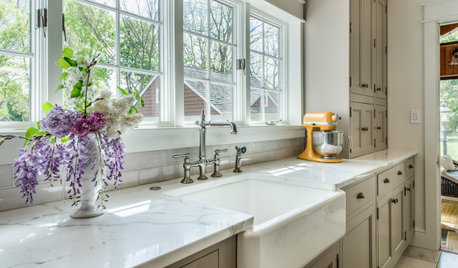
    You are avoiding the easiest and most logical and least expensive solution. Do a stainless.............You''ll have to click this to see, sorry never got a shot in great light. It's not a cheap out here in any way. We simply didn't want the marble behind the cook. The hood is chimney, disappearing into our paint : )

    This was a pretty horrible maids kitchen UNTOUCHED (but for a fridge in the middle of nowhere) since the 1920's ......trust me, fraught with more issues than will fit in print.

    In general · More Info


    In general · More Info


    Jane C. thanked JAN MOYER
  • 7 years ago

    Ugh, sorry this happened. Unfortunately, with any renovation, there are always lessons to be learned and compromises to be made.


    I do not think your Plan B is feasible. Cobbling together from other remnants might lend a result that looks worse that what you currently have. (which really isn't that bad, honestly)


    I think you really have 2 options, one of which is easy and less expensive, but will require that you adjust your expectations, while the other will be a PITA, but is the only way to lend the exact results you want:

    1. Use an alternate material for ONLY the center section above the range. (I like Jan's suggestion of SS.) Once you do this, the little bit of backsplash on the right will look fine, and it will not be noticeable that the subtle "grain" runs in a different direction.

    2. Remove backsplash and countertops, and redo the whole job with new slabs.


    If you decide to go with option #1, you might try to lighten that vertical seam first, as others have suggested, and see if that helps with how noticeable it is. I think direction of the veining will be FAR less noticeable once that seam disappears. Can't hurt to try!


    Jane C. thanked gm_tx
  • 7 years ago

    Jan Moyer, I agree, if not for anything but fire safety..and by the way, not all materials discolor or burn with heat, soapstone doesnt. I put my hot pots and pans directly on it and also had it installed on my fireplace, very safe and heat friendly for those looking for that feature.


    Jane C. thanked Sandra Martin
  • 7 years ago

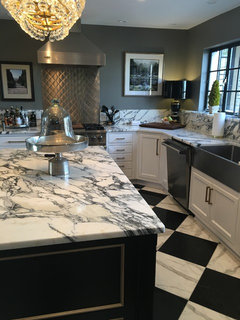
    Jan, is that yours? That countertop is stunning. Is it Arabescato?

  • PRO
    7 years ago

    Yes : )

  • 7 years ago
    last modified: 7 years ago

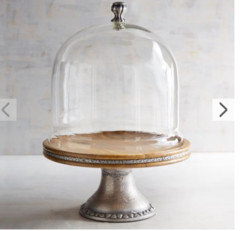
    Jan, I love that metal/bell-jar cookie/cake/pastry saver (or whatever you call it!). Where did you find that?

  • PRO
    7 years ago

    It was a hammered pedestal tray. The BELL? Aurrggghh!!!!!!!!! I can not even remember! It took me a hundred hours online to find one in an appropriate size, four years ago. It usually has muffins or cupcakes below....... guess nobody remembered to buy or BAKE?: LOL

  • 7 years ago
    last modified: 7 years ago

    beautiful Jan. I'm jelly! I want to redo my 'garden window' with exactly how you have yours above your sink.

  • 7 years ago

    Hahaha! But it LOOKS MAHVELUS!

  • 7 years ago

    Adhere as simple sheet of stainless to fill the space OVER the quartz and you can leave the quartz over the hood - with that much distance, you won't notice the grain.

    (love the idea of the "quilted" stainless - that's gorgeous!_

  • PRO
  • 7 years ago

    Jan your kitchen is gorgeous!

  • PRO
    7 years ago
    last modified: 7 years ago

    The clients entire house is a cozy "glamaffair" : ) Not many let you gild a powder room ceiling. Like I could leave it WHITE?!

    I loooove daring clients. : ) No farm anything here. You need a flashlight, hold the sunglasses : )


    Tudor glam redux · More Info


    Tudor glam redux · More Info


  • 7 years ago
    last modified: 7 years ago

    If you use a grout color that is lighter and if done by someone who pays attention to the veining, colors, etc., I believe that you can minimize how much you notice the variation in grain pattern. Using Photoshop and choosing a medium color from the stone, I "blended" the grout line. There's no way anyone would notice the veining difference if this could be done onsite.


    Jane C. thanked shead
  • PRO
    7 years ago
    Shead, that's brilliant!