Software
Houzz Logo Print
bostonbull

Dining table finish replacement?

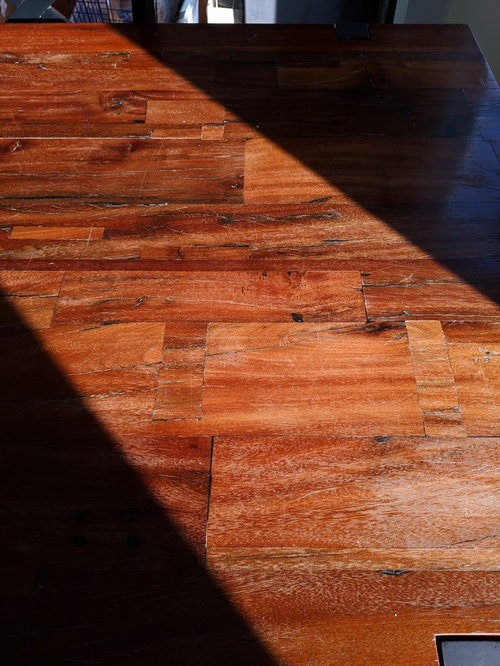
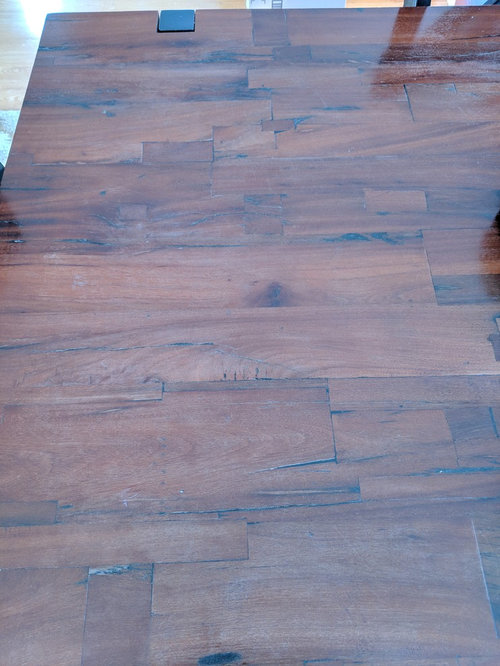
We have a beautiful table from Crate and Barrel. It is nearly a decade old, and the finish is beginning to wear off. It is dull and scratches easily. My partner put the finish on herself as the table was shipped raw.

I have four small children, and this table serves as three meals, homework, arts and crafts, and a general landing spot when we walk in.

I've received estimates locally to have it professionally finished, anywhere from $500 - $1,200 and we would be without the table for two weeks. Can't do that.

We don't want anything super glossy. Such as the top of a bar in your favorite Irish pub, that's the oppostoe of what we want. We're lookig for a durable, yet elegant and understated finish that will allow the wood to do the talking.

I would like to tackle this myself, is that crazy talk?

Any and all tips appreciated!!

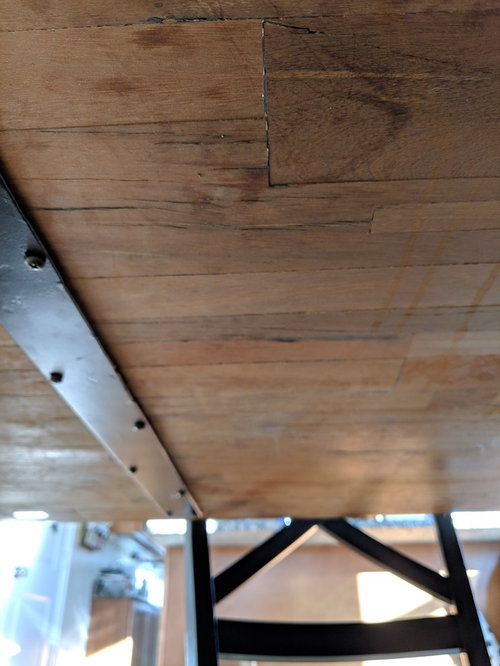
I've included two photos of the top, and one of the underneath.... Which is raw, to give you an idea of what the wood looked like before this topcoat was applied.

Comments (19)

  • 7 years ago

    along with that orbital sander and shop vac, get ear protectors to protect your hearing!

  • 7 years ago

    I recently helped a friend refinish the top of her sticky dining room table (I think she had a shellac finish that "broke" or whatever you call it). We stripped it with CitruStrip, wiped it down with mineral spirits, sanded with fine grit (orbital sander, shop-vac, and we wish we'd had better hearing protectors than basic ear plugs!), and then we wiped away dust w/ a tack cloth and then with T-shirt-based rags.

    Then we applied three coats of PolyAcrylic (no stain). We worked in pairs, opposite one another on the table, brushing across in about 2-foot sections and meeting in the middle (to keep a wet edge).

    We just did it in the dining room, so there is probably a dog hair or two in the finish somewhere, but nothing glaring.
    We left the room undisturbed for about 2 hours, or until the finish really wasn't tacky anymore, and then we turned on a fan.

    We also didn't sand between coats.

    It's probably not the world most perfect finish, but it's not sticky anymore! And it looks glossy and smooth.

    I kind of wish we'd done four coats--there was some unevenness, or bleed-through of some rough spots on the table itself, after coat 2. That was gone by coat 3, but I sort of wish we'd done coat 4.


    If I lived closer, I'd be suggesting that we get together every Labor Day to apply another coat of the exact same finish.

  • 7 years ago
    My experience says that oil based polyurethane holds up best to wear and tear. It will cause "ambering". Back in the '80's, I purchased a ready to finish table, and remember the directions saying that the bottom of the table must be finished the same as the top to prevent cupping. Some if the leaves of my MIL's antique DR table have cupped because she didn't do anything with the bottoms of them when she refinished it.
  • 7 years ago

    Excellent point regarding cupping kooten.

  • 7 years ago

    I don't think you'd have to start with 80 grit, that seems very rough. If you're just trying to smooth it and not necesarily remove all the old finish, I would think 100-120 would be OK for initial sanding. JMHO.


    Also after all the sanding and after all your cleanup and vacuuming, let things settle a couple hours, THEN wipe down the surface one last time to get any fine dust that was floating around in the air.


    Make sure to use fresh polyurethane - I've tried to use opened cans that were on teh shelf for a long time, and sometimes they don't cure and are permanently sticky. This can be fixed with a top coat of fresh product, but best to avoid it to begin with.


    I think you will like 'satin' finish. I don't like glossy finish on most pieces.


  • 7 years ago

    This seems like quite the project! I was hoping it could be quickly hand sanded and then a new top coat applied. The surface is in good shape, just dull. The color is OK as well.


    Do I need to do both sides of the table?


    The table was purchased over 10 years ago, and she can't find what was originally used. Whatever CB2 sent with the table is what she used.


    What brands of finish should I be looking at?

  • 7 years ago

    If estimates run $500 to $1200,you shouldn't expect " it could be quickly hand sanded and then a new top coat applied."

    There are no "cut the corner"method of refinishing if you want good results. And changing your description will not change that one bit. When were you telling it like it is?

    When you said " the finish is beginning to wear off. It is dull and scratches easily." or when you said " The surface is in good shape, just dull. The color is OK as well."

  • 7 years ago
    last modified: 7 years ago

    I wonder if CB2 would be able to tell you what they sent.


    If you had the exact same stuff, then yes, you could just sand it and apply a finish--of the exact same stuff.

    https://www.doityourself.com/stry/how-to-tell-if-furniture-has-a-polyurethane-finish

    Did she refinish the underside?
    is there a place you could test?

    If it was shellac, that's used as a primer, and it's particularly good for sealing off old finishes or oil or silicone. So you could polyurethane right over it. (Or Polyacrylic--which isn't as durable as polyurethane, dries faster (good and bad with that), and doesn't amber). (You can tell it's shellac if you can remove a patch of it with rubbing alcohol.)

    This article explores the risks of applying a new coating over the old. (they don't really talk about how to choose a finish that doesn't include lacquer thinner)

    https://thefinishingstore.com/blogs/news/coating-over-an-existing-finish-a-risky-business-that-sometimes-works


    Actually, your best bet might be to:

    Wash w/ TSP. Let dry well.

    Sand in order to scuff it up and dull the surface.

    Apply a layer of shellac to seal the old finish in.

    Apply two layers of polyurethane. (you could do all shellac, but I don't think shellac holds up well on a table that sets used a lot and washed, etc. I think that's what "broke" the original shellac finish of my friend's table. Though it's easier to rub on a new coating of shellac every year or two than it is to do w/ polyurethane, etc.)


    I'll also say this--with my friend's table, I kept worrying about ruining it. I finally decided, it wasn't going to damage the table irreparably, even if I screwed up the finish. Some later time, she could refinish it really well, but for now she had a nicer finish and a useful table.

    It's possible to kick the can down the road.

  • 7 years ago

    And yes, you should coat the underside of the table too.

  • 7 years ago
    Easy there, let's all get along. Nobody is looig to bamboozle ya.


    There are no dents, dings, or dongs in the table. No scratches that I can even catch a fingernail on. No wood damage in other words.

    Happy with the color, meaning I don't need to sand it down to bare wood and start fresh.
  • 7 years ago
    Talley

    The underside is still bare, it's just the color of the wood down below.

    I'll call CB2 and inquire! Let's see what I can dig up
  • 7 years ago

    a thread elsewhere on applying polyurethane over shellac
    http://www.oldhouseweb.com/forums/viewtopic.php?f=2&t=14377

  • 7 years ago

    If you read this guy, he touts shellac as a great choice to place over an existing finish and under a new one.
    https://thefinishingstore.com/blogs/news/why-shellac-is-my-go-to-finish-for-fine-furniture

  • 7 years ago
    last modified: 7 years ago

    and another thread about applying over dewaxed shellac (Zinnser SealCoat is the brand you'd look for)
    festoolownersgroup.com/finishing/polyacrylic-over-shellac/

    (re: the underside--you don't be able to test there, then. But from what I'm reading, you may not really need to)

  • 7 years ago
    OK, CB2 was mildly helpful.

    We learned it is called the Derjeeling Table and is made from reclaimed wood from India. Apparently it is called Saal wood and was railroad cars.

    Cb2 said they most likely recommended and water based clear lacquer sealant or a natural beeswax for this product. They are checking and will email me back.

    Here are links to the table:
    https://www.remodelista.com/products/darjeeling-dining-table/

    https://www.apartmenttherapy.com/cb2s-darjeeling-table-67588

    https://www.google.com/amp/s/www.furniturefashion.com/darjeeling_reclaimed_dining_table_from_cb2/amp/
  • 7 years ago

    Oh, good to hear that CB2 is being helpful!


    That's a lovely table. But with those wide planks, you definitely need to seal the underside.


    (If you do that first, it'll give you a chance to practice your technique for a smooth finish, plus you won't worry about denting a new finish on the top)

  • 7 years ago

    that doesn't look like beeswax to me; it seems too thick and "having been liquid."


    Here's some info on wax and oil finishes. Note this:

    "once a coat of clear wax dries on the wood, it will look like freshly cut, but unfinished, wood."

    and

    "Virtually all waxes will dissolve in mineral spirits or naphtha, which is handy to know should you ever need to remove wax, either from wood or on top of a finish. "

    http://www.woodworkersjournal.com/understanding-oil-wax-finishes/


    https://theprovince.com/life/care-part-ii-how-to-identify-the-finish-and-why-this-matters

    "Wax – You can tell if wax has been applied by lightly scraping your finger nail in a inconspicuous area to see if a scratch mark is left."