Software
Houzz Logo Print
heruga

Is propagating tsugas from cuttings difficult?

7 years ago

I see that in the conifer propagation 101 article cutting propagation from tsugas are described as 'for people with a magical touch'. What is that supposed to mean? What differences are there in propagating other conifers? I've got some tsuga diversifolia that I'd like to propagate once they get into bigger specimens but would rather want to know if I'm only going to be wasting time with this or not. And this is not anytime soon. My tsugas are only 2 ft tall now so who knows in how long maybe 20 years...

Comments (19)

  • 7 years ago

    I'm guessing no one has even tried propagating tsugas from cuttings which is surprising

  • 7 years ago

    Perhaps folks were waiting for your trees to be ready?

    Relatively recent thread HERE albeit for T. canadensis, not diversifolia.

    tj

  • 7 years ago

    I've tried, as I wrote in that thread. It's not easy, if it's just species, grow from seed... otherwise...I have no insights, as I have been wildly unsuccessful with tsuga cuttings

  • 7 years ago

    So it looks like its an extremely challenging process reading from Bill's thread. I got my species tsuga diversifolias from farreachesfarm and they told me they grew it from cuttings. How do they do it like its a piece of cake? They must have professional propagators in the high high ranks of it over there..

    True I can try to grow from seed but I wonder if they'll still be alive by the time they first start producing cones.. I guess this thought of attempt would go to a no then!

  • 7 years ago
    last modified: 7 years ago

    A professional propagation setup probably helps them!

    I was curious about this, and had an extra spot free in my propagation area, so I'm trying 4 cuttings of Tsuga canadensis. 8-10" terminal cuttings, 1 inch wound, dipped in 1:1 dilution of Dip 'N Grow with water for 5 seconds, and stuck 2 inches deep in 511 mix, in 4 inch deep individual cells. Under fog, bottom heat at 72-76°F, air temperature at 69-70°F, under LED running 18 hours/day. I'll update in 2-3 months..

  • 7 years ago

    Nothing ventured nothing gained!

    I'll be trying Tsuga canadensis again this season.

    I don't think it is more difficult in what is required and it may take longer or it may not root at all. But it's really no more work than rooting that is done on other conifers.

    I came very close to success toward the end of April last year, with one cutting putting forth the beginning of roots. If I had left them alone another two weeks or so, I think I would've had rooting but when I removed them from the bags, the humidity dropped substantially, causing them to abort.


    This year, it's high humidity all the way! :-)

  • 7 years ago

    I agree, there is only one way to solve the puzzle... I think one mistake I made is not selecting thick enough cuttings, this goes for any conifer you are trying to root. It has to be thick enough that it can form a good enough heel/calus to push roots. The ones I tried to root were like toothpicks, so they probably didn't stand a chance.


    The other thing is volume... I never have enough material, so I can't try a lot. With 'Gentsch White', I stuck 6 cuttings and 1 rooted... they were all treated the same, same conditions, size, rooting hormone, ect... So, had I only tried 5 I would have said these are impossible to root...


    To Bills point, I think patience is key... and I struggle with that. If I don't see progress within 2-3 months I usually pull the plug. I think that's why I failed with umbrella pines too... just couldn't wait 6m - 1 year

  • 7 years ago
    last modified: 7 years ago

    It can certainly be done, but don't expect great results on your first attempt.

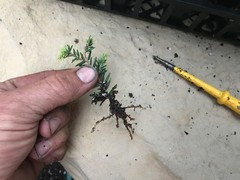
    This is one of my Tsuga canadensis cultivars that I rooted last season (first attempt I've made to root anything). This is at 20 weeks when I transplanted the healthy scions from the rooting media into growing media. Maybe I jumped the gun, I don't know how long they are supposed to stay in the rooting media before transplanting.

    I'm trying some different techniques this year to hopefully increase the success rate. I do believe aftercare will be just as difficult if not more so than the rooting stage itself.

    If you are interested in propagating only straight species, it might be easier to start from seed. I'm not a professional propagator though.

    Agree with above, patience is required.

    Ryan

  • 7 years ago

    Wow, 20 weeks!

    What was your setup? Light, media, bottom heat, rooting hormone, air temperature, method of providing humidity?

  • 7 years ago
    last modified: 7 years ago

    I'd be interested in hearing how the lower temperatures affect your strike rates. Very nice setup!

    Can I ask why you chose that dilution of Dip 'N Grow? Most of the information I've found for hardwood cuttings, and specifically some of the needled evergreens, points towards 0.8% - 1% IBA for high success rates, although a few required as little as 0.3%.

  • 7 years ago

    I'm hoping the lower temp will slow down the growth of the unrooted cuttings. Last year the scions were pushing growth early on. I think they still will, but slowing it down should help. Just a theory though.


    I mostly went with that rate because the label calls for 5x for hardwood cuttings. In researching, I found the data to be all over the place. One study consistently used 100 mg/L (.01%) of IBA and soaked for 24 hours. I'm already using a significantly higher rate and only dipping for a few seconds.


    I might play around with the rate next year depending on how these turn out.


    Be sure to keep us updated on your operation illsstep, the more info we can share the better.


    Ryan

  • 7 years ago

    Oops, I should have mentioned that the rates of IBA I mentioned were for a several second ("quick") dip. Rates for longer soaking are definitely lower.

    I'm also curious how new top growth before rooting can affect rooting percentages. For deciduous hardwood cuttings, it's been suggested that early (before rooting) top growth, which uses up carbohydrate reserves in the cutting, can reduce or prevent new root growth because those carbohydrate reserves are no longer available to use for roots. I have no idea if the same would hold true for hardwood cuttings of needled evergreens, which have the photosynthetic machinery already in place (and so may be less dependent upon stored reserves for new growth).

    I'll definitely update with my results.

  • 7 years ago

    I'd like to ask about this from you guys that use IBA/NAA like Dip n grow.

    I've read this in more than one article I've found on the net about rooting T. c.: the following link.


    Quote: " Rooting percentage of each species responded differently to varying auxin concentrations (0, 1, 2, 4, 8 mM NAA). Maximum rooting (56%) for eastern hemlock occurred at 0 mM NAA; then decreased with increasing auxin concentration. "


    Am I reading this right that Zero mM NAA has the highest percentage of rooting? Or is this another piece of worthless information parroted over the internet?


  • 7 years ago

    You do appear to be reading that correctly. I'll point out, though, that that study appears to not use IBA at all (also - softwood cuttings..) Two other sources I've found mention that best rooting of hardwood T. canadensis occurred with 0.5% IBA + 0.5% NAA (together) .. this might be more applicable to those of us that use Dip 'N Grow.

  • 7 years ago

    Thanks! I'm easily confused sometimes with the way this information is presented. So I'll just not worry about that. :-)


    There were many other places that stated an increase and best rooting when using IBA+NAA.

    I've kept my Dip n Grow I bought last year in the refrigerator since then and according to the bottle label, it should be good to use this year? I'm hoping so.

    Probably won't get anything done for another week or two but I'll post up with any progress.


  • 7 years ago

    According to their website, Dip 'N Grow should be good for three years as long as it's stored out of sunlight and heat. So you should be fine.

    I saw in another thread that you're planning to try Juniperus virginiana this year. I'm interested in seeing how that goes! The upright junipers are supposed to be pretty difficult to root.

  • 7 years ago

    Good to know!

    We're in an Arctic blast here, winter hitting us pretty hard. Lots of snow and cold. It's supposed to moderate some by the first week of February so hope I can get out by then and collect some branches. I'll have lots of room this time around so I might as well try several things.


    Don't know if you saw [this thread about rooting Juniper v.[(https://www.houzz.com/discussions/would-these-make-good-cuttings-for-rooting-dsvw-vd~5375886?n=15) from last summer. peter_out has some interesting information about using the lower branches and getting good results.


  • 7 years ago
    last modified: 7 years ago

    Oh, I hadn't seen that. Thanks for the link!

    I vaguely remember now reading something elsewhere about superior rooting percentages coming from using the laterals instead of the branch tips. I'll have to see if I can find that..