Software
Houzz Logo Print
htwo82

New dirt pad, soil help!

7 years ago
last modified: 7 years ago
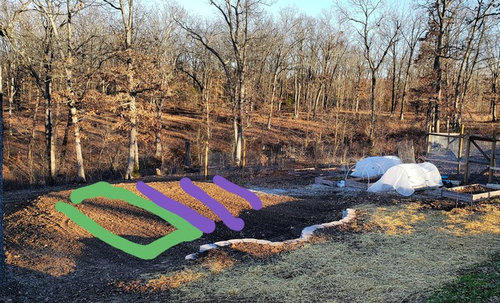
I recently had a large pad built to place my greenhouse on. It will also accommodate 3-4, 3' wide beds/rows for vegetable garden planting. The dirt that was used to build the pad was the dirt that was there, it was just moved around (dug down in front, built up in back). The dirt is clay heavy and is not draining. My thought it to use the tiller to till deep down and maybe remove a bit of the clay dirt and add in compost and shredded leaves. This would only be done where I plan to have rows or beds. After getting the dirt back up to level, I'll add some good garden soil on top to form the beds or rows. I'll then add shredded trees/bark (or sawdust if I can find it) in the walkways in between the rows, which should absorb the water for a while until it breaks down and starts helping condition the soil.

I've attached a pic for general reference. The greenhouse will have 3, 3'x36'x16" raised beds, and the remaining area will hold the additional 3'x36' rows.


Thoughts on using this method to condition the soil under the beds so that the drainage issue doesn't drown my roots?

Comments (18)

  • 7 years ago

    Just to add to the previous comment, one solution is just to add lots of organics to the mix. But it's a temporary solution. As the organics degrade and volatilize, what you end up with after a few years, is ... clay. So the nuisance factor is that you'd have to do that regularly. So I'd agree that going after better quality soil (and perhaps removing a lot of the clay and replacing it) is the best fix.

    But if your underlayment is clay, you're going to have drainage issues at some level.

  • 7 years ago

    I will typically add a good amount of compost and shredded leaves as mulch each year, anyways. Will that not eventually help change the structure of the soil? My main concern is having clay underneath and beside the beds. But to be fair, that's our native soil and everything I've planted in the ground elsewhere grows well. I have always added compost when planting tho.

  • 7 years ago
    last modified: 7 years ago

    You *always* have to continuously add organics to soil to keep the structure good. Why? Because organics in soil aren't permanent. They slowly degrade and, as they do so, their carbon turns into CO2 and POOF! they're gone. Organics in soil entirely disappear, on time scales of a few years. If they're buried deeply, or degrade slowly (e.g. Hugenkultur, with big chunks of wood buried deep) they'll last a while. But of course, in that case, it takes a long time for the soil to see any improvement.

    You can see this if you watch a compost-amended bed over the course of a year. It sinks! Not because it is compressing, but because the organics are departing.

  • 7 years ago

    Yes, I know. I'm not THAT green, lol. Thank you for the advice tho.

  • 7 years ago

    Lot's of people don't understand that. To them, compost is an ingredient that you add to soil to make permanently great soil. Do it once, and it's fixed! But, but, I added a lot of compost five years ago, and now my soil is crappy!

  • 7 years ago
    last modified: 7 years ago

    If you are amending planting holes for long term plants like trees, shrubs and herbaceous perennials you should stop doing this as it is not beneficial - you want the new plant to have the same soil texture throughout the area around it.

    And of course any organic matter added at time of planting will disappear long before the plant does, so that most of the time the plant is present on the site it will not be receiving any benefit from the original dose of amendments.

  • 7 years ago

    wet saturated clay soil is not a big issue in a greenhouse since you control the irrigation. if the beds are filled with growing medium that is well drained you should be good to go.

  • 7 years ago

    I thought this was supposed to be a greenhouse + outdoor beds next to it. Definitely I would not loosen soil that a building was going to be placed on. If there is a possibility of water puddling inside and around the installed greenhouse, due either to irrigation or rainfall then a drainage system should be put in first.

  • 7 years ago
    last modified: 7 years ago

    The pad will accommodate a 14'x36' greenhouse, and 3 additional, 3'x36' outdoor beds/rows.

    My worry for the greenhouse beds is that the growing medium will drain well - right to the clay, then stops, drowning my roots. So I wondered if I should add compost and till the ground underneath the beds only, then add my growing medium. I don't think it's so much that it's clay, but rather that the bobcat used to build the pad, packed the soil very tight during the build.

    For the outdoor beds, I'm going to add compost and till in, then mulch my plants heavily with shredded leaves in the spring and fall. I'll continue mulching with compost and leaves every spring and fall. Luckily I have 23 acres of heavy forest so there will be no leaf shortage!

    For the remaining ground, I'm planning to plant a mix of wild grasses and bee lovers clover, which will do very well in the clay soil without amendments or fertilizers.

  • 7 years ago

    I also want to mention that I will be having the soil tested, to ensure proper amendments are made.

  • 7 years ago

    Also important to note that the greenhouse beds will be used for growing greens during the winter, so most will have shallow roots. I plan on building 8" raised beds in the greenhouse. Otherwise, it'll be used for potted plants and cold hardening seeds in the early spring. The outdoor beds will be used for asparagus, tomatoes and carrots.

  • 7 years ago
    last modified: 7 years ago

    Again you do not want to add large amounts of organic material to any soil as this is actually undesirable. And if you mix in much material beneath your beds these beds will sink as it decomposes. If you are going to fill your beds with a purchased planting medium anyway then use that by itself, without changing the existing soil beneath.

    Except for maybe poking holes in it with a spading fork, or loosening the top few inches with a fork. In order to break up artificially induced surface compaction.

    8 in. is kind of shallow, you should probably think about making the walls higher. In terms of human comfort an optimal situation is one where the walls of a raised bed can be used to sit on while tending the plants. With the top of the bed walls doubling as a bench it is possible to work longer, without becoming distressed by stooping or squatting.

    htwo82 thanked Embothrium
  • 7 years ago

    My raised beds will be filled with a purchased planting medium. From what I understand, you're saying DON'T disturb the soil underneath, unless it's simply using a fork to loosen the top few inches. That'll be my plan.


    For my outdoor rows, the compost I plan on adding is aged cow manure. Are you saying not to till it into the soil? I'm not planning on purchasing growing medium for the outdoor beds, but simply adding the aged manure and tilling. Should I instead just plant directly into the clay dirt and mulch with the manure and leaves?

  • 7 years ago
    last modified: 7 years ago

    If native soil is clay, and even if you're bringing in a lot of better quality topsoil, I sure don't see anything disadvantageous about adding plenty of compost. Certainly don't anchor your greenhouse on heavily composted soil, but putting lots of compost on the beds inside? Sure! Soil structure is always improved by adding organics. Probably want to keep the compost content to <10% or so, though, in order to avoid having a mix that won't hold water. Of course, if you bring in vegetable-bed quality soil, that will already have a lot of organics mixed in. Now, as noted, the organics will eventually disappear, and the bed will shrink, so when the greenhouse is sitting on top of the beds, it better be straightforward to dig in more organics every year.

    Minimum depth for good quality soil in the bed is 12-inches. I'd double that, if you can.

  • 7 years ago
    last modified: 7 years ago

    The Myth of Soil Amendments, Part III
    “Healthy soil has high organic content”

    Last fall we collected soil samples from a local organic demonstration garden and sent them out for
    nutrient analysis; this garden had recently experienced some soil and plant health problems. Every single
    one of the sites that was tested came back with nutrient readings off the scale. In large capital letters the
    report warned “DO NOT FERTILIZE THIS SOIL.” The excessive addition of nutrient-rich compost to
    this landscape contributed not only to plant health problems but to nutrient loading of adjacent natural
    waters.

    https://s3.wp.wsu.edu/uploads/sites/403/2015/03/soil-amendments-3.pdf

  • 7 years ago

    I'll plan on building the beds at least 12-18". I can already hear my husband crying about how much the soil to fill them will cost! LOL

  • 7 years ago
    last modified: 7 years ago

    Good article. You might read it.

    "Ideal soils, from a fertility standpoint, are generally defined as containing no more than 5% OM by weight or 10% by volume." (OM is "Organic Matter")

    Which is what I said. The myth applies to people who basically want to garden in pure compost. Linda is NOT saying that organics are bad. She's saying that too much is bad. She is also talking about permanent landscapes, in which when the organics volatilize, it is impossible to add more to the soil -- like a lawn. For beds that can be amended? "The annual incorporation of compost makes sense here."