Software
Houzz Logo Print
dicouris

I'd like a rose that will create a thicket

7 years ago

I have an old rose that sends our runners and has basically created what I'd call a thicket. While that would often be a nuisance in some parts of the garden, it's a very useful habit in a particular location and I'd like another rose this this spreading tendency to plant nearby.


The current rose is medium pink, medium height, with somewhat lax canes. I'd enjoy a different color. The area gets nearly full day sun.


Must be cane hardy without protection in zone 5, tolerant of wet weather and not terribly susceptible to blackspot.


Thanks for your suggestions!


Di


Comments (13)

  • 7 years ago

    Pretty much any Gallica will do this. Generally they make low, suckering thickets, around three feet tall; some will get as high as five or six feet ('Violacea'). Gallicas can be double or semi-double; their colors are mostly in the pink to wine-red/purplish ranges. You have to get them ownroot, or plant grafted plants with the graft a few inches below the surface, and wait. Gallicas are hardy in your zone. Do I need to mention that they're once-blooming?

    The once-blooming roses of European origin all tend to sucker on their own roots, some more some less. Both the Petites, 'Petite Lisette' and 'Petite Orleanaise' make tallish--five or six feet--thorny, thick thickets. Flowers are pink, smallish, and fragrant. Almost all these roses are scented. 'Centifolia' suckers, not as densely as some, lanky plant, exqusite rose pink, rose scented blooms. (I remember you said you wanted a different color, but still...) 'Belle Amour', of uncertain classification, about five feet, loosely suckering, thorny, blooms semi-double, unusual warm pink, unusual myrrh scent. 'Robert le Diable', mixed origins, low, dark blooms, thorny. 'Capitaine Ingram', moss, dark, lowish in my garden, very lovely.

    Pure Gallicas tend to be bristly but not thorny. The roses I've listed have in general good health records. They're deciduous. I love all of these, and recommend them highly. I haven't listed all the possibilities.

    Baboosic z5b NH thanked Melissa Northern Italy zone 8
  • 7 years ago
    last modified: 7 years ago

    Pretty much any gallica or rugosa on its own roots will do the trick for you. They will also have the hardiness you require.

    Baboosic z5b NH thanked Rosefolly z5
  • 7 years ago
    last modified: 7 years ago

    Are there some gallicas that have a particularly bad reputation for suckering? That's the trait I'm hoping for.

    Here is the old rose I mention, and I believe you can see a photo in fuller bloom from a few years ago if you go to my profile.

    I do enjoy contrast. For some darker colors, High Country has these available: Alain Blanchard, Belle de Crècy, Cardinal de Richelieu, Charles de Mills, Hippolyte, La Belle Sultane, Orpheline Juillet, Tuscany Superb. Rosa Mundi looks interesting too. Does anyone have experience with any of those?

    What about The Bishop? Is that a gallica and/or is it inclined to sucker? I visited Suzie Verrier's North Creek farm in Maine many years ago and admired what was labeled "the Bishop". She didn't have it for sale and I've searched for it without success. I've heard that there are perhaps some imposters in commerce. High country has it and they're calling it a centifolia. The photo they show looks nothing like the large, very full "TheBishop" that I saw at North Creek.


  • 7 years ago

    In addition to those mentioned, you may also wish to look at some of the species native to the US -- especially if you're looking for something forming a thicket in a "wilder" area. Off the top of my head, R. carolina, R. nutkana, R. nitida, R. virginiana, R. blanda, and R. acicularis. could work, depending on which has a habit more to your liking. Also note that some of the species don't bloom at the same times as others, so having thickets of different species can mean seeing flowers over a long period.


    The article below gives some general descriptions, but certainly look up the species on HelpMeFind for more information and pictures.


    http://www.wildlifegardeners.org/forum/feature-articles/3659-native-roses-north-america.html


    You can find some native species at High Country Roses -- but, from what I remember, their R. blanda may not be accurate. Another wide range of species can be found at Forest Farm.


    :-)


    ~Christopher

    Baboosic z5b NH thanked AquaEyes 7a NJ
  • 7 years ago

    I just came across this rose in an old post. Mme. ZoetmansMme. Zoetmans

    Baboosic z5b NH thanked Vaporvac Z6-OhioRiverValley
  • 7 years ago

    Mme Zoetmans is exquisite!


  • 7 years ago

    Oh, I just thought of another -- 'Indigo'.


    :-)


    ~Christopher

    Baboosic z5b NH thanked AquaEyes 7a NJ
  • 7 years ago
    last modified: 7 years ago

    Really! That's been on my someday list. How large a thicket are we talking? Do you grow it and if so, how does it do for you?

  • 7 years ago

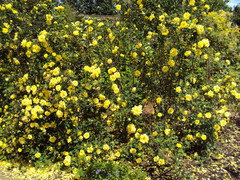
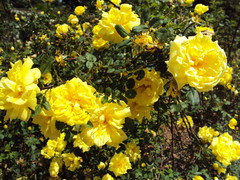
    This is supposed to be hardy to zone 3b... and as you can see, forms a good thicket..

    I think it's R. foetida 'Persian Yellow' as the prickles are curved, but it may be the similar 'Harison's Yellow'... whatever, I found it quite startling...


    Baboosic z5b NH thanked User
  • 7 years ago

    "Persian Yellow" and its sibling, R. foetida bicolor "Austrian Copper," are very susceptible to black spot. It's arguable that R. foetida ancestry, often by way of 'Harison's Yellow,' is the source of vulnerability to black spot in many modern roses, even some that are not yellow, so these may not be ideal for the purpose.

    Baboosic z5b NH thanked Paul NY 5b-6a
  • 7 years ago

    I have 'Indigo' in a bad spot, but it suckers about as much as 'Tuscany Superb' in the same area. I was told to treat it like a Gallica that repeats. I actually got it as a few suckers from Carol in Oregon on here. This will be one of the roses I dig up from here and move to the cemetery in a more favorable spot, but still keeping in mind its suckering habit.


    I don't think 'Harrison's Yellow' factored into the ancestry of many modern roses. Sure, there were a few descendants, but I think the majority of R. foetida genes funneled through 'Soleil d'Or' and a few other direct crosses with R. foetida, R. foetida bicolor, or 'Persiana'. And while it is susceptible to blackspot, and probably passed down some further issues to its descendants, it's not like the HPs and pre-Pernetiana HTs were all blackspot resistant to start with, after all. The R. foetida ancestry just made it a bit worse.


    :-)


    ~Christopher

    Baboosic z5b NH thanked AquaEyes 7a NJ
  • 7 years ago

    When you say reputation for suckering, the immediate and lasting rose that "sticks" in my mind is Charles de Mills. Do not plant that rose lightly in any area you ever want to plant anything else, as it'll colonize the area with exquisite dark purple blooms and viciously thorny canes that will never disappear. If you just want the thorns and coverage, Darlow's Enigma comes to mind as a totally self-sufficient and repeat blooming rose. It might be amusing to put DE at the back and let CdM ramble in the front and have them duke it out for thuggishness. May the best rose win...

    Cynthia