Software
Houzz Logo Print
rabainsz7bpnw

fertilizing new raised beds

7 years ago

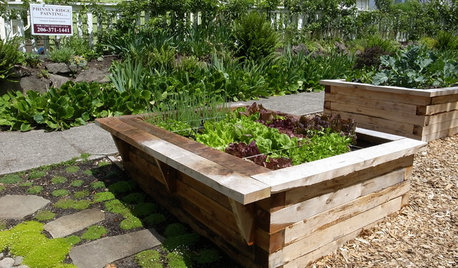
I have got a couple raised beds made and will be adding dirt soon (bulk bought from a nursery). the nursery tells me to add a fertilizer when soil is added to the bed. What is good? Espoma garden tone? plant tone? dr earth veggie and herbs, any other? or a mixture of some other things? I am new to this . I am going to grow tomatoes, cucumbers, beans and peppers. I am in Pacific northwest.

Comments (20)

  • 7 years ago
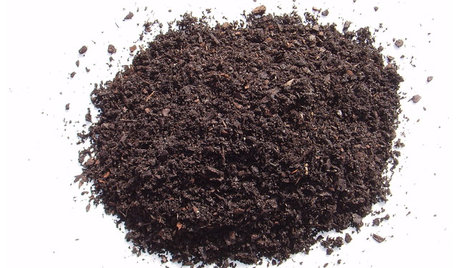
    When we built raised beds, we filled it with compost. Then used seaweed & bone meal fertilizer to pump it up. Each year, we add more compost from our bin & a bit more seaweed & bone meal. Our veggies grow great and without chemical fertilizers.

    A trick a master gardener taught me was to add the compost before winter then the cold here would kill most weed seeds. Not all, but most. I hand weed during the growing season.
  • 7 years ago

    Needs to be said again (and again, and again), compost isn't fertilizer. Compost provides a small amount of nutrients, and does so VERY slowly, as the lignins degrade. The main purpose of compost as a soil amendment is to improve soil structure (which it does, until the lignins degrade!) Most organic ferts are pretty slow acting as well. Fish emulsion tends to be more potent. Blood and bone meal are pretty good. I suppose Epsoma is mostly that.

  • 7 years ago

    I agree on the compost part, I tried only compost with nothing else and didn't work that great one year with a very small bed. It was a small 4x2 bed so used bagged soil and compost and didn't add anythin else. The results were not great. Had to add some all purpose Fert the next year along with compost .

    So, espoma and fish emulsion will serve the purpose. I guess garden tone is good then?

  • 7 years ago

    It is always smart, when putting together a new bed, to just get a soil test to tell you what the issues are. With regard to NPK, native soil can have very little N (no nitrogen-bearing minerals), but can be abundant in P and K through mineral decomposition. That test can be used to guide your fertilization strategy.

  • 7 years ago

    or in this case ask the supplier for an analysis of the soil they are selling

  • 7 years ago
    last modified: 7 years ago

    I like to mix in some Tomato Tone in the rows at the least.

    I use some stonger stuff too.

  • 7 years ago
    last modified: 7 years ago

    Been using gardentone here for several years with good results. Homemade compost piles are always contributing organics to the garden with chicken manure in the mix for the last 3 years (have some hens). I'm trying 2 other brands of organic fert this year which match well with gardentone ingredients, will compare results using some potted tomato seedlings as controls. We have 3 seasons here and the soil needs consistent replenishment.

    We can plants peas, followed by cukes, followed by turnips, (several combos to chose) from spring to fall all in the same plot. Being in Z-8a you probably can do this same, it can be a real space saver. You listed "beans" and if they are bush beans then you could follow them with some late cukes if your climate can accommodate. Cukes here produce good for about 2 months before they give up and a later planting can be good supply, esp if pickling. Well that's enough of my jaw boning, Happy Gardening

  • 7 years ago

    Pretty short growing season in the PNW, despite its very mild zones. Soil - even in raised beds - does not warm up very early so planting of hot season crops is restricted until after mid to late May or even early June. And it never gets very hot even in midsummer so things finish off rather early as well. Succession planting is just not very feasible here except for quick-to-harvest crops like greens or radishes.

  • 7 years ago
    last modified: 7 years ago

    That's where the USDA gardening zones fail. Growing in the z8 PNW is nowhere like growing in the z8 Central Texas where I am. I've gardened in both places. Down here, in my current z8, I plant out my "hot season" crops in March or April. Actually, those gardening zones are really "hardiness zones", which tell you what you can have as a perennial. They tell you how cold it gets in the winter, which is next to useless for evaluating summer gardening. I wish people wouldn't rely on them in this forum. But people seem to worship them.

  • 7 years ago

    ^^ Amen!! I can't safely plant out tomatoes until around 6/1. And they better be harvested by mid to late September because it cools down so much and the daylight is short and the sun too low on the horizon much later than that. If one is lucky and times it right, you can get probaby get a second crop of peas in early fall. And most brassicas do well late into fall and early winter.

    OTOH, because the area is so mild climate-wise, what we can grow with garden ornamentals is huge!!

    I'm not sure folks "worship" the zones....they just don't understand what they do and do not measure :-)

  • 7 years ago

    "Only problem is, not many people use them! "

    And leading the pack are the growers/distributors!! I know of only one large wholesaler that supplies plant tags with both Sunset and USDA zones. There is a heck of a lot more to growing plants successfully than just how cold a winter they can take!

  • 7 years ago
    last modified: 7 years ago

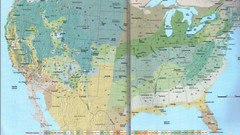
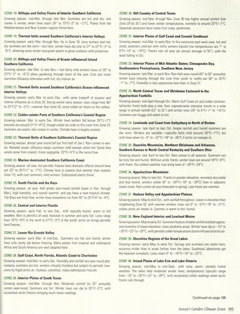
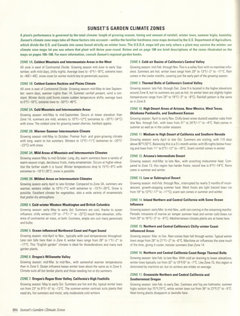
    Yes, Sunset zones are, in principle, actually functional as predictors of growing climates, but as far as I know, they're only available for the western U.S. I used to put that Sunset zone in my header line, before I realized that. I believe the site you point to gives a link to those Sunset zones that redirects to a page that doesn't even talk about them. Though you can still find them here for the west coast - https://www.sunsetwesterngardencollection.com/climate-zones. This joke of a Sunset web page titled "Find your U.S. Sunset climate zone" doesn't tell you how to do it - https://www.sunset.com/garden/climate-zones/climate-zones-intro-us-map. No maps.

    At least to me, the Sunset zones were well intentioned, but are now implemented poorly. If someone can find a real all-U.S. reference to Sunset zones, I'd be delighted to see it.

  • 7 years ago
    last modified: 7 years ago

    The map I linked is for all of the US. Is it not showing that? Hmmm.

  • 7 years ago

    Not in http://www.plantsearchonline.com/zones.htm it isn't. Nor is the http://www.sunset.com/garden/climate-zones web page that it links to (which actually redirects to https://www.sunset.com/home-garden/garden-basics, which says nothing about zones). What web page are you looking at that gave you that U.S. map? That looks like exactly what I'd like to see, and which this whole forum should get to see.

  • 7 years ago

    Dan, the link you just gave ( http://www.plantsearchonline.com/zones.htm) takes me right to it. You have to scroll down a fair bit to get to the map, but I assume you are scrolling down. The sunset.com page is linked there, but down close to the map is a chart describing each and every zone listed on the map. They even have a time zone map, and 1990 and 2012 USDA Hardiness zones. Very informative and useful website that I keep bookmarked.

    What is it showing you when you visit the link?

  • 7 years ago
    last modified: 7 years ago

    Oh my goodness. My apologies. I didn't scroll all the way down. Thank you! But those other links run by Sunset are really lame. This map looks like it was copied out of a book somewhere. It looks like there are two jpegs there, and if you want a copy of it, you have to pull both - Sunset USAw.jpg and Sunset USAe.jpg. I wonder why Sunset can't seem to put the original online. I will add my Sunset zone back to my header line. Now we've got to get the other few hundred people in this forum to do the same!

  • 7 years ago

    No problem Dan, haha. It's actually quite common that people I show the map to make that mistake, not scrolling down. It really seems as if it ends below those hardiness zone maps! They even put copyright info that is typically at the bottom of the page....The sunset zone links are lame. That map could easily conquer the might hardiness zone maps if more people used it.

  • 7 years ago

    You know, it's really a misnomer to call those USDA zones "gardening zones". In fact, the USDA calls them "hardiness zones", which is much more accurate. MIght as well have a map of how far you can easily stick a shovel in the soil, and call those "gardening zones".

  • 7 years ago

    I used to think the Köppen-Geiger zones were suitable for gardening, but I've since concluded that they aren't finely divided enough. Much of West Texas is Bsk, as is much of North Dakota and Montana. That doesn't quite work for me.