Software
Houzz Logo Print
sartist37

Saltillo tile hard on your back?

7 years ago
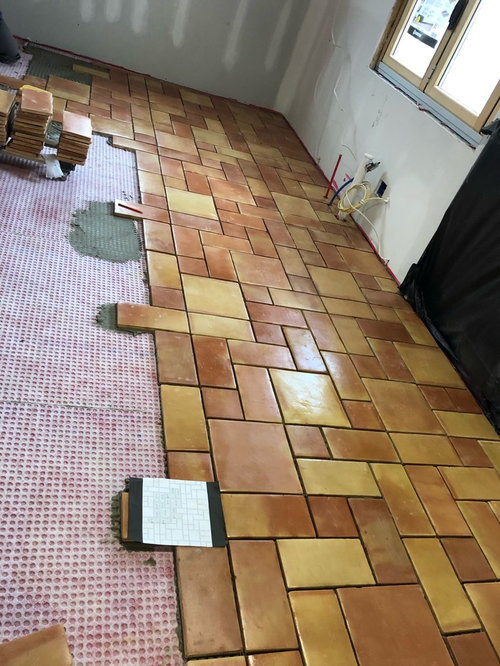
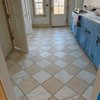
Hi everyone! I just came upon this post. I am in process of building a house, and my long awaited Saltillo tile is being laid down now in the kitchen, dinette and side hallway area of my home. I love the look of it, but as I hope to spend many years in this home I am getting concerned about a few posts I see here saying it can be hard on your back? I actually do NOT have a great back and have had problems throughout the years. I am so worried about this that thinking of ripping off the tile they already put down and changing it, even though I really love it. Can anyone say the experience they have with this tile and if indeed it is hard in the back or a trip hazard? I also have little children. Thanks in advance for any advice!!

Comments (30)

  • 7 years ago

    Poorly installed saltillo is a tripping hazard. We had a house were many of the tiles were very lipped--so much so that even the 1" grout lines didn't prevent a few major tripping hazards. From your pictures, it looks like you have more uniform tiles, especially if they can get the grout lines so thin, but it's impossible to really tell from a picture. As long as your tile guys are being picky, you should be fine.

    As far as comfort, I don't think it's any worse than any other tile. The strategic placement of rugs might be a good idea if you're on your feet for long periods of time in the kitchen.

  • 7 years ago

    I have concrete floors. For the first 1-2 years I found it a strain to walk on. Now, I always wear crocs inside and have no issues. We've been here 12 years.

  • 7 years ago
    Tile (or concrete) is harder on the joints than wood or carpet - back, knees, etc. If you have a good shoe to wear inside it will mitigate it. I have to wear shoes inside even with wood.
  • 7 years ago

    Technically, there is no difference between flooring materials when you just stand (because once you don’t move, physical forces (and therefore joint stress) reach an equilibrium that is a function of your weight and foot surface).


    So that limits the problem to moving around. Dynamically, the added stress on your joints is a function of vertical deceleration (impact), which is a lot less for soft materials. Your bare feet are a lot softer than tile. So just your feet alone will have a huge cushioning function. This will make your feet hurt but will not affect your back, as the impact is mostly absorbed by your heels (assuming typical movements in a kitchen for hours). If you wear a soft shoe, it gets even better. I’d prefer that over shag carpet in the kitchen for hygiene reasons.


    All that is mostly a problem if you stomp your feet (e.g, if you run - that’s why it’s important to get good shoes if you run long distance).

    Personally, I don’t stomp or run in the kitchen and have never felt pain due to surface. If I did, I’d wear a nice set of memory foam house shoes.

  • 7 years ago
    last modified: 7 years ago

    I'm going to disagree with the "won't hurt your back". I'm a back pain sufferer and I have HUGE issues standing in line at Costco (famous for their concrete floors). Like the song says, "knee bones are connected to your thigh bone"). Everything is connected. Standing on a hard surface for any length of time will cause issues with ankles, knees, backs, shoulders and can create head aches. This is true for any hard surface, not just saltillo.

    Then the second issue with Saltillo is the UNEVEN surface. This adds a new dimension to the problem. As you walk across the surface (with or without shoes) your foot will be walking over an uneven surface. This will cause a slight rocking or rolling of the foot/ankle. For healthy people this is not a concern. For those of us with back pain, this will add stress to our bodies.

    The flex of the foot is then compensated by the knees. The knees will then cause a slight adjustment at the hip girdle. The hip girdle is the START of the back. Slight adjustments in the hips can create stress in the lower back and along the lateral line of the body (ie the lateral obliques). Once those start to flex and twist then the rest of the back starts to get involved. And anyone who has lived through a back injury will tell you, even slight adjustments can cause a flare up of symptoms (pain, swelling, muscle contractions, etc). And that's just the muscular system. If impinged nerves are involved then this means a whole new level of involvement.

    Even with tiles as beautifully made/laid as yours, There will always be an uneven surface. It may not be a trip hazard but it will always be uneven.

    If you are worried about your back and pain, then you may need to reconsider the Saltillo tile. As beautiful and highly desirable as they are, they can be painful for those of us already in pain.

  • 7 years ago

    I have to agree with SJ. I had tile in my rental and both my back and knees felt it constantly. It's so much better now that I'm on wood floors.

    If you have issues, maybe look into cork flooring.

  • 7 years ago

    I'm among those who regret tile in their kitchen. Can't stand the kitchen for long periods of time. Got one of those cushion carpets for the sink area to help with dishwashing. I do wear soft-soled slippers in the house though. Perhaps I should look into better indoor footwear.

  • 7 years ago

    I personally love tile, and have considered a house with tile on all floors, much like a house in Tuscany. However, I do have a rubber mat at the kitchen sink to reduce fatigue when working in there. And we have area rugs in the living room and bedrooms. I like them for their beauty, and because they can be picked up and cleaned under, unlike installed wall to wall carpet, which I view as a dirt trap. Wood is beautiful, but needs a lot of care.

  • 7 years ago
    Thank you all for your comments. I am not considering whether or not to do tile as I am used to a tiled kitchen (such as I have now). I am more concerned as to the particular Saltillo tile in regards to unevenness (as SJ McCarthy) mentioned. I use mats right now for the sink areas and I would definitely do so again in my new home to help this. I am more wondering what people’s experiences have been living with Saltillo and if it exacerbates back issues. I did have a back issue years ago and I do regular physical therapy which helps to keep it in check. When I have a bad flare up
    I can’t walk on ANY surface easily so I don’t know if that would make a difference. I usually don’t have trouble waiting in line at Costco or other places. Although sometimes after a long day of cooking my feet and legs will hurt me, but I think that would happen regardless of my tile choice. I also have small children and am wondering about the tripping hazards and what people’s experiences have been. I appreciate everyone’s advice.
  • 7 years ago

    Any hard surface flooring - you might as well be walking on concrete. Keep it, but get a nice rug for your Kitchen spots where you stand/work, and buy good slippers or house shoes


    It's not like wood bounces around and is perfect, but this one specific tile is somehow the stiffest tile on the planet. It's all hard surface

  • 7 years ago

    For those who claim there is a difference between tile, concrete, and hardwood, I'd be interested in hearing why you think these hard surfaces have any differences on joints or backs. I can understand with vinyl flooring, or cushioned engineered flooring, or carpet. And I can understand how, for example, tile and hardwood have different heat transmission characteristics. But when one is talking about things that are all pretty hard, I'm having trouble figuring out what could be going on from a physiological standpoint.

  • 7 years ago

    My hardwood floors have a "give" that my tile floors just don't.

  • 7 years ago

    We had hardwood in all the living areas of our previous home. It was a lot easier on feet and back than the tile-on-concrete in some areas of our new one (or than the terrazzo flooring I had to deal with when I was still in the workforce). Wood on joists has some "give" to it that you just don't get with tile. That said, I find that, regardless of which type of floor I'm standing on in the new house (carpet, tile or engineered wood on a slab) I need to wear good "house shoes" to protect my back, hips and feet.

  • 7 years ago
    Wear good shoes. If yours is a family that removes shoes at the door, get a pair of " inside" shoes, that never leave the house.
    Most of our Florida homes are slab on grade, often tile. I wear " inside shoes", even though we now have truss floors and cork.
  • 7 years ago

    Properly installed, I don't see why your tile would be different than any other tile. IMO it's beautiful!

  • 7 years ago

    I've been waiting for Mark to say you should hire someone to deliver it.


  • 7 years ago

    Or "what does your architect say" - about anti fatigue mats and shoes lol

  • 7 years ago

    I'm still not understanding how a hardwood floor has "give" to it unless the joists are inadequate and the floor bounces.

  • 7 years ago

    What can I tell you, kudzu9? It's an old house. Older than me, even. My joists are inadequate too. :)

  • 7 years ago

    Not trying to dispute this so much as understand what the physico-mechanical properties are that would account for this. It's not the first time I've heard this, but I've never had an explanation provided that made sense to me if the sub-surfaces are the same construction (wood vs. tile). I've lived in houses with bare concrete floors, and with hardwood on a slab, and with hardwood on joists, and with tile on joists. I never noticed a difference other than that the non-wood surfaces felt different because of the heat transfer properties.


    Sorry...old engineers are sometimes annoying... ;-)

  • 7 years ago

    Kudzu9, I'm not an engineer, but I can give you my experiences. I didn't used to have back problems, but now I do (spinal stenosis, which causes nerve pain).

    Until recently, I was still running a couple of days a week. I can tell the difference between running on cement, tarmac and hard-packed dirt (this is the softest), in terms of the impact. And now that I have back problems, I can tell the difference between walking on the hardwood floors of our vacation house, vs. the mostly-carpeted floors of our "regular" house. I am very glad, now, that I didn't get my way about having cement floors. I don't know the bio-mechanics of the hardness of the surfaces, but my back can definitely tell the difference.

  • 7 years ago

    I'm not an engineer either but to me, it makes sense that hardwood flooring has more give than tile. Aren't the planks laid next to each other on some type of underlayment? And installed to allow the wood's expansion? Planks are nailed down in a few spots but tiles are grouted together after being set in mortar on plywood or cement board. Tiles have no "give" whatsoever.

  • 7 years ago

    I have (wood look) tile in my kitchen. And yes, it makes my knees and back act up. What helps is the bamboo wood mat that I have in there. I have no engineering cells in this old body but that wood mat really really helps.

  • 7 years ago

    Louise, that's probably because a wood mat has flex in it, which is different from a rigid wood floor that is nailed down every 10" or so and whose rigidity is reinforced by the tongue-in-groove structure.

  • 7 years ago

    Nothing rigid about my wood floors, kudzy9. They squeak when I walk on them and the space between the planks expands and contracts with the weather.

  • 7 years ago

    On the Mohs scale, ceramic tile is only slightly less hard than a steel knife blade. Here's a suggestion how to determine the relative hardness of tiles. Any properly-installed ceramic or stone flooring will also have a stiffer sub-floor than other surfaces. (Unless the house is on a concrete slab.)


    My greatest punishment as a teen working in a supermarket was to be a cashier standing for hours on a concrete floor. No mats were allowed.

  • 7 years ago

    No mats allowed?! Was management afraid you'd fall asleep on the job? The hell.

  • 6 years ago

    I have both tile and hardwood floors in my house. I have a large tiled entryway and sunroom and hardwood with some area rugs though out the rest of the house. I have had herniated disks and back surgery and I can tell you that tile is DEFINITELY harder on you back than wood floors. Both my orthopedic surgeon and chiropractor said no tile floors in the most lived in rooms of the house especially the kitchen.

  • 4 years ago

    Ever since we put satillo tile thoughout the house, other than the bedrooms,my legs ache!! I cant standor walk aound for long periods of time when Im at home. I stand at my job for 37 yrs and its fine on a rubber matt but I m at home and the legs ache! sad about the tile.