Software
Houzz Logo Print
westes

Does Anyone Make Prefabricated Wood Walls for Raised Beds?

7 years ago
last modified: 7 years ago

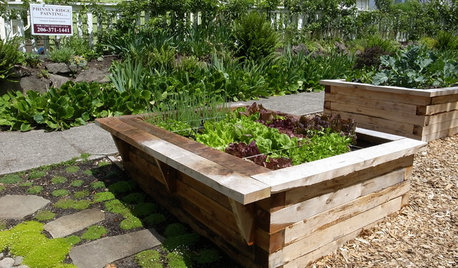
I want to create a raised bed for a line of hedges, to make the soil fast draining. The hedge line will run about 30 feet. I do not have a tremendous amount of width for the raised soil, so I would like to consider using some kind of structure to give the raised bed the maximum height in the minimum width available. Does anyone make a prefabricated wood wall that could be joined together for 30 feet on each side of the raised bed? This would construct what is effectively a 30 foot by 6 foot container, with no bottom. I am hoping that this is available as a kit, which would then give me tremendous flexibility in the actual sizing of the container.

I know that there are kits available for constructing raised bed gardens at Home Depot. I can use that as a worst case, but I am hoping to find something that is a little bit nicer quality.

A related question: for a pittosporum hedge, is the general rule to use about four inches of root depth for each one foot of hedge height? So a four foot high plant would need a 16 inch deep root, and a five foot high plant would need about 20 inches? How deep should the raised bed be, in addition to the required height for the root ball?

Comments (20)

  • PRO
    7 years ago

    Even though, with a raised bed, you will build up a "fast draining" mass of soil on top of the existing ground, the plant roots are going to extend into the native soil. Instead of going through all the bother of building this structure, why don't you just put your effort into improving the native soil some. It won't require near the effort and will almost surely look better, too. (Wooden raised beds have a tendency to become shabby looking after not all that much time has passed.)

    westes Zone 9b California SF Bay thanked Yardvaark
  • 7 years ago

    I had a redwood lumber yard build raised boxes for me. They are located in Morgan Hill. I do not remember their name, I am not at home.

    westes Zone 9b California SF Bay thanked User
  • 7 years ago
    last modified: 7 years ago

    @Yardvaark been there and done that and it has not helped at all. Please also remember that if you put "better" soil into a clay pit, all you do is trap water in your better soil and end up drowning the roots. The fast draining soil needs to be above the water line for gravity to do its thing.

    If a six foot high hedge has a 24" deep root, and I build the raised bed to 30" why should I worry about the additional root penetration to native soil when the plant is growing to eight feet tall? The vast majority of the plant's nourishment will be coming from healthy fast-draining soil, and why should I worry at all about the 20% of the roots that are in the base soil? I think plants are highly adaptive to conditions, and by the time the roots are that well established the plant will figure out how to balance it all out.

    I guess a key issue is how do the roots grow out for a particular species of hedge plant. If a hedge has invasive roots that want to grow out 30 feet from the plant, then a raised bed will probably end up creating a giant root ball and mess, particularly if the raised bed has stone or wood walls that sharply define its shape.

    My problem is my hedge has been in the ground for over five years and has not grown more than six inches higher in the entire time. Now apparently it has a probably-fatal root fungus from too much water saturating the ground for an extended period. Five years of constant experiments at soil conditioning is enough. I'm done with trying to make the in-ground planting work.

  • 7 years ago
    last modified: 7 years ago

    @JIm Mat I would love to get the name of your vendor in Morgan Hill.

    What do others thing about Juniper as a choice of wood for a raised bed rather than Redwood? Here is a website with photos of both.

    How important is it to protect the wood with some kind of water proof coating? I guess if you do this you run the risk of giving the plant a chemical burden that might stress or kill it?

  • 7 years ago

    So this hedge is already in existence? Or do you intend to dig out the current hedge and start again? If the former, adding soil over the roots will not do it any good. If you do build a raised bed using timber it would need to be very robust. I can see the sides bowing out and breaking down in a short time. Masonry or something of the dimensions of railway sleepers would be required to retain the roots of an 8 foot hedge.

    westes Zone 9b California SF Bay thanked floral_uk z.8/9 SW UK
  • 7 years ago
    last modified: 7 years ago

    @floral_uk The hedges would be removed from the ground and placed into the raised bed. The entire plant would be raised up so that the existing root structure is no longer in the ground.

    Take a look at the Home Depot product linked in my original post. It appears to be a set of concrete blocks that are secured into the earth by rebar, and then you place boards into slots in that concrete to form the sidewalls. You prevent bowing of the boards by keeping the runs between concrete structures short.

  • 7 years ago

    Morgan Hill CA. Johnson Lumber.


    I have been out of town.

    westes Zone 9b California SF Bay thanked User
  • 7 years ago
    last modified: 7 years ago

    You are transplanting a diseased, 6 foot tall, 30 foot long hedge? And presumably also bare rooting the plants (which will be an ordeal if you do indeed have a heavy clay soil) since you were discussing using a different soil instead of your native soil?

    westes Zone 9b California SF Bay thanked User
  • 7 years ago

    @ilsstep At this point I am going to set up three small raised beds with three different test soils and just grow new plants in those and see how they do over a season. Once I have a soil that I know the target plant will thrive in, I can consider possibly migrating the existing plants over.

  • 7 years ago

    Have you asked for any feedback about your transplanting plan, maybe from a professional? That sounds like it could put an incredible strain on the plants, especially if they are not in good shape to start.

    westes Zone 9b California SF Bay thanked User
  • 7 years ago
    last modified: 7 years ago

    @ilsstep for now I am not transplanting. I will put new plants into the experimental raised beds.

    Every professional I talk to gives me a different opinion so it is hard to gauge what is the truth.

  • 7 years ago

    You've been given different opinions about the health of your plants and the best way to address it?

    Or you've been given different opinions about the likelihood of your specific transplanting plan killing those plants outright?

    westes Zone 9b California SF Bay thanked User
  • 7 years ago
    last modified: 7 years ago

    I have been given opinions about both of those issues.

    I want a definitive diagnosis about what disease my plants have, if any. Every person who has looked at it gives me a different story. Some say it is a lethal disease. Some say it is malnourished and needs fertilizer. Others say it needs mulching.

    Regarding transplanting, many people express concern about whether that will harm the plants. The main thing for me though is why bother to transplant them if I do not even know what soil they will flourish in. So a better first step for me will be to do some soil experiments in side by side raised bed, using the same plants, and different soils. Once I know which soil works for those plants, I can think about transplanting the existing ones if they are still not thriving (and do not have a lethal disease).

  • 7 years ago

    Have you had the soil tested? Might be a good place to start.

    westes Zone 9b California SF Bay thanked einportlandor
  • 7 years ago

    @einportlandor I am trying to find the professional who will both diagnose the plants and test the soil together.

  • 7 years ago

    In my region you have to send (or take) the soil to a lab for testing. If you are looking for pathogens or soil contamination, a home testing kit won't do the job. Testing up front could save you time and money in the long run.

    westes Zone 9b California SF Bay thanked einportlandor
  • 7 years ago

    @einportlandor I am agreeing with you. I want a specialist to come out on site, take the soil, and that person will work with the lab of his or her choice.

  • 7 years ago

    Here's a link to the UC Davis Integrated Pest Management (IPM) publication on pittosporums. On the right you'll find links to pests and diseases that might be responsible for the problems you're experiencing. It might help you narrow it down while you search for professional help. http://ipm.ucanr.edu/PMG/GARDEN/PLANTS/pittosporum.html


    Another option is to contact your local Master Gardener office. Send them pictures (close-up, distance, etc.) and describe the growing conditions in detail. Or bring them a sample of the diseased plant and they can look under the microscope. It's a free service and could be all you need to figure it out. Good luck!

    westes Zone 9b California SF Bay thanked einportlandor
  • 7 years ago

    @einportlandor That is a very valuable reference thank you!