Software
Houzz Logo Print
westes

Define Loam Soil

7 years ago
last modified: 7 years ago

Traditional "loam" soil contains 40% sand, 40% silt, and 20% clay. There are however different types of loam. Can someone list the different types of loam soil, and what are the exact compositions of each of those types of soil? I see some people define these sub-categories as "light", "medium", and "heavy" loam. Others define using other terms. I have had a hard time finding an authoritative reference. I am not trying to just understand the concept. I want a formula for creating each type of soil.

Regarding "silt", this is fine granite, but how large are those particles? No rockery sells granite "silt". What they do sell is granite "fines". "Fines" are usually defined as 1/4 inch and smaller granite particles. Would that be silt, or close enough for practical purposes?

Assuming you want to buy sand in bulk, you rarely find a rockery selling beach sand with larger sizes targeted to horticultural use. What you do find is "fill sand", typically used as a drainage layer. Can that kind of sand be used as the sand to make a loam soil? If not, what are the characteristics of the sand that makes a loam soil.

The above are just some hardcore "soil geek" questions. I want to have a very solid understanding of loam soil.

Comments (24)

  • 7 years ago
    last modified: 7 years ago

    @gardengal48 The loam soil triangle is extremely useful, and you can understand my confusion in just reading all of these different soil names that sound very very similar.

    Is it possible to buy silt specifically, or are you saying that silt is the result of (probably millions) of years of erosion, and there is no cost-effective way to separate it out and sell it as a separate component?

  • 7 years ago

    There are different loams...loam, sandy loam, silt loam, clay loam with all inbetween variations such as silty clay loam.


    Sand ranges from coarse to very fine sand with the inbetween sizes. I belive silt starts at .02mm and smaller with the small sizes that need a microscope. Clay is very, very fine in particle size. The muddy water that you see has clay particles in suspension. Silt and sand settle out to the bottom unless stirred vigorously.


    I have changed the texture on about 4,000 square feet of garden soil to a depth of about a foot. Adding to silt loam soil...3 inches of medium and coarse sand, 3-4 inches of uncompacted 90% sphagum moss, leaf compost, horse manure with a lot of hay in it. This all has worked out to dream soil.


    westes Zone 9b California SF Bay thanked wayne_5 zone 6a Central Indiana
  • 7 years ago
    last modified: 7 years ago

    "Is it possible to buy silt specifically, or are you saying that silt is the result of (probably millions) of years of erosion, and there is no cost-effective way to separate it out and sell it as a separate component?"

    No, it cannot be purchased specifically. Unless one were able to dredge a river bottom or mine an alluvial flood plain :-) And if or when that happens, I am sure the resultant material is marketed in some form.......probably mixed together with other soils (like topsoil) and amendments to create a 'manufactured' loam. Wikipedia has a pretty good explanation of silt soil.

    ETA: wayne, you haven't changed the texture (or not to any measurable degree).....you have changed the structure. They are two very dfferent things!!

    westes Zone 9b California SF Bay thanked gardengal48 (PNW Z8/9)
  • 7 years ago
    last modified: 7 years ago

    @gardengal48 So let's assume you have a loamy soil that you like in terms of texture and drainage characteristics. You want to amend this soil with organic material to make it a decent soil for planting evergreen shrubs.

    Would something like this amendment mix of compost, sawdust, and feather meal be suitable for the amendment? What percentage of the amended soil should contain this amendment?

  • 7 years ago

    I would prefer to see bark rather than the sawdust but yes, that amendment mix should work. And no more than 25% of the mix......15% is better.

    westes Zone 9b California SF Bay thanked gardengal48 (PNW Z8/9)
  • 7 years ago

    gardengal48, Changing texture involves changing particle size...that is what adding sand does. I changed structure also.

    westes Zone 9b California SF Bay thanked wayne_5 zone 6a Central Indiana
  • 7 years ago
    last modified: 7 years ago

    wayne, you actually added 37 cubic yards of sand to this area? That is several dump trucks full! And how far down into the soil profile was it incorporated? Unless you worked into the soil a good 12-16 inches, there was minimal impact on any textural change. Otherwise it is just a topdressing of various amendments.

    There are very good reasons why all soil texts state that soil texture cannot be easily changed....it is just not economically or practically feasible to do so with a sufficient volume of material to a sufficient depth. But it is quite easy and very practical to change soil structure. And that's what most gardeners do when they improve their soil or add amendments.

    westes Zone 9b California SF Bay thanked gardengal48 (PNW Z8/9)
  • 7 years ago
    last modified: 7 years ago

    Yes, I added several dump trucks of sand. One load was 18 tons....about 15-16 cubic yards. Several smaller loads were added. I forked and mixed these things in about 8 inches deep. The resulting mix of added sand and peat moss amounts to about 12-13 inches of dream soil...soaks water like a sponge...changes texture some permenately.....great!

    gardengal48, You are very enlightened and helpful here on Garden Web. Not all of us are novices. I figured you might not let my post go unopposed....peace.

    westes Zone 9b California SF Bay thanked wayne_5 zone 6a Central Indiana
  • 7 years ago

    That must have one heck of a lot of work!! I doubt many homeowners would go to the bother :-) And I doubt it would be the slightest bit practical for the OP, who is just looking for a soil mix to fill a raised bed. Purchasing an engineered soil mix is infinitely easier!!

    westes Zone 9b California SF Bay thanked gardengal48 (PNW Z8/9)
  • 7 years ago

    When I retired, I had the time and will to go from good to excellence in the garden soil.


    I have seen foo fooing here about changing both the texture, structure, and reminerlization of garden soil. Yes, I believe in increasing organic matter by horse manure with lots of hay, leaf composts, chopped leaf mulches, cover crops, llama compost, and returning all residue.

    westes Zone 9b California SF Bay thanked wayne_5 zone 6a Central Indiana
  • 7 years ago
    last modified: 7 years ago

    @wayne_5 So far gardening has been an exercise in frustration for me. Every lesson learned takes one full season to learn. You need to iterate through three or four growing seasons until you finally understand which plants thrive in which soils in your particular location and climate.

    I am convinced that unless you invest in the creation of soil from scratch, you never truly develop an understanding of what the plant likes, and most importantly you never develop an understanding of which soil ingredients kill the plant (again, specific to your environment...the same soil in a different climate might work well).

    Soil amendments might work very well, but they leave me with a very incomplete understanding of what my final soil composition actually is, and in the end I do not feel I would have the kind of knowledge that would let me repeat a success in a different location and climate. So I like that you invested in a large soil replacement project. Hopefully you had already tested that soil on a small scale first, otherwise it could have been an expensive and time-consuming disaster if the mix had been wrong.

  • 7 years ago

    @gardengal48 I could amend 15% with this rhododendron mix, with is heavy on bark.

  • 7 years ago

    westes, Adding sand and local peat moss to good silt loam soil was not an adventure in any kind of danger. What I desired to change in my soil was making it looser with NO crusting, a joy to work, a deeper and looser structure for roots to grow and feed in...no danger. I have done extentsive reading on soils. Also I grew up on a farm and have worked soil all my life...many, many decades.

    You may want or need to start from scratch, but I don't need to do that. I have a pretty good idea what a good soil mix consists of. Below is a typical soil in lower areas. Hundreds of others on the web.

    Typical soil type around here

    westes Zone 9b California SF Bay thanked wayne_5 zone 6a Central Indiana
  • 7 years ago

    westes, Most of my garden soil was the Blount soil type. Usually 40 acres would have about 4 soil types.

    Soil type in parts of fields around here

    westes Zone 9b California SF Bay thanked wayne_5 zone 6a Central Indiana
  • 7 years ago

    You could use the rhody amendment if you like but I would test the pH of the finished mix to make sure it was not too low. I;d shoot for right around 6.0 or slightly higher.

    wayne, I am not even going to comment on "creating a soil from scratch" or a soil that can kill plants with its ingredients (unless heavily contaminated :-)) I have an idea what I think you mean but neither of those statements holds any water to a soil scientist.

    westes Zone 9b California SF Bay thanked gardengal48 (PNW Z8/9)
  • 7 years ago

    westes,

    Google 'Mason Jar soil test' if you haven't done so. It will tell you what the percentages of Sand, Silt & Clay are in your soil. You can compare that to the soil triangle and it will tell you what type/name of soil yours is.

    Here is a link, you may find better explanations than this one.

    westes Zone 9b California SF Bay thanked User
  • 7 years ago

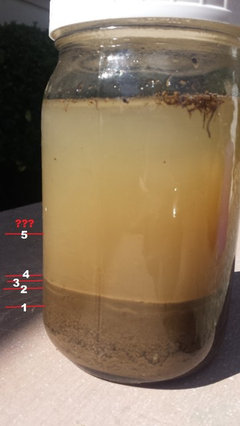
    Here is a photo of a mason jar soil test for my clay soil. It's very hard for me to interpret this test and I would appreciate some help. This photo is three days after I took the sample and shook the jar. There are a few things that throw me for a loop:

    * The clay layer between 4 and 5 is not settled. It looks like a murky sediment and probably it will take a week or more for the size of this segment to delineate more clearly.

    * The heavy sand layer up to the line marked 1 is pretty clear

    * Between 1 and 2 is probably lighter sand?

    * Where it gets incredibly confusing is there is a very thin white line above 2 and below 3. I have no idea what that is. Then we get a very thin dark line between 3 and 4. Is that my silt layer? Not a lot here between 2 and 4, and difficult to interpret because there are three layers between those numbers.

    Based on my result, what can we say about the characteristics of my soil for a hedge plant?


  • 7 years ago

    I would consider under #1 the sand, from 1-3 the silt (ignore 2, just a different color particle) and between 3&4, clay. Above 4 is just water, although there may be some small particles still precipitating out.

    I would say you have a sandy loam....50% sand, 40% silt, 10% clay.

    westes Zone 9b California SF Bay thanked gardengal48 (PNW Z8/9)
  • 7 years ago
    last modified: 7 years ago

    @gardengal48 In many of those photos online, the clay layer has a milky appearance. What would the milky layer in this photo be? That is just a different particle coloration?

    Our soil here used to be under a shallow sea. Would the mix you describe be typical for that kind of soil?


  • 7 years ago

    @gardengal48 If your reading is correct, then my main problem may just be lack of nutrients and organic matter? Mulch and fertilize might be particularly valuable here?

  • 7 years ago
    last modified: 7 years ago

    I agree with gg's assessment and was going to post the same earlier but got distracted. Clay can be many colors, blue, grey, white, brown, etc.

    So really not bad. The fact that you have clay and high amount of silt should help the soil retain moisture.

    A soil test would reveal the levels of Potassium (K), Nitrogen (N) and Phosphate (P) and micro-nutrients. Any of those get out of whack and things can suffer.

    Mulch is a great way to add nutrients to the soil but I'd be careful with the Fert until you know what your soil needs. Generally almost all sandy loam needs some N because nitrogen is volatile and tends to leach through coarse soils more than fine clay soils. Especially when heavily irrigated or lots of rain.

    westes Zone 9b California SF Bay thanked User
  • 7 years ago

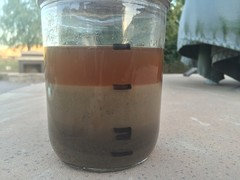
    Here is a close-up photo of my soil, which probably does not change any of the comments above but makes it easier to visualize the layers.