

Design help needed
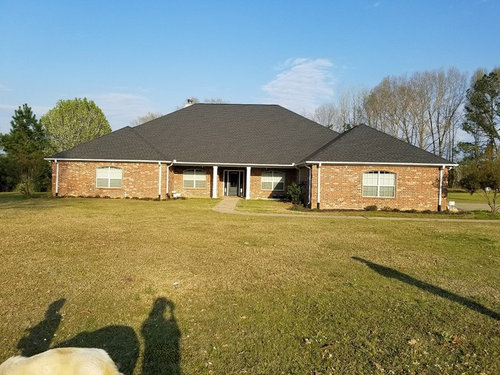
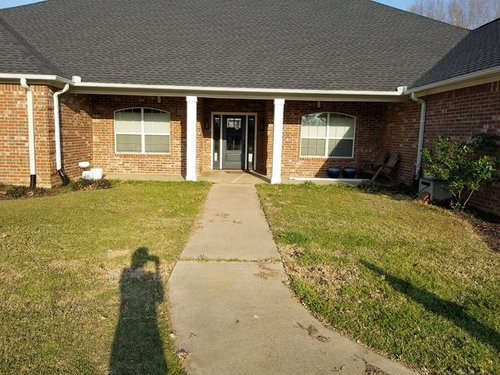
We recently beefed up our columns and installed a new front door. While I love the bigger columns I wonder if we need to add two more, one at each end of the porch?? Or are the existing two fine?
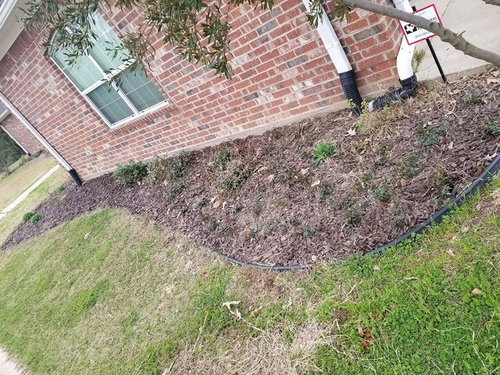
Also, I am working on the landscape and am a little lost. I planted Asian Jasmine in hopes it would create a nice ground cover and I wouldn't need to mulch every spring and fall but it appears it's being a bigger mess than anticipated. Leaves blow in and then just get stuck instead of blowing through the bed. I have a list of plants I'd like to use and that work in our area. They are of varying heights and widths. I just need help on the actual design. As of now we have pairs of Indian Hawthorns under the windows, Azaleas at the corners along with Daylilies and Sweet Olive at the ends.
I am very open to design help and recommendations.
I am also wondering if the curved beds are best or if we need to square them off to make them more appealing.
We are in Zone 8, full sun on the front of the house. I have done a lot of research on the plants that I'd like to and can use I just don't know how the bed should look. We have a large slope on the side of our property that we could move the Jasmine to if we need to remove it from the bed. I'm fine with spreading new mulch out, I actually prefer mulch to groundcover but thought a groundcover would help with cost and weeds. Thanks in advance for any sugestions.


Comments (90)

mcbrayer0814
Original Author7 years agoAwesome! Thanks for all the help. I will remark lines to accommodate the trees better.
mcbrayer0814
Original Author7 years agoWould it be possible for someone to replace the corner shrubs with Junipers? I'm trying to narrow down my plant selection and having a hard time visualizing a more formal shape. If I don't like the pyramidal shape of the Juniper, against the house, than I can start to lean in another direction.
Related Professionals
Oxford Landscape Architects & Landscape Designers · Cleveland Landscape Architects & Landscape Designers · Amarillo Landscape Architects & Landscape Designers · Laconia Landscape Contractors · Denver Landscape Contractors · Poughkeepsie Interior Designers & Decorators · Laredo Architects & Building Designers · Champaign Architects & Building Designers · Amherst Architects & Building Designers · Lawrence Architects & Building Designers · Elmira Architects & Building Designers · Eugene Architects & Building Designers · Olympia Architects & Building Designers · Jackson Architects & Building Designers · Beatrice Kitchen & Bathroom Designers PRO7 years ago
Are you asking if it's possible?... or if it's good? IMO, affirmative on the former and negative on the latter. What is a "more formal shape"...? The dilemma is not clear.
mcbrayer0814
Original Author7 years agoI think "formal shape" when there is a definite shape.

This is what comes to mind when I think "wild" or unmanicured .

I like both looks, in the right spots. I'm not sure if the corners need a more defined shape specimen or a different look. I know I can prune almost any shrub into a formal shape (and that most shrubs need some pruning) but I don't want the high maintenance of maintaining that shape throughout the year.
- PRO7 years ago
I think the problem is that your plan can not yet be understood. At the beginning, a person gets a vision of what they want the yard to look like, that probably starts with a perspective picture. But then it must be converted into a PLAN (which is similar to an aerial view ... looking straight down at everything. This is how one calculates out how close one thing is to another, and how things are arranged. Understanding it, lets a person know what there is room for, and suggest what forms would work in order to fulfill the goals. I'm guessing that you might be trying to create your plan as you go, directly on the ground. Then you are stuck with trying to figure things out while the plan is still in flux. It would be better to do the plan on paper (where erasing is easy) and resolve the issues before trying to install it. If you had the plan on paper, you could photograph and upload it so we could see, and then it would be easy to give you feedback. Without it, it's a mystery. "At the corner" of the house is not a single pinpoint. I'm not sure exactly what plant position you're asking about so an answer could just as well be wrong, as right. The plan would clarify it.
mcbrayer0814
Original Author7 years agoI'll see what I can draw up and be back once I have it on paper.
mcbrayer0814
Original Author7 years agoI created something that MAY be helpful? I've never drawn out a bed design so just trying to go off of others I see online. I'm not sure how to depict the correct shapes but I have sized them to their mature widths.

- PRO7 years ago
Your attempt at drawing a plan is BEYOND valiant and completely accomplishes the goals! I would suggest, though, that it's not necessary to give each plant a different symbol, and that plain circles work well enough, especially numbered and keyed, as you did. If circles are larger, they'll read as trees. If they're smaller, they'll read as shrubs. For perennials, I think it's better to draw the outline of their whole group, as usually they are next to their same kind. (Here, where you are showing them as separate, distant plants, that wouldn't work ... but I also question using them in that way, thinking it is inferior.)
One thing to note ... when a plant height is stated as 4'-6', it really means 8'-12'. Even 4'-6' would be way beyond my tolerance threshold for the spot where you have the left side Lorapetalum. If it's in front of a blank wall, I think it will work at the right side, as it is not too close to the porch area.
We all have a tendency to want to add flourishes, but the slight triangular pattern of the indian hawthorn is going to be moot. If you want it, it is so slight that it could easily be accomplished simply by trimming, presuming you are not trimming as three separate balls, which I would highly not recommend. It would be better IMO to place the plants in a line that is centered with the bed, so there is more space for the back half of the plant to grow toward the house. These spread enough that it will be no trouble for them to fill the space.
What you're doing with blue point juniper, to my thinking, is adding a negative. It's not possible for me to say how to adjust it, unless it was to adjust it right out of the plan. You will probably need someone else to tell you what you want to hear, as I can't do it. to my thinking, house corners are attractive architectural features, so I don't want to obliterate them from view. At the outside house corners, where you have blue point and sweet olive, I can't see that working at all. It would be one or the other (which I would, of course, ditch the BP.)
Presently, you have two trees off of the house corners. Is the one at the right a sweet olive that you are keeping? ...or is it something to be replaced? It's existing position seems good for a small tree. The plan seems to show it closer to the house. At any rate, whatever you end up with, I would have at least that far from the house. And I would match that distance away from the house over off of the left corner ... even if that necessitates a larger bed at the corner.
I don't get the "perennial" placement below the corner trees. Why wouldn't you want a solid bed of something? (This question applies wherever perennials are shown.)
To answer some of these questions, I'm sure you'll need to revisit the vision you are using. I'm not sure which one that is, or if it exists in any of the above illustrations.
mcbrayer0814
Original Author7 years agolast modified: 7 years ago
This is the picture I'm kind of following.
Yardvaark, thank you! I was hoping I could create a picture well enough to be understood.
The corner shrubs (BP) are more for covering the abundant amount of downspouts on the front of the house. I understand where you are coming from but I would much rather have a shrub draw my attention than downspouts. Our gutters are in great condition and I don't want to remove a few "extra", patch the holes and then have issues with that area that was patched. My solution is to conceal....so many commenters have stated that their eyes are drawn to all the downspouts immediately.The shrubs at the base of the trees will be planted to grow in to one another and just create a circle, not separate shrubs. The Sweet Olives are currently there and will stay. They are both a good distance away from the house and I did extend the left bed to accommodate it being in the center.
I will replace the left loropetalum with a smaller option, maybe a Concorde Barberry. There is nothing on the right, interior wall except a waterhose box and the current placement of the loropetalum isn't close to the porch.
I placed the perennials around the shrub for just an idea of placement in that area.

- PRO7 years ago
I would not crowd the house corners with the plants I'm showing moved (red arrows). It doesn't look good to let them hang over, and it also doesn't correlate to the vision you are using.
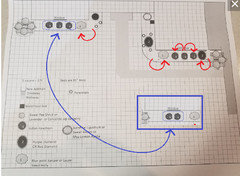
If the finished product of shrubs below windows is three separate balls as shown in your vision, you need to space them out farther. If you are trying to underscore the window with a small hedge, you could do this with two shrubs (inset picture) unless you are looking for a broad underscore. At any rate, shrubs will grow; don't pack too tightly together.
mcbrayer0814
Original Author7 years agolast modified: 7 years agoI wasn't thinking about overhang on the corners when I placed those shrubs but it makes sense.
I'm pretty sure I won't want to keep up the maintenance of three separate shrubs under the window so I will space them accordingly to grow in to a small hedge, not sure if I like the two or three size.
We have plans elsewhere this weekend so should hopefully start on removing the sod next weekend and preparing the edge. We will move on from there, weather permitting. Looks like we may have a wet April.
- PRO7 years ago
"... not sure if I like the two or three size." It depends on rate of growth and patience level. I have a lot of patience and seem to be able to spur fast plant growth. And I don't like things getting to big, causing me more work. So for me it would be two. I had a pair of windows that I put 3 1 gallon Plumbago below. OMG, the first year it was up to my neck. two years later I took two plants out and did the job with just one.
 7 years agolast modified: 7 years ago
Choice of particular species and cultivar of shrub is important. For instance, in this area if someone wants a Hydrangea paniculata under a window, one of the smaller cultivars such as Bobo at 4’ or Little Lime or Little Quickfire at 5’ might be a better choice than Limelight or Quickfire, both of which grow to 9’ and regrow quickly from annual pruning. I am not suggesting that you plant this species, just that you choose what you plant carefully to minimize the work you have to do to keep it the size you want. We see a lot of overgrown plants here on the LD forum that were planted in inappropriate spots for the size they would grow to as opposed to their size at planting. I typically look up plant size on a botanical garden website since plant tags often give a 5 year size, and many plants will get considerably larger. Doing good quality pruning is a skill that takes time, and there are other tasks and activities that I much prefer to spend my outdoor time enjoying.
mcbrayer0814
Original Author7 years agoNHBabs, yes! There are plenty of other activities and and chores I would like to and have to do other than constantly pruning shrubs to a desired size. With that said I may need to rethink my Indian Hawthorn and move them to another area of the house that doesn't have windows or possibly a grouping of trees. I have been constantly researching plants that work in our area and reach my desired height as a max.
I think I will stick to two shrubs under each window instead of three. Now back to finding a good evergreen that will stay around 3-4 ft.mcbrayer0814
Original Author7 years agoHonestly, I can't remember if they are dwarf or not. I will have to check with the nursery I bought from to see which they carry. Hopefully I bought the dwarf.
mcbrayer0814
Original Author7 years agolast modified: 7 years agoCould someone digitally replace the taller shrubs at the house corners with pyramidal shrubs on this photo?
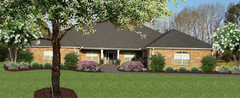

I'm trying to picture the change in my head and it's just not working. TIAmcbrayer0814
Original Author7 years agoWe are also replacing a tree that we lost in the yard. The tree will be about 30-40 feet from the house and 15-20 from the walk and driveway, right side of picture. We are currently looking at Red Bud, Yellow Poplar, Red Maple, and Sweetbay Magnolia as a replacement. I've read several articles listing pro's and con's of each but wanted to see if anyone had experience with these.
I am really interested in the Yellow Poplar (tulip tree) but read that it's root system is extensive and can cause issues with pipes and concrete. I like Magnolias but read that they can have a lot of surface roots.
Anyone have any experience or advise on these or another tree that would be nice? I am looking for a moderately sized tree that can provide shade during the hot summer months. Not necessarily shade to the house but for us and guest while we are outside for birthday parties and other gatherings.- 7 years ago
Magnolias and maples can have surface roots. With that kind of distance from your paving, I don’t think roots will be an issue for anything but the lawn, and all three may need mulch or groundcover instead of grass under them when they have grown enough to create shade around them as well as use more water.
I haven’t particularly noticed shallow roots on redbuds or the immense tulip tree at my workplace.
mcbrayer0814
Original Author7 years agoNHBabs, I was thinking of adding a bed around the tree anyway. That way we could avoid dealing with surface roots all together. I just want to avoid any tree that people have had to relocate due to damage caused by roots.
- 7 years ago
Root damage will be from a tree planted too close. At 15’-20’, it won’t be an issue IME. 5’ from the walkway or drive, it might.
- PRO7 years ago
At those distances from house and paving, I wouldn't be worrying about root issues with the tulip tree. You can pretty much hear stories about any tree and roots, if that's the tree that someone has near a walk or drive. Any of the standard, popular shade trees would probably work for you. Redbud seems too small for your purpose in your large lawn.
mcbrayer0814
Original Author7 years agolast modified: 7 years agoWe received several quotes to have the edging installed but after hearing the labor cost and no one wanting to use the material I want my husband decided he'd deal with the sunburn and do it himself. We started late this past weekend so should hopefully have edging completed after this weekend. Will work on getting shrubs and plants once the border is set.
I've researched and have physically looked at a lot of plants. I'm having a little trouble narrowing down my selection. Anyone have any experience with Blue Point Juniper? Would be full sun, west facing( 1's in the design I added). I have several other options but I really like the low maintenance aspect of the Juniper. I want a shrub that will fill out well, stay around 8ft max, help cover the downspouts, and be low maintenance.
- PRO7 years ago
Leave the gutters white as part of the trim. Paint the downspouts the color of the brick and it will instantly be better. You won't need to use plants in a strange way so they will cover the downspout. I can't answer about blue point. In general, I don't like trimming juniper so don't think of it as low maintenance, unless growing in a way that it doesn't need trimming.
mcbrayer0814
Original Author7 years agoWould you know how to get a color close to the brick color? Can I take a spare brick to have a computer color match it?
- PRO7 years ago
Your brick is a combination of lots of colors. What you'd be looking for is a color that represents the combined average of them all, which would be hard to get by computer matching. The computer would match one small spot and ignore the rest. I'd go get likely paint chips from wherever you get paint, line them up against the wall and start narrowing down the ones that seem to blend in best with the overall brick. You'd need to stand at a distance to assess them accurately. When you paint the downspouts, you'll be staring at them thinking they don't look exactly like the brick. That's because it's one average color, not a camouflage scheme, and because you're staring at them. As soon as you go about your life ignoring them, at some point you'll become aware that they more or less disappear into oblivion. If I'm wrong about it you can paint them white again.
mcbrayer0814
Original Author7 years agolast modified: 7 years agoWhile we are at a standstill I'm working on plant selection. Anyone have experience with Blue Point Juniper, Dwarf English Laurel or North Pole Arborvitae? Even considering Loropetalum Purple Diamond.
I am waiting to paint the downspouts after I plant to see if the shrubs distract away from them enough to skip painting.- 7 years ago
Quite a while ago, you mentioned removing couple of leaders that were very prominent and sealing up the gutter. Please don't do that. If you gutter system was professionally and carefully installed, each one of those leaders needs to be there. The gutter is pitched to them for the water to flow out.
I decided to see if I could get a good color match for your leaders. I used the close-up picture for the sample. Hopefully it is close to reality.
I used Benjamin Moore's color chart of reds. Ironically, the best match is called Colonial Brick. I kid you not! The little lines in the lower right corners are color samples from the red bricks only. One sample was almost an exact match. Hope this helps push you to painting those annoying white leaders. Then you don't have to cover up the corners on your house.

- PRO7 years ago
It would not be accurate to color match by remote because it's dependent on an individual camera's interpretation, lighting, and each monitor displays colors a little differently from others. Also, you could not match the brick itself but have to match an average of the overall wall, which has a lot of grey mortar and various other brick colors. In the above example, the color would need to be more grey/taupe than what is shown.
mcbrayer0814
Original Author7 years agoSo the section my loving husband poured did NOT turn out well. Not at all. He can build me anything out of wood or metal and repair like a pro but concrete is apparently his nemesis.
We received a reasonable quote today from a smaller concrete company that we have decided to use. They will start work the week of the 13th. Will be back with photos once that is completed and forms are removed.- PRO7 years ago
Are we talking about edging? If there are curves involved, concrete would not be my first choice to recommend for DIY. If it's straight with 90* corners, not so bad. For DIY, brick or pavers, sailor course, would be a better choice. It can make curves (not too tight) and straights. But we don't really know what you're doing.
mcbrayer0814
Original Author7 years agoYes, concrete edging. We DIY a lot but have realized concrete work needs to be hired out to the pro's. This company does great work and hopefully we have a beautiful finished product in a few weeks.
mcbrayer0814
Original Author7 years agoWhile searching plants for the refreshed beds I came across these https://www.thetreecenter.com/cherry-laurel-english-laurel/
The site says they are 4-6 ft tall but when I search the latin name I'm finding that they are the very large Laurels that grow well over 16 feet.
Has anyone heard of this variety or know of a Laurel variety that stays under 10 ft?
mcbrayer0814
Original Author7 years agoBorders being poured tomorrow, yay! We finally have a week without rain so project is good to go. With the edging being completed I can finally move forward with adding some plants. I have a more formal shrub and a more "natural" to fit two looks. I'm torn between which look I like more. Formal vs. informal. Opinions on which better suite the house?

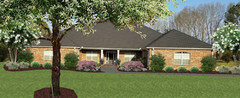
- PRO7 years ago
Keep in mind that in order to keep either of these shapes -- since they are both shrub forms -- that you will end up needing to keep them pruned to size without fail. If the pyramidal shape is juniper, evaluate how much you (or whoever is doing it) likes to prune junipers. Also, it is not a plant that takes well to getting back in shape if it is allowed to grow beyond its bounds. I don't know what you'd be using for the more oval shape, but likely it would be more amenable to a super hard pruning if you "accidentally" let it get out of shape and too large. The speed at which plants grow will also matter to whoever is doing the pruning. Also, keep in mind that ALL shrubs must be pruned wider at the bottom than at the top or you will inadvertently be turning them into tree forms (with raised canopies.)
mcbrayer0814
Original Author7 years agolast modified: 7 years ago
Selecting shrubs that meet my wants/needs is proving to be 100% harder than expected.The pyramidal forms are Blue Point Juniper and the other would be a Gardenia, Cleyera or a type of Holly that does well in my area. The pruning would be performed by me which is why I am looking for a shrub that is low maintenance in the pruning area. I don't want to be out there weekly to make sure I don't ruin it by letting it get too large and cutting back or that it's just plain ugly if it grows for several months without attention.
Almost every shrub someone suggests just isn't appealing to me so narrowing my selection is been a task.
On a happy note forms are being built in a few hours and hopefully they will pour my the concrete as well for my borders.
- PRO7 years ago
There ARE a lot of minute details that ultimately go in to the creation of a complete landscape installation. Most of os who do (or did) it for a living had many of the same struggles of learning about nuances at the beginning of our careers. Then we begin to see patterns of what works and what doesn't, gradually learning to eliminate landscape problems before creating them. For the DIY-er it can be the same as us starting out ... lots of frustrations. On the other hand, there are some landscape architects/designers who never do landscape maintenance and do not have a clue how much more maintenance they're adding with certain configuration schemes. (If you noticed, I limit shrubs to specific places and numbers instead of plastering them solid across the entire front of buildings. This saves a lot of trimming. Also, it eliminates the smothered-in-shrubs look.)
Pruning won't be weekly, but likely monthly-ish.
mcbrayer0814
Original Author7 years agoYes, very frustrating to find plants that won't cause extra work or headache in the future. I drive around now seeing plants everywhere that I know require constant maintenance and wonder why they were even planted in the beginning.
Of course a commercial landscape has maintenance crews or landscapers that appear weekly or bi-weekly but I am very against hiring anyone to do something I can do myself. Don't necessarily want to do but can do myself.
Speaking of pruning. Any advise on how often Cleyera varieties would need pruning? I have found a few newer varieties that don't contain the red or bronze and am considering those.- PRO7 years ago
Plant growth -- cleyera or anything -- depends on so many factors that it would be impossible to predict without knowledge and observation of specific variety and situation
mcbrayer0814 thanked Yardvaark mcbrayer0814
Original Author7 years agolast modified: 7 years agoEdges have been poured and are fabulous. They are scheduled to come back this weekend to smooth the fronts but again we have rain in the forecast. Fingers crossed.
Once they are smooth and final I will need to move some plants around for better spacing and add the remaining plants and get a picture of the final product.
Cardboard and mulch were in place to block weeds while we waited for the rain to stop and work to begin so the below picture is definitely not end result.
Also, now down to two options on the taller shrubs flanking the windows, 1's in earlier sketch. How tall should these shrubs be? One option reaches 6 ft max, 3-5 width and the other is 10 ft max, 5-6' width but easily pruned to maintain desired size.
- PRO7 years ago
The beds look large enough to hold shrubs so that's a promising start.
When you say "one option reaches 6' .... etc." ... if you are quoting published sizes, keep in mind that those are snapshots in time (at 5 years maybe, I don't recall.) But they are not the ultimate size of a plant. In other words, figure that ultimate sizes might be something closer to double the published size. There is much variation in the way people manage plants and the #1 determination of size, besides genetics, is how a plant is pruned. For example, many Bougainvilleas grow in the neighborhood of 20' to 30' height. But I see them everywhere kept at 2'-3'. Still, I suggest trying to get a reasonable size match to minimize the pruning you'd do.
mcbrayer0814 thanked Yardvaark mcbrayer0814
Original Author7 years agoThink I may stay with the smaller option. If I'm outside pruning is not how I want to spend my time.
mcbrayer0814
Original Author7 years agoWaiting for a storm free weekend to finish the final details before posting pictures. We are having crazy storms and they seem to always be part of or all of the weekend. This weekend looks clear so if it stays that way I will finish up my mulching and post pictures of the completed landscaping.
I am ready for this project to be done.- PRO7 years ago
- "... and post pictures of the completed landscaping." We'll see how closely you followed Doug's idea.
mcbrayer0814
Original Author7 years ago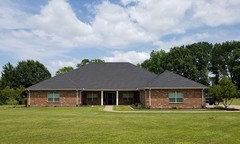
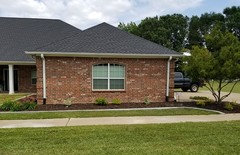


Final product, well as far landscape goes. I am still considering shutters and possibly painting downspouts. Since our weedeater broke and the small engine shop was closed this weekend our walkway is a bit sloppy.
I wish I could have found mature plants with more growth but no such luck. I am very impatient but I hate paying a higher price for jut a few more inches. Now that I see the third photo I am considering moving the Loropetalum closer to the hose box to even out the space a bit.
I can't wait to see how everything grows and fills out in the next few years.Thanks to everyone for the input and if we do make any other changes I'll be back with more updates.
- PRO7 years ago
I'm sure you're happy to be finished! The border formalizes and dresses up the bed and, in turn, the house. I'm glad to see its lines coordinate with the house. The bed is probably deeper (front to back) than you otherwise would have made it, had you not come here, and that should work out well. (You may want to add a little topsoil along its outside edge to raise the surrounding grade in order to make the border appear inlaid -- like a mowing strip -- rather than raised.)
Congratulations! And thanks for the pledge of updates. They're always nice to see.









Dig Doug's Designs