Software
Houzz Logo Print
maackia

Aesculus pavia (Red Buckeye)

7 years ago

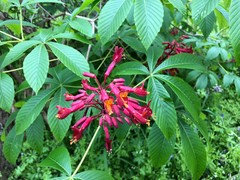
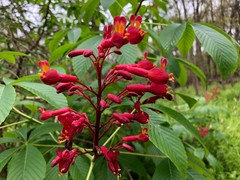
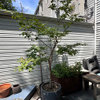
This is small native tree is so pretty, I wonder why it isn’t seen more often? I’m sure there are good reasons, and my attempts with red buckeye have been less than successful, but I assumed this was due to our sandy soils and harsh winters. It’s often listed as z4, but I have my doubts. One is still alive, but it’s on life support and I should move it, either to give it a better chance at survival or kill it.


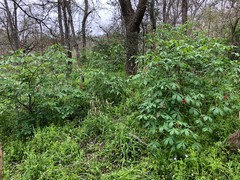
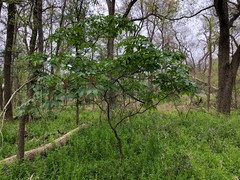
This tree was almost weedy in parts of east Texas, which was a first for me. I’ve seen a planted specimen here and there, but not in the wild. What’s your secret for growing red buckeye?

Comments (24)

  • 7 years ago
    last modified: 7 years ago

    Wow, looks like an awesome native! How far west in Texas does it naturally range?

    Says here it extends west to Central Texas, although I have never seen (or at least noticed) this tree before?!

    maackia thanked blakrab Centex
  • 7 years ago

    Blake, it would be in deep moist woodlands (from what i see in Arkansas)

    maackia thanked dbarron
  • 7 years ago

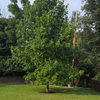
    I noticed them being abundant east of San Antonio. These pics are from Palmetto SP.

  • 7 years ago

    Provenance seems to be an issue...I had one from seed collected in Arkansas (from a cultivated tree) and it died to the snow line every 3-5 years. My other one (original source unknown) is perfectly hardy in contrast. I recognize that is not overly helpful except to say that east Texas Red Buckeye is probably notably less hardy than Red Buckeye from Illinois or Tennessee.

    maackia thanked Smivies (Ontario - 5b)
  • 7 years ago
    last modified: 7 years ago

    If it's relevant that cultivated tree could have been Aesculus x carnea. Unless you saw it to have the correct foliage for A. pavia, or the hybrid would be expected to be hardy in Ontario anyway. For instance the supposed US National Champion A. pavia could clearly be seen in a photo circulated some years ago to be A. x carnea. Which explained why it was so much bigger than usual for A. pavia.

  • 7 years ago

    Based on what I witnessed, they seem to be very shade tolerant and have a strong preference for moist, rich soil (i.e. bottomlands). It's no accident they were growing in an area populated with Dwarf Palmetto (Sabal minor).

    Will, this is a long shot, but do you know the provenance of your Red Buckeye? There's a strong possibility I'll be visiting Possibility Place.

  • 7 years ago
    last modified: 7 years ago

    The more horticulturally appealing SE US natives are often characteristic of prime habitats in the wild, sometimes including in addition to deep fertile soils sheltering rock formations and proximity to streams.

  • 7 years ago

    I'd have to ask the grower...I believe he gets seed from Sheffield's (or perhaps Schumacher) but it's been 7 years or so. Also possible that's it's from his own tree which might mean it's either straight A. pavia or hybrid with A. glabra, flava, or sylvatica. Definetely not x carnea though. I'll know when it finally flowers.

  • 7 years ago
    last modified: 7 years ago

    Smivies - does the foliage on your tree still look good by late summer? Red buckeye is apparently quite susceptible to leaf issues - this webpage (from TX) says "anthracnose and leaf blotch habitually cause leaves to fall off by the end of the summer. Red buckeye will suffer leaf scorch in sunny, southwest exposures"

    Here's one that looks promising for northern areas: Mystic Ruby Buckeye

  • 7 years ago
    last modified: 7 years ago

    Aesculus x bushii characteristically combines the yellow-green and crimson flower colors of the two parents into red, pink and yellow individual flowers. A combination which the Mystic Ruby ('Aaron 1') appears to have, in the photos at the above link. So to enjoy that one a body must like that feature, and realize it is not going to be a nearly solidly red buckeye.

    (There is also an A. pavia var. discolor that produces red and yellow bicolored flowers. With a cultivar 'Koehnei' of it that marries rose-pink to yellow-orange).

  • 7 years ago

    Good point, I should have clarified that Mystic Ruby is a hybrid.

    Currently there is no National Champion Red Buckeye per a search of American Forests' National Register of Champion Trees.

  • 7 years ago
    last modified: 7 years ago

    As I understand it AF has something like a routine where listed champion trees get automatically dropped form their listings if nobody remeasures them at predetermined intervals. I'm aware of this because one of my local friends is the WA coordinator for AF. Otherwise I have no current information about the red horse chestnut they were calling a red buckeye. It is/was located on the other side of the country from me.

  • 7 years ago
    last modified: 7 years ago

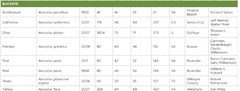
    That must be the issue. Co-champion Red Buckeyes were listed in the Register as recently as 2014 (both in Roanoke VA):

  • 7 years ago

    Spot on with the foliage assessment.

  • 7 years ago

    There’s probably more suitable small, native understory trees that have an amazing scarlet flower that I should try. If you know of any please let me know. ;)

  • 6 years ago

    Nice specimen. Is that in a public park?

  • 6 years ago

    Beautiful

  • 2 years ago

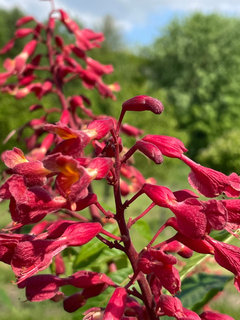
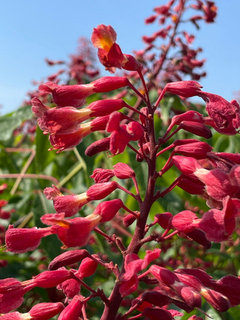
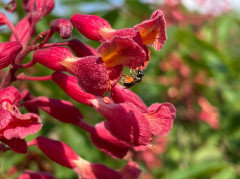
    Some photos of the flowers on one of the few A. pavia I'm aware of in my local area, from earlier this week (5/21/24)


  • 2 years ago

    I just purchased one of these from Wilson Bros Gardens, where I also scored an Acer carpinifolium. They will both be planted in a highly protected, part-shade area where an old shed was recently removed. I'm somewhere between cautiously optimistic and excitedly pessimistic.

  • 2 years ago

    I'm going to send you a 5 gallon bucket of seed from the plethora of A. pavia growing at the Valley and in Louisville. I suspect you will then be superfluously apoplectic.

  • 2 years ago

    I hope so! Are you promising my woodland will look like what I saw at Palmetto State Park? Mmm….

  • 2 years ago

    Of course I promise! What you saw in TX is easily 30 years old, and is the culmination of hundreds of not thousands of seedling A. pavia duking it out in the great competition of life.


    Plant. Wait thirty years. Observe. Pay off your bets.

  • 2 years ago

    Ha! That’’s good. Call me skeptical, but I’m not nearly as optimistic as you that my dry upper woodland will be as hospitable to RB as the conditions I found in Texas. On the other hand, there’s no harm in trying. A 5-gal. pail is a lot of seeds.