Software
Houzz Logo Print
blueberrybundtcake

Solution for paint that won't cure

7 years ago
last modified: 7 years ago

Hello,

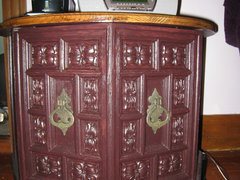
I rescued a cabinet that was in a sad state, and I'd love how it came out ... if it weren't still tacky. We decided on mostly paint with the top trim stained/varnished where the slate top sits into it. I ended up picking a Sherwin-Williams color and followed their recommendation to use their All-Surface Enamel paint. Several months later, it still hasn't cured, and I'm tired of having a cabinet I can't put things in with wax paper hanging out of it to keep the door from sticking shut.

I need suggestions of how to make this piece usable as a cabinet instead of just a table. (I need the storage!) I'd really rather avoid stripping it, as it didnt strip well the first time and has a lot of nooks and crannies in the door panels. Would varnishing the whole thing solve the problem?

Further projects have been done with Benjamin Moore paint and cured wonderfully and quickly. I will not be using Sherwin-Williams paint again.

Thank you,

BlueberryBundtcake

Comments (11)

  • 7 years ago

    You will need to strip the paint again, and repaint. Seems like you either had bad paint, or poor prep.

  • 7 years ago

    It could be the paint is overloaded with colorant. What color is it? Also, have you asked Sherwin Williams what you are supposed to do?

  • 7 years ago
    last modified: 7 years ago

    It's SW7630 Raisin. It used an ultra deep base and apparently has an LRV of 3. Does the color make a difference in curing?


    This is the paint:

    https://www.sherwin-williams.com/homeowners/products/all-surface-enamel-latex-base

    This is the color information:

    https://www.sherwin-williams.com/homeowners/color/find-and-explore-colors/paint-colors-by-family/SW7630-raisin#/7630/?s=details&p=PS0


    I havent had had a chance to get over to Sherwin-Williams since I decided I was done waiting for it to cure ... or not. I figured I'd ask the Internet in the interim. I'm guessing they'll recommend that I strip and repaint.

  • 7 years ago
    last modified: 7 years ago

    My other project that cured quickly was prepped pretty similarly: originally stripped with the same stripper and cleaned the same after. The materials on this one are inferior, but they told me I didn't need to prime with this paint ... I asked ... maybe I shouldn't have believed them. They were only done a couple weeks apart in an air conditioned house, so environmental situation was pretty similar.


    Is the material of the piece going to affect the curing? I could paint something random to see if it cures, but is that going to give me useful information on whether repainting with the same paint will cure on the cabinet?


    This is my other project's paint, by the way, in case it's relavent:

    https://www.benjaminmoore.com/en-us/interior-exterior-paints-stains/product-catalog/awiap/advance-interior-paint

    Other project color:

    https://www.benjaminmoore.com/en-us/color-overview/find-your-color/color/af-585/wisteria?color=AF-585

  • 7 years ago

    Here's the poor little piece:

    I pulled the wax paper for the picture ... but you can see where I had sticking from when I tried without (tan line on the bottom just to the right of front edge).

    It looks much darker without the flash ... more like the tone of the sweater hanging to the right but, you know, more raisiny.

    The legs and top rim (stained) are actually wood ... the bottom is some sort of particle board, the sides are probably plywood, and the door is something plasticky. If it was just the door that wasn't curing, I'd say I did it wrong, but surely one of these materials should have cured???

  • 7 years ago

    That's the problem, the front is plastic and you used enamel paint. I don't why they told you that you needed enamel, latex would have been fine. You absolutely should have primed it first. I don't see any other solution other than to strip the paint off.

  • 7 years ago

    Enamel just means that the paint forms a protective skin on top of the paint when it's dry. Any washable paint is an enamel technically. That all surface enamel just looks like a regular acrylic paint to me, though I don't know for sure since I use the Pro Classic for projects like that. I think your problem is the color though. Very dark colors take longer to dry and in this case seems like it will never dry. If you go into the store you bought it from, you may get some free product at least unless they tell you it is your fault somehow.

  • 7 years ago

    So reading the Sherwin-Williams and Benjamin Moore websites, it seems like my issue is what's referred to as blocking adhesion and is a latex paint issue. It makes me wonder why the paint store recommended a latex based paint when I told the guy that it was a cabinet. From what I've read further, I should have gotten a latex paint with high-blocking resistance or an alkyd paint to avoid this risk.

    I've also realized that I did paint something else with this paint ... I painted the back piece of some wood pegs and then, as it happens, varnished over the whole thing because it was easier than trying to just varnish the stained pegs ... It's firm and not tacky or anything.

    The suggested solutions for blocking on the websites is to de-gloss and paint over with a paint with better blocking resistance ...


    So I'm thinking my varnishing solution might be effective?

  • 7 years ago

    I usually grin slyly when I read about these kinda issues.....

    First off- "Enamel". The term itself means NOTHING. Never did. It's been used as an advertising term since widespread-use of OIL-based paints started 50+ years ago. Oils/Alkyds usually hardened-off ("Cured") pretty well. So, when the marketing-machine started long ago, the word "Enamel" was chosen! The idea was to make the Oil-based paint film sound as hard as "the Enamel on your teeth"!!!

    When "Water-based" paints became widespread much later, they instantly became "Enamels" too!! Hmmmmmm......how can this be?!??!?!

    ;-)

    Secondly- Your paint IS Latex/Water-based. Oils are becoming pretty scarce due to the VOC-regulations. And....fewer & fewer people even know what they are anymore. It's an equivalent argument to the "explaining a rotary-telephone" to anyone under 30 years old! (I'm 57...) Latexes don't get as hard as Oils. It's both a Plus AND a Minus.

    YOUR Issue:

    High-Colorant-Load colors take a lot longer to "Cure-through", relative to a White/Light color. If a customer is gonna paint a bookshelf a "Deep" color these days, I'll usually recommend a "Cabinet & Trim"-Class paint. These versions have a Polyurethane-like component to them. They don't "tack-up" so fast, giving you more stroking-time. Hardness & Leveling is a little better too.

    I'll also tell them to apply 2-3 somewhat lighter coats. It'll slightly reduce Cure-through times for a dark color. THEN.....I tell them to put it away for 2-3 WEEKS before putting anything on them.


    >>> Your problem has NOTHING to do with whether it was primed or not!!

    * For such a textured piece, your coats may have been a little too thick.

    * Deep colors applied too heavily may NEVER really harden-off.

    * To be honest......I would strip it, sand if desired, prime to a medium-GRAY....using SPRAYPAINT. Then....find a spraypaint color, & apply many LIGHT coats. It'll turn out beautiful!

    Faron