Software
Houzz Logo Print
bastet984

Warm solutions for concrete basement floor with mild water issues

7 years ago

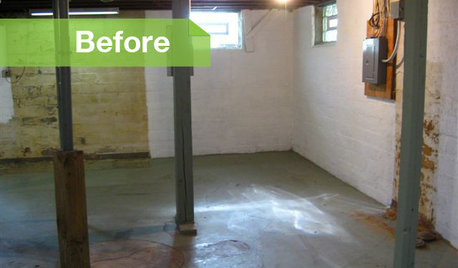
We have a 1978 house with a walkout basement that is poured concrete. We are located in MN, so we get all the seasons - very cold, very wet, and very humid. There is a living room and an office for a total of 380 square feet. I need to figure out a flooring solution, but the requirements are: it needs to be as WARM as reasonably possible (again, this is MN and these rooms will be my office 5 days a week and a playroom for our kids) and it needs to hold up against possible moisture.


We have a sump pump in the laundry room that runs frequently during the rainy months but we have not historically had many water issues. However, we recently discovered water in the office when I pulled up the (5 year) old vinyl click tile. We figured out it was primarily an issue with the sump pump, which we have fixed and has kept the water from accumulating as much. I also painted two coats of Drylock masonry waterproofer.


However, the flooring contractor came by and won't install the either the Dricore or the flooring because his concrete moisture meter is reading a "10" in some areas of that office floor. He wants to see it 6 or below. I bought a dehumidifier and after 8 hours the floor is now reading an 8-9 in those areas, but because I know the issue is coming from under the slab, I do not believe this is much of a solution. It is not coming from the walls -- the water is only in the middle of the floor and clearly was coming from some cracks and general hydrostatic pressure.


I also do not want to just lay the vinyl tile directly on the concrete, because we had that in the office and I had a space heater on my feet even in the summer when it was 90 degrees outside - COLD and hard. And it traps water because it doesn't breathe. I refuse to do carpet (or carpet squares) because we have a cat with urine issues and two office chairs that roll around and I think carpet squares are ugly. I have read a lot about how Dricore causes mold issues if you don't have the moisture issues under wraps, so I get that it's not as popular with some flooring contractors. But logically it seems like the option that should work the most.... an underlayment raised off the floor and a hard base to lay the LVT on?


Does anyone have advice on a good sealer that will prevent moisture from coming up in our slab and that could go over the sealer I already tried? Or a flooring solution that can live with the moisture but still be reasonably warm? I'm trying to avoid having to do drainage tile or other high-labor and cost solutions and wondering if there are things I am not finding in online searches.


Thank you!

Comments (5)

  • PRO
    7 years ago

    Start with repairing all the cracks in the slab and allow it to cure. Then measure the moisture content using a calcium chloride test. The results will then tell you how to continue.


    If, readings are still high after the test. Best likely scenario is to install a subfloor frame system over a vapor barrier, using a high performance subfloor panel, insulated, install another vapor barrier and then flooring (engineered or LVT).


    Or you can always install radiant heat and tiles.

  • 7 years ago

    Solve your water first. That’s required. From the outside in.

  • 7 years ago

    As above...the moisture is the BIGGEST hurdle. If you do not spend the $$$$$ on the moisture you will have the same issues every time you want a floor.


    Here's the order of business:

    1. Bring in 3 different 'wet basement specialists' to offer quotes.

    2. Reassess finances as the 'fix' could come in at $5/sf for the ENTIRE basement

    3. Choose the company that offers the best options for the 'right' amount of money

    4. Empty basement (entirely) and bring in the company

    5. Bring in landscaping company to slope the land away from the house

    6. Have eaves and roof inspected and drainage run to the road


    And to be clear, a home built in 1978 does NOT have a vapour barrier underneath the slab. That means the concrete will ALWAYS be sitting in a pool of water (imagine the Earth as a big swimming pool floating in space....yep...we live on a water planet). That water is CONSTANTLY trying to evaporate through your slab.


    The only way to stop this from happening is to have the ENTIRE slab shot blasted, sealed, primed, and finished with micro topping. The concrete walls/retaining walls in the basement will ALSO require this treatment to be 95% effective. And that *could mean that all the 'finishings' have to come down.


    Zoinks. I know this is a horrible thing to think about....but wet basements have big issues and big issues have big solutions. It is not possible to 'fix' the 350sf of office space if you allow the other "X" amount of basement slab to be wet. It is an 'all or nothing' fix.


    Your flooring installer has HUGE integrity. S/he has just saved you another $2000 worth of useless flooring. I suggest you send her/him a gift basket for being so honest. I am being serious. Most of the 'fly by night' people would simply do as they were told and install whatever you have on site. They would drive away without a second thought. You have found one of the good ones. I would keep her/him on speed dial.


    Please have specialists deal with your old, wet slab to the best of their ability. And please ensure you have the finances ready should you be looking at an expensive fix (more than $5/sf for the entire basement). It is *possible there is more going on here than meets the eye. I would have $10/sf on hand....just in case.

  • 7 years ago

    Thank you so much, I do appreciate the feedback. I managed to find a waterproofing contractor who can come out this weekend and I'm hoping he will give some valuable feedback after looking at our situation. It just doesn't seem that dire to me to have somewhat damp concrete, but I also don't want to make a hasty mistake and have moldy flooring.


    Our flooring contractor is pretty great to work with. He left his concrete moisture meter with me so I could keep testing the floor as I tried various options. The readings haven't changed much, even when we are putting down multiple coats of waterproofing sealer. But that makes sense right? Logically, it seems to me that the sealer isn't going to change the moisture content. It's just going to keep that moisture from escaping. As far as anyone knows, could a good coat of waterproof sealer be enough to prevent moisture from coming out and ruining our flooring? Would that be an adequate vapor barrier to prevent mold and mildew under flooring, if there aren't other major water problems?


    Thank you!

  • 7 years ago

    Anything that is applied topically has the potential for being overwhelmed by moisture. And yes, you are correct that the moisture content won't change because the slab is still 'holding' onto the moisture. Absolutely correct on that one.


    Did the ENTIRE BASEMENT receive the treatment? If not, it won't work. Imagine trying to keep a small portion (size of a penny) of a sponge dry by placing a penny sized piece of plastic on top of the sponge. Now float that sponge in a sink full of water. How long will it take the tiny piece of plastic to become 'useless'? Not very long.


    Water finds the path of least resistance. It will move up/around/sideways and over top of anything in its way. The only way to keep 'office' area dry is to treat the entire basement. Yep. The ENTIRE thing. And that's assuming the SHOT BLASTING and the EPOXY and the PRIMING and the MICROTOPPING are done using an epoxy specialist.


    A 'good coat' of sealant is probably not going to work. The DIY level of coatings from HD (et al) are some of the epoxy specialist's best friends. These topical products make the professionals a whole heap of money. Because they are called in to 'remove' (ie. spend more time removing the bad 'fix') and then fix the topical sealant that was originally applied. It gains them another $1-$2/sf for the job. They like it (but hate it at the same time...they wish people would simply call them first).


    In your situation, the BEST solution (warm underfoot) is carpet. I know you don't want that, but it is the honest truth. Carpet and its pad are BREATHABLE materials. Believe it or not, that is the BEST THING for a slab with moisture issues (not 'standing water'....but water vapour moving up through the slab). The water will always have a place to go...which is into the air. It will not be 'trapped'. Trapped water means potential for mold growth.


    I would go with a low-pile berber with an appropriate pad (most berbers don't need them...but some will accept them) for now. Carpet is cheap to purchase and cheap to install. It is cheap to remove and cheap to dispose of. If you are not overly concerned/pressed to fix the issue, then carpet is your best friend.


    To get down any other type of flooring (and NOT have mold/mildew issues) you will NEED to fix then entire basement slab with the professional shot blasting/epoxy/primer/microtopping routine.

Sponsored
Custom Home Works
Average rating: 4.6 out of 5 stars10 Reviews
Franklin County's Award-Winning Design, Build and Remodeling Expert